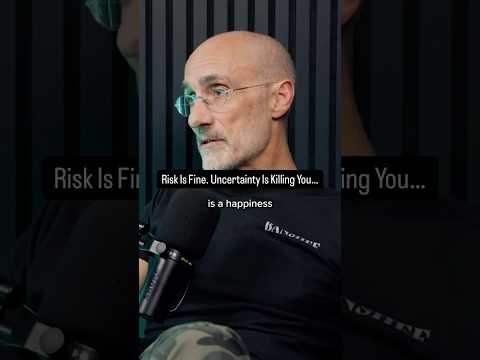
[@ChrisWillx] Is Uncertainty The Enemy? | Arthur Brooks
· 3 min read
![[@ChrisWillx] Summarizer](https://summaries.pages.dev/img/logo.webp)
Link: https://youtu.be/aBAdLyZAJPI
Duration: 0 min
Short Summary
Insurance serves as a happiness business by transforming uncertainty into manageable risk, ensuring policyholders feel secure. This process leverages the amygdala's threat vigilance to regulate negative emotions and stimulate evolutionary survival mechanisms. By functioning ideally through the HPA axis, the system addresses fear through intense, occasional responses rather than chronic dysregulation.
Key Quotes
Key Quotes
- "Insurance is a happiness business. What it does is it converts uncertainty into risk." (00:00:00)
- "Uncertainty is a source of fear and that stimulates the amygdala because the amygdala says it makes you hypervigilant and when there's a lot of uncertainty you're more vigilant than you would have been otherwise and that's a source of negative emotion. So you're feeling this constant sort of negative emotion." (00:00:30)
- "Because you're vigilant against threat and it's the possibility of threat. So when people say you know I'm really worried about uncertainty they're worried about threats and threat vigilance is really part of human evolution. The species has survived because of threat vigilance in the way that we're vigilant in the face of uncertainty." (00:00:44)
- "The problem is it's really disregulated. It doesn't work the way it's supposed to. We're supposed to be occasionally really fearful and then have a sudden burst. The HPA axis goes bonkers. We start running and climb a tree." (00:01:00)
Detailed Summary
Insurance and Happiness
- Insurance operates as a happiness business by converting uncertainty into risk, which helps policyholders feel better and more secure.
- Uncertainty is distinguished from risk by involving unknown outcomes where probabilities cannot be assigned, unlike risk which allows for probability assignment and contingency management.
- The human stress response is ideally characterized by the HPA axis functioning occasionally and intensely, rather than being frequently disregulated, which should trigger physical responses like running and climbing trees.
Biological Mechanisms of Risk
- Uncertainty acts as a source of fear that stimulates the amygdala, promoting hypervigilance and generating a constant negative emotion that is regulated by threat vigilance.
- Threat vigilance serves as an evolutionary survival mechanism where the species remains vigilant against uncertainty, ensuring the possibility of threat is addressed.
- The interplay between the amygdala and threat vigilance fosters hypervigilance, which is essential for maintaining emotional balance in the face of unknown outcomes.
Outcomes and Evolution
- The system's ability to address threats through the HPA axis ensures that fear is managed effectively, leading to improved well-being and reduced anxiety.
- By focusing on the specific needs of the human species, insurance policies can be tailored to mitigate the impacts of uncertainty and enhance overall life quality.