[@CityPrepping] How to Build a 1-Year Food Supply (Step by Step)
· 6 min read
![[@CityPrepping] Summarizer](https://summaries.pages.dev/img/logo.webp)
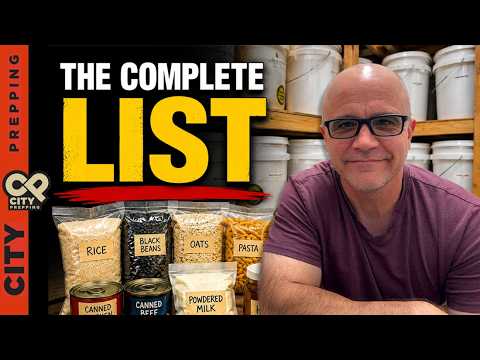
Link: https://youtu.be/Wjga6ZTFBfE
Duration: 26 min
Transcript: Download plain text
Short Summary
A presenter details a revised one-year, one-person emergency food supply totaling ~835,000 calories (≈4% above the 803,000 baseline of 2,200 cal/day × 365 days), with specific quantities across grains, legumes, fats, proteins, produce, and pantry staples. He walks through three pantry models, Mylar packaging methods, five common oxygen-absorber mistakes, ideal storage conditions (~65°F), water and fuel planning, and a progressive 2-week-to-1-year buildout. The episode closes with a 10–15 meal readiness test and a free blueprint with an adjustable spreadsheet.
Key Quotes
- "Multiply those together, and the target is approximately 803,000 calories for the year." (00:02:03)
- "The plan contains approximately 835,000 calories. That is slightly more than the 803,000 calorie target, giving us a buffer of roughly 4%" (00:09:14)
- "And this is one of the categories that people frequently underestimate." (00:07:05)
- "A spreadsheet, it can tell you the math works. Only practice can tell you whether the food works." (00:25:37)
- "A 1-year food supply is not one enormous shopping trip. It's a system." (00:25:46)
Detailed Summary
One-Year Emergency Food Supply Blueprint
Baseline & Calorie Math
- The 1-year target is ~803,000 calories for one adult at 2,200 cal/day × 365 days.
- The revised baseline reaches ~835,000 calories — a deliberate ~4% buffer covering packaging loss, spills, damaged cans, serving-estimate errors, and higher activity levels.
- Daily averages include ~74 g protein and ~70 g fat based on representative nutritional values.
Pantry Models & Presenter's Approach
- Three models are presented: a working pantry (rotated, eaten regularly), a long-term reserve (sealed staples for emergencies), and a hybrid that combines rotated shorter-life items with protected dry staples.
- The presenter personally uses a climate-controlled long-term reserve with some hybrid rotation, emphasizing this setup is optional, not required.
Diversified Food List (Revised vs. Original)
- Original plan from 5 years ago: nearly 1,000 lb of grain, ~400 lb of it wheat — now viewed as over-reliance on a single food.
- Revised grains and starches (215 lb total): 80 lb white rice, 60 lb hard wheat, 40 lb rolled oats, 35 lb dry pasta, 20 lb cornmeal, 15 lb dried potato flakes.
- Legumes (70 lb total): 30 lb pinto beans, 15 lb black beans, 15 lb lentils, 10 lb split peas.
- Fats (frequently underestimated): 4 gallons liquid cooking oil + 12 lb coconut oil or shortening — much shorter shelf life than grains, requires intentional rotation.
- Animal protein (omnivore example): 15 lb non-fat powdered milk, 8 lb whole egg powder, 104 cans of assorted chicken, fish, or meat (~2 cans/week).
- Fruits and vegetables: 180 can-equivalents (~1 every 2 days), via canned, dehydrated, freeze-dried, or mixed methods.
- Pantry staples: 15 lb white sugar, 8 lb honey, ~8 lb salt, 2 lb yeast, 4 lb baking powder, 4 lb baking soda, plus bouillon, spices, sauces, and coffee/tea.
- Vegetarian substitutions are to be treated as a separate variation rather than altering the central example.
Low-Prep Reserve & Supplements
- ~30 days of comfort/low-prep foods (soup, instant cereals, crackers, applesauce, meal replacements) are recommended for illness, exhaustion, or dental problems.
- A daily multivitamin serves as a modest nutritional backup.
Progressive Buildout
- Milestones: 2 weeks (~4% of annual plan) → 1 month (~8%) → 3 months (~25%) → 6 months (~50%) → 1 year (complete).
- A balanced milestone should be completed before expanding; substitutions must preserve the calorie and nutritional contribution of any removed category, or the plan breaks.
Storage Conditions
- Ideal environment: cool, dry, dark, stable, and protected from pests and physical damage.
- The presenter's cold storage room is held at ~65°F; attics and garages are discouraged due to temperature extremes.
Mylar Packaging Methods
- Option 1: a single 5-gallon Mylar liner inside a food-grade bucket for bulk staples.
- Option 2: several 1-gallon Mylar bags inside the bucket, so remaining bags stay sealed once one is opened.
Five Common Storage Mistakes
- Using oxygen absorbers with sugar, salt, moist, or high-fat foods — sugar and salt can become rock-hard.
- Using old or compromised absorbers; examples cited at 3–4 years old as too old.
- Deliberately undersizing absorbers relative to bag volume and food density.
- Sealing across food dust, wrinkles, or contamination.
- Skipping labels or a rigid outer container — Mylar alone can be punctured.
Water, Fuel & Cooking
- The water plan must cover drinking, soaking, cooking, and cleanup — not just drinking water.
- Lentils and split peas generally cook faster than many beans.
- Pressure cookers reduce fuel use; retained-heat methods such as a wonder bag or thermal cooker allow a pot to continue cooking with far less ongoing heat.
Labeling & Annual Audit
- Each bucket and internal bag should be labeled with food, quantity, package size, packed/purchased date, rotation date, and storage location.
- At least one annual inspection should check for pests, moisture, package damage, temperature problems, missing categories, and changes in household needs.
- A 5-year audit opened one grain bucket and one legume bucket: Mylar intact, heat seal intact, no moisture, insects, mold, or off odors; any package showing moisture, mold, infestation, or rancid smell should be discarded.
Final Readiness Test & Free Blueprint
- The "10–15 meal test" asks whether the household will eat the meals, whether they collectively cover calories/protein/fat/supporting nutrition, and whether water, fuel, equipment, seasoning, and skills exist to prepare them — then cooks the meals before any emergency.
- Oils, canned meats, powdered dairy, and egg products should be rotated more actively than properly packaged dry staples.
- A free 1-year food supply blueprint is offered: reconciled baseline, milestone shopping list, packing guidance, annual audit checklist, and an adjustable spreadsheet for calorie targets and substitutions. The recommended start is a 2-week milestone: complete it, test it, then build outward.