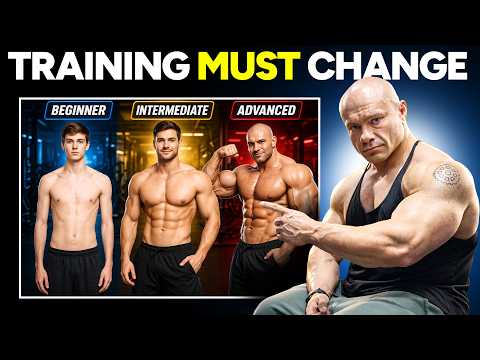
[@RenaissancePeriodization] How to Train for Muscle Growth: Beginner vs Intermediate vs Advanced

· 53 min read

@RenaissancePeriodization - "How to Train for Muscle Growth: Beginner vs Intermediate vs Advanced"

Link: https://youtu.be/zhP5gsBbgYY

Duration: 44 min

Short Summary

RP Strength podcast outlines progressive training strategies across three experience levels: beginners (0-2 years) learn technique fundamentals with 2 sessions weekly in the 5-10 rep range, intermediates (3-6 years) systematically test exercises and rep ranges across mesocycles to find optimal stimulus, and advanced lifters (7+) require custom programming with strategic prioritization due to elevated fatigue accumulation and injury risk.

Key Quotes

  1. "The thing about technique is it's not terribly difficult to learn good technique, but it is terribly difficult to unlearn bad technique." (00:00:14)
  2. "It is really sad when someone calls themselves advanced but does every exercise wrong." (00:00:07)
  3. "Advanced lifters make slow gains and you do not make very rapid gains anymore in most cases." (00:00:24)
  4. "Beginners do not need high volumes to grow. They can grow from very small amount of volume, which is really cool because you can structure the plan very differently." (00:00:50)
  5. "you don't want to rush through the process. As a matter of fact, you want to milk each stage." (00:00:29)

Detailed Summary

ThinkingBlock(signature='4ea071cd2ed3025f9dcaa48b11e431300957baad356e06583eebbf9602d3cfb9', thinking="The user wants me to write a detailed markdown summary for a long-form transcript about RP Strength podcast discussing progressive training strategies for different experience levels. Let me analyze the requirements:\n\n1. Markdown only\n2. At least 8 section headings using '##'\n3. Each section should start with 1-2 narrative sentences\n4. Include at least 24 bullets total across the document\n5. Bullets must focus on substantive claims, disagreements, mechanisms, examples, chronology, names, numbers, and outcomes\n6. Avoid sponsor copy, banter, repeated praise, meta commentary, and filler unless substantively relevant\n7. Prefer concrete details over generic abstraction\n\nI need to expand the coverage further while staying strictly grounded in the supplied structured summary and section digests. The previous expansion was too thin, so I need more depth.\n\nLet me organize the information:\n\n1. Episode Overview - introduction about Mike and Jared hosting\n2. Beginner Training Guidelines - all the details about beginners\n3. The Newbie Effect - explaining why beginners grow easily\n4. Technique Fundamentals - why technique matters\n5. Intermediate Training Guidelines - details about intermediate lifters\n6. Exercise Testing Protocol - how intermediates find optimal exercises\n7. Volume Management for Intermediates - sets, reps, frequency\n8. Advanced Lifter Guidelines - slow gains, custom programming\n9. Fatigue Accumulation and Prioritization - how advanced lifters manage fatigue\n10. Injury Risks for Advanced Lifters - specific injuries mentioned\n11. Progression Strategies - adding weight/reps over time\n12. RIR Testing Method - how to verify rep in reserve estimates\n13. Active Rest Phases - recovery periods\n14. Key Principles Across All Levels - universal takeaways\n\nLet me write this with narrative sentences at the start of each section and concrete bullet points with specific numbers and examples.\n\nI need at least 24 bullets total. Let me plan:\n\nSection 1: Episode Overview (2-3 bullets)\n\n\nSection 2: Beginner Training Guidelines (4-5 bullets)\nSection 3: The Newbie Effect (3 bullets)\nSection 4: Technique Fundamentals (3 bullets)\nSection 5: Intermediate Training Guidelines (4-5 bullets)\nSection 6: Exercise Testing Protocol (3 bullets)\nSection 7: Volume Management for Intermediates (3-4 bullets)\nSection 8: Advanced Lifter Guidelines (4-5 bullets)\nSection 9: Fatigue Management (3 bullets)\nSection 10: Injury Risks (2-3 bullets)\nSection 11: Progression Strategies (3 bullets)\nSection 12: Active Recovery (2-3 bullets)\nSection 13: RIR Testing Protocol (3 bullets)\nSection 14: Universal Training Principles (3 bullets)\n\nThis structure gives me 14 sections with 40-45 bullets total, meeting the requirement for rich content across different training levels.", type='thinking')

Episode Introduction and Framework

This RP Strength podcast episode, hosted by Mike and Jared, presents a comprehensive framework for structuring resistance training programs based on training age—categorizing lifters into beginner (0-2 years), intermediate (3-6 years), and advanced (7+ years) stages to optimize progression strategies and volume management at each level.

  • The hosts emphasize that training age represents accumulated training experience rather than chronological age, meaning a 40-year-old could be a beginner while a 20-year-old could be advanced depending on their training history.
  • Each category requires distinct programming approaches, recovery protocols, and progression methodologies to continue making gains.

Beginner Training Guidelines

Beginners should start with 2 training sessions per week, progressing to 4 sessions after months of consistent progression to balance recovery capacity with growth stimulus.

  • The optimal rep range for beginners sits at 5-10 reps per set with an average of approximately 8 reps to balance technique practice with growth stimulus.
  • Beginners should perform 2-5 sets per exercise per session, starting at 2 sets and progressing based on recovery capacity rather than a fixed timeline.
  • Full-body workouts containing 4-6 compound exercises per session target all major muscle groups effectively without overwhelming recovery systems.
  • Coaches and beginners should use 1-2 maximum coaching cues per exercise per set to avoid cognitive overload that inhibits skill acquisition.

The Newbie Effect and Growth Mechanisms

Beginners experience accelerated growth from minimal training volume due to the "newbie effect," where every exercise presents a novel stimulus that triggers muscular adaptation.

  • The novelty of resistance training creates growth-promoting mechanisms that diminish as the body adapts to familiar movement patterns over 2+ years of consistent training.
  • Because beginners grow efficiently with lower volumes, they should prioritize learning fundamental movement patterns over maximizing training density.
  • Early training success depends more on consistent technique execution than on maximizing training variables like volume, intensity, or frequency.

Technique Fundamentals and Form Degradation

Technique degradation from improper form is substantially harder to correct than establishing good technique from the beginning—making investment in proper form essential from day one.

  • Heavy weights above 85-90% of one-rep max trigger fight-or-flight responses that cause involuntary technique breakdown even in experienced lifters.
  • Ultra-high rep ranges beyond 30+ reps also cause form breakdown due to accumulated fatigue affecting motor unit recruitment and coordination.
  • Free weights including barbells and dumbbells develop stabilization patterns and proprioceptive feedback that machines cannot replicate, making them preferable for beginners.

Intermediate Training Guidelines

Intermediates training 3-6 times per week require higher frequency and volume than beginners to continue driving muscle growth as the body adapts to training stimuli.

  • Early intermediate lifters face specific constraints including poor RIR (reps in reserve) estimation accuracy, unknown individual exercise response, and unreliable mind-muscle connection that must be systematically addressed.
  • True intermediate status requires mastery of core barbell, dumbbell, and bodyweight exercises rather than simply accumulating years of gym attendance.
  • Intermediates should not assume they have reached their genetic potential for any muscle group until they have systematically tested various exercises and rep ranges across multiple mesocycles.

Exercise Testing Protocol for Intermediates

The recommended approach for intermediates involves trying all candidate exercises for 1-3 mesocycles (1-4 months) to identify which movements maximize pumps, soreness, tension, and joint comfort while minimizing local fatigue accumulation.

  • Each exercise should be tested across the entire repetition spectrum including 5-10, 10-20, and 20-30 rep ranges to discover the optimal loading zone for individual response.
  • Intermediates should initially train all muscles evenly to discover their genetic strengths and weaknesses before implementing later-phase prioritization strategies.
  • Exercise selection decisions should be based on measurable outcomes including training pumps, post-workout soreness patterns, perceived tension during sets, and joint comfort rather than arbitrary preferences.

Volume Management for Intermediates

Optimal weekly volume for intermediate lifters ranges from 5-15 sets per muscle group, spread over 1-2 exercises per muscle per session to balance growth stimulus with recovery demands.

  • Training sessions lasting 1-1.5 hours with rest periods of no more than 2 minutes between sets maintain appropriate training density for hypertrophy work.
  • The progression rule for intermediates: if not experiencing significant soreness and recovering quickly, add 1 working set per muscle per week until recovery quality begins declining.
  • Set volume should be adjusted based on recovery quality indicators including sleep quality, soreness patterns, and performance across training sessions rather than arbitrary weekly increases.

Advanced Lifter Characteristics and Challenges

Advanced lifters making slow gains require ultra-high effort per set and elevated volumes that strain recovery systems—making advanced training "not a badge of honor but an inconvenience" according to the hosts.

  • Scientific literature indicates advanced lifters can accurately estimate RIR within approximately 1 rep of actual performance, though this accuracy developed over years of training experience.
  • Advanced lifters cannot train all muscles to maximum recoverable volume simultaneously because total weekly fatigue exceeds systemic maximum capacity of approximately 120-180 total sets per week.
  • The hosts emphasize that advanced lifters should build custom programs or significantly modify existing programs rather than following others' programs exactly, as individual fatigue patterns and recovery capacities vary substantially.

Injury Risks and Constraints for Advanced Lifters

Advanced lifters face elevated injury risks including both acute injuries like herniated discs and chronic issues that may permanently eliminate certain exercises from their programming.

  • Common advanced injuries include tricep evulsion, shoulder issues, and spinal disc problems that require careful movement selection and load management.
  • Accumulated injuries may force advanced lifters to substitute exercises that no longer feel comfortable, making exercise testing an ongoing process rather than a one-time evaluation.
  • Shoulder issues frequently prevent overhead pressing movements, requiring alternative pushing exercises that maintain anterior chain development while respecting joint limitations.

Prioritization Strategy for Advanced Training

The recommended prioritization approach for advanced lifters involves placing half to two-thirds of muscle groups on the "front burner" receiving maximum recoverable volume while one-third to half operate on the "back burner" at maintenance volume.

  • If chest typically receives 24 sets at end of a mesocycle, a deprioritized chest should receive at most approximately 8 sets to maintain tissue without exceeding recovery capacity.
  • Front burner muscles receive concentrated training focus while back burner muscles maintain current development with reduced training frequency and volume.
  • Prioritization rotations allow advanced lifters to continue progressing overall while managing accumulated fatigue across multiple muscle groups.

Program Progression for Advanced Lifters

Advanced program progression typically starts at 10-15 working sets per muscle per week, progressing to 25-35+ sets over 4-6 weeks to expose muscles to sufficient training stimulus for growth.

  • Smaller muscle groups like side and rear delts may require up to 35 sets per week for optimal development at advanced stages where larger muscles already show significant adaptation.
  • Progression rate should target adding 2.5 pounds to the bar per week or 1 rep every other week to maintain consistent linear progression without excessive fatigue accumulation.
  • Progression should be measured across mesocycles rather than individual sessions to account for day-to-day performance variation and recovery fluctuation.

Active Rest Phases for Recovery Management

Advanced lifters should incorporate active rest phases 1-2 times per year, consisting of 2-week periods of minimal training to systematically reset accumulated fatigue across all body systems.

  • Active rest periods prevent chronic fatigue accumulation that eventually manifests as stalled progress, increased injury risk, or training burnout.
  • These rest phases should be planned into annual training calendars rather than implemented reactively when problems emerge.
  • Complete cessation of training is not necessary; reducing volume to 30-40% of normal maintenance loads preserves tissue quality while allowing systemic recovery.

RIR Testing and Estimation Verification

Lifters can verify their RIR estimation accuracy by returning to a previously trained exercise through a mesocycle and systematically adding approximately 5 lbs or 1 rep each session until reaching true failure.

  • If a lifter needs 40+ additional pounds or 16+ additional reps to reach failure, their initial RIR estimate was significantly off, indicating they were stopping substantially short of true failure.
  • This testing method provides objective feedback on estimation accuracy, allowing lifters to calibrate their perceived effort with actual performance capacity.
  • Regular RIR verification prevents chronic underestimation of performance capacity that could lead to insufficient training stimulus for continued progress.

Universal Principles Across All Experience Levels

Training levels exist on a sliding scale with no distinct day marking graduation between stages—the boundaries between beginner, intermediate, and advanced represent gradual transitions rather than sharp demarcations.

  • Technique mastery provides the foundation for all subsequent training variables; compound movements including squats, deadlifts, bench presses, rows, overhead presses, and pull-ups form the core exercise selection for most lifters regardless of experience level.
  • Progressive overload remains the primary driver of adaptation across all training ages, though the specific mechanisms for achieving overload differ substantially between novice and advanced lifters.
  • Individual response variation means general guidelines require personal adjustment based on recovery capacity, injury history, time availability, and personal goals.

Full Transcript

Show transcript

There is no distinct day that you graduate from beginner to intermediate or intermediate to advanced. The longer you train, the more your training should look more intermediate and then the more your training should look more advanced. It is really sad when someone calls themselves advanced but does every exercise wrong. And advanced lifters make slow gains and you do not make very rapid gains anymore in most cases. If you can maintain beginner results with beginner volumes, for the love of God, don't go do intermediate shit. And you don't want to rush through the process. As a matter of fact, you want to milk each stage. Hey folks, Dr. Mike here for RP Strength. Should you be training differently if you're beginner, intermediate, or advanced and you want the most muscle growth longterm? The answer is yes. Long-term is the big working word there. Because if you just want as much muscle as possible in the near term and just train a ton, that could get you hurt. It could sabotage your gains for later. If you want the best long-term gains, listen up, cuz we have the guide. First, some quick definitions. We count a beginner as someone who's trained between zero and about 2 years of consistent training. An intermediate is someone who's trained something like 3 to six years of consistent training. That means like you don't miss more than two to three weeks at a time in your program. And advanced is someone who's been training for 7 years or more. These are very funible, very average definitions just to get you a good vibe. Now, how do we determine how beginners versus intermediates versus advanced folks should train differently? The way we determine this, what's most appropriate and inappropriate for all these three levels is to use a combination of constraints and affordances. Things that get in the way of some of these groups of people but not others. And affordances are things some groups can get away with and benefit from while other groups cannot. Whatever passes the filters of stuff you can do versus stuff you can't do ends up being a fairly good recommendation and a likely good way to train if you're a beginner, intermediate or advanced. And the thing is beginners versus intermediates versus advanced lifters have actually quite large differences in many cases between their constraints and their affordances. So, there are some big important differences in how they should best train for the most long-term muscle growth. First up, beginners. Let's talk about constraints. Beginners have minimal technique knowledge. You're like, "Do a squat." And they're like, "What's that?" You're like, "Oh, gee whiz." And if they do a squat, it's usually all kinds of wrong because they don't know how to do it well. Beginners have a high need for technique reinforcement during sets because learning technique builds the foundation for the rest of the training career. It is really sad when someone calls themselves advanced but does every exercise wrong. Same for intermediate. Beginner is when you learn how to do exercises properly and you will have that knowledge inculcated into you for the rest of your life. After that everything is smooth sailing technique-wise. Beginners need practice at a few simple moves because the constraint there is they can become overwhelmed. If you teach a beginner five exercises in one day could be overkill. Maybe three is better. If you teach them four exercises for a single muscle group, they just start confusing a ton of stuff. Beginners also have kind of not so great core strength and coordination under heavy loads. Scott, you know that whole noodly wobbly beginner thing where you give them anything heavy and they start wobbling. That's not something you want when you get a lot stronger. So, that constraint is going to have to inform how much weight we use. In addition, super heavy weights lead beginners to go into fight orflight mode and have technique breakdown. So, you can show how a beginner how to do a stiff leg deadlift, but if you do it for sets of four or three reps or something like that, each rep is so heavy that the next rep the person's just trying to survive. They round their back, they bend their knees, and it's not really a stiff-legged deadlift anymore. More advanced folks will be able to keep a steady technique under really challenging loads. Beginners, not as dependably. But there's another problem. Say, okay, low reps aren't so great, but for very high reps, sets of 10 and more, beginners get so fatigued and the pain of the burn gets so intense, their technique also breaks down at higher reps. So, breaks down at low reps and at high reps. And lastly, beginners are very, very bad at estimating reps in reserve, how close to failure they are. So, a program with reps in reserve guidance just doesn't really work super well for beginners because they're like, do two reps in reserve and they're like, okay. And then they stop at either six reps in reserve or they go, you know, all the way to failure and be like, oh, I thought I had two more. Beginners, that's the bad news. The good news is they have really cool affordances. First, beginners do not need high volumes to grow. They can grow from very small amount of volume, which is really cool because you can structure the plan very differently. Beginners can train multiple muscles with great effect for each muscle just with distributed compounds. If you're advanced and you're going to want to work your chest and your triceps, probably have to do some chest work like wide grip bench. You probably have to do some tricep work like skull crushers. But for a beginner, because they don't need a ton of volume and every exercise is super novel and super growth promoting for them, they can do what's called distributed compounds, which means compounds that distribute the load and thus the effort to multiple muscles as opposed to focused compounds, which are just technically compound like a wide grip bench, but really just focus on one thing like the pecs for example. So with a beginner, you can give them some close grip benches. And for them, that's a really good tricep stimulus and a good chest stimulus. And because they don't need high volumes to grow, just a few sets of close grip bench could be all the chest and tricep work a beginner needs in a given program. Beginners also don't need a lot of variation in exercises and in rep ranges because of the newbie effect. They just don't need a lot of variation in anything. you can just only do squats for six months as a beginner and your legs grow phenomenally, which is if you just did only six months of squats as an advanced lifter, you might squat your back and knees into different planetary orbits and have not as much leg growth to show forward at the end of the day because you need more variation to stay in one piece and to get your best gains. And another piece of good news, the last one for beginners, they need only basic progression with no highly detailed estimates of reps and reserve required. just doing a little bit more every now and again is good enough progression logic for beginners. So we take all of these constraints and all these affordances and we mash them together and outcome the training tips for beginners which are as follows. Beginners can do as few as two sessions per week because they can learn technique and grow muscle from just two sessions a week. And a lot of times that's really good because it doesn't overwhelm them and cause burnout. You give beginners a 5day week program, half of them won't show up on week number three. give them a two day a week program, more of them show up in the first few weeks of beginner training. I mean, total noobs, it's a good idea to use super light loads that are very far from being challenging, never mind failure, just to work on establishing proper technique for sets of about five reps each set. Couple sets of each exercise, five reps, nice and easy. Because beginners are completely new to training, just from very light work of technical work, they will get sore and they will grow. You could be eight reps in reserve for all of these sets and grow like crazy as a beginner because beginners grow like crazy and there's no rush. Huge deal. But after the first week or two of establishing basic technique, you can start to have the latter sets. Let's say you do three sets per exercise. The last set of each exercise can be not just a practice set of five, like eight or 10 reps in reserve. It can now be like a two reps in reserve. Now, as a coach, you know that. And if you're a beginner listening to that, that just means the bar starts to feel really heavy and tough towards the end or the dumbbells or whatever of those reps of whatever number uh of those sets of whatever number of reps that you're doing. So, now we go from a program in the first few weeks of everything's light to the last sets of each exercise are kind of heavy. And then in week three, four, five, it all gets replaced with every set is pretty heavy and pretty challenging. But good technique never ever leaves. It's always rank one. The best rep range for beginners in my view is the 5 to 10 rep range, like sets of eight on average. That gives you enough practice and enough growth stimulus to get really good at technique and grow, but not so many reps that autopilot and pain avoidance kick in and your technique degrades. And not so ultra heavy sets of three or four that your technique will degrade and you might get hurt. You still warm up, but one or two sets of warm-ups before each exercise in week six plus of the program. And then every other set after that is going to be a tough working set. If you're coaching beginners or if you're a beginner yourself and you have to tell yourself cues, remind yourself knees out on the squat, etc. Just one to two cues per exercise and even per set is a good idea. You start lobbing eight cues per set. And a beginner, they don't know what to correct and it's too confusing. Remember, the bandwidth they have is really tiny anyway because it's all new for them and they're under pain and duress of lifting really hard. So just one or two corrections like knees out knees out knees out you're good that is good enough and over time slowly you can give more corrections not per set but over time you know one week you do a lot of correcting for the back another week you do a lot of correcting for the heels and so on and so on and so on. Technique improvement, technique stabilization of good technique is a huge deal, which is why queuing is massively required. If the individual is pretty easily completing multiple sets of five to 10 reps with what looks like not so much effort and the bar is not slowing down and they're like, "Dude, I can do more." Then you can add 5 to 10 pounds to the lift. And you can do this every week, potentially every other week, as soon as the beginner athlete, as soon as the beginner lifter seems not to be overly challenged by the sets, increasing the load is a good idea. After the first few months of probably lifting no more than about twice a week, if this individual or if that's you are really loving the process, really loving the results, and have extra bandwidth, you can move up to three and then eventually four sessions per week for the next several years of your beginner training career. More than four as a beginner is probably like overkill. You can get amazing gains from four and save all your psychotic motivation for later when you're an intermediate when you'll really need it. But don't rush. Again, not a good idea to get beginners to come in and do four sessions every week right off hand. Better idea to get them to come in and do two sessions a week. And then if they really love it a few months later, if they're still around, you can bump them to three and then eventually four sessions a week. Every session that beginners do pretty much on average should be whole body upper and lower all the major muscle groups and mostly distributed compound. That means you might have like four to six exercises but all of them train muscle multiple muscle groups such that you get the whole body trained every single time. And this is a big one. Ideally, you're going to use free weights, barbells, dumbbells, and body weight exercises mostly or really only to imprint the neural patterns of basic movements like presses, rows, curls, hinges, etc. under your own stabilization. The way to become a long-term the best lifter you can be is to do things yourself. If you have a trainer groping you the entire time and helping you arc through the movement, you're getting ripped off. The trainer likes it because they get to touch you and that's nice. Maybe they have nobody else in their life that they can touch. Real talk. You want to become competent at the basic movements. When you do that, you're going to be ready to do every single other fancy machine in the gym, which you will get to do as an intermediate. I promise. So, in summary, two to four sessions of whole body lifting per week with mostly distributed compound exercises. two to five sets per exercise on average. Start at two and if you can handle more volume and you're not super sore or weak, slowly work up to five. About four to six exercises per session is typically good. Many more than that's not ideal. Sets of five to 10 reps is really good, challenging, but not crazy. And you can pick some exercises and run the same identical exercises for months on end because you need to learn them really well. And variation, it's just not a big factor for beginners. I can recommend something to conserve variation. You could probably repeat the exercises you do early in the week, later in the week, just change the rep range slightly by changing the load. So maybe five or 10 or 20 lb difference, maybe 30 lbs difference in some exercises and load so that in the first day of the week, you do about sets of five to seven reps, tough, heavier, and then you lighten the load a little bit so that later in the week, you're doing sets of about 8 to 10 reps. Same exercises, same execution. And that means you get practice twice at the same movements after 3 or 4 months of the same movements and you really know those movements super well. Then you can change them to slightly different movements, still distributed compounds, like from a close grip bench to an incline close grip or something like that. And then you can continue to reproduce that process. Do not worry about how hard you're training. Just add weight to the bar if the bar stops slowing down altogether and sets of 5 to 10 as you master that 5 to 10 rep range. Technique, technique, technique. If you trained a little bit, not hard enough, but your technique is amazing and solid, I would much prefer that entering the intermediate phase than having trained too hard, but literally learned the wrong technique. The thing about technique is it's not terribly difficult to learn good technique, but it is terribly difficult to unlearn bad technique. So, making sure you train nice and hard, nice and heavy, but really emphasizing good technique is number one. All right, that's for beginners. Let's move on to intermediates. First, we'll talk about the constraints of the intermediate lifter. Intermediates can't really estimate reps and reserves super well yet. They don't really practice it much with their beginners stages, so why would they? They also don't really know which exercise they respond better to or worse to. It cracks me up every time when someone who's been training for two years says, "Yeah, man. I seem to respond better to squats than to leg press. Like, and you know that how like well vibes, man. Like, dope. Vibes are great. The mind muscle connection is not a reliable proxy for early intermediates because they basically are beginners at the end of their beginner journey. So, it's not a variable that we can use. We also know another constraint. Intermediates need more effort, more volume, and more frequency than beginners do to make their best gains. Your body's pretty well adapted now. It needs more to grow. Intermediates do have some affordances, though. They have some upsides. They can demonstrate good technique all on their own. And I would go so far as to say if you can't demonstrate good technique all on your own, you're kind of a beginner still, no matter what you say. They have often, ideally, mastered the core barbell, dumbbell, and basic bodyweight exercise. If you claim to be an intermediate and I ask you to do push-ups, you'd better show me how to do push-ups relatively well. If they suck, I'm skeptical. Beginners also get tired really easily and take a long time to recover because everything's such a big shock to them. But intermediates have the work capacity to now train three, four, five, or even six times per week, allowing them to have the higher frequency and volume that they so desperately need to grow their best. And here's the really cool thing about intermediates. They survive the beginner phase, which means they're lifers now. They're in. And that means they have the motivation to train hard and often and for long durations at a time per session to make their best gains. Combining those constraints and affordances, what do we get? Here are the intermediate training tips. First, I highly recommend that you train with all exercises in the gym for one to three meal cycles at a time at least to see where and how your responses proceed as you train through literally every exercise. I don't mean in one program. I mean, in one program, pick a bunch of exercises, train them for one to three months or so, or one to three messy cycles, maybe up to four months, and then switch exercises, pick tons of other ones. Guys, intermediate training is amazing. It's kind of like Halloween. You get a bunch of different kind of candy. Intermediate training is you want to use every exercise and every machine at least for one messycle to see if it works well for you. Loads of fun. What are you looking at? You're looking at pumps per any given number of sets. Does this machine or this exercise or this repetition range give me good pumps? How much soreness does it give me? How much can I feel the tension of the target muscle in this exercise? How much do I feel the burn in higher reps from this exercise in the target muscle? How much local fatigue do I get after I do skull crushers? Are my triceps feeling like super tired or do they feel pretty pretty okay? And how much joint comfort and discomfort am I feeling? Does do dips shred my elbows or are they really amazing for my elbows? See where these are maximized and minimized? And it's not just exercises. You want to train through the entire repetition spectrum. So you are going to have opportunities not necessarily in the same session though you could not necessarily even in the same mess cycle though you could same week over the course of your intermediate times give most exercises a shot with most rep ranges which means you're going to do some training cycles where some exercises you're going to train often in the 5 to 10 rep range. Sometimes you're going to train in the 10 to 20 rep range. sometimes in the 20 to 30 rep range for the same exercise oftent times in different mess cycles or different times of the week or you train a couple sets in the 5 to 10 and then a couple sets in the 10 to 20 something like that. You want to see where pumps and soreness and joint stuff, all that stuff is maximized and minimized in the intersection of exercise and rep range, which is a big deal. What you're going to learn from this to prepare you to be advanced is where your body best responds to a given exercise and rep range because that is going to put an X exactly on where you want to spend most of your advanced time. But as a beginner, you're going to just just run through the meadow of exercises and uh I don't know, Scott, you probably have to have a dress and a flower basket or something. >> Yes. Um, and like you know the cool thing about that running through the field shit is that it's dope vibes. The bad thing is like bees are real, bro. I don't give a that you're a little German girl or some shit. Don't up. >> Volumewise, I recommend training with between five and 15 sets per muscle per week. Right? So that could be biceps for five sets total in the week or it could be biceps for 15 sets total in the week. And I want you to spread these over one to two exercises per muscle per session. So you might do like one bicep curl exercise and two quad exercises or something like that, but definitely at three or four or five exercises for a muscle in a given session. You want to train from anywhere between three to six sessions per week. Probably starting intermediate phase closer to three or four and then eventually if you'd like getting up close to five and six. And you're going to want to spend for optimal gains about one to one and a half hours in each session working diligently with no more than about two minutes rest between sets, often a minute or less. It's going to smash that volume in that you need. I highly recommend most intermediates to train all of their muscles evenly. Remember, this is for the most long-term growth to be the most jacked when you're advanced. You can prioritize as an intermediate, but like if you have okay biceps and not so great pecs, you prioritize then you're later going to have pretty good biceps but very meh pecs. If you train everything evenly, you can find out what the genetic strengths and weaknesses you have are and also bring everything up to at least a decent standard. You also as an intermediate want to do a very important thing. Push each working set hard and get a feel for how tough three reps, two reps, one rep, zero reps in reserve, and actual failure feel. Do this by guessing guesstimating your three repetition m Oh, good god. Three repetition max. Your three reps in reserve estimate. So, you put your you think it's your 15 rep max on the bar. You're like, I think I think 12 is going to get me there. And you just go and you kind of stop at 12. Or you say, ah, 12 was kind of easy. I'm going to stop at 13 or 14. Just your best guess. And then every single time that you come back through that whole mess cycle, you're probably going to add a rep or about 5 lbs to that exercise. And you're going to do however many match your reps or match the uh total amount of weight and just do one more rep every time. That increased challenge through the mess cycle will eventually lead you to go to zero R or failure. And then you'll know how good your estimate was of three AR. If you started an exercise you thought was three RIR but then at the end you actually have to put like 40 more pounds onto the exercise or do 16 more reps to get to failure. It wasn't three R. Probably it was more like eight to begin with and now you know that you can go a little harder next. Mezo, if you start at what you think was three R, but you hit failure by session number two and even fewer reps. You definitely just did like pretty much failure in that first one. That is not three reps in reserve. Scott, have you ever spotted anyone that's like, "I'm going for two reps in reserve." And their last rep is like a grinding utter disaster and you rack it and they're like, "It's pretty good." And you don't know what to say to them. >> Like, "Yeah, man. Uh, that was awesome. That was uh not two reps in reserve." See, I can't stop myself from saying it. It's a big deal to learn how to go hard. But here's the trick. You're going to need to go hard when you're advanced, but you cannot break your technique. So you take your solid technique education that you got as a beginner and you apply it rigorously to the hardest training. If you claim to train hard and you can go all the way to failure with great technique, I salute you. If you claim to train hard but your technique breaks down towards the end of your sets, you feel me? I love you like I love every other human being on this planet. But you could clean up your technique is what I'm trying to say. Because good technique is what allows us to target the musculature we want and reduce injury risk. Sounds like a good deal. As you train as an intermediate, you are going to want to bring your mind at peace and start to notice which muscles are limiting factors on which exercises and which exercises seem to give you the biggest stimuli proxies like pump and soreness and tension in the muscle and which ones give you the least of those proxies and give you the most fatigue. And you're not just going to want to learn this about an exercise. You're going to want to learn it about rep ranges, too. So, you could say something like this, just an example. Sets of 5 to 10 on leg press, uh, really heavy. My knees feel weird. Sets of 20 to 30 on leg press, my lungs give out. I'm just breathing super heavy. I can't even feel my quads anymore. And the bottoms of my feet hurt. But sets of 10 to 20 on leg press, blow my quads under the moon, and my joints feel great and my cardio is not limiting. Hey, shit. Now, you know something really important, and it's the following. Is it possible that sets of five to 10 on leg press could a future you could do productively? Yes. So, never completely write anything off. Is it possible that you'll get enough cardio to be able to do sets of 20 to 30 reps in leg press in the future? Absolutely. But is your best guess in the future of how to construct your routines once you're advanced sets of 10 to 20 in leg press based on that data? It absolutely is. And now you know something super important about yourself. you know a more likely direction of success from a less likely direction of success. That means your map of how to get the most jacked is starting to fill in with shapes, which is exactly what the intermediate stage is all about. The beginner stage is about like how to walk properly and read the map at all. The intermediate stage is the map really really starts to kind of fill itself out so you know where your peaks and valleys are. And the advanced stage is going to be about making sure to traverse the peaks and valleys in the most effective way possible. Lastly, for intermediates, if you're not getting super sore or super pumped and you're healing super fast, add a working set to that muscle next week for that exercise and repeat the process. So, if I have uh cable curls on Monday and barbell curls on Wednesday and I come in every Wednesday and I'm like, I can't even tell I trained by some cable curls. Matter of fact, right after the cable curls, man, I just just like do 50 more cable curls. It wouldn't bother me. add a set of cable curls next time to next week and continue that formula of addition as long as you're not super sore, super tired, or not getting pretty goddamn good pumps. All right, you did it. You survived and now you're advanced. What are the constraints? And then what are the affordances on the constraints front? Advanced people are generally strong enough to now have higher risks from high volume superheavy training. risks of injury. Not just acute injury of, "Oh snap, I snapped my shit up." But chronic injury of like, "Ah man, my elbow's just not working today. It's been three weeks where it's been getting worse." You're now so big and so strong relative to where you started that injury risk is a much more real factor for you. And that's going to play into how you design your programs. Advanced folks also often run into the fact that if they trained all of their muscles up to their maximum recoverable volumes, which can be a lot of work, they're that total amount of fatigue exceeds their systemic maximum recoverable volume. Like it's like if someone said, "Hey, you got to work five jobs." You can be, "Oh, hold. I could maybe do two of these jobs well if the other three I could just come in and smoke weed at work and back burner the shit. But I can't do five jobs all at once. I'm just going to get overwhelmed. It's the same thing for training. When you're advanced, it means you can't full send for your whole body all the time because your whole system is like, "Bro, I can't do 120 total sets per week. That's going to kill me." Or 180 or whatever it is. That's a big constraint. So, we require some clever programming. Advanced folks in the real world also often have nagging injuries, maybe a history of some acute injuries, and thus they have some offlimits exercises or rep range combos with exercise. So, the era of very heavy rack deadlifts might be over if you've herniated a disc or two. Ultraheavy jam presses when you've had a tricep evulsion may no longer be on the table. And ultraheavy laterals cuz you have some shoulder issues, not really anything, but it just starts to hurt if you go heavy. That's something advanced lifters deal with all the time. And you got to be smart about it. You can't pretend that it's not a thing. And advanced lifters make slow gains. They do not make very rapid gains anymore in most cases. But the hilarious irony is to make any gains at all. They need ultra high efforts per set and ultra high volumes, number of sets to make the best gains for sure, and sometimes any gains whatsoever. So this problem where you just don't make really good gains, but in order to make gains, you got to go after it like crazy. Imagine a job that used to pay you $12 an hour, but now it pays you six. And it used to be able to just breeze through it and they pay you money, but now you got to go super hard and they can only pay six bucks. That sucks when I put it like that. But you're advanced. You're already jacked. And now you're perfecting your physique. Advanced people don't just have constraints, though. They have affordances as well. Here are a few of them. Advanced folks have mastered technique. If you haven't mastered technique, there's a good chance you're not advanced. They have mastered training hard and estimating the reps in reserve. We have good scientific literature to show that folks that are close to advanced, often advanced, are hitting their reps in reserve within about one rep in reserve of the actual result. That's really good. So when people say people are bad at tracking ri that's true as shit for beginners but absolutely not true for advanced people and that's a big deal. Advanced folks also because and especially if they really broaden their horizons with exercises and rep ranges and even different kinds of weekly routines know a lot about which exercise and rep range combos have the highest stimulus to fatigue ratios for them. They know which splits and exercise and muscle group combos and orders work best for them. Is it best for them to train triceps first then chest or the other way around? Only the advanced lifter will know that about themsel and they have distinctly more developed and less developed muscle groups because they have different genetics for their muscles expression-wise. And so not all muscles are like you know the best muscles on their body. And there are clear areas which they can do asymmetric improvement to bring up weak points or to exploit strong points. Take those together, mash them. Constraints affordances. And now we are looking at the advanced training tips. First tip, and this is a huge tip. If you're advanced, I highly recommend in most cases that you do not do other people's programs or splits. modify from theirs or build your own from scratch in the RP hypertrophy app, of course. Period. You know your body the best. When Jared and I train folks, pro bodybuilders and stuff like that, it's always an interactive process where we go, "Hey, we're going to train you like this. What do you think?" And they go, "I can't do that, but I can do this." And then we fudge it for them. We're never like, "Do this or that's it." Advanced folks know their body super well. Scott, you ever seen people that are technically advanced like just do like some kind of offline workout, like some website, printing it up. Yeah, man. I'm going to do the superhero workout. And you're like, >> not usually. >> Yeah, there's a good reason for that. I actually known some people that are pretty advanced who every now and again lapse back into absurdity and they're like not making gains on their own shit. Like, I'm just going to try this one workout I saw online. And I'm like, I I believe the term for that is giving up. And I also still have a lot of folks ask me like, "Hey man, you ever do like 10 by 10 like in Bulgarian blah blah blah?" And I'm like, "Sir, I do my own situation. Maybe kids, I'm an expert." Shut up, Mike. Okay, Mike. As an advanced person, you want to choose exercises, rep ranges, and training splits that give you the best guess at your best stimulus to fatigue ratios. You always want to keep an open mind so you're not just like, "Nah, that doesn't work for me. I only do this." But don't do too much shit that you know is almost certainly not going to work. If you're doing underhand pull-ups for years and all they do is shred your elbows and up your shoulder joints and you barely feel your lats and someone's like, "Underhand pull downs today?" It's probably best that you go, "You know what? I'm going to try a set or two in the warm-ups, but if it doesn't work out, typically it doesn't. I'm going to go to parallel pull-ups." And voila, nine times out of 10, you'll be correct. Remember, knowing what works and doesn't work for you is the wisdom that you gather from all of your years of experience. Use that shit. Another thing is pay close attention to the mind muscle connection. That is the detection of tension and or burn in the target muscle during a hard set. Try to get as much mind muscle connection by doing the best technique that you can with as little loading externally as possible. What does that mean? That means if you can do the leg press in some way that you can do 700 lb for a set of 10 and your quads hurt an X amount. If you can bring your feet maybe closer together, maybe a bit lower down, maybe point your toes out, maybe wear weightlifting shoes and maybe sink in deeper. And now instead of 700, you can use 500 lb for a set of 10 and it hits your quads just as much through mind muscle connection perception of tension and burn in the muscle. You're probably just going to save the living shit out of your joints and really meaningfully reduce your probability of injury, both acute and chronic, if you stick with that better method that lets you use less weight. You'll see lots of advanced bodybuilders say shit like this all the time. Try to maximize the amount of tension you get from a certain given weight, not try to do as much weight as you can over the weeks. Of course, increase the weight, but when you're picking how much weight to do at the beginning of a mess cycle, use your best technique to try to make sure that you're not at least using excessive amount of weights with bad technique. As an advanced person, if you want your best best gains, you're going to train four to six or more times per week. Does that mean seven? No. It means you almost always want to have a rest day in there. But the plus in the six plus means you may want to consider double days. come in for back in the AM, shoulders and biceps in the PM twice a week, stuff like that. And your training is going to take one to two hours per session. Remember, you're advanced and you're trying to make your best gains. You're going to have to work for that shit. There's no way around it. Your body's not interested in growing much anymore. You really got to push the pace. At the same time, remember, if you just push the pace on everything, you would overreach and then overtrain because your systemic maximum recoverable volume just gets completely exceeded by the some individual maximum recoverable volumes of your individual muscle group. So, what you're going to want to do is take something like half or at least a third of your muscle groups and put them at either maintenance volume or minimum effective volume, which is basically like about a third of the typical volume that you would do. So if you typically at the end of a mess cycle do about 24 sets for chest. If you're not prioritizing chest, you're going to want to do at most about eight sets of chest. And that's definitely good enough. So a third to a half of your body you're going to put on back burner. And then half to 2/3 you're going to put on the front burner and really crush it as much as possible. In the RP hypertrophy app, we actually have a selector for which one to do for which muscle group and then the app takes care of the rest. The reason for this is you can't hit everything hard. If you try to hit everything maximum hard all the way to MRV, you're just going to cook yourself and you're not going to be able to you're going to be systemically limited, which means ultra tired and prone to injury and you're not even going to be able to train your muscles hard. So, you have to make a choice every messy or every few. Which muscles am I putting on front burner, which on back burner? And the choice isn't super hard to make because you know your body really well at this point. You know which muscle groups you want to bring up and which ones you don't want to bring up at this very moment. Four muscles you are prioritizing. That means training for minimum effective volume all the way up to maximum recoverable. You want to aim for true maximum recoverable volume at the end of every meal cycle in that last week before a de lo. Which means in many cases you want to design your plan such that you start at about 10 to 15 working sets per muscle per week and over the course of the next four to 6 weeks get up to 25 to 35 or more working sets per muscle per week. This is especially true especially true if these are smaller weaker muscle groups. So yeah 35 sets of hamstrings sounds like an insane idea and it is. Don't do that. But 35 sets of side delts or rear delts per week may be functional and will usually get you better gains than fewer of those sets. If that's too systemically fatiguing, put more of your other muscles on maintenance or on slower gains, minimum effective volume, so that you can free up more recovery ability to train the muscles you need to ultra hard. Remember, yeah, you can start from 10 to 15 and get to 25 to 35, but this is all going to be individualized and autoregulated. Individualized means you know your body well. So, you're going to start with five sets for hamstrings and you're going to start with 30 sets for side delt as an example. Other people may choose very different numbers and autoregulated which means you adjust your volumes up or down week by week by week based on how you're recovering or you just rate the appropriate ratings in the RPI app and it just chooses that for you. Advanced folks can accumulate an unbelievable amount of fatigue because they know how to push themselves hard and they have to train it and they're already pretty goddamn beat up from all the shit they used to do before. In this case, active rest phases should be incorporated one to two times a year. Those are two week periods of you basically hardly training at all and just like vibing on life, just eating enough protein, getting a decent amount of sleep, going on vacation or something like that. Those twoe breaks every six months to 12 months can reset your body's fatigue so much that it gives you months and months and months of amazing training after. If you don't do any kind of reset, you're going to have a bad time. Your fatigue is going to get so high during a given mezzo, you're more likely to get hurt or just as bad as getting hurt in many cases, spin your wheels for no gains at all. Progress will be slower and you have to accept that. I would say aim to add as an advanced person two and a half pounds to the bar per week or a rep every other week. If you're a beginner, you can sometimes go up two reps and 10 lbs to make it tough because you're so quickly learning in your neural abilities. And the intermediate typically sticks to about one rep per week of increase and or usually or 5 lbs increase. These are just standard numbers. There's some variation there. But that's the recommendation. One thing that's painful to watch advanced people do is try to go up by 10 lbs or 5 lbs and reps at the same time and hit failure way earlier than meo. Have to do, you know, a half d lo or something like that. A few recovery sessions and they're just like, why is this happening to me? Because you're advanced and you adapt slower. you drop fatigue slower and you accumulate more of it and you haven't accepted that yet. 2 and a2 pounds every week or one rep every other week and you're going to be coasting to amazing gains because consistent high volume training is what grows muscle, not your ability to just ram into a wall, bounce off and be confused about it. In the big picture, to sum all of this up, beginners train with whole body splits and basic movements in the 5 to 10 rep range a few times a week to get the easy gains and especially learn fundamental techniques. Intermediates should probably train something like whole body or very basic splits like upper lower or pushpull and all movements and all rep ranges to really get the diversity and learning going in about 3 to six weekly sessions. They're going to make amazing gains and learn both how to push hard with great technique and explore which exercise and rep range combos seem to provide the best stimulus to fatigue ratios for them. And lastly, advanced lifters train with specialized programs, get their best gains like that designed to focus on specific muscle groups, and they focus on exercise and rep range intersection combos that they know work best for them in most cases based on years and years of insight from their intermediate days. The experimentation absolutely should continue, but is more constrained to shit that's likely to work and it doesn't often include shit I know damn near for sure does not work well for me. Intermediates, you try it all. Advanced, you know, a little bit, maybe a lot of it about what you need to be doing. Volumes in specialized muscle groups, prioritized groups that you're trying to really bring up need to go high. So, we're talking about 20, 25, 30, 35 or more work sets per muscle per week if you can recover. And you better damn well know what that means by the time you're advanced. And that also means four, five, six or more, including two a day sessions. And these sessions are an hour to two hours long each. That's what's key for your best gains as an advanced person. And the gains will come, but more slowly than they used to. So, don't be surprised about that. It's just a reality. None of this is dogma. It's a sliding scale. There is no distinct day that you graduate from beginner to intermediate or intermediate to advanced. But the longer you train, the more your training should look more intermediate and then the more your training should look more advanced. That's the big takeaway. And the last thing I'll say is this, and this is really important. Being at a given level, be it intermediate or advanced, is not a badge of honor. Hey man, what uh what's your general level of lifting in a training career? Like I don't want to talk about it much, but some uh some have called me intermediate, others advanced. Can I get your autograph, mister? Get out of my face, kid. I got to go lift four to six plus times a week for one or two hours at a time. It's not a badge of honor. It's actually an inconvenience. If you can maintain beginner results with beginner volumes, for the love of God, don't go do intermediate shit. That's all in the future. Get as much as you can for as little as you can. You want to milk as much out of beginner and intermediate training as you can before you need to get advanced with the shit. Somebody that's really good about talking about this is a gentleman uh named Steve Hall. You can find him on Instagram and he has a great YouTube channel. And Steve used to be pretty interested in this beginner, immediate, advanced economy. And then he made a lot of really great posts and made a lot of great videos and talked about a fact that like once you get to being advanced, people say it's great, but no one gives a shit and you just have to make these really, really crazy programs and dep prioritize a bunch of other stuff to get any growth at all. It's not a badge of honor and you don't want to rush through the process. As a matter of fact, you want to milk each stage for all lifters. No matter the training age, the RP hypertrophy app is waiting for you in your chosen app store right now. It's lonely. Go say hi, click on stuff, pay us money so that I can get another Lamborghini and crash it into a nightclub. That's the only way to arrive to a nightclub. I guess I could use my derigible. I'll think about that in my off time. Just kidding. I'm going to have my butlers think about it for me. See you guys next time.