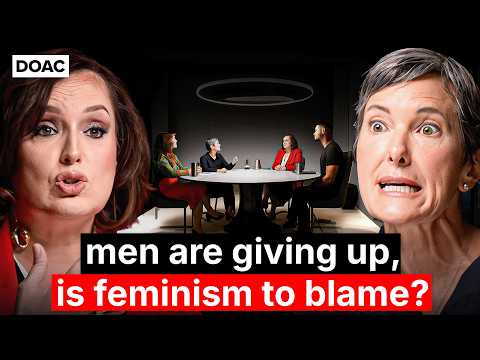
[@TheDiaryOfACEO] THE FEMINISM DEBATE: Is Feminism Betraying Women? The Hidden Risk Of Casual Sex!
![[@TheDiaryofaCEO] Summarizer](https://summaries.pages.dev/img/logo.webp)
Link: https://youtu.be/ZHuZ_8VYCWA
Short Summary
Okay, here's the requested information based on the provided transcript:
Number One Action Item/Takeaway:
Recognize that the second wave of feminism did not unite women. It split women. There are significant disagreements, trade-offs, and complexities surrounding feminism, particularly concerning motherhood, female identity, and societal expectations. The conversation emphasizes that women should have agency and autonomy in their choices and that other women should not demean/diminish the choice, but be supportive instead.
Executive Summary:
This discussion explores the multifaceted impact of the feminist movement, specifically focusing on the sexual revolution and it's consequences. While the movement has undeniably granted women agency and autonomy, it has simultaneously created challenges, such as the denigration of motherhood, unrealistic standards, and potential harm to children due to institutionalized childcare. The participants stress the importance of honoring individual choices, addressing the increasing power imbalances between men and women, and advocating for policies that support diverse family structures and promote children's well-being.
Key Quotes
Here are five quotes from the transcript that I found particularly insightful:
-
"Freedom is a wonderful thing. No one would want to take freedom away from human beings. But excessive freedom without structure is not good for human beings." - Erica
- This encapsulates the tension between individual liberty and societal needs, suggesting that unchecked freedom can be detrimental.
-
"So agency is just the ability to go around and choose what you do moment to moment. And autonomy is can I can I decide what my life looks like, the shape of my life, what what choices do I have? And emotional freedom is the third one." - Deborah
- This provides a clear breakdown of the concepts related to liberty, which are often used interchangeably.
-
"I think that one of the perennial problems with feminism is that the women who tend to sort of rise to the top and get media careers... are not representative of other women and will often have preferences that are very different which are just not shared by everyone else." - Louise
- This identifies a crucial issue within feminism itself: that the voices amplified might not always reflect the experiences and desires of the majority of women.
-
"I would also call myself a maternal feminist and I think that feminism has had a a really difficult relationship with motherhood certainly since the 60s because motherhood is really difficult because it particularly if you got if you're ideologically committed to the idea of gender sameness underplaying the differences biological differences between men and women sometimes called biological determinism then motherhood is a real problem for you because it really highlights those differences" - Louise
- This identifies why motherhood has caused an issue with feminism when the ideologies and the real world clashes.
-
"Problem is, we can't put a price on how important it is to raise children. There's there it's unpaid work. And because we focus so much in society on paid work, we can't put a price on how elevated women's work should be." - Erica
- This gets to the heart of the undervalued nature of caregiving in society, a consequence of its lack of direct financial compensation.
Detailed Summary
Here's a detailed summary of the YouTube video transcript, focusing on the key topics, arguments, and information discussed, excluding sponsor announcements and other advertisements:
Key Topics and Arguments:
-
The Impact of the Sexual Revolution:
- The video explores the positive and negative consequences of the sexual revolution, particularly its impact on women, men, children, and society.
- Arguments are presented on whether it brought autonomy, agency, and emotional freedom or excessive freedom without structure, leading to negative psychological effects and societal shifts.
-
Feminism's Role and Evolution:
- The discussion centers around whether the feminist movement has united or divided women.
- Criticism is aimed at some aspects of second-wave feminism, suggesting it prioritized women becoming like men, potentially harming children and devaluing traditional roles.
- The concept of "maternal feminism" is introduced, emphasizing the importance of valuing women's work as mothers.
- There's discussion around whether contemporary society overvalues career success while diminishing the importance of raising children.
-
Hookup Culture and Casual Sex:
- The video examines the rise of hookup culture and its effects, particularly on young people's mental health.
- Arguments are made that hookup culture may be better suited to the average preferences of men, potentially leading to negative outcomes for women.
- Debate revolves around whether young people are pressured into participating in hookup culture, even if they don't truly desire it.
-
Gender Roles and Expectations:
- The discussion addresses changing gender roles and whether society has gone too far in empowering women while disempowering men.
- The emergence of the "manosphere" is examined as a potential reaction to perceived female dominance.
- Traditional gender roles are explored, discussing whether they provide structure and security or limit individual freedom.
- Arguments are presented for and against maintaining some aspects of traditional gender roles, particularly in regards to providing and caregiving.
-
Motherhood and Childcare:
- The video explores the impact of working mothers and daycare on children's development.
- Arguments are presented that daycare may be detrimental to children under three, affecting their emotional regulation.
- Discussion focuses on whether governments are incentivizing women to join the workforce at the expense of stay-at-home parenting.
- Alternative solutions for childcare are discussed, particularly for poor women, emphasizing community support and surrogate caregivers.
-
Fertility Rates and the Future:
- The video addresses declining fertility rates and the potential consequences for society.
- Arguments are made that feminism must find a way to accommodate motherhood to ensure its continued existence.
- The video examines the relationship between political and religious beliefs and birth rates.
-
Pornography and its Impact:
- The discussion tackles the impact of pornography on society, including potential negative effects on relationships, sexual expectations, and young people's development.
- The exploitation of performers within the porn industry is condemned.
-
Masculinity and Raising Boys:
- The discussion examines modern masculinity and what it means to be a good man in today's society.
- Arguments are presented for and against traditional masculine virtues, such as providing, protecting, and procreating.
- Debate revolves around whether boys should be raised differently from girls, catering to their unique neurological and emotional needs.
- There is conflict of opinion regarding the role of providing men the space to express themselves differently for mental wellness.
- The concept of male quotas in college enrollment to balance numbers and prevent educational gaps from causing social imbalance is argued.
Specific Information and Data:
- 50% of young women are said to not want to have children.
- 82% of young women report feeling depressed and anxious after casual sexual encounters.
- Approval of casual sex in the UK rose from 10% in 1999 to 42% in 2018.
- Statistics on domestic abuse and violence against women are cited to challenge the idea of monogamy as a utopia.
- Research is mentioned indicating young men are increasingly struggling in school, facing mental health problems, and turning to the manosphere.
- In the UK, boys are falling behind in language communication skills, have lower GCSE results, and higher suicide rates than girls.
- Young women aged 16-24 earn nearly 10% more than their male peers.
- In the 1970s, women married at around 21, now it's closer to 30. For men, it was 23, now just over 30.
- Research shows women are more likely to choose men who earn more money.
- 66% of women in the UK would prefer to stay home with their children.
Intra-Feminist Debate:
- The video highlights disagreements and diverse perspectives within the feminist movement regarding sex work, sex positivity and the prioritization of certain women over others.
- The video presents that while all are here to advance women's standing in life, the approach and consequences can vary between different ideals and goals.