[@alux] Every Time the Economy Collapsed
![[@alux] Summarizer](https://summaries.pages.dev/img/logo.webp)
Link: https://youtu.be/Tk9FMLg16IM
Short Summary
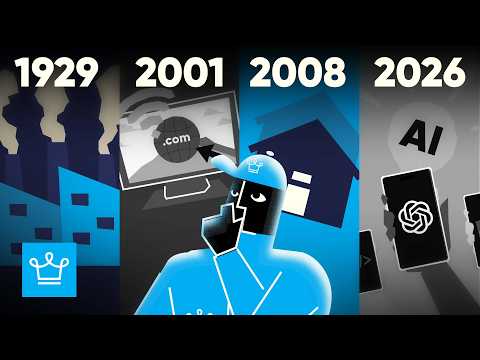
This YouTube video analyzes four significant economic crises: the Great Depression, the dot-com crash, the 2008 financial crisis, and the potential AI bubble. It explores the causes, impacts, and lessons learned from each crisis, while also providing arguments for and against the existence of an AI bubble and its potential consequences.
Key Quotes
Here are five quotes extracted from the transcript, representing interesting data points, surprising statements, or strong opinions:
- "Just because stocks are hot doesn't mean the economy is." (This highlights a critical disconnect that can occur between the stock market and the real economy, a common theme in economic crises.)
- "One of them, an online wedding invitation company of all things, spent twice its total lifetime revenue, just to buy a 30-second ad slot. That's how detached from reality things had become." (Illustrates the extreme irrational exuberance during the dot-com bubble.)
- "According to a recent study, around 95% of companies that have tried to integrate generative AI into their operations reported zero improvement in productivity and some actually got worse. Only about 5% say they saw a positive return." (A startling statistic that challenges the widespread hype surrounding AI's immediate benefits.)
- "AI isn't being fueled by its own profits. It's just being fueled by investors who eventually want to see their dollars turn into more dollars. And that's just not happening right now." (This directly addresses the sustainability issue within the current AI boom.)
- "We gave it the script for this video, told it to analyze the arguments, and asked it for a one-word answer to the question, are we in an AI bubble? And well, it thought for about 12 seconds and said, probably." (A somewhat humorous and thought-provoking conclusion, demonstrating AI's assessment of itself.)
Detailed Summary
Okay, here's a detailed summary of the YouTube video transcript, broken down into bullet points:
I. Introduction
- The video promises to explore four major economic crises in modern history: The Great Depression, The Dot-com Bubble, The 2008 Financial Crisis, and a discussion on whether we are in an AI bubble.
- The video aims to explain how the economy works by examining historical failures.
II. The Great Depression
- Overview: The worst economic crisis in modern history. The US economy shrank by nearly 90%, with 25% unemployment and a third of banks collapsing. It had global impact.
- Pre-Depression Era (Roaring 20s):
- Post-WWI industrialization led to mass production and consumer goods.
- The UK promoted free trade and globalization.
- The US emerged strong from WWI, with booming industries and optimism.
- The rise of consumerism, advertising, and mass production.
- The Build-Up:
- Banks increasingly loaned money to individuals for consumer goods (cars, refrigerators, etc.).
- The stock market boomed, attracting ordinary investors.
- People began borrowing money to speculate on stocks, creating a bubble.
- The stock market became detached from the underlying economy.
- Consumer demand began to slow down in the mid-1920s.
- European countries couldn't afford to import American goods.
- Supply outpaced demand.
- A significant portion of consumer debt was used for stock purchases (40% by 1929).
- The Crash (1929):
- October 24, 1929 (Black Thursday): Market dropped 11%.
- October 29, 1929 (Black Tuesday): Prices collapsed another 12%.
- The market lost nearly 40% of its value in weeks, wiping out savings.
- The stock market continued its downward slide, bottoming out in 1932 (down 90% from its peak).
- Domino Effect: The stock market crash was just the beginning; the real disaster came with the spread of financial panic into the real economy.
- Reduced Spending: People stopped spending money to save or repay loans.
- Business Decline: Businesses earned less, leading to layoffs and bankruptcies.
- Increased Unemployment: Unemployment rose, further reducing spending.
- Bank Failures: Businesses and individuals defaulted on loans, causing bank losses. Bank runs occurred as people rushed to withdraw money. A third of US banks failed.
- Deflation: Factories continued producing goods despite low demand, leading to falling prices.
- Deflation led to less spending, and it led to more bankruptcies. More bankruptcies mean fewer jobs. Fewer jobs meant even less spending.
- Government Response (and Initial Failure):
- Initially, the government raised import taxes (tariffs) hoping to encourage buying local. This backfired as other countries retaliated.
- The US was taken off the gold standard to allow printing more money.
- Increased taxes on the wealthy to fund social programs
- The New Deal:
- Government intervention through the New Deal:
- Large public works projects to create jobs.
- Lending to banks to stimulate lending.
- Bank reforms, including FDIC insurance and temporary bank closures for inspection.
- Creation of Social Security, the Securities and Exchange Commission (SEC), unemployment insurance, minimum wage laws, and overtime pay.
- Government intervention through the New Deal:
- Global Impact:
- World trade collapsed by 66%, impacting countries reliant on exports (Latin America, Africa, Southeast Asia).
- European economies suffered with high unemployment.
- Germany experienced political extremism (rise of Nazism).
- Japan militarized and launched invasions.
- Lessons Learned:
- A little inflation is good.
- Governments have a vital role in steering the economy during a crisis.
- Government spending can stabilize demand.
- Recessions and crashes are human stories.
III. The Dot-com Bubble
- Overview: A financial disaster that also enabled the modern internet.
- The 1990s Context:
- End of the Cold War and economic recovery in the US.
- Low interest rates and reduced capital gains taxes encouraged investment.
- Rapid growth and increasing accessibility of computers and the internet.
- The Rise of Netscape:
- Netscape Navigator, a user-friendly web browser, popularized the internet.
- Netscape's IPO in 1995 was a landmark event despite the company not being profitable.
- The stock price doubled on its first day of trading, making its founder a Silicon Valley Legend.
- The Bubble Inflates:
- Other internet companies rushed to IPO, some innovative (Yahoo, Amazon, eBay), many with weak business models.
- Example: Pets.com - sold pet supplies online, losing money on every sale, yet valued at $300 million.
- "Growth over profit" mentality prevailed.
- Investors focused on how fast a company could grow instead of its sustainability.
- Record number of IPOs, with many doubling in price on the first day.
- Venture Capitalists make the most money on IPOs.
- The Crash:
- The Super Bowl that year was known as the dot-com Super Bowl because so many dot-com companies spent so much money on advertising.
- In March 2000, the market peaked.
- Investors realized that most companies would never become profitable and began selling stocks.
- The NASDAQ lost a third of its value by April 2000.
- Trillions of dollars in wealth evaporated.
- A recession followed.
- Positive Aftermath:
- Strong companies (Amazon, eBay, Craigslist) survived.
- The bubble left behind infrastructure (fiber optic cables, data centers) that enabled future growth (YouTube, Netflix, cloud computing).
- Industrial bubbles create the infrastructure and knowledge for the next era of growth.
IV. The 2008 Financial Crisis
- Overview: Near collapse of the global economy. Loss of jobs, homes, and market value.
- The Setup (Early 2000s):
- The Fed lowered interest rates to combat the dot-com recession.
- The government encouraged home ownership.
- Regulations limiting investment bank leverage were lifted.
- Mortgage-Backed Securities (MBS) and Collateralized Debt Obligations (CDO):
- Investment banks bundled mortgages into MBS and sold them to investors.
- CDOs included various debts, including MBS, car loans, business loans, and credit card debt.
- Banks gave out "ninja loans" (no income, no job, no assets) that were considered subprime loans.
- Credit Rating Agencies and Conflict of Interest:
- Agencies that rated financial products like MBS and CDOs were paid by the investment banks, creating a conflict of interest.
- Credit rating agencies started inflating their ratings.
- AAA rating (highest rating) for the safest investment in the world being given to bad subprime mortgages.
- The Housing Bubble:
- Increased demand for housing drove up prices.
- The Crash (2007-2008):
- Housing prices peaked and mortgage payments increased.
- Homeowners defaulted on mortgages.
- Investment banks went bankrupt.
- Banks stopped lending money.
- The Federal Reserve lowered interest rates.
- Bear Stearns was bailed out by JP Morgan.
- Lehman Brothers collapsed.
- AIG received an emergency loan.
- Government Bailout:
- Congress passed a $700 billion bailout package for financial institutions.
- Consequences:
- The US entered the worst recession since the Great Depression.
- The stock market lost half its value.
- Millions lost homes and jobs.
- The crisis spread globally.
- Aftermath:
- Federal Reserve slashed interest rates to zero.
- The Obama administration passed a stimulus package.
- Dodd-Frank Act implemented new financial regulations.
V. AI Bubble - Are we in one?
-
Introduction: Discussion on whether we are currently in an AI bubble.
-
Bull Case (No Bubble):
- Money is coming from established and profitable companies (Google, Microsoft, Amazon, Meta).
- AI is already useful in many applications (writing, coding, image generation).
- Built on established infrastructure (cloud computing, data centers, GPUs).
- Trillion-dollar companies have the capital to keep investing.
-
Bear Case (Yes Bubble):
- Many companies aren't finding AI useful (95% report no productivity improvement).
- Usefulness isn't the same as profitability.
- There's a massive gap between what AI was supposed to be and what it is now.
- AI companies (OpenAI, Anthropic) are largely unprofitable.
- Roundtripping - companies fund each other's growth in a closed circle.
-
Is it the Bubble causing the Recession? Or a Recession causing the Bubble?
- If investors start pulling money out of AI to cover their losses in other parts of their economy, the biggest most powerful companies in the world, Microsoft, Google, Nvidia, Amazon are also the ones most exposed.
-
Chat GPT Analysis: When provided with the video's script, Chat GPT responded "probably" to the question "Are we in an AI bubble?"
VI. Alux App Promotion: The video promotes the Alux app as a tool for self-improvement, offering daily lessons and courses on various topics. Discounted pricing is offered.