[@Area52Investigations] Hidden Alien Photos! - Amaury Rivera pt.3 | DEBRIEFED ep. 89
Link: https://youtu.be/0yF3yPFJXr8
Duration: 68 min
Transcript: Download plain text
Short Summary
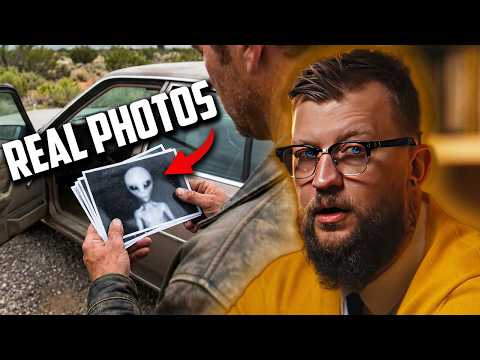
Amorei Rivera, a former Pennsylvania janitor who moved to Puerto Rico and operated a hot dog stand called Tamarindo, claims to have photographed a UFO near a military plane in 1988. Four men identifying as CIA arrived at his home demanding the negatives, prompting him to hide them in his dog house due to a premonition. Jorge Martin, a prominent Puerto Rican UFO researcher, verified the photos through computer analysis as authentic with no manipulation.
Key Quotes
- "The drawer of oblivion." (00:19:13)
- "I for one get excited when someone has a book. This is how I see books. There are books all around me. I read books. I love books. I love audio books. I love reading paperback." (00:20:32)
- "Money sometimes has a supernatural power over some people. It's mesmerizing to see the things some people are willing to do in order to get it. even destroy other people's lives." (00:40:48)
- "The nightmares became an everyday thing for me, but I never got used to them. Every time was like the first." (00:11:01)
Detailed Summary
Overview
This episode recounts the alleged 1988 UFO encounter of Amorei Rivera (also known as Amorei Rivera Toro), a former Pennsylvania janitor who moved to Puerto Rico and operated a hot‑dog stand called Tamarindo. After photographing an unidentified craft near a military plane, he became the target of mysterious harassment from individuals claiming to represent government agencies, and his photographs were later verified as authentic by a leading Puerto Rican UFO researcher.
- Amorei Rivera, a janitor at an elementary school in Puerto Rico, bought a food cart and opened “Tamarindo hot dogs” near Road 301 and a tamarind tree on the route to El Kombate beach.
- In December 1988, over 100 witnesses in Cabo Rojo reported a massive triangular craft, prompting the interception of multiple F‑14 jets.
- Amorei’s enlarged UFO photograph was displayed on his cart but met with ridicule; customers mocked him, called him “crazy” and “Martian,” and even placed ketchup and mustard on the picture.
- Four men identifying as CIA arrived at his home, demanding the negatives and presenting documents with a CIA heading.
- Amorei hid the envelope containing pictures and negatives inside his dog Christina’s wooden dog house before leaving for work, a decision he later attributed to intuition or premonition.
The 1988 Cabo Rojo Mass Sighting
On the night of the incident, a giant triangular craft hovered over the Sierras Bhas mountains, which are visible from Amorei’s hot‑dog stand, and was observed by more than 100 people.
- At least two F‑14 jets intercepted the craft, circling it several times before appearing to collide with it and vanishing.
- A third F‑14 that inspected the UFO was chased by three red orbs deployed by the craft and was never heard from again.
- The FAA confirmed that F‑14s were deployed for testing during that period, but the U.S. government publicly denied any such activity when questioned.
- Jorge Martin, a prominent Puerto Rican UFO researcher, later confirmed that multiple F‑14s were launched from an airfield in the Bahamas.
- Amorei described the craft as consisting of wedge‑shaped pieces that could separate like pizza slices, possibly components of a larger mother ship.
Amorei Rivera’s Background and Move to Puerto Rico
Amorei Rivera arrived in Puerto Rico after living in Pennsylvania, where he worked as a janitor, and settled into the local community before opening his food business.
- After moving from New York, he secured employment as a janitor at an elementary school in Puerto Rico.
- He later purchased a food cart, met all Department of Commerce requirements, and began selling hot dogs at the “Tamarindo hot dogs” stand.
- Edgardo, the stepson of Mr. Popo, told Amorei about seeing a ball‑of‑fire UFO through the windows of a church when he was a child, a story that later resurfaced when Amorei shared his own encounter.
- Mr. Popo initially dismissed Amorei’s account but later changed his opinion after experiencing a personal anomalous event.
The Photo and Early Harassment
Amorei displayed an enlarged version of his UFO photograph on his hot‑dog cart, but the response from the public was largely hostile, damaging his business.
- On the morning the men arrived (Chapter 9), Amorei hid the envelope containing pictures and negatives inside his dog Christina’s wooden dog house before leaving for work.
- The harassment led Amorei to refer to the hiding spot as the “drawer of oblivion,” a place where he concealed the evidence after it was mocked.
- The ridicule included customers calling him “crazy” and “Martian,” and even placing condiments on the photograph, which contributed to a decline in his sales.
The Harassment Incident: Four Men Claiming CIA
Four men arrived at Amorei’s residence on the afternoon of the incident, presenting credentials that bore the CIA crest and demanding the photographic negatives.
- One of the men wore a suit, tie, and sunglasses, while the other three were dressed in casual clothing; all presented documents with a CIA heading.
- They asked Amorei if he was “Amorei Rivera Toro” and insisted he hand over the negatives, which he denied knowing about.
- Amorei permitted the men to search his home, and the search continued for the entire afternoon, with agents methodically emptying drawers and checking even the most unusual locations, such as between slices of rotting eggplant in the refrigerator.
- The agents confiscated family photo negatives (including pictures of birthdays, weddings, and baptisms) but failed to locate the hidden UFO photographs.
- One agent wore a “guya,” a white South‑American shirt‑style garment, suggesting the men were likely local rather than American operatives.
Contact with UFO Researcher Jorge Martin
After the harassment, Amorei was approached by a man later identified as “Mr. B,” who claimed to be a UFO investigator working for a local magazine and offered to help publicize the sighting.
- Mr. B described himself as having black hair, a wide face, tan skin, and an obese build, and claimed personal contact with an extraterrestrial being named Cosmin.
- He asserted that he possessed hundreds of UFO photographs and that he and his friends regularly conducted vigils, recording UFOs flying at very low altitudes.
- Amorei experienced a vivid dream in which a man in black instructed him to send the pictures to Jorge Martin, the researcher from the magazine; upon waking, he realized the man matched a figure in his own photographs.
- Amorei’s father warned him to avoid involvement with the magazine people, citing prior trouble related to the CIA.
Verification of the Photographic Evidence
Amorei anonymously mailed the photographs to Jorge Martin, who later visited the Tamarindo stand and conducted a thorough analysis of the negatives.
- Jorge Martin examined the pictures and was astonished, describing the sighting as one of the most compelling cases he had encountered.
- He explained that hundreds of thousands of people worldwide have experienced the “lost time” phenomenon, with hundreds of documented cases in Puerto Rico alone.
- Computer analysis of the negatives confirmed that the pictures were definitively real and showed no evidence of manipulation or trickery.
- Martin investigated the case for more than a year, honoring an agreement to remain silent and not publicly disclose Amorei’s identity.
Ongoing Surveillance and Mr. B’s Threats
Despite the agreement, Mr. B leaked Amorei’s personal information, leading to continuous surveillance and intimidation.
- Mr. B disclosed Amorei’s identity, workplace, and home address to others, breaching the confidentiality of the investigation.
- He followed Amorei everywhere—to the supermarket, the beach, the car mechanic, and down every street—creating a persistent, threatening presence.
- Amorei concluded that Mr. B’s obsessive behavior was motivated by a desire to monetize the photographs.
Disposition of Evidence and Aftermath
In response to the threats, Amorei and his brother Charlie took steps to protect the evidence and limit its exposure.
- Charlie advised Amorei to forget about the experience, focus on productive activities, and keep the encounter private.
- The evidence package was sent to Japan via a post office in a different town, using covert communication protocols, with the key stored in a safety deposit box.
- Charlie opposed having the “baby” (the photos) examined by doctors, reminding Amorei of the fate of others who possessed graphic evidence.
- Amorei reported experiencing daily nightmares after the encounter, a symptom that persisted despite his efforts to move on.
- Jorge Martin published an article about the case around 2011, roughly 15 years before the podcast’s recording.
Host Interpretation: Non‑Human Intelligence and Suppression
The host suggests that the pattern of intimidation and secrecy may indicate collaboration between non‑human intelligence and a government faction to suppress disclosure.
- The narrative highlights that thousands of cultures across millennia have valued dreams as portals for interaction with otherworldly beings.
- Beings appear to engage with individuals during altered or deep REM sleep states, potentially influencing decisions such as hiding evidence.
- The host posits that the coordinated harassment of witnesses like Amorei could be part of a broader effort to control information about UFO phenomena.