[@ChrisWillx] The Art Of Self Mastery - Shaolin Monk Shi Heng Yi
![[@ChrisWillx] Summarizer](https://summaries.pages.dev/img/logo.webp)
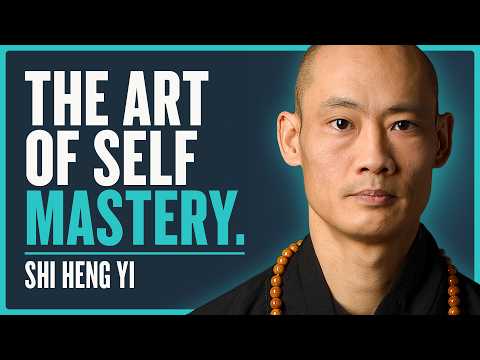
Link: https://youtu.be/OHxjZxg7K3w
Short Summary
Number One Takeaway:
The most important action item is to develop self-awareness by observing your patterns, thoughts, and behaviors as if you were an outside observer, in order to break free from unconscious cycles and make conscious choices.
Executive Summary:
This video explores the concept of self-mastery, emphasizing the importance of understanding and training both the body and the mind. It encourages listeners to become aware of their unconscious patterns and behaviors, drawing on ancient traditions and modern science (like epigenetics). By cultivating self-awareness and breaking free from these patterns, individuals can reduce suffering and live more consciously, balancing the need for achievement (doing) with contentment and peace (being).
Key Quotes
Okay, here are 5 insightful quotes from the provided transcript:
-
"I do think in order to manage people, it makes sense to actually know how to manage yourself in the first place... you might change your job one day, you might change the location where you're living, the surrounding is going to change, the people that you are dealing with is going to change, but there's always one one thing that always remains the same um which is you always carry yourself along the way."
-
"If I am not the body, if I am not the mind, what is the I? ... This answer of what is it that you are identifying yourself with also gives you the answer how do I reduce the suffering of this lifetime."
-
"If you are identified with this pattern, you cannot escape it. So this is now where it helps this ancient saying before you are not the body and you are not the mind. So even if you just take this as a concept right now then it means from time to time try to just let's say jump out of yourself and just observe yourself, just imagine it is a movie this is the movie character and I'm jumping out and I'm watching the movie of this one and from this perspective suddenly I see something differently."
-
"Why would I set a goal? because I assume that when I reach the goal, it's going to give me something that in the moment where I'm setting the goal, I don't have...So how do I find this balance between being and doing? You're not supposed to do nothing. But you are also not supposed to run and run and run and never arrive. Both of them are like pointless."
-
"But I do think that at the same time that there is no other way um to really clean yourself up. Yeah, there is no other way to clean yourself up than really looking at all the stuff that's hidden inside of you."
Detailed Summary
Here is a detailed summary of the YouTube video transcript using bullet points:
Key Topics:
- Self-mastery
- Training the mind
- Understanding the 'I' (self)
- Reducing suffering
- The balance between "being" and "doing"
- Regret and forgiveness
- Discipline and focus
- Awareness and self-discovery
- Facing one's "dark side"
Arguments and Information:
- Self-Mastery Defined: It's about managing oneself before managing others. Involves training all aspects of oneself (body, mind, emotions) like training muscles at a gym.
- The Importance of Self-Awareness: The speaker emphasizes carrying oneself along throughout life and not being able to escape dark sides and triggers, making self-understanding crucial.
- Neglected Areas of Self-Mastery:
- Training the Mind: People focus on diet for the body but neglect "feeding" the mind with positive and conscious thoughts.
- Ancient traditions emphasize body and mind with the missing element as mind.
- Ancient Traditions and the "I": Ancient traditions suggest we are neither the body nor the mind. This is a crucial concept.
- Thinking Experiment: Are You Your Body/Mind? You cannot control aging or hunger with your body. Similarly, you cannot have an influence in what you are thinking next.
- Conditioning and Information Passed Down: Both body and mind are conditioned, carrying information passed down. Epigenetics supports this idea.
- The Essential Question: What is the "I"? This question is key to understanding how to reduce suffering.
- Suffering and Perspective: The goal is to find a proper perspective on life to reduce unpleasant experiences. Happy people may not need to pursue this, but they either developed the process or their "winning streak" will end.
- Practice When You Don't Need It: Developing mindfulness, meditation, etc., is best done when times are good to prepare for difficult times. It's easier to calm the mind in nature but more beneficial in fast-paced environments.
- Why Share These Ideas Publicly? The speaker values providing valuable, free, and functional information that can benefit people's lives.
- The Speaker's Background: He had an academic background (degrees, MBA) and gave it up to dedicate his life to something meaningful. His initial connection was through Shaolin Kung Fu.
- Why Begin the Journey of Self-Discovery? If life is fine, there are no questions. But questions arise as one observes life's patterns. He was an overachiever who found the pursuit of material goals shallow.
- Freedom vs. Structure/Pattern: People desire freedom, but life is full of patterns and structures that restrict freedom.
- Breaking the Cycle of Wanting: Observing patterns can break senseless cycles of wanting, achieving, and then wanting again.
- Observing Yourself: Imagine watching yourself in a movie to see patterns from a wider perspective. Become aware and mindful to break the cycle of conditioned identity.
- Conscious Goals: The speaker still sets goals but makes them consciously, considering if they are worth investing his limited lifetime in, preventing unconscious structures and patterns.
- Balancing Self-Improvement with Self-Love: Self-improvement should not come at the expense of self-disdain.
- Being vs. Doing: Find balance. The speaker suggests to be aware and balance out those two areas and you are not supposed to run and run and never arrive.
- Dealing with Regret: Learn from what went wrong. Learn to let go by forgiving both others and yourself. Unhealed frustrations can lead to diseases.
- Discipline and Focus:
- Discipline is sticking to a plan regardless of feelings and avoiding things you know are bad for you.
- Focus is the ability to mobilize energy, intention, mind, and awareness, directing attention toward the desired task to maximize output.
- The Mind After Contemplation: One becomes less compulsive and reactive, no longer driven by external circumstances and feeling as though one's life is more in one's own hands.
- Quiet The Noise: A lot of the actions people do is not what they mean to say and this could be a gift to yourself and the rest of the world.
- Physicality as a Starting Point: Encouraging physical activity as the first step toward becoming aware of oneself and one's hidden issues.
- Facing the "Dark Side": Recognize it was wrong, after you repent, then comes the freedom.
- Motivating Bravery: Find motivation to face your dark side, knowing that good things come from overcoming challenges.