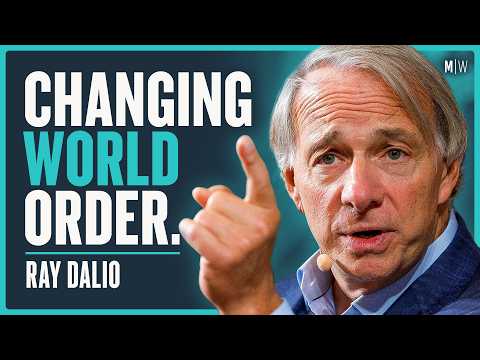
[@ChrisWillx] The Changing World Order: How Countries Go Broke - Ray Dalio
![[@ChrisWillx] Summarizer](https://summaries.pages.dev/img/logo.webp)
Link: https://youtu.be/Tr0F-EQRm5o
Short Summary
Number One Most Important Action Item/Takeaway: Study history to understand repeating patterns and cycles, particularly the rise and decline of powers, monetary orders, and the impact of debt cycles, and apply these lessons to the current global situation to make informed decisions.
Executive Summary: Ray Dalio emphasizes the importance of studying historical patterns to understand the present and predict future events, particularly regarding the economy, political cycles, and geopolitical shifts. He highlights the cyclical nature of these forces and the need to be aware of the mechanics that cause their breakdown, offering his books and free video content as resources for further learning.
Key Quotes
Okay, here are 5 quotes from the transcript that I found particularly insightful, interesting, or strong:
-
"You need to study the mechanics of things that have happened before because a lot of what's happening now is most similar to what has happened before our lifetimes." This highlights the importance of historical context in understanding current events, a recurring theme throughout the interview.
-
"All orders, all monetary orders, all political orders and all geopolitical orders, in other words, systems have broken down throughout history. So they're breaking they're breaking down in predictable ways especially if you know what you're looking for right okay but at least don't be ignorant okay about how do they break down what happened what hap today." Dalio emphasizes the cyclical nature of global systems and the importance of understanding their breakdown patterns.
-
"There are five major forces and that repeat over and over again and interact". Dalio's mention of the five forces and their interplay (debt/money cycle, political cycle, geopolitical world order, acts of nature, and man's inventiveness) provides a helpful framework for analyzing complex global events.
-
"I believe strongly that we are on the brink of that. Okay. that it could go either way that that but that there's more risk." Dalio's belief that we are approaching a critical point regarding trust in the system.
-
"Politics, okay, that I have at least a good understanding of how the current economic situation can impact internal politics. We've got polarity. People feel like they can't give an inch. That's seen as a lack of conviction by their own side. It's seen as a lack of feelalty by the other side. They're an unreliable ally. You have this sort of us and them situation that often comes out of capitalism. good system, lots of problems." Dalio's perspective on the impact of the economy on the political landscape.
Detailed Summary
Okay, here is a detailed summary of the YouTube video transcript, presented in bullet points:
Key Topics:
- Changing World Order: Exploration of the cyclical nature of reserve currencies, great powers, and global orders based on historical patterns.
- Debt Cycles: Examination of how debt accumulates, its impact on economies and societies, and potential consequences of unsustainable debt levels.
- Political Cycles: Discussion of the cyclical nature of political polarization, populism, and internal conflict, often linked to economic conditions.
- Geopolitical Cycles: Explanation of how global geopolitical orders rise and fall, typically following major wars and shifts in power.
- Impact of Acts of Nature: Consideration of the influence of droughts, floods, and pandemics (acts of nature) throughout history and their potential impact in the modern world.
- Technological Disruption (AI): Analysis of the impact that AI is going to have over the next few years in terms of technological advances and its potential for both benefits and disruptions to employment and society.
Arguments and Information:
- Dalio's Journey: Dalio explains his interest in the changing world order stemmed from personal experiences (Nixon shock), historical study (Great Depression), and the desire to understand recurring patterns.
- History Repeats: He argues that while technology evolves, fundamental human and economic patterns recur throughout history. Studying the past provides valuable insights into the present.
- Debt as a Cycle: Debt rises relative to incomes, leading to debt service payments squeezing out spending, which triggers various economic and political consequences. He uses the analogy of plaque in arteries.
- US Debt Situation: The US government is spending more than it takes in, accumulating significant debt. He provides a detailed breakdown of spending, income, debt rollover, and the challenge of finding buyers for US debt.
- Mechanics of Dealing with Debt: Countries deal with debt problems through default, pressuring others to take the debt or printing money and devaluing the currency.
- Political Polarization & Populism: Economic inequality and values gaps fuel political polarization, leading to populism on both the left and right, threatening domestic order and rule of law.
- Geopolitical Shifts: The post-World War II order, led by the US, is breaking down due to the rise of other powers, particularly China. US is no longer as dominant.
- Acts of Nature and the Cost of Climate Change: The costs of the damage is estimated at $8 Trillion a year.
- China's Role: China's economic rise, fueled by cheap exports and US debt-funded consumption, has contributed to the decline of the American middle class and growing geopolitical tension.
- AI's Impact: AI will be hugely beneficial, but also highly disruptive to employment.
- Loss of a Strong Middle: Believes a strong political middle ground is necessary to address complex problems, but it is being lost, making compromise and effective solutions more difficult.
- The "3% Solution": He proposes a "3% solution" for the US debt problem, requiring small sacrifices from everyone (taxes, spending cuts, etc.) to reduce the budget deficit.
- **Analogies:**Uses multiple analogies to explain complex concepts (life cycle, disease, circulatory system of the body)
Dalio's Perspective & Recommendations:
- Passing on Knowledge: He wants to share his understanding of these cycles to help others make better decisions.
- Importance of Learning: He emphasizes the need to learn from history and understand the mechanics of these cycles.
- Need for a Strong Middle He Emphasizes the need for compromise and finding common ground to solve problems.
- Diversification and Protection: Suggests diversifying investments and protecting against potential economic and geopolitical risks, like an insurance policy.
- Action is Required: Recommends diversification and protecting against potential economic and geopolitical risks, like an insurance policy.
Book and Video Promotion (Mentioned for Context):
- "Principles for Dealing with the Changing World Order": His book that explains the patterns of the changing world order.
- "How Countries Go Broke the Big Cycle": Another book he wrote.
- Free YouTube Video: A free video available on YouTube explaining the changing world order.
This summary provides a comprehensive overview of the key points discussed in the provided transcript.