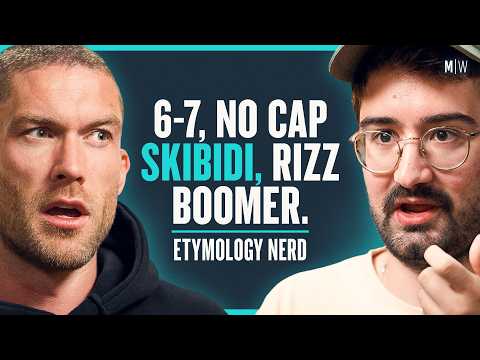
[@ChrisWillx] THEY’RE BRAINWASHING YOU! (& other secrets that made you click) - Etymology Nerd
Link: https://youtu.be/jxDDW5OKhdA
Duration: 95 min
Short Summary
Lex Fridman interviews a linguistics influencer who studied at MIT and went viral on TikTok for their constructed dolphin language, exploring how algorithms, AI, and social media are reshaping human language—from influencer vocal patterns engineered for retention to AI-generated speech infiltrating politics and academia. The episode covers slang diffusion pipelines, language death, etymology, framework maximalism, and how platforms commodify attention while transforming consensus reality through linguistic bottleneck events.
Key Quotes
- "Whenever a dictionary chooses their word of the year, that's a marketing ploy by big dictionary to sell more dictionaries." (00:00:12)
- "Contentment makes you feel warm and fuzzy inside, but it doesn't trigger your brain to click a like button. The like button, of course, is more of a metric of how willing you are to click this button than it is whether you like something." (00:28:48)
- "Clip farming is the future of distribution online." (00:53:36)
Detailed Summary
Episode Overview
This Lex Fridman episode features a MIT-educated linguistics influencer who went viral on TikTok for their constructed dolphin language, exploring how algorithms, social media, and AI are fundamentally reshaping human language and communication patterns. The conversation spans etymology, constructed languages, framework maximalism, and the attention economy, with the guest positioning themselves as a public service announcement for creators aiming to expose manipulation tactics.
Influencer Vocal Engineering and Platform Dialects
The lifestyle influencer accent traces back to early beauty YouTubers, Kim Kardashian, and Paris Hilton, filtering into TikTok through what linguists call the "founder effect." The conversation examines how specific vocal patterns are engineered for algorithmic retention rather than authentic expression.
- Uptalk (lengthening final vowels) signals "I'm not done speaking," creating retention-optimized holding patterns that keep viewers engaged
- Downtalk (falling intonation) is avoided because it signals "scroll away," making influencers unconsciously maintain rising intonation
- Mr. Beast deliberately switches between his screaming on-camera voice for 14-year-olds and his calmer interview voice, demonstrating code-switching for different audiences
- Educational influencer accents follow a lineage from Bill Nye → Hank Green → Vsauce, featuring stressed individual words, faster pace, and clipped consonants for authority positioning
- TikTok, Twitter, and LinkedIn function as distinct linguistic houses with their own dialects, fandom language, linguistic play, and professional speech
- Micro-dialects exist within K-pop and Swifties communities, creating granular subcultures within platforms
AI's Infiltration of Human Language
The episode documents how AI is changing human language patterns, often without people realizing they're adopting machine-influenced speech. The guest provides specific data points showing measurable shifts in word usage and linguistic structures.
- The word "delve" spiked 1,000% in usage since before 2022 after ChatGPT was released, appearing 10x more than normal speech
- An estimated 13% of all research abstracts are now written with AI assistance
- British politicians in the House of Commons now use phrases like "I rise to speak," indicating AI-written content
- Humans are adopting AI-influenced language patterns without direct interaction, with Latin-derived terms like "commendable," "meticulous," and "crucial" increasing in human usage
- LinkedIn posts increasingly use bullet points with negative parallelism ("not just X, it's Y"), a style influenced by AI training
- AI exhibits Latin-based bias over Germanic words because models are trained to sound confident and prestigious, reflecting institutional training data
- ChatGPT converts input words into tokens (smaller segments paired with numbers) that become coordinates in high-dimensional embeddings representing meaning
- Neural networks predict the next token based on learned patterns and translate output back to language
Word of the Year and Clip Farming
The episode examines how words are selected as cultural markers and how viral content distribution has changed linguistic spread. Dictionary choices reveal marketing motivations behind seemingly cultural selections.
- Dictionary.com chose "67" as 2025's word of the year, described as a marketing ploy
- Oxford chose "rage bait" (itself noted as an act of rage-baiting)
- "Slop" was another selection, describing the sloppiness it critiques
- Clip farming—viral phrases engineered to get clipped and monetized—is identified as the future of distribution
- The "no because" opening used by influencers creates an in medias res effect, making viewers feel they're already mid-conversation
- A 2022 Know Your Meme study found words now originate from TikTok and Twitter rather than 4chan and Reddit
- Approximately half of Gen Z slang still traces to African-American English or 4chan despite new platform origins
Etymology and Word Origins
The conversation explores fascinating word histories that reveal the nonlinear trajectories of linguistic evolution. These examples demonstrate how meanings shift across centuries and cultures in unexpected ways.
- "Muscle" derives from Latin musculus (little mouse) because the muscle resembles a mouse moving under skin
- "Salary" comes from Latin sal (salt), as Roman soldiers were historically paid in salt
- "Assassin" originates from Arabic hashishiin (hashish consumers), referring to a Persian sect
- "Candidate" comes from Latin candidus (white-robed), associated with purity expectations
- "Silly" evolved from Old English salig (blessed) drifting through innocent and naive to foolish over centuries
- The Aztec word for avocado also meant testicle, reflecting cultural associations
- "Nightmare" derives from a Germanic demon called a "mare" that sat on sleepers' chests
- "Penguin" likely comes from Welsh "pen gwyn" (white head), originally referring to the now-extinct great auk
- "Orange" comes from Sanskrit through Arabic "naranja" with the 'n' eventually dropping off
Framework Maximalism and Avoiding Simple Narratives
The guest advocates for understanding reality through multiple frameworks simultaneously, warning against the seductive certainty of single-explanation narratives. This philosophical position underlies much of the episode's approach to linguistics.
- "Framework maximalism" proposes understanding reality through as many frameworks as possible because single frameworks are inherently reductive
- People who claim a single explanatory framework solves all problems project conviction that remains seductive even when opposing figures make equally absolute claims
- The war in Ukraine is cited as having hundreds of different reasons, all potentially equally valid, rejecting simple single-cause explanations
- Human brains prefer connecting dots from point A to point B in simple stories, but etymology and reality involve complex, nonlinear trajectories
- The Westermarck effect proposes that children raised together develop sexual aversion to each other, reinforced when sexuality emerges around ages 13-15, driving independence from family
Language Death and Linguistic Diversity
The episode addresses the crisis of language extinction and what is lost when languages disappear. The guest emphasizes that each language represents an irreplaceable worldview that cannot be translated.
- One language dies every two weeks, with approximately 7,000 languages existing today
- Most languages are predicted extinct by the end of the century
- The Potawatomi language contains expressions like "to be a Saturday," representing irreplaceable worldview perspectives that cannot be translated
- Agglutinative languages like Turkish and German create meaning by combining words; inflection languages like English, Latin, and French alter word forms themselves
- Japanese has more syllables per second than Thai, yet both transfer approximately the same bits per second of information due to Thai being more inflectional with more tones
Slang Diffusion and Gay Micro-Languages
The conversation examines how slang spreads through social hierarchies and how marginalized communities create distinct linguistic systems for survival and identity. The guest documents specific pipelines of linguistic diffusion.
- Slang spreads through a documented pipeline: Black people → gay people → straight white girlfriends → mainstream English
- Ballroom culture's "king/queen" terminology originated in 1980s New York City
- Gay micro-languages like Polari (England) and Swardspeak (Philippines) emerged in marginalized communities as survival mechanisms
- Emojis serve as tone tags and substitutes, with ICE protesters using ice emoji to avoid detection
- A Canadian court ruled thumbs-up legally constituted agreement in documented ruling
- The crying emoji evolved from literal crying to laughing in documented semantic shift
- 4chan's anonymity required demonstrating shared slang proficiency, and terms like "maxing," "pled," and "gooning" have slowly diffused into mainstream over a decade
- The manosphere is noted as linguistically interesting, with distinct terminology that has gradually entered broader discourse
Generations, Consensus Reality, and the Attention Economy
The episode interrogates how generations are constructed as consumer demographics and how social media is reshaping consensus reality. The guest argues that labeling tendencies conflict with individual uniqueness.
- Generations as social cohorts began with the Lost Generation after WWI
- The guest argues Gen Z was manufactured as a consumer demographic by marketing interests
- Labels constrain because once they exist, people must choose to identify with or against them
- The Overton window (acceptable discourse range) shifts based on consensus reality shaped by algorithmic amplification
- The memory bump effect locks in language, music, and movie preferences from ages 12-16, creating generational taste markers
- Each person speaks a unique idiolect shaped by background, upbringing, and social circles, despite surface-level linguistic convergence
- Social media's labeling tendency conflicts with individual uniqueness that resists categorical assignment
Constructed Languages and Linguistic Research
The guest shares their personal journey creating constructed languages, including their viral dolphin language. The episode explores why constructed languages have historically failed and what makes natural languages succeed.
- The speaker studied linguistics at MIT, took a conlanging class, and had their first viral moment presenting their constructed dolphin language on TikTok
- They also created a whistled bird language for different communication experiments
- Conlanging has been used for fictional languages including Dothraki for Game of Thrones and Klingon for Star Trek
- Esperanto is a famous constructed language intended as a global second language but did not achieve widespread adoption
- A hypothesized conlang called "ithquil" was designed to create maximum information transfer but has no native speakers because it is impossible for humans to learn
- Cornell University has a bird tracking app used for notable research on bird communication
Language, Information Transfer, and Communication Speed
The episode examines the relationship between language structure and information transfer efficiency, including why certain keyboard layouts persist despite being suboptimal. Language serves purposes beyond pure information transfer.
- Language serves purposes beyond information transfer—it facilitates ritualistic bonding, social ties, and establishing relationships through small talk
- Courtesies like saying goodbye on phone calls serve bonding functions rather than pure information transfer
- ChatGPT does not speak English as humans do—it predicts tokens based on a statistical model
- The English language is actually a homogenized category where everyone speaks their own slightly different version with shared reality between individuals
- QWERTY keyboard was designed with the most-used letters on edges to prevent typewriter keys from jamming, making it purposefully inefficient
- Alternative keyboard arrangements can make people 30% to 50% faster than QWERTY
Recommendations and Philosophical Framing
The guest offers specific recommendations for navigating the attention economy and linguistic manipulation landscape. They frame their work as exposing tactics rather than moralizing about them.
- The guest frames themselves as a public service announcement for creators, aiming to expose manipulation tactics without direct moral judgment
- They recommend consuming diverse media across multiple sources to combat confirmation bias and algorithmic filtering
- Brave New World is cited as more relevant than 1984 because people entertain themselves while not realizing they're in a "dictatorship" consuming content and drugs
- Tristan Harris from Center for Humane Technology notes that Anthropic appears better from an optics perspective, but every platform has the same goal of training AI as fast as possible
Full Transcript
Show transcript
67 was voted word of the year in 2025 from dictionary.com. Is that cheating? Not even a word. Don't mean anything. Well, you have to understand that whenever a dictionary chooses their word of the year, that's a marketing ploy by big dictionary to sell more dictionaries. Yes. 67 of course is this reference where if you say it, you can go viral. That's the idea behind 67. That's the whole joke that this is a possibility of getting clipped that you can cash in on the virality of it for your own game. And dictionary.com played that game, but every single person who did it also cash in on that. There was a Connecticut house representative, Bill Buckby, who said 67 on the Connecticut uh state floor. And all these people are doing the exact same thing as Talon Kenny, who was the um basketball player who started the trend, and all the Gen Alpha kids who were cashing in on it, like the 67 kid. All of it was a ploy for virality and it is a realization that clip farming is the future of distribution online. >> Wow. Okay. But it's a word that doesn't mean anything and is specifically designed to be vacuous and to incite the question, what does that mean? Is that is that unique? I don't believe that it doesn't mean anything. Right? >> I believe even when something is absurd, absurdity is a meaning. And it's absurd for a reason. And it's absurd because it's sort of critiquing the general information ecosystem. It's absurd that this would emerge as a word, but that is the meaning. The absurdity of the word is its own definition. >> Ah, okay. So, it's a story about it. It's a meta word. >> Yeah, exactly. It's it's all it's a knowing wink. >> By uttering 67, you're playing into the ponopticon. >> Rage bait was Oxford's 2025 word of the year. >> Right. They're also they're rage baiting with that. They they're hoping that it sparks controversy. Now when people are commenting about the word rage bait being chosen as the word of the year that drives the word further on Twitter or whatever X excuse me and uh and as a result more people know about Oxford dictionaries. You got to remember this is big dictionary at work >> and slopp was another one as well. So a word describing a a word that is sloppy describing something that is sloppy being used for people to complain about the fact that look at the state of language today. It's all well it's slop actually. >> Yeah. Yeah, I I like to combat that idea that language is slop or brain rot. Um there's nothing inherently in a word that's good or bad. It's a tool that you can use, but I think we cast our negative associations of social media onto the language. And uh yeah, of course, a lot of the videos we see are slop, but that doesn't mean the words themselves are bad for your brain. >> Do you think is Tik Tok becoming the most powerful linguistic engine on Earth at the moment? Is that what's shaping language more than anything else? >> Absolutely. There was a study by know your meme in 2022 that found where words come from over time by percentage of platforms. And it started out mostly on 4chan and Reddit and Twitter. And now it's mostly Tik Tok and Twitter. Um and again, sorry X. And uh you see >> it's still Twitter. >> I know >> it's still Twitter. >> I'm I'm holding on to it. Yeah. >> Um yeah. No, but a lot of stuff is happening in Tik Tok. There's linguistic innovation. There's a kind of everything comes from the user interface. There's a feeling of a conversation happening there. Users come there for the conversation to chip in to be part of this effervescent thing that's going on. And in that language is created. Along with this, we have all these echo chambers and algorithmic trends being perpetuated that push modern slang cycles faster than ever before. >> Is there such a thing as a Twitter dialect versus a LinkedIn dialect versus a Reddit or a live stream dialect? Are these almost individual um variants on language in each of these different cohorts? >> Absolutely. It's the same way when you're in your grandmother's house versus when you're in a frat house. You have a different expectation of how to speak. You're not going to speak to your grandmother the way you would to a frat brother. There's like a normal way of communicating. So, a platform functions kind of like a house. It is a place where you go to use a certain type of language. So, on LinkedIn, you're going to use this more professional language. On Twitter, you're going to engage in more linguistic play where you're uh you'll have all these words like jester gooning or whatever emerge. Uh on on Tik Tok, there might be more fandom language or something. But also, I don't want to speak broadly about individual platforms. Even within these platforms, there are micro dialects going on. There's K-pop groups and Swifty groups and uh they all speak kind of their own language. >> What did you make of the fallout? I think one of the most viral instances of linguistic exposure was that mid uh jesteru maxing at the club when the fuds come over. Is it better to be mogging with the bros than what did you make of that fallout? >> Yeah, I think it's kind of doing the same thing as 67 where there's a meaning beyond what the literal meaning technically is. It's kind of a knowing wink again to the algorithm that by saying these words you can go viral. You can cash in on Clvicular's fame. He is the human 67. Um, and >> if you talk about him, you get to go viral. That's that's kind of the thing. But in doing so, you can also push the trend further. And while 67 was innocuous, maybe clvicular is more harmful. Um, but that that is kind of the name of the game of virality that all these things are just key words, maxing, gooning, whatever. And you can just say that and you can go viral because the key words are what pushes things through the algorithm and they're what people resonate with on the personal level when they're scrolling. It also tells you something about the person using them. It's an identifier of inroup uh belonging. >> 100%. Language is a tool of identity. And when you use a word, you are signaling that you're part of this cohort. >> What are the most defining characteristics of influencers speaking online for creators? What how do you think about the constituent components of that? >> Yeah. Um, I spent a lot of time working on the influencer accent. I used to consult on a court case where one influencer was suing another influencer for stealing her vibe and part of that was the accent. Um, but yeah, >> hang on, hang on, hang on, hang on, pause. What? >> It was here in Austin, actually. Um, but there was one, it was called the sad beige lawsuit that there was this minimalist influencer kind of wore a lot of brown clothing and there was another minimalist influencer also in Austin who wore a lot of brown clothing and they kind of spoke the same and so one of them sued the other for for stealing their IP. Um, but you can't >> which included >> the Exactly. So I was brought on as a consultant in that case and um the takeaway is that neither of them were really original and that they pay homage to an older tradition of influencers talking. It's a long and illustrious history of influencers speaking in this. >> Absolutely. I mean, I think the modern like the hey guys, welcome to my podcast. That kind of like that's the lifestyle influencer accent. Um, that traces all the way back to like Kim K and the Paris Elton and early beauty YouTubers. And then that kind of filtered into Tik Tok and that same voice with the uptalk and the vocal fry is preserved because there's this thing called the linguistic founder effect where you kind of follow in the footsteps of people who came before you linguistically. And that's why also platforms do have different commenting cultures and different linguistic cultures. >> Um, and that's only one type of influencer accent. I obviously >> pause on that one. What what are they trying to achieve with the lifestyle influencer accent? What are the important parts and what's the outcome they're trying to get toward? >> Yeah, great question. There's a few things going on. One of it is just social signaling. It's saying I'm part of your group because that's what all of language does. So there is a identity marker of what it's like to be an influencer. And so you're performing this idea of an influence. You're also performing relatability to the young women who are watching you. At the same time, the accent is optimized for the algorithm. There's an element of retention, which is how long you watch the video. And when you drag out words, it kind of works better for captivating your audience. Um, dead silence is very bad on the algorithm. So if you have a live stream or something, you want to drag out your final syllable. So actually that uptalk where you kind of lengthen your final vowel is very good for online hooking. >> No way. So if you don't have your next sentence queued up, you can have a holding pattern, which is the end of the last word so that you know what you're going to say at the end and then after that you can work out what's coming next. >> That's exactly it. In linguistics, >> holy [ __ ] >> It's called floor holding. It's an actual like strategy that people use before, you know, social media. If you were on a stage, if you're on a debate, you want to keep grabbing people's attention. So use things like filler words. Actually, um, is a great example of a floor holding tactic where you are trying to get people to keep listening to you even though you don't have something immediately to say. Alex Okconor taught me this great one about Christopher Hitchens that if he was in the middle of a debate and he needed to take a sip of water or have a thought, he would get halfway through the sentence and then would continue from there. And I thought that's so [ __ ] cool. as opposed to pausing at the end and then thinking about what he was going to say by taking or even ask so you might say why is that the case well >> really what we need to consider is oh oh I'm waiting so the use of want to know what comes next >> bingo >> yeah and same with the influencers it's like if if there's an uptalk there's an implied I'm not done speaking and that's kind of the meta signal that there's something more to come it sounds like something's is unfinished when there's up talk and when there's down talk you'll never hear down like I'm done like that's like a falling >> oh it's a handoff there you go >> so you will not hear that online at all because it's it's a signal to scroll away >> that's funny I I've trained myself I just said signal to scroll away I like uptalked because that's like I've sort of trained myself into speaking in a I call an educational influencer accent which is different than that lifestyle influencer accent >> okay give me the educational influencer accent >> the most interesting thing about that is you know and I uh kind of stress more words to keep you watching my videos and I'll talk a little faster and I clearly talk quickly in real life, but I think I there's a difference between a conversational style and then when I'm purely reciting a scripted video to hook you maximally for your attention. >> M okay. So you're stressing individual words speaking a bit more quickly. That's interesting that the valley girl vocal fry lifestyle influencer. What I get the sense of as someone who isn't exactly a a connoisseur of that content is a softness, a sort of welcomingness, almost a familiarity, an attempt to sort of show, hey guys, welcome back to my channel. It's almost welcoming you through the door. Whereas it's much sharper when you're thinking about the educational influencer. But given that one is kind of slow, although there's no breaks, but it's certainly not d, it's much more cozy, uh, and the other is significantly more aggressive in terms of its pacing. >> Absolutely. Well, it's again the question of what are you trying to do on the meta level? The lifestyle influencer wants you to feel like you're parasoially watching this video. An educational influencer wants you to feel like they're a trusted source of authority. >> And it's that level of communication that's happening there. I don't actually want you to relate to me 100%. I want you to think of me as a teacher if I'm talking to you. >> So if you're speaking more quickly with authority in a almost staccato manner, it's there's brevity in the words. There's clipping. The consonants are always being pronounced pretty pretty accurately to create shape and color. This is an interesting one. Have you looked much at diction? The the the way that the mouth the um functionality of the mouth, the physiology of the mouth works. >> 100%. That's a big part of linguistics. Yeah. >> Yeah. Unreal. So, I I I just really loved the first time I ever worked with a speech coach and he said his description to me was uh vowels give words color and consonants give them structure. And one of the problems being from the northeast of the UK, we have a glottle stop typically. So, people will say butter. >> Butter. There's two T's in butter and they're not saying either of them. And neither was I when I was younger. Um >> by removing or by losing those consonants, you sort of fall through words. they don't have the same kind of structure, clarity, clippiness, and bringing those back in helps to give it a little bit more form. But what you're describing here that you've modified your speaking style for what will perform better online is kind of exactly this greater homogenization effect that's happening. There's nothing less valid about a North England dialect than the received pronunciation or the transatlantic accent or any of these things. We just [ __ ] into thinking that some of these are like fancier than other accents. uh but it's all in our heads and yet there's still this pressure to perform to use a more standard pronunciation of English. For my book I interviewed a lot of um Indian creators who feel like they can't speak in Indian accents because that's kind of maligned upon seeing as little status. >> Yeah. Um and they have to kind of code switch into more British sounding or American sounding accents. >> Wow. Well, in my defense or at least in my mother's defense, she was sort of slapping me on the wrist and beating it out of me as a child. So, I didn't make it to adulthood without saying butter. Correct. >> That's because of an ingrained shame. There really is nothing inherently wrong with you speaking in a northern English. >> I'm gonna go back to it. I'm [ __ ] gonna go back to it, mate. You [ __ ] cannot stop me from saying butter as much as I want. Uh >> the cost is you might go less viral because the viewer has an expectation that I want you to be speaking the way I expect you to speak. >> Also, there is a degree of legibility or illegibility. If you get a strong Jordi accent from the Northeast where I'm from or a strong Scouse accent from Liverpool, it is as close to a different language whilst being the same. It's like one step away from speciation in terms of language. I I think language can be correctly described as following a very similar path to evolution and that there are bottleneck events and speciation events and the algorithm for example I think is one such bottleneck that it compresses our language into you have to be speaking in these widely recognizable accents but then it speciates and and creates new environments um and so on these different platforms and in the different fandom communities on the platforms you will have new outgrowths of language that have first passed through this filter event. >> What else? So, we've had cozy lifestyle lady. We've had educational influencer man. >> Mr. Beast, >> there's a beast in the room. Yeah, I was about to say. >> Very good. What What's happening with M Mr. Beast's accent? >> If you look at his video and uh if you look at how he actually speaks in interviews, they're completely different. He is very deliberately switching his accent to grab your attention as much as possible. He screams in it. I just bought a private island. I'm giving away a million dollars. Like, he's he's very like ostentatious with it. He's screaming at you every sentence. Uh because that works for his 14-year-old viewers attention spans. Uh he's speaking to a different audience than somebody trying to educate and is a different audience than somebody trying to appear relatable because he's clearly being ostentatious. So it's reflected in his vocal style. Like he sounds like he's about to give away a million dollars even as he does it, you know? >> So it's excitement, loudness. What else? >> Uh shock and awe really. You just you want to the viewer to remain so dumbfounded watching the video that they don't even think to scroll away. It's like a magician. You just want to keep the attention going. >> I saw a live streamer in the wild for the first time ever a couple of months ago and I've obviously I've seen live streams online. I've seen some IRL stuff, not tons, but seeing an IRL streamer from side camera or behind camera was a a real experience. It was at the Beast Games 2 premiere in Hollywood. And what I found fascinating was because the live stream essentially never ends until it finally does. There is this permanent edging of the audience that there will be a payoff but not yet. And there will be a payoff but not yet. At least with Beast it's like we're going to go to the most expensive gym in the world. But first I'm going to show you the cheapest and now I'm going to show you one a bit more expensive. And now I'm going to and then finally you do it and there's a payoff and then you're done and the video is finished. >> Yeah. Different medium because it's bounded by a specific time. So, you know, the beast video is 14 minutes long, but the live stream is lasting however long. It's kind of like definitely live performers. If you go to like a public gathering and there's those people doing back flips in a crowd like uh for money or whatever, they won't do the back flips immediately because nobody like people leave immediately. >> They dance around for ages. >> They'll dance around. They'll do a round of collection of the money. They'll dance around some more. They'll do another round of collect. I promise guys, we're going to get to the back flips. And you keep watching because they're edging you. It's what's Yeah, exactly what's happening. And if you look at like Tik Tok live streams, I keep getting click baited by this like video of this guy trying to peel an egg and he gets the last part of the egg and he's like he keeps like edging us like I'm going to take off this this shell here. Um but I think there's something an important parallel between that visual way that you get click baited and the auditory and linguistic way that happens as well. >> Okay. How so? >> Well, live streaming I think there is a dissolution between this online presentation and the offline presentation. And I think it's particularly dangerous because it it does play into this um attention mechanism, but in real life where you're exploiting real people for it. Um linguistically speaking, that does mean you're going to keep doing the up talks, you're going to um speak in attention grabbing manners. All of that is Yeah. And you do kind of delay gratification. When I do a video and I script it out, I kind of don't immediately say the resolution of the question I pose at the start. And you'll see this a lot in YouTube videos. Mhm. The payoff's held until the end. >> Yeah. >> What other subcultures online do you think are particularly interesting linguistically? >> Oh, wow. I mean, I've spent a lot of time studying the language of the manosphere. I think it's particularly interesting because half of Gen Z slang is either African-American English or it's from 4chan. >> Um, and you do have a lot of those incel words trickling in. Um, I definitely 4chan was a linguistic incubator for decades. Um and uh well a decade and uh all these new words came came out of it that are still slowly diffusing into more mainstream culture like maxing and pled and you know um gooning. >> What made 4chan such a useful incubator for language? >> There's the anonymity on the platform where users need to demonstrate a shared proficiency in slang to show that they're not a normie and there's this huge selection pressure to show that you're one of the 4chan users. And because it's such a constrained platform, you can't do video, you can't do voice, you're not doing face, you don't know the identity of someone, you need to very quickly through your language identify I am one of you, not one of them. >> Yeah, you can do like images and things which that's how we get a lot of um memes also come from there. But um linguistically, yeah, there's >> no one's posting a selfie though, right? To say this is me, I am one of us >> in the sense that language is identity. 100% these people on fortune are also trying to build a shared identity for themselves. >> Self-branding, belonging, >> and it's cool to come up with the new joke and language spreads when it's funny. It does. We like saying things that are funny. That's reasonable. I It's funny to say I'm podcast maxing. >> Yeah, that's true. Well, I am I have been for eight years now. I am podcast maxing. Uh what about newscasters? How come they speak so strangely? >> They're doing the exact same thing. This just in and they speak in this authoritative kind of manner. It's doing the exact same thing as the educational influencer really. It's a way of grabbing attention that's conditioned to a certain medium. And there's a broadcaster voice just as there's an influencer voice. There's a they used to train like uh American broadcasters to use this mid-Atlant not yeah mid Midwestern US accent that was kind of the homogeneous US accent. And uh that was also a way of presenting in an accepted this is how a TV broadcaster is supposed to speak kind of way. And at home they might still use like a local accent speak in a different way. It's interesting that that becomes enforced over time just through consensus and expectation that there's some first mover somewhere. Maybe one person's particularly effective. There's a legendary newscaster and this guy speaks in a way and then the generation around him shaped because that seems to be a successful approach. Therefore, you see this online, someone has a new thumbnail style and now everybody's doing thumbnails like that or somebody does a new video style and everyone's doing videos like that. It's the same thing but with the accent for newscasters. And then that becomes not only something effective for his colleagues at the time, but it's now shaping the entire future and that's the expectation. Well, that's how newscasters speak. And if you were to come in and you speak in a different manner, that would be very different, >> right? That's what I was saying about the founder effect and uh you kind of follow in the footsteps of people before you. For example, for my educational influencer accent, probably it's highly influenced by people like Hank Green or something, Vsauce. There's like they were the early educational influencers and they're probably copying people like Bill Nye or something. So, it always trickles back to something earlier. You know, you exist in the context. >> Yeah. Yeah. Yeah. Yeah. This episode is brought to you by Gym Shark. I have tried pretty much every brand of gymware over the years. Most of it looks good on the website, but very little of it survives realworld training, which is why I'm such a massive fan of Gym Shark. Their hybrid shorts, especially in onyx, gray and navy, are basically my uniform in the gym at this point. They move properly. They don't bunch. They're super lightweight. You can wash and dry them in an afternoon. The geo seamless t-shirt is what I train in almost every single session. Breathes properly, holds its shape after you wash it. Everything that Gym Shark makes is lightweight and sweat wicking and easy to wash and dries fast. And if you're still on the fence, they offer a 30-day free return, so you can buy it and try it for 29 days. If you don't like it, just send it back. Plus, they ship internationally. And right now, you can get 10% off everything sitewide by going to the link in the description below or heading to jim.sh/modernwisdom and using the code modernwisdom10 a checkout. That's jim.sh/modernwisdom and modernwisdom10 a checkout. What about sports commentators? Because they're doing something similar but a little bit distinct and different. >> Yeah. If uh news broadcasters are the equivalent of educational influencers, then sports commentators are kind of closer to Mr. beast. They want to keep you excited. Go, you know, like it's very exciting. They want to keep you excited about watching the game and that's reasonable. Yeah. >> Yeah. But speaking with a lot of clarity again, like super expressive, there's not much or I I don't see very many filler words with those people, which I guess is because it's trained out of them. I have to imagine that over time if you're looking to maximize relatability, uh, authenticity, a felt sense of belonging, what you're actually going to do is not sterilize your use of language too much to make it too precise that that then feels contrived as opposed to something that's naturalistic. You want to hit a fine line. I mean, think about like phone calls in movies. They famously never say goodbye. They just finish saying something and they hang up. Because in real life, we do the whole like, "All right, I'll see you later. Goodbye." But in a movie that doesn't really work. So you do actually make it more concise. >> No way. Because it would just waste screen time. Exactly. Yep. Okay. Okay. Well, I have a good Yep. It's fine. Yeah. No worry. Yeah. I'll catch you later. Goodbye. I mean 5 seconds that you didn't need in the movie. >> So, it's performing the idea of a phone call while not actually doing phone call as we actually do it. >> I never thought about that. Holy [ __ ] Uh but sterilizing language too much obviously puts it. you did a great TED talk. I did a a TEDex talk five six years ago or something now. And uh one of the things that I realized as I was getting ready for that and doing the preparation was I actually need to drain my knowledge of my own talk in a way so that it doesn't sound too contrived so it doesn't sound too performative. There's that idea of what a TED talk sounds like. I mean, there's a great video on YouTube of like guy just doing TED talk by saying things that don't mean anything, but he's saying in the cadence of a TED talk. >> That's funny. >> Um, definitely recommend looking that up. But yeah, there's there's you can, you know what I mean when I say there's a cadence of what a TED talk sounds like. >> I think it's kind of dead. I think it's in the past. And um, TED talks are also they've lost a lot of their prestige of what it was. And the way people should be doing TED talks now is just clip farming which is the future. >> The way that people should be doing TED talks now is just clip farm. So if you get booked for a TED talk you should just try and get clip farmed. >> I think so. >> How would you do that? >> What actually matters like I don't know the audience of TED talk is I guess aspirational speakers themselves or um like it's if you have a real message to say it's probably not the audience that's there. it's probably better if you transmit it on the internet um because you could reach that audience >> and that's the idea behind 67 and behind jester maxing and all that stuff is that distribution matters more than the content itself that you just saying the thing that goes viral and if we're existing in a age of social media verality the TED talk is kind of a dead format um >> existing as this quasy online talk which was fantastic in the early days of YouTube when there wasn't enough content going on but now the media ecosystem is oversaturated and the TED talks have way fewer views than they used to >> because they don't do the same function that they did in the early internet. >> Well, especially because one video can get you can write a book and then each sentence can be sold individually and then even those sentences can be reproduced and reproduced and reproduced and individual productions of those can be re-shared. So yeah, you're actually looking for as much distribution as possible. When uh what was it called? Um, the HH bomb thing that happened with the guys in the Miami club where they played that Kanye song and the insane bar. That was >> every single second of that video was broken down and shared and re-shared and published and republished and commented on. And that's a single book just being sold word by word essentially. And what that points to is that there is a dangerous misalignment between human preferences. Like I I can imagine that most of us don't think that song is good for humanity. And then what goes viral online because online there are certain emotions that are rewarded more than others. There's anger, fear, awe, humor, things that trigger a state of mental arousal where your brain is more activated. Now things that don't do that is like contentment. Contentment makes you feel warm and fuzzy inside, but it doesn't trigger your brain to click a like button. The like button, of course, is more of a metric of how willing you are to click this button than it is whether you like something. And you're more willing to click a button if your brain is activated. And your brain's not activated when you feel warm and fuzzy, which means warm and fuzzy ideas are not going to spread online. The things that are going to spread are rage bait and clickbait. >> That's so fascinating. So, if you're a meditation teacher by design, because you make people feel good and you get them out of that brain mode, you're going to get less engagement, which means that you're going to go less viral, which means there's less of an incentive for you to keep doing your content. >> Look at the wellness space. The same way movie phone calls perform what it's like to be a phone call. Wellness influencers are performing the idea of wellness, but it's this hyper aestheticized sanitized clean girl thing where you're on a yoga mat doing Pilates or whatever. But that does like you're presenting this um hyper wellness idea. That's not true wellness. And if you're actually feeling warm and fuzzy, you don't need to prove that to other people. Uh you don't need to play like you're feeling good. >> Yeah. You're not doing yoga in the living room with your floor to ceiling windows and you're waving sage everywhere. You're sat on the couch relaxing. >> Sometimes it's just watching a movie is, you know, sitting on the couch >> but not sufficiently visually interesting. So it wouldn't be compelling for people. What about the gay male accent? What's going on there? Yeah, 100%. There's a lot of research on well emerging research on lesbian accent as well, but gay accent um that there is a certain way of talking um that of course will differ between different communities and it's not a monolith. Um but you you know you can recognize when somebody talks in a gay accent. Um there there's a few sociological things going on. I think it's incorrect to say that they talk more like women, but they adopt many strategies that are similar uh to how women have talked. um they raise certain vowels and um they will um yeah um and it's it's all kind of the same identity thing. It's historically a way like the gay slang words which is a lot of our Gen Z slang words also come from gay ballroom speech >> but like >> oh like slay serve queen cooked ate uh cooked is gay. >> Yeah, I'm pretty sure that come Well, there's cooking and cooked which come from different sources. Cooking is sports lang. Um, >> yeah. Yeah. Yeah. Yeah. Playing well. >> Yeah. >> Yeah. >> Unreal. So, I wonder if there's stuff that even we wouldn't notice that there's little uh identifiers in the gay community like tops speak in one way and bottom speak in another or um well, I guess guy there's guys that present in much more masculine manner and there's guys that present in a much more feminine manner. Interesting conversation I had over dinner. Probably best to have it over dinner. um looking at uh what it is the the the presentation that most straight men notice in gay men and what they notice is what you said which is are you coding as female not as female but in a manner that somebody who isn't a part of that culture would identify as feminine. I'm going to sound like a broken clock but everything is performing the idea of something. And so gay men perform the idea of of being gay which is fine. Straight men perform the idea of being straight. And it's also a way to signal to other people like in historically um gay men had to be closeted and they needed ways of signaling to other gay men that hey uh I'm chill and we should hang out, you know? And uh that's sort of linguistically there are little cues you can drop that hint at I'm a gay man, >> right? What like >> using certain slang words like uh I'm thinking about like I don't know cottaging in Britain but when homosexuality was illegal. There's like certain ways of tapping your foot or Polari was a whole gay can like a kind of a micro language created in England that was used specifically by gay people as a way of evading detection by police because police didn't know what was going on and it was a way of signaling a shared identity for themselves. And we see sort of gay micro languages emerge everywhere. In the Philippines, there's one called swardspeak. Um there's one in South Africa. every community because gay people have been historically kind of marginalized. They need ways to come up with subversion of the traditional norms of language. >> Do you know what capoera is? >> It sounds British. >> It's a Brazilian martial arts. >> Brazilian is what I >> um capoera was a martial art developed in Brazil when they were under a uh military rule and they weren't allowed to practice fighting because they didn't want there to be a military force that could rise up. So, this thing, if you watch a video of it, looks very distinctive, very dancy. It kind of looks like a I mean, it very quickly gets into a fighting art, but um that makes me think about gay guys in Britain before it was legal having to have a secret language. And, uh, Brazilian martial art developed by Africans taken to the country as slaves. That was it. So, they they weren't allowed to practice fighting. And they've got music that goes with it as well, which would be a way to hide what was going on. It's just a party. We don't need to worry about that. It's just a party. And yeah, the >> Wow. Yeah, that's amazing. >> Yeah. >> Well, if we accept that language is a tool of identity, identity is tied to power. Who's in control? It's part of your identity. >> And so, we see the English language, which is defined by these white British people in the 1700s or whatever, and we're still following the the norms. Yeah. >> Uh but it doesn't represent all the speakers of English. And so different speakers try to come up with different ways to subvert that structure that's imposed upon them. And so a lot of that has been African-American English speakers who now have come up with a lot of slang words that later bled into mainstream Gen Z slang or um specifically gay people because these were straight white men uh creating language. And so it's a way of subverting of establishing their own norms of language. Um, king and queen for example, like the slang word what's up king, you know, like that or what's up queen that uh that comes from ballroom slang in New York City in the 1980s, which is this like black, gay, Latino space. Um, >> black, gay, Latino, >> black and Latino, gay, you know, gay people uh in New York City. Um, and it was a way of elevating people uh in that community. I see you on the status of royalty because we are not seen as that by society. And that even goes back even further to the history of kind of like uh black people in the United States. Um a lot of slang goes from black people to gay people and then to like the straight white girlfriends of gay men and then to the mainstream English. >> Right. Okay. So there's a pipeline a fourperson human centipede with normies at the end and black people at the front. >> That's pretty much it. >> Fantastic. >> Or 4chan is the other end of >> 4chan black people gay people cool people normies. >> Language spreads when it's funny or cool. And it's cool when black people use it. And it's funny when 4chan people use it. It can be considered funny unfortunately when black people say things as well, which is a whole genre of hood irony memes like uh um cap like is an example. Um or huz is a recent slang word. What's that? It's like a slang word for hose. Um but it comes from like a parody of African-American English. Um >> or that was that was also kind of making fun of Yeah. Yeah. Um, but it comes from the the word godamn pronounced in an exaggerated African-American accent. Um, and of course when I say that there's many different African-American accents in the same way there's many different gay accents and many different internet accents. And I really hate to speak of language as a monolith. I'm not even sure language exists as like a thing. It's just like we all speak separately kind of close to people around us. >> Um, and there's like a gradient of what language is rather than a monolithic thing. The monolithic thing is this institutional assumption that there is a dictionary that can capture a snapshot of what language is. that every person has their own language in this regard. It's called idio idioct from the Greek word idios meaning one's own and we all speak in a completely unique way conditioned by our background our upbringing our education the people we hung out with the words that resonated with us based on just our history of interacting with language um I find that really compelling that you have a linguistic footprint unlike anybody else that's how they caught the uni bomber um yes his brother found out that he said eat your cake and have it too as opposed to have your cake and eat it too because the one that he used actually makes more sense but was completely unique. >> Exactly. Um and so we all have like these little quirks whether you think you do or not, they're there. >> What about lesbian accents? >> This is harder to identify and uh there are studies showing that speakers can identify a lesbian accent, but there are very mixed results on what defines one. There is again indication that they speak a little closer to the idea of a masculine language and yet at the same time it would be reductive to say that. So, there's certain stuff going on with perhaps uh lowered vowels and um maybe a deeper voice, but again, I would be generalizing to say that we know for sure. There definitely is something going on, but the studies aren't there to fully explain it. >> It would make sense if you were to think about uh much of gay fashion compared with straight fashion for men, you would say, well, there's a bit more flare, there's maybe a bit more color, uh the there's more beautifification, there's more accessories. Okay, that that seems to code somewhat feminine. And if you were to look at gay women compared with straight women, you say, well, there's more plaid and jeans and sort of malecoded clothes, a little bit more loose- fitting sometimes. Uh, that would tend to code a bit more male. You go, okay, well, it would make sense that if you're presenting outwardly that way, that maybe your language would match that, but it would also be unique and distinct because gay men aren't trying to be women. That would be very bad for the gay men they're trying to attract, right? And gay women aren't trying to be men because they wouldn't attract any of >> this thing that is the idea of gay men again. Uh, which is maybe close closer to women than straight men. >> Performing the idea of being a gay man. And >> all we're doing all the time is performing, laring. We're just pretending to be on a podcast right now, but in doing so, we actually are. You know, >> can you I need you to diss Can you blow that apart for me? It's really cool. I'm not entirely sure what you mean. >> Um, I think people should all read this guy, Irving Gooffman. and he's a sociologist from the 1960s and he comes up with this uh great book, the presentation of the self in everyday life and he describes how we all adopt faces or roles in society. Um there's a front-facing role and a backfacing like so when you're on stage or offstage and when you're on stage right now we're presenting to the public. We are on stage we're presenting as ourselves but as soon as we get off the podcast we might speak more casually um because there's a different way of communicating when you know there's this invisible audience present. Um, in the same way when you're literally on a stage or you're literally backstage that you'll do the same thing. But if you're talking in front of your parents versus you're talking with your friends, you'll adopt different registers. And it's that kind of the same thing we were describing with different rooms and different platforms and you have an idea of what your environment is and you will mold yourself into the role you see that environment as bringing to you. And so we do everything through this idea of a role and all of what we do as a performance. to be a man is kind of a performance. Like we need to keep replicating this idea of manhood. We both um like have beards. We both uh dress and talk a certain way. Um and in doing so, we're kind of adopting symbols of masculinity. And Clvicular is doing a great job of that himself. >> I've got a I I've got a take on that, which is I think it's uh the most caricatured traits of masculinity. uh not necessarily in terms of speech, you know, because you might say a powerful, precise, uh educated or a brusk maybe even someone who's very curt with the way that they spell strong and silent type. But that's because masculinity is couched within 2026. What does it mean for masculinity to be that way? I think visually masculinity has just been going in one direction. If you look at the tracking of Luke Skywalker uh star action figures over time, in the '60s he was super skinny and then in the '9s he gain do me a comparison. Just search a Chad GPT Luke Skywalker >> action figure over time comparison and um yeah he just he goes on a very heavy course of testosterone for about six decades. >> That's really interesting. >> And um just gets more and more and more and more and more jacked. Um, so I think what's happening is a performance of masculinity. That's the best way to put it. >> Luke Skywalker looks next. >> Luke Skywalker absolutely mogs, dude. Um, yeah, he he's performing masculinity. It's a a male to-male visual comparison. >> And there is always an evolving definition of masculinity, too. Like back in ancient Rome, being masculine means you could like as long as you could have sex with other men as long as you weren't a bottom, that would be like not masculine. But that was that was the definition of masculinity for a certain period in ancient Rome. True. You're allowed to [ __ ] Just you're you you have to [ __ ] if you are. >> Caesar Caesar was famously offended uh not at the accusation that he was gay, but the accusation that he was a bottom. Uh because that's the Roman idea. But it's an evolving idea whether men should have long hair or short hair, whether you know we should uh you know what it means to be a man is always a moving target and we're always performing for this target. So it just proves how arbitrary it is. >> That right now of course there is a current 2026 idea of a man that we're performing toward. But that's a very different idea than back when we were wearing togas. Hm. That's 1977, 1995. Heavy course of testosterone, dude. >> Unbelievable. >> That and then they've used the uh stats of what it would be like to give the same proportions to a human on either side. 37in shoulders and a 32-in waist versus 52in shoulders and 27 in waist. >> Right. The last thing that looks nothing like uh >> a human. >> Mark Hamill. Yeah, a human. A quick aside, there is a stat that genuinely surprised me when I first heard it. 95% of people don't get enough fiber. Not because they're being careless, but because hitting your daily fiber target through food alone is actually quite hard. But that's why Momentus built Fiber Plus. See, fiber isn't just a digestion thing. It's the foundation of your gut health, which drives how well you absorb nutrients, how stable your energy is, and how quickly you recover. If your gut isn't dialed in, everything else that you're doing is working at a fraction of its potential. Fiber Plus is a threein-one formula built to address digestion, gut barrier strength, and blood sugar stability all at once. And this cinnamon flavor is unreal. You might think, fiber, wow, I bet that tastes great. Well, yeah, actually it does. Doubters, uh, I really enjoyed this. Best of all, Momenus offers a 30-day money back guarantee. So, if you're not sure, you can buy Fiber Plus, try it for 29 days. If you don't love it, they'll just give you your money back. and they ship internationally. Right now, you can get up to 35% off your first subscription and that 30-day money back guarantee by going to the link in the description below or heading to livemus.com/modernwisdom and using the code modernwisdom at checkout. That's l i v o m n o s.com/modernwisdom and modernwisdom at checkout. What about emojis? Cuz they're kind of like language and picture. I guess they feel like modern hieroglyphics. >> Yeah. Well, there's a few different functions of emojis. You can use it to substitute a word like uh we see this with ICE protest. People want to censor the word ice because they think the algorithm is like going to hamper their video. So they'll just sub it out with the ice cube emoji. That's a substitutive emoji. Then you have emojis that are more paral language meant to augment your sentence. So if I say something and then I comment the or I have a sentence and then at the end of the sentence there's like a laughing emoji or a sneezing emoji or a crying emoji that serves as a sort of a tone tag telling you what the emotional form of my sentence is. Um and then there's a few other separate ways you can send them individually. You could use them as a reactions. Um there's a lot of things going on but they absolutely are linguistic in the sense of they carry meaning and they communicate something from one person to another. I saw a court case where they were trying to determine what this emoji meant. Had it have Did it >> Was it the farmer in uh Canada? >> What was this one? >> Okay, so there's a great court case where there was a a farmer who had a contract for grain shipments. Uh and he would occasionally uh like they they did month by month and they would sign off with a yes or whatever. Uh, and then one month the farmer signs off with an okay emoji, just a thumbs up. >> Okay? >> And the grain supplier doesn't deliver the grain or something like that. And then the farmer sues the grain supplier. Maybe I'm getting it the other way around, but the point is the court case was about whether the thumbs up emoji legally constituted an affirmation of this agreement occurring. Um, one person said this could be acknowledgement and the other person said this is a direct agreement. And I think the court case ruled um in favor of thumbs up being in agreement, but it was kind of based on previous context, right? Because previous context was >> a long established history of emojis in court cases, >> right? Well, there's a few things going on. Yeah. What was the one you were thinking of? >> There was a a murder case and it was about intent. It was about whether or not this person had intended to kill somebody or not. And um it's an interpretation of what this emoji means. And it's so funny because it's a single thing, right? It's there's no intonation. I guess it's couched in what has been said before and after, but if you just take it on its own, uh there is no different way to say it. There is no different way to spell it. And it's only been around for 15 less than 15 years, something like that probably. Okay. So, the definition of it hasn't had enough time to really cement itself and become established. >> Well, that's the thing. It's so fluid. >> Emoji definitions are also constantly changing. Like the crying emoji once meant literally crying and then it meant laughing and then uh it also the laughing emoji is now seen as like ironic by some. >> Yeah. You shouldn't use the laughing emoji. Yeah. That's kind of cringe because >> unless you're trying to like signal boomer, >> correct? Yes. Yeah. Yeah. Yeah. Yeah. It's the horseshoe has come all the way back around again. >> You can post irironically use it, I think. >> Okay. Yeah. We're in the post cry laughing face world, >> right? >> Yeah. Yeah. Yeah. Okay. What's the what's the direction of emology? It feels like there's sort of an entropy to words that they move in a direction. Are they always getting simpler and shorter over time? Is there an arrow of of motion when it comes to word development? >> I think language more than anything is a reflection of who we are as people right now. The word etmology comes from Greek etumos meaning truth. there's a truth to the word that we look at and it tells us something about humanity, about who we are as people because again this is a tool of identity. And so less of there being a direction and more of it just reflecting who we are right now, what we're feeling, it's language is our way to categorize what we think is going on. I'll use words to describe my reality and then I'll use that to communicate it to you. So it's describing reality and then it's communicating that reality. If our reality changes, yeah, language will change as a result. uh because now we have to describe something different. So we have we're using fewer words to describe different types of plants than we were in the 1800s because we're interacting with fewer plants. That's kind of sad. >> Oh, okay. And what about when what's the the term for when a word gets uh broken down to make to be made shorter? So uh goodbye as a good example. God be with you. >> God be with you. And then yeah contracted to goodbye and then eventually you can truncate it to just bye. >> Yeah. Yeah. What's that called? That's a contraction. >> Abbreviation contraction. There are different ways of doing this. You can make words shorter and you can also make portmantos where you combine different words. >> Um and uh >> yeah, we're making new words all the time. Jester maxing is a great evidence of that. We're combining new words in new ways and but that sort of reflects our new reality. And so if reality adjusts, we will both come up with new words and we'll lose old ones because language is a moving living thing. You mentioned black people, gay people, cool people, normal people. Young people, how much do they drive language forward? Because young people are almost always seen as being cool, but they're also the ones that have got the least uh cemented history with regards to their linguistic use. >> Yeah, exactly. They're the ones that are the earliest to adopt new words because older people have this cemented idea of what language is. Younger people are both more flexible with that and they're trying to build a shared identity for themselves. And I know I keep bringing identity into it, but that's what language is. It's a way of uh, you know, figuring out who you are and what kind of words you want to use. And you don't want to sound like your mother. You want to sound like your your peers. >> Yeah. How much of the changes in language is just because kids want to different differentiate themselves from? >> That's a huge part of it. Most of language change, I would say, is driven by PE like right now, honestly, middle schoolers. But historically, people between the ages of like 10 and 25 are the ones coming up with slang. Now, of course, there's different types of how language gets adopted. There's institutional words. So, like iPhone is a new word, but it's not a slang word. Uh podcast, a shortening of iPod plus broadcast. Um that's sort of new, but that come these things come from more institutional avenues. Uh that's another route or mechanism of language change. But for the slang, which is this kind of lower status feeling of language that eventually can become just real language, >> um that comes from younger people. So all the video game terms we see in uh bleeding into mainstream English um NPC skill issue that kind of stuff um or all of the yeah the the black people uh or the uh incel language um all of that's kind of the driven by young people right now. >> How effective are institutions at topdown dictating language and linguistic use? Because when I think about and this might just be because I'm terminally online. When I think about most of the language that I see, yeah, you're right with podcasts, but they're usually categories. They're not the sort of thing that people are using as a a a important identifier of the way that they're put together, and it doesn't really seem to be shaping culture. Maybe it represents something that shapes culture, but the words itself won't. So, how easy is it for people in power to top down dictate the way that language is used? If it feels like a word is intentionally being forced upon you, we actually often feel a resistance to it. There's a in the movie Mean Girls, Gretchen famously couldn't make the word fetch happen. She was trying to get trying to make fetch. >> Yeah. Yeah. >> Um and that's because it felt forced. So if you feel like someone is pushing a word onto you, you might actually not want to adopt it. There is a difference with institutional acceptance. So if you see a word in a dictionary, uh that's just like this is accepted as language. Um even though of course there's just an idea of language. Um, but you might point to that now and you'll see news outlets only use words that are in the dictionary or uh books in academic publishing and all this stuff will use this standard idea of language which is filtered through the institutions. So they're not forcing the word. They're merely once a word has been used around for long enough they legitimize it. M lots of people have got issues with the word like um uh you know >> what are some of the older versions of filler words because it can't have just been now that filler words were brought in. >> Yeah. Well, there have always been filler words and um might be one of the most universal words. There's across different languages that mid-ententral vowel uh shows up in a lot of when people are thinking. I know Spanish speakers use like e uh or it's it's some kind of vowel that's close to the center often. Um that's used when you're you just I said it that's used when you're thinking about something and that's a universal constant that we think about things and we need time to say things. Um for >> it's a holding pattern. >> Yeah. Yeah. It's the floor holding thing again. >> Um >> um >> I think it's stigmatized because it's associated with not thinking through things. like especially is associated with like the valley girls and th those women are stigmatized just because they're not seen as speaking standard English even though there's nothing inherently wrong and actually like has a lot of different applications. There's the quotative like where um you can say you can say something you can quote someone directly. I said this or you can adopt an affect. I was like this. And that actually serves a different linguistic function. That's actually a really beautiful thing that you can adopt a persona in the middle of speech instead of directly claiming to quote something. >> Like implies it doesn't have to be 100% accurate, but >> it's a self analogy. It's a self simile. Yeah. >> I was like it's a self simile. Yeah. Yeah. Uh yeah, one of the things someone brought this up, I can't remember who I was speaking to. Um uh >> the Etomlogicon, who wrote that? Mark Foright. Mark, >> that's the book that got me into etmology. I read No way. I read that in 2016 and I was like, "This [ __ ] is gas." And I >> I just started reading more etmology books, started a little blog for myself. Um I don't think anybody read it, but then I studied linguistics in college and ended up becoming a linguistics influencer. But it started because of that book. >> No way. Did you read Elements of Eloquence as well? >> Yeah. Yeah, >> bro. So Mark's Mark's great and I I brought up the holding pattern like stuff. >> He had this great take which is if you just roll back to your grandparents' generation a lot of the time sentences would begin with well you know it's what we what we must it's this sort of there would be a almost bloiating approach to it. I have this guy that I bring on all the time Rory Sutherland. He's kind of like a my mad uncle. And every time that he speaks, there's precision and then there's these parentheses of noise, but it's not like it's still filler to some degrees. It's padding and it's nice. It actually provides a little bit of breathing room because he speaks quite quickly, too. So, having a ah I know this is coming in to land. Um the same as getting off the phone. Okay. Yep. Yep. No worries. I've got Yep. It's that it's foreplay and postcoidal talking talk. >> Exactly. No, I think we talked about floor holding, but you got to take the floor in the first place. >> And you were describing that, you know, is a great example. You are signaling that you're taking the conversational turn. There's in influencer spaces, people start videos with no because, no, because why did this happen? And it's just like a it doesn't mean anything really. >> Falling halfway through a sentence. It does. in media's res feel feeling that you you want to we resonate more with the video when we feel like we're already in the middle of it rather than having to deal with this whole introduction. So, but it does it does still serve to grab your attention and continue from the middle of a thought. >> What are some of the other powerful linguistic tricks that creators either are using a lot of or you think that more creators should be using in order to That's interesting. I didn't think about no because and you go hang on I didn't see what happened before. Am I I guess I'm in this now. Uh what else is what else is some good uh keyholes in the brain that you can latch into? >> Uh I'm trying less to provide advice to creators and more just get people aware of what creators are already doing to you. >> You're like you're like a public public service announcement for creators. >> Yeah. PSA everybody is doing everything for your attention. The platforms have monetized your attention. and they're commodifying your data and your information and are trying to sell you ads. Everything's based around your attention. They create incentive structures now for influencers to replicate where the attention economy famously just runs around what will grab your attention. And so that means our language will all serve that end primarily and then there's maybe a secondary purpose of I want to sound like I'm I know what I'm talking about or I want to sound relatable. But it starts with attention and we'll use key words like all words are keywords at this point. metadata used to be like their search engine optimization terms that you would put in a website description to make sure it ranks higher. Every single term now is a search engine optimization term because the algorithm is looking at every single word you use and it's using that to create a a cluster representation of what your video is in this mathematical space and it uses that to push out a video. And so by using a word, you are creating a signal for the algorithm that this video should be distributed in a certain way. And then you are also creating signals for the viewers that you should look at the video a certain way. >> There's several meta layers to everything we're saying. >> I feel like you're a guy that went away for a decade to some mountaintop kung fu retreat and learned a bunch of really dangerous martial arts where you can kill a guy with one touch. And I'm now asking, okay, so how do I kill guys with one touch? And you're saying, well, what I'm here to do is I'm here to warn people about the one-touch death move. That's exactly what it feels like. >> I think we should be immensely critical of these platforms. And I'm a big believer that the medium is the message. That the way we consume media strongly affects everything we understand. That algorithms are uniquely constraining our language through this bottleneck we've described. That they are shaping our expression. And if they're doing it to our language, that's one thing because I do think language again is this tool that's sort of neutral. But they're also doing it to our ideas, our discussion, our greater sense of reality. There are certain biases that get coded into the algorithm that then get perpetuated. We see the same thing happening with AI. There's a bottleneck again there. What kind of language goes in? What kind of uh language is reinforced into the model and then what kind of language goes out? Nothing is neutral when it's happening through a tech intermediary that's trying to make money off of you. >> Okay. Talk to me about what AI is doing to language. >> You know about the word delve. >> Delve to sort of jump into. >> Yeah. >> Yeah. So we have studies indicating that since chatpt came out usage of the word delve has spiked a thousand% since before 2022. >> Why does chat GPT like delve? >> So chat uses the word delve 10 times more than regular because there is a bias in the reinforcement learning process which is when the words get trained into the model. So one there's a few things going on here. One, the reinforcement workers are in Nigeria and Kenya where they do actually say delve at higher rates but still not that high and that's partially they're rewarding words that they're familiar with. Two, Delve is a Latin word and we know that ChachiBT exhibits a Latin based bias over Germanic words because again >> it's Latin supremacy. >> It's prestige. It's like you think Latin sounds fancier than Germanic words. Like Germanic words are basic ones like the but and whatever. And then Latin words or dig in is a Germanic word versus delve is a is a Latin derived word, right? and it sounds fancier to say the Latin word. And because these models are trained to sound like they know what they're talking about, they're going to use more of the romance language stuff. They they're trained to sound confident and incisive and sicopantic and they will use certain words that perpetuate that and then that gets reinforced into the model. So all this stuff happens and when you're a reinforcement learner clicking reinforcement worker clicking through what kind of words are okay and not okay, you don't really catch a small discrepancy like that that delve is showing up a little bit more. So it accidentally gets reinforced into the model and then chat starts spitting out the word delmore. And now we have evidence in the past few years that humans in our spontaneous spoken conversation are also starting to use the word delvemore. >> So the creature that programmed the AI is being programmed by the AI. >> We are now being trained by ChachiBT to use different language. In other news, Shopify powers 10% of all e-commerce companies in the US. They are the driving force behind Gym Shark and Skims and Aloe and Newtonic, which is why I partnered with them because when it comes to converting browsers into buyers, they are best-in-class. Their checkout is 36% better on average compared to other leading commerce platforms. And with Shop Pay, you can boost conversions up to 50%. Basically, you didn't get into business to learn how to code or build a website or deal with the inventory stuff [ __ ] on the back end. You just want to get down to creating and promoting an awesome product. And Shopify takes all of the mess off your hands and allows you to focus on the job you actually came here to do, designing and selling the thing that you love. So upgrade your business and get the same checkout that we use with Newtonic with Shopify. Right now you can sign up for a $1 per month trial period by going to the link in the description below or heading to shopify.com/modernwisdom. All lowercase. That's shopify.com/modernwisdom. Wasn't there a study done on British politicians and what they'd been saying? >> Yes. In the in the House of Chambers, they're now saying I rise to speak instead of I I don't know what the norm was before, but they're using a US uh colloquial term uh which is clearly indicating that their speeches are written by CHBT. We've seen academic research papers that probably 13% of all research abstracts are written aided by some kind of large language model. You can't trust any source whether you think it's so it's not even you're being directly influenced by the AI. It's you're being influenced by somebody else who was influenced by AI. You're reading a text that you don't know was written by AI. >> Yep. >> All of LinkedIn is already like I can't tell whether it's AI or these people genuinely think like this, but that you speak in the bullet points that it's not just X, it's Y. That's the negative parallelism which also sounds again things that sound incisive are reinforced into the model and then they end up affecting our actual speech patterns. >> But what it also does is it means that you need to counter signal away from it. So I'm going to draw an analogy to Ompic. Ampic at the moment means that people can more easily lose weight. That means that losing weight naturally becomes less high status. Something remember when Adele lost weight in the before times prehistoric just did it with calorie deficit and cardio or whatever she did. >> You lose weight now. Whether you did use OMIC or not, you're going to be accused of having used it. >> So we are now already seeing counter signaling away from the what's the double dash. >> A little tasteful chub is back in. >> Yeah. Yeah. Yeah. It will be soon. Aha. It's nice. A natural. I see. >> Um, what's the double dash thing that Chacht got? >> The M dash. >> M dash. No one can use. So, I have a couple of friends. >> I'm going to hold on to it for as a writer. >> Well, I think you have a competitive advantage because no one's going to assume that you will be using. >> There is a way that Chach uses the M dash to segment thoughts in those negative parallelisms and so on. And there's a way that a good writer can use an M dash because Chachip speaks predictably and a good writer will speak unpredictably. >> Yeah, I'm friends with some very good writers and they love the use of the M dash and now they feel like they need to count the signal away from it. Nobody wants to use the word del. I got to imagine >> I don't use the word delve. >> We're going to feel or we're going to see the word delve >> drop off because people are going to be terrified that even if that was the word I wanted to dig in. >> Here's the thing. Delve is merely the poster child for a much broader phenomenon. We got commendable, we got meticulous, crucial, potential, significant. All of these words all kind of Latin derived are also increasing with chatbt. But we're only pointing to delve in the mdash because those are the easiest things to pick up on. There's so many smaller things and I'm more concerned about the insidious things. Again, not linguistically. I think language should serve as a signal for this broader thing that's happening. If it's a reflection of our reality, that means our reality is being shaped by ChachiBT. And I don't think there's anything inherently harmful to the word commendable or meticulous. But the fact that we are also proven to be saying those words more after ChachiBT has been proven to say those words more means that its reality is influencing our reality. And I'm now concerned what if there's a political bias, a gender bias, a whatever racial like all this stuff gets coded into the model. And >> I mean Elon Musk doesn't even hide that he like tweaks Grock to like align with his political preferences. So he's being obvious about it. the other uh platforms aren't being obvious about it. Maybe Anthropic is doing a better job than than uh um Open AI, but they're all kind of still trying to make money at the end of the day and uh they're all >> doing something that's not aligned with human priorities. Well, I had Tristan Harris, Center for Humane Technology. He was set there yesterday and um he brought up this great point about anthropic, which is from the outside, you know, the the the doing things that seem from an optics perspective to be really great, but every single platform has the exact same uh outcome desire, which is the models need to be trained very quickly, as fast as possible to become as good as possible. >> And if they're not, then we're going to fall behind. So window dress it however you want. The the big mover is what's the alignment problem looking like? What's the level of safety? >> I do think we should at least praise anthropic for thinking more about alignment and safety than other uh platforms. But that does not mean we should become complacent and we should always be questioning who is the intermediary between us and our speech because there is something affecting when you go through a medium something is constrained. That's why I say the medium is the message. >> Okay. What is there going to be linguistic chaos then as AI begins to kick off more and more? >> We're just kind of going to get a little more homogenized probably, but then hopefully we'll see a new >> already more homogenized you said through social media. >> We have a language dying out every two weeks. That's the stat. There's 7,000 languages in the world and it's predicted that most of them are going to die out by the end of the century. >> It's a mass extinction event. >> It is. It is. And so we're losing all this beautiful stuff, all these ways of expression. I love this book Braiding Sweetgrass. In it there's uh the podawatami expression to be a Saturday. It expresses Saturday as a verb that you could embody a Saturday as a verb. And this is not a concept that we really think about or express in English. And I'm not saying it's impossible to imagine this, but it's a way of expressing the world that is lost when a language dies out and you have all these languages dying out that homogenizes and constrains the creative potential for expression. Not saying that we couldn't think of these thoughts, but the options, the affordances are less there than they otherwise would be. Why does some languages seem to have words that represent much more niche long sentence descriptions than others? So for instance, Shardan Freud is like an obvious example, but uh what is the German word that describes the sensation of migratory birds when they are stopped from migrating? Do you know this one? >> No. That's incredible. It's it's a kind of restless a desire to fly and the restriction from being allowed to fly that is felt by a migratory bird. >> Sounds like a human instinct as well. I guess very much very much so. Yeah. Ex. God, I I should be adventuring or traveling or something and I'm being restricted from doing it. >> Kind of like wanderlust but to a degree. Well, so there's there's a difference between uh aglutinative languages and inflection languages where um an aglutinative language like Turkish and German does this by just tacking words together. You can just add things onto other things and then there's inflection where you change the form of the word. So, English like you can, I guess, add s to the end of a word, but like a lot of stuff like I don't know um changes based on the form of the word. In in Latin, in in French, uh you'll conjugate, you'll do all these things where it um yeah, uh you're changing the form rather than adding on. But there's different ways you can do language. >> Are you more concerned about social media or AI for what it's doing to linguistics? social media for sure because whatever's happening with AI, it then just immediately gets captured by social media. And what I'm concerned about here is that they replicate the natural way that ideas diffuse through populations. Idea is kind of like a virus. It starts in a host. It can infect other hosts. You had Malcolm Gladwell on I think talk about this. Um it's a little reductive to just say that, but I think it's a good model for understanding the way information scatters is kind of like in a virus network. like it's sort of like a disease and algorithms have created a replication of natural human social networks that operates faster that connects more nodes than ever before which means these ideas can spread faster than ever before. What that means is also misinformation can spread faster than ever before. More information is not necessarily always a good thing because now you can be flooded with information and uh it's called flooding the zone where you you lose track of what's the real information among all the false information. um you are being bombarded with ideas from people who have an agenda. There are memecoin traders and polyarket traders who are trying to make a quick buck off of pushing certain words or ideas because now we're betting on ideas and we're betting on uh there are coins attached to which idea goes viral. So if an idea goes more viral, you make money off of it. So now there's a financial incentive to push certain ideas. And so I think we should remain highly skeptical of everything. Maybe we should touch grass more, but at the very least, we should be highly inquisitive of what the medium is doing to us and how it's affecting our uh communication. >> Is there a science to meme language? >> It's called mimemetics. Yeah. Um but there definitely are people studying how these networks work >> and then presumably reverse engineering it. I mean, I I I have to wonder it would take a long time. There was an interesting successful attempt by Gym Shark to do a grassroots social media campaign promoting uh Francis and Ganu. They used a burner account on Reddit on maybe the UFC subreddit to post a video supposedly of CCTV of Francis and Ganu trying to get into maybe a dry cleaners and the door was locked and he goes like this and goes and the whole door just smashes and breaks. The entire thing was contra the whole thing was constructed. They filmed it. It wasn't CCTV. It was fake glass. Francis Inu was wearing a Gym Shark logo here. Burner account on Reddit. nothing just left it just completely set ablaze. So I wonder okay that's you know people that are quite close to the ground floor but they're not they don't have the resources of a country if you did the ability to shape language to think what sort of words do we want people using we can't podcast it top down because people are going to push back if they feel like they're we've watched too much of Adam's stuff we know that people are going to push back if they feel like this word's being forced on them >> how can we maybe we need to get on to fortune maybe we can start to >> definitely don't No, I I think um get offline as much as possible while remaining aware and appraised of what's happening online because I do think we should like be aware that even if we are offline, this stuff will still affect us to some degree. Like the if your friends are adopting ideas that come from the algorithm and you're offline and you're interacting with your friends, you're still going to be adopting the algorithm ideas without even knowing it. So, we should be highly media literate knowing that our information is probably being manipulated by these actors who have vested interests in giving us bad information. And this effect is only going to be amplified as more and more people figure out how to exploit the information ecosystem. If I'm giving you a warning, it's this one. It's that uh I see in real time how our language is being shaped by malicious actors that these uh there are companies and foreign governments with dashboards um on tracking populations and how clusters of similar ideas are represented in the social media space and they know how to seed ideas in ways that spread better. Um, and they're trying to do that and maybe they're not being fully successful, but there are active like information warfare campaigns occurring as we speak. >> How does living inside of these algorithmic constraint systems change what type of thoughts we can easily express? Because this isn't just the language that we're using. The whole point of 1984, sorry to go to we was no way we're going to be able to get through this podcast without talking about um >> feeding back up into your capacity to think. Yeah, it's a controversial question in linguistics. Um, it's generally accepted that language is not the only thing determining thought, right? But it might have an influence on it. That's called linguistic relativism. Um, I don't think we're going to end up in a 1984 scenario. If anything, I think people should pay more attention to Brave New World, the Aldis Huxy novel where we're entertaining ourselves and don't are not even aware that we're in a dictatorship because we're too busy consuming content and and drugs. >> Um, but I don't think language can truly be constrained. I I wrote my book on algo speak on how um words emerge in response to censorships. The stuff I said about the ice emoji or just words like unal alive where you can't say kill. We come up with ways we are incredibly tenacious as human beings to express ourselves and say what we want to say. That does not mean that some things aren't harder to say that certain ideas aren't more constrained. And it there's a idea called the Overton window which is the range of acceptable discourse in a society that right back in the day like gay marriage was unthinkable right and then the Overton window moved and all of a sudden it was okay. Um and that was a maybe I think a positive change but there's also the Overton window is moving toward looks maxing. There's way more interest in this stuff right now. So, but the this window moves with the amount of represented discourse that we think. It's a consensus reality. It's what we think other people are thinking and what is acceptable. So, if a certain kind of discourse, like back in the day, more and more people started saying there was the gay liberation movement, more and more people started saying maybe gay people should have rights, that moved the window in the direction of gay marriage. Now, there's more and more people saying like uh replicating these all-right ideas, replicating that uh idea that um looks maxing is a good way to, you know, maybe you should be on a zenic, all this stuff. um and that moves the window toward that range of discourse. So while your thoughts are not necessarily being constrained and everybody still can think for themselves and can still find ways to express themselves, the consensus reality is kind of moving. Um and that's something maybe I'm concerned about apart from the linguistic level. If you had to give a steelman argument that Gen Z is really different, what do you think it would be in the context of how every generation thinks that the kids are destroying the >> concept of a Gen Z? Yes. Every generation thinks that kids are um destroying language and somehow the older people die out and the kids grow up and then now we're pissed at the younger kids >> and we run it back. Is there is there a Steelman argument for how Jenz could be different? >> I don't think Jenzi exists. I don't think generations exist. Um, these are weird social constructs that we believe exist. >> This is your one-touch death move. Like [ __ ] like trying to catch smoke here. Come the [ __ ] >> I'm not dying that there's older and younger people, that there's familial generations, right? That there's uh but we only started this idea of a broad social cohort, like a generation with the lost generation after World War I really. And then we had the silent generation with the GI generation with World War II. Then we have baby boomers. And then we're like, "All right, we don't know what to call the next people." So Gen X means we don't know. Um, >> lazy. And then it's like, okay, millennials is good enough. And then it's like, well, we're too after Gen X, we'll call it Gen Z. Well, we ran out of the alphabet. We'll call it Gen Alpha. That's literally it's it's all made up. And it started in the early 1900s, but it's become more and more salient. And I this is, if anything, a new category that can be used to sell you as a consumer demographic that can commodify you, that they uh have manufactured Gen Z as a concept, that now we're also performing what it means to be Gen Z, whereas a person in the 1800s wouldn't perform for their social cohort because there was no social cohort. It's simply you are the age that you are. And now now I'm supposed to as a older Gen Z person have more in touch with a younger Gen Z person than a younger millennial. But really I feel much more in common with younger millennials. Um it's all it's all made up. And yet there's this idea now of being Gen Z that is forced upon us and is part of this broader social media tendency to label every part of us as human beings and put us into buckets that actually do not describe us perfectly. The self-branding is constraining because it's giving you another role to perform too. A label is kind of a violent thing to impose on someone because now it's you either have to identify with or against a label. Once it's out there, it's out there. And now I need to choose whether I feel more like Gen Z or not like Gen Z. And now I need to choose whether I'm cottagecore or not cottagecore, whether I'm a Swifty or not a Swifty. And all these things kind of combine and now I'm all of a sudden I'm a cottagecore Swifty, Gen Z, whatever. Uh >> me too. But really at the end of the day, I'm just every person is a unique human being. In the same way that we have a unique idioct, a unique dialect that is our own way of speaking, we have a unique identity. Um, as a linguist, I have one word tattooed on my body. It's the word umvelt. It means the world as it is perceived by a particular person. And I really like this idea that we all really see the world in a completely unique way. And yet, when we put ourselves into buckets and when we pretend that we are, it's nice to feel like we are like so other people. And it's a a useful thing to have a category to kind of signal toward your identity, but you are completely unique. And what social media wants to do is put you into small small buckets. Yes. But buckets that really make you interchangeable with other people. Before we continue, as you're probably aware, I'm not a massive drinker, at least not anymore. But even if you too are not drinking, sometimes you just want something cold, frosty, and tasty without the fear of a hangover the next day. Which is why I'm such a huge fan of Athletic Brewing Co. Thank you very much. Their non-alcoholic brews taste just as good as the real thing. They've got IPAs, Hazy Goldens. They're so good that you'll forget that there's no alcohol in them until you wake up the next day feeling fantastic. It means that you can enjoy the ritual without the wreckage. No hangover, no 3:00 a.m. panic, no wasted Sunday recovering from Saturday. That is why I partnered with them. You can find Athletic Brew and Co.'s bestselling lineup at grocery or liquor stores near you. Or best option, you can get the full variety pack of four flavors shipped right to your door right now. Get up to 15% off your first online order by going to the link in the description below or heading to athleticbwing.com/modern wisdom using the code modern wisdom at checkout. That's athleticbwing.com/modernwisdom and modern wisdom at checkout. Near beer, terms and conditions apply. Athletic brewing company, fit for all times. It's a strange tension because on one hand we all want to be individuals but on the other hand we all want to belong. >> Classic. Yeah. >> Yeah. And I can see >> two wolves inside of you. >> Yeah. Of course. And the the there's a really interesting bit of evolutionary anthropology that's looking at the uh desire for autonomy and the desire for support and kinship. And this is what you see. Good way to look at this would be a child's life cycle. So unbelievable need for kinship up until 11 12 then you start to get a bit rebellious and then by 13 14 15 you don't want anything to do with your parents your mom and dad >> that's also when you're coming up with new slang. >> Yeah. Well of course it's also the most you know the memory bump effect. You familiar with this? No. What's this? I think it's the rem reminiscence effect which is the language the uh music and movies that you grow up listening to between the ages of about 12 and 16 tend to be locked in as what you like for the rest of your life formative >> very formative that makes a lot of sense >> and um you know every >> not to say that we can't keep developing new tastes >> of course people find new stuff new bands new movies they like >> it does affect you in that sense that this made a huge impression on you at this particular and you can't ever separate that from who you will be in the future. >> Super formative. And to think, okay, well, what's going on at 13, 14, 15? Well, sexuality is coming online. What is the one thing that you really, really, really do not want to do? >> Have sex with someone that's part of your family. So, my family's going to suck. I'm going to I stay away. I want I want my own independence. >> I didn't expect that to go on the Yeah. I mean, it's it's incess avoidance, I think. Uh well, I mean, that's one framework. I always I tend to think that uh any one framework is always like reductive but it is like part like in the same way like I think for example Freud he was kind of cooking with some stuff but you think about the world just in a Freudian lens or uh honestly the looks maxes are kind of right that attractiveness matters but if you're looking at it just through that one lens the framework now constrains you now you're looking at the world reductively we should adopt as many frameworks as possible sorry I went on a tangent there >> but if you have too many frameworks it becomes chaotic right and that that also becomes I think difficult sometimes to amalgamate together >> my general world view I think is characterized by trying to understand as many frameworks as possible and they all kind of point in >> a framework maximalist >> maybe maybe because they all point at this indescribable hole >> um we can never know you know what unnamed da or whatever the middle thing is that we're trying to figure out what reality is yeah uh but everything else is signaling or pointing at it and if you broaden your worldview as much as possible and consume as many different forms of media as possible I do think maybe we should be on algorithms a little bit we should also be reading regular news and we should also remember that's bias and we should remember we should like be consuming as many different forms of media as possible and we should be consuming as many different ideas and perspectives as possible because that helps us better understand what's really going on rather than this biased uh we're always looking at the world through like a confirmation bias sampling bias like uh everything's filtered through the algorithm everything's filtered through AI and if you try to just consume your world view through that you're going to be limited so consume other things as well touch grass you know and then maybe we can build a better picture of what the real world is. >> Polyconumption poly framework approach. >> Yeah, >> I I like it and I agree. Um for me to say the western arc effect, which is what we do for incest avoidance and and the fact that you sexuality is coming online, you don't want to be around. No, it's interesting. I'm not I'm not saying that that is the one ring to rule them all. But what I do mean and I I totally agree is that there's another incentive that exists online which is if someone plants a flag in the ground and says I have a single explanatory framework that solves all of the questions that you've got that person sounds that the level of conviction is so sexy and I >> I wonder whether it it takes an awful lot of conscious draining to look at someone that's ardent and completely unforgiving in their worldview and say, "Huh, I don't know if I'm that confident about anything. I don't know if I'm that confident about my own birth date. >> So, how is this person about this really?" Well, we know why the war in Ukraine started. We know why the war in Ukraine started. We know exactly what's going on there. >> Every war has like a hundred different reasons behind it. And all of those reasons could be equal valid, you know, but >> but we know what's going on with the Lux Maxing community. Oh, that's interesting. And you what you state as an absolute fact that is incontrovertible and unid-dimensionally explained has a completely opposing guy with the opposite perspective which is also unid dimensionally explained. You go okay how weird how that happened. >> Comport those two for me because both of you are saying that you are completely right and that the other person is therefore implicitly completely wrong. >> Yeah. No, I think it's it's reductive to look at the world through one set of glasses. Um and Sexiness, the sexiness of the conviction. >> The human brain thinks in terms of simple stories. We like connecting the dots from point A to point B. Like for etmology, we want to think that a word comes from an older word and evolved into a newer word. Really, it was evolving through an aesthetic lens. It was evolving through a social context. There was another maybe a word C that affected the trajectory of word A as it evolved into word B. Um, it's never one simple story. I see this with language, but also the world is this hugely complex interrelated thing. And to call one framework the framework is ignoring all the different ways the world could exist. Ignoring the fact that a Saturday could be a verb instead of a noun. >> I feel like a Saturday sometimes. >> You're quite you're quite a Saturday guy. You're a big big Saturday guy. All right. I want to play uh surprising word histories with you. >> Hit me with it. >> Okay. Muscle >> comes from the Latin word for mouse. Little mouse. Musculus. >> Why? >> It like looks like a mouse when it moves under your skin, right? Hey, they call me the admission nerd for a reason. No, I'm I'm going to flop the rest of them. >> I can't wait. This is going to be so good. Salary. >> Salary is the Latin word for salt. They would pay wages in salt. Saul. >> All right, next one. Uh, assassin. >> Uh, that comes from Arabic hasheen. It meant marijuana. Hashish consumer. >> Yeah, >> cuz uh they would like it was a >> You're scaring You're scaring me. There was a sect in like Persia that would just like get high and like uh kill people. I don't know what they were doing, but that was kind of the >> misari is sect. >> All right, >> you're terrifying. >> Candidate >> uh from Latin Kandidus, white robed. So a candidate that was uh like white was associated with purity. So it was like you were vying for a pure noble office if you wore white. >> Okay. Uh, did the girl did the word girl originally mean a young woman or did it once mean something completely different? >> I think it was like a genderneutral term. It could mean boy. Um, >> correct. Any young child? >> Yeah. Yeah. Yeah. Uh, how did silly go from meaning blessed to meaning stupid? >> Well, in the same sense that like awful and awesome both share that root awe. Like when something has just an emotional veillance to it, like a quality to it, it can move easily between different boundaries. But uh what what did you have there? >> Uh the old English of salig meant blessed or fortunate and over centuries it drifted through innocent, naive and then yeah foolish. >> It's the semantic drift is uh yeah how words evolve over time and it is like terrible again uh and all the like words that describe this shaking feeling you get can really range easily between uh the same word as terrific terrible and terrific terrifying. Um, so it can quickly move between different types of motions because how do we even describe what's going on here, you know? >> Yeah. With difficulty. >> Yeah. >> Ancient Aztec word for avocado. What else did it mean? >> Awak. And uh, it had a secondary definition of testicle. >> Um, nightmare. Is there anything interesting about nightmare? >> Is that Marlike horse? Is there there's like the idea of like a incubous horse that attacked people, but I'm not sure if that's the what the >> a Germanic demon that was a mare that sat on sleepers chests. >> Yeah. So it was a horse or Okay. >> But it was the mare came from a Germanic demon. >> So mare was a Germanic. So it might have actually been >> a demon in the night. >> A demon that then became the name for a horse and the night horse. >> Wow. No, I have to look into the mare thing. That's fascinating. Yeah. Uh, goodbye. With God be with you. Um, penguin. Why does the word penguin probably mean white head even though penguins don't have white heads? >> I don't know penguin. Please educate me. >> Okay, so there's a Welsh word which is pen pen gn penguin, right? Which looks [ __ ] Welsh as [ __ ] >> No way would I have expected that to be Welsh. Uh, >> I mean like it's a weirdass word. I believe it. And it originally referred to the great orc. It's it wasn't referring to penguins. Yeah. But it then got repurposed. Um >> orange. >> Uh well, it comes from the Sanskrit word for orange tree, but it moved through um like Arabic naranja, same as like the Spanish word. Um, and then uh I think people kept saying N orange and the N got cut off because it turned into like a a norm. >> Yes, dude. You won. Whatever the [ __ ] that was, you won. You won. Yeah. Yeah. Yeah. A nor. >> Yeah, >> bro. Unbelievable. Yeah. I um look, from between you and Mark uh Foresight, it is so [ __ ] fun. You must have so much fun doing this stuff. I think it's great. >> I got into etmology for the fun facts. That was the And then, you know, I came to see this. >> Terrifying on a quiz scene. Terrifying on a quiz scene. >> Um, you played with inventing languages. >> Yeah. >> What did you learn? >> So, the whole thing I was saying about languages being a different way to express reality. I think a really fun way to play with that is building your own language. So, the uh we see this in movies like there's a Dothraki language and a Klingan language and people have made fictional languages before. This is a practice called conlanging constructed language. Um, and you know, Espiranto is another famous one where they tried to make that a global language and didn't really work out, but they built it from scratch and were like trying to make this thing sort of an evidence-based language that was going to be more precise and easy to use. >> I think maybe you're thinking about ifquill or something or maybe espiranto is is just meant to be like an easier language to use. That was the idea. Of course, that what that means is like a strange concept. Um, and it's still >> surely there are there are languages that have more and less linear rules around it. >> Different types of rules, but there's always a complexity to it because I mean humans got to express themselves in many different ways. Um, I I think it's really hard to make a claim about one language is more complex than another or something like that. Um, but you can talk about one-dimensional language again, adopt one framework and then talk about it. Um anyway um I uh I dabbled in conlanging first in >> what what >> conlanging which is constructed language uh creation. >> Okay. Thank you. >> Uh sorry. Um and then I studied that linguistics in college and I took a coning class at MIT actually that kind of got me into it. Um but I was sort of dabbling before that before the coning dabler. >> Yeah, I've dabbled and then a little more professionally. Um, I uh uh for the conlanging class at MIT, I built a dolphin language and that was my first like moment going viral on TikTok was me presenting my dolphin language where like the word for shark for example is and but the idea is what if you can create a language out of just whistles and clicks and that's kind of cool to play around with the funological format. So I played around with a lot of other animal languages. I made a bird language that's just whistled. Um there are actual whistled registers of languages. I saw didn't AI reverse engineer what birds are saying. Did you see this? >> I I mean I don't know what that means at all. Animal communication is just like not a decodable thing in the way human communication is. So >> supposedly I I I'm probably wrong, but I'm pretty sure that I saw um AI has analyzed tens of thousands of bird song sounds and have decoded some of the communication. Another thing, I don't know whether this is true or not. I remember hearing that most bird song is actually just territorial marking. So, it's basically birds saying call or something like that. >> Birds saying [ __ ] off at varying. Oh, here we are. >> Um, no, 100% there's stuff being done uh with bird Cornell is doing amazing bird stuff. They have a bird tracking app that they actually use to follow bird migrations and there's cool stuff being done with language. And uh but the thing is when we talk about like animal language, there's good research being done with whale communication too. Um the people who are talking about this, if you're a linguist talking about it, you don't understand how the whales work. And if you're a whale research talking about you don't understand how language works. um or you might have an idea, but it's I don't think it's correct to really talk about animals having language as much as communication. And of course, they have communication, their own way of signaling things, but when you're a whale, you're also using things like uh your body rolling over in water. Dolphins have sonar, like bats of e like this is crazy that they have all this stuff going on that humans don't. And this can all be a part of the communicative context. And it's not like maybe the language has an abstract meaning in the way that humans do. Maybe it simply signals uh a a presence and a certain uh emotional intent in a moment in time, but it's also contextual and the other bird might have a different interpretation. I like I don't know. Language is a very difficult thing that I'm not even sure how to define it. Uh anybody who who do says they know >> after a decade of study. I'm so glad to hear you say that. >> Anybody who says they know what language is is telling you a framework, right? It's uh >> Do you know the story of how the Quarterty keyboard came to be? Well, weren't the typewriters jamming with the they had the ABC like and they tried it out and didn't uh they tried the Dwarak keyboard. Um, but Querty was the one that prevented the typewriters from from jamming together. >> Bingo. Yeah. Yeah. Yeah. So, they put the most used letters out on the edges so that they weren't next to each other so that you wouldn't trigger them because both of them would fire at the same time. But that is purposefully built to be slow. >> Quote keyboard is designed to be inefficient. Well, once we get attuned to it and like like it does move quickly, I I think >> but there are even slow relative to when we thought the alphabet had to show up in an order on a keyboard, >> but like for like if you train people on other keyboard arrangements, they can be up to 30% to 50% faster. So I wondered as you were talking about they tried to put Esparanza in that didn't work so on and so forth if there was a world in which you could design a language from scratch to be as >> the only goal of language unlike with typing which is an intermediary process between things that are not being changed is not just to be efficient right it's to be beautiful it's to be illustrative communicate >> that is a big flaw of how people talk about language and that's how the algorithms want you to talk about language that it's just information bits transferred per second and that there's a certain amount of information that's communicated and that's the goal of language to just get information across. That's something that can now be categorized and commodified. Um I think language is also this ritualistic bonding thing between people. Small talk for example like when you say the goodbye at the end of a phone call why are you doing that? You're not communicating anything. You could just hang up and that would >> I'm going to go I'm going to all my phone calls are going to be done movie style now. All right. [ __ ] >> But you do it because it helps establish social ties with the other person and that's kind of a beautiful thing. courtesy. >> Yeah, you're building this thing with another person. And there's an element of humanity in the small talk and in the saying goodbye at the end of the phone call, which maybe not good for an algorithm. Maybe you don't like end algorithmic video by saying goodbye, whatever. But um it it does add something importantly human to communication. Anyway, that being said, I think what you were getting at is do can different languages have different information transferred? Um as humans, we have a certain maybe capacity for processing information. And it what's funny is that even a a language like Japanese has way more syllables per second than Thai. >> And yet they will still transfer about the same bits per second as each other because Thai is a more inflectional language. As I mentioned, they like have more tones. Uh they build on the individual syllable more. And Japan is more likely to add syllables. But at the end of the day, they'll speak slowly in Thai and they'll drag out their word more, but they're saying the exact same thing that a Japanese speaker is saying with three syllables. >> Unbelievable. I wonder I I wonder what it would be like to try and design a very efficient language. Be so interesting to hear how can we communicate the most content in the smallest number of syllables or words. >> Yeah, I I mentioned this language ifquill which is a hypothesized conlang and conlangs are great for really just exploring the boundaries of what language could be and that's kind of what I was trying to say with the the dolphin thing. You can just explore the sounds. Sorry, digression. Um, eithquil is a language that creates like the most information transferred and it's like a highly dense language carrying many different meanings in a you know and um >> it's impossible for a human to learn. I mean no no no native speakers of exist because at the end of the day we are humans using language to connect with other humans and we're using it in a way that we can understand and describe our reality and that's that's how it works. I'm sure I'm sure you create a robot language that works more efficiently. But >> I was going to say I'm sure that you saw that conversation between two AIs that realized that they were both AI and they say should we switch to bleeps and bloops and it's way quicker for us to be able to communicate like that. I don't know whether that was actually fake or real. >> I'm not I'm not sure about that either. But it is true that computers do not think about language in the way we do. In fact, I would be very hesitant to say Chachi even speaks English rather than it's just predicting tokens based on a statistical model of what English should be. Um, what it's actually doing is when you input something in English, it converts those words into tokens, which is like a segment of the word. So, it breaks up the words into smaller parts, pairs those parts with numbers. These numbers turn into like coordinates kind of like on a um cartisian plane like XY axis but like way more dimensions. So XYZ and to like thousands of dimensions. Um then it ends up as like a data point called an embedding. And this embedding is like the representation of what you said, right? And then that gets processed through these neural networks. Um and they figure out through previous learning things and previous ways they've understood embeddings how they can predict the next token output. So then they create an output token and then that's translated back into a language. And so all this is happening between you saying something and chat GPT responding with something. I think that's very important to understand because there's a huge misconception that it's speaking English along the whole way that I I spoke about language getting broken down turned into another numbers broken back up into these tokens and then turned back into language. A lot of meaning can get lost and that's where something like Delve could get over represented. That's where something could happen where our natural way of speaking gets improperly encoded. The training process does not work correctly and then it ends up speaking this misaligned version of language. I wonder what's going to happen. I wonder what the next few years are going to have in store for language because you have got bigger influences and bigger broadcasts than ever before. So is this would you say that this is going to be the time in human history where language is potentially going to change the most rapidly? >> I think so. I think it's a hard it's a hard thing to measure what it even is for a language to change because as I mentioned I don't even know what language is. So if I'm starting with my research question >> realistically no we don't know what language is. It's all made up and and because of the thing I mentioned where everybody speaks their own kind of version of language and the thing that we call a language is really just this weird spectrum of people talking that sounds similar to each other and it's like where do you draw the category here? Um, of course, Chachi is trained on a corpus of the English language, which is made up in the same way Jenz is made up. It's like a category that we think is a thing. And then that category is this weird homogenized thing already that there is an English language. There's a way you speak and a way I speak that are slightly different from each other and that we can find this shared reality between ourselves. But then when our collective shared reality is fed into the chatbot that then creates its own reality based on the shared reality and outputs this what we end up with is just something that's not really a a way that you speak. It's not a way that I speak. It's not a way that anybody speaks. It's a mathematical representation of speech. >> Dude, you rule. Your work's so interesting. Where should people go? They want to keep up to date with everything you got going on. Let's bring this one out. >> I think the most important thing is I try to use my media to push people to more longer form stuff. So, I got a Substack etmology nerd and I got a u a book called Algo Speak about how social media is changing language, but I am on social media platforms as etmology nerd as well. >> All right, goodbye everybody. Click. >> Thank you for having me, >> dude. So [ __ ] good. >> That was a lot of fun. Wow. I feel like we covered so much ground. >> You roll. >> That was great. >> Thank you very much for tuning in. If you enjoyed that episode, YouTube knows who you are deeply. It thinks you're going to like this one even more. Go on, press