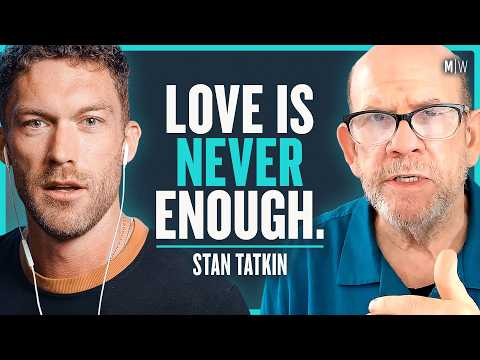
[@ChrisWillx] Why Your Brain Turns Your Partner Into An Enemy - Stan Tatkin
![[@ChrisWillx] Summarizer](https://summaries.pages.dev/img/logo.webp)
Link: https://youtu.be/NzNI5B-E-74
Duration: 69 min
Transcript: Download plain text
Short Summary
In this Modern Wisdom podcast episode, host Chris interviews Stan Tatkin, founder of the PACT Institute and developer of the Psychobiological Approach to Couple Therapy, about why long-term romantic relationships fail without deliberate design. Tatkin argues couples need an explicit social contract, quick threat repair within 30 minutes, shared purpose, and ongoing curiosity to survive evolutionary mismatches and neurobiological threat memories. The conversation covers attachment biology, secure functioning, true incompatibility, and practical rules like never arguing via text.
Key Quotes
- "It's the I can't quit you biology. We confuse it for love." (00:02:20)
- "Only purpose that's based on a selfish reason will carry the day because we're too uh unreliable as a species. Um our species is uh notably historically moody and fickle and impulsive and uh unpredictable, sometimes opportunistic, warlike, uh xenophobic, um easily influenced by groups and other people." (00:04:55)
- "Attachment is is nature's glue. It keeps us sticky. It keeps us together." (00:49:56)
- "If you're arguing about memory, you're you're engaged in something where you're both wrong." (00:42:03)
- "Curiosity is the flame. Curiosity is the dopamine. Curiosity is the strangeness that goes, you know, you're novel even though I think you're familiar." (00:54:52)
Detailed Summary
Guest Background and Credentials
Stan Tatkin appears as the featured guest on the Modern Wisdom podcast, hosted by Chris, where the discussion centers on why long-term romantic relationships fail without deliberate design and psychological sophistication. Tatkin is identified as the founder of the PACT Institute, located at thepactinstitute.com, which delivers couple workshops, retreats, and clinician trainings worldwide.
- Tatkin developed a new product called Win-Win Couple, described as the first filming dedicated to how couples collaborate under stress.
- He is credited with developing the Psychobiological Approach to Couple Therapy (PACT), the framework underpinning the episode's recommendations.
- His clinical work spans couples together for as little as 3 years and as long as 30 years, many burdened by accumulated resentments.
Core Philosophy: Relationships Must Be Designed
Tatkin's central claim is that romantic relationships cannot be left to chance, mood, or feeling, because the human nervous system was not built for decades-long pair bonds and is prone to threat-driven memory errors. He frames adult romantic attachment as dyadic pair-bonding between human primates in herds, the earliest survival-based relationship humans evolved.
- Tatkin describes his worldview as "earned love" rather than "love by design," achieved by hacking the brain and neuroendocrine system rather than trusting it.
- He argues all relationships are "made up" inventions that must be deliberately engineered from the ground up to account for change over time.
- Long-term relationships between adults of equal power require a shared purpose and vision ("ride or die" commitments not based on fluctuating feelings).
- Without this design, Tatkin contends, couples default to threat-driven interactions that erode the bond over years.
The Social Contract Problem
Tatkin opens his argument by contrasting romantic relationships with every other high-stakes human system, noting that almost no one enters marriage with the same preparation they would bring to a professional role. He points out that couples walk into relationships unprepared, without predicting what could go wrong, unlike fields such as police work, the military, medicine, science, and business.
- Couples constitute the only voluntary system of free individuals of equal power and authority, and without an agreed social contract, Tatkin argues they will not last.
- He insists couples must explicitly define their highest priority (each other, self, or religion), because all governance is predicated on that hierarchy.
- Deal breakers — such as wanting children versus not, or monogamy versus polyamory — must be agreed upon ahead of time, with Tatkin citing the 10 Commandments and Old Testament as early examples of social contracts.
- He frames this as a governance issue: voluntary systems without rules collapse under the weight of competing interests.
Memory, Threat, and the Brain
The neurobiological core of the conversation focuses on why couples accumulate damage even when they intellectually want to stay together. Tatkin explains that most daily behavior is automatic and memory-run, with critical thinking reserved for novelty and work tasks.
- Negative experiences are favored in memory because of the survival instinct, which sits at the top of subcortical drive.
- The threat response does not differentiate between severe threats (a gun) and minor slights (a judgmental look), producing the same defensive reaction in both cases.
- Each repeated threatening experience increases the array of threat cues scanned for via pattern recognition, a snowball effect that sensitizes the system over time.
- An evolutionary mismatch is identified: humans historically died at 15–30 and pair-bonded for about 4 years, meaning the nervous system was not designed for modern long-term relationships.
- Citing Robert Sapolsky, Tatkin notes that even small amounts of glucocorticoids coursing through veins can cause a person to stop caring about a partner's interests.
- He cites a 100% chance of accruing threat memory through missteps if couples lack skill in minimizing threat under stress.
Secure Functioning Principles
Tatkin introduces "secure functioning" as the operational replacement for attachment-style language, defined by what couples do under stress rather than how they feel. The formula for secure functioning is taking care of oneself and one's partner simultaneously under stress; if either party fails, the other becomes perceived as an adversary.
- Humans in close proximity are psychobiologically wired to pick up social-emotional cues from a partner faster than from their own bodies, priming them for interactive regulation (coregulation).
- The two greatest causes of sustained anger are identified as injustice and helplessness, and Tatkin asserts that any voluntary equal relationship that is too unfair cannot last.
- Insecure functioning, by contrast, treats the relationship as "good to be king," getting things at the partner's cost.
- He contrasts secure and insecure functioning as a choice of operating system rather than a personality trait.
Repair and Apology Mechanics
Repair is positioned as the single most important practical skill for couples, because time converts minor breaches into permanent threat memories. Tatkin's prescription is quick repair within 30 minutes, the primary remedy to keep harmful memories from consolidating into long-term storage.
- Unresolved breaches cause cortisol stress, which Tatkin claims leads people to "die sooner."
- Effective apologies must be offered without equivocation, qualification, or explanation, and must apologize for what the other person thinks happened, not what you think happened.
- The minimum sufficient repair, in his view, is something like "I hate you right now, but we're okay" — enough to signal safety without demanding resolution.
- Tatkin shares a personal rule with his wife: they can go to bed angry but must at least touch toes, ensuring physical contact survives the conflict.
Communication Under Stress
Tatkin argues that stressed brains are unreliable narrators, making the medium of communication critical. Under stress, perception becomes a "funhouse mirror", with the error rate in appraising a partner going "sky high."
- He states that couples should never conduct relationship discussions over text, limiting text-mediated communication to emoticons, "I love you," or "what time's dinner?"
- He argues it is impossible for a stressed couple to talk about more than one topic without fighting, or to have an emotional conversation while one partner is driving.
- These rules are framed as biological constraints, not preferences — the medium dictates the accuracy of perception.
Compatibility vs. Incompatibility
Tatkin draws a sharp line between real incompatibility and the smaller differences couples often mistake for deal breakers. True incompatibility is defined as pointing in two different directions on "big ticket items" — such as full transparency versus privacy and secrets — that cannot be reconciled through honest persuasion.
- Differences in sex drive or hobbies (for example, one partner liking tennis) do not constitute meaningful incompatibility, because interests change over time and couples can build mutual interests.
- He warns against treating nuisance-level differences as fatal flaws, which can prematurely end otherwise workable relationships.
Attachment, Curiosity, and Long-Term Love
The episode closes on mechanisms for sustaining romantic love over decades, framing attachment as biology that keeps partners together whether or not the relationship is functional. Attachment is described as "nature's glue" — a survival-based biology that keeps partners stuck together even in abusive relationships, where separation feels "like death."
- Sacrificing one's needs is initially noble but can be "hijacked," producing couples who stay together for decades without enjoying each other.
- Tatkin qualifies attachment as having an addictive component but clarifies it is "not truly" addiction.
- Behavior lags behind feelings, making it hard to fall in love again every day; curiosity is described as "the flame" and the dopamine-driver of novelty.
- Awareness that a partner could die at any moment is offered as an antidote to taking the relationship for granted.
- Energy conservation drives humans to ignore familiar stimuli, so rituals must be built in to keep romantic behavior alive over time.
Notable Examples and Illustrations
Throughout the conversation, Tatkin grounds abstract principles in concrete cases drawn from his clinical work, family, and public life. He illustrates household norms using his 14-year-old daughter, telling her she can be angry but cannot destroy the household atmosphere — applying couple-theory principles to parent-child dynamics.
- He shares a personal anecdote about his partner Tracy: as long as they are together, "home is where we are," even in "really terrible places."
- He cites the Israel-Palestine conflict as an example of generational memory loops where people keep seeking justice at one another's cost.
- He uses a "feature and bug" framework: every trait has contexts where it is useful and harmful — for instance, OCD is desirable in surgeons, pilots, and accountants but problematic in a spouse.
- He uses tennis preference as a worked example of a non-issue often mistaken for incompatibility, arguing such interests can be incorporated or grown into mutual activities rather than treated as a breaking point.