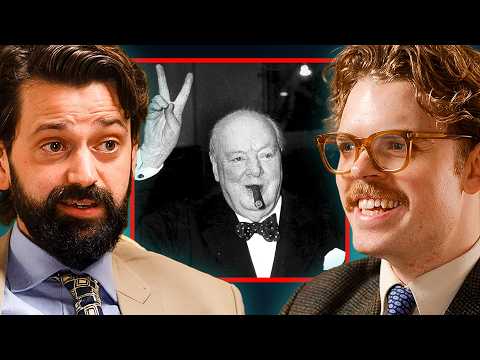
[@ChrisWillx] Would Churchill Succeed in Modern Politics? - Fin Taylor & Horatio Gould
· 4 min read
![[@ChrisWillx] Summarizer](https://summaries.pages.dev/img/logo.webp)
Link: https://youtu.be/5VCKh5oxBCQ
Short Summary
This YouTube video segment explores the allure of historical figures like Churchill, questioning whether their charisma and controversial behaviors would translate to modern politics. The discussion then veers into the concerning rise of pro-Hitler content and communities online, highlighting how niche ideologies can gain traction in fragmented digital spaces.
Key Quotes
Here are four quotes extracted from the YouTube transcript:
- "Hitler invented that really."
- "The idea that you've been lied to is thrilling for a lot of people. Very seductive."
- "...niches are getting bigger...because the echo chambers actually start to grow..."
- "...it's more that if the market digitally is everyone then a niche of that market at the center is a massive amount of people it's enough to hold a community together."
Detailed Summary
Okay, here's a detailed summary of the YouTube video transcript, broken down into bullet points:
Key Topics:
- Winston Churchill and Modern Politics:
- Discussion of how Churchill's charismatic, "day drinking," speech-giving style would be received in today's world.
- Questioning if such behavior would still be considered acceptable or effective.
- The Decline of Political Charisma and Trust:
- Argument that political charisma has diminished due to a lack of public trust in politicians.
- Critique of electing politicians based on appearance rather than substance.
- Comparison of "statesmanship" to more modern, less traditional political styles like those of Trump and Farage.
- Historical Context and Political Leadership:
- Exploration of whether a country's success is linked to the charisma and effectiveness of its politicians.
- Referencing the Victorian era as a period of British dominance and seemingly charismatic political leaders.
- Churchill's Productivity and Drinking Habits:
- Awe at Churchill's ability to maintain high productivity despite heavy drinking.
- Comparison to modern health-conscious attitudes and reduced alcohol consumption.
- World War II as a Cultural Touchstone:
- Why World War II is fascinating to many, particularly white men in their 30s.
- Characterizing it as a significant event in history, akin to a "season finale" or a turning point (hourglass/pyramid analogy).
- It happened recently enough to be well-documented, but long ago enough to research.
- The clarity of good vs. evil, iconic villains, and aesthetic influence on culture (e.g., Star Wars) are also appealing.
- The Rise of Pro-Hitler Sentiment Online:
- Shock at the emergence of a pro-Hitler community online.
- Observation that this sentiment extends beyond irony and includes genuine support.
- Examples given include translations of Hitler's speeches and comments suggesting apologies are owed to Germany.
- Possible repackaging of anti-Semitism.
- Documentaries and other content portraying Hitler as a "misunderstood artist" or a man who changed the world.
- Suggestion that the defined "evil" of Hitler sparks rebellious interest.
- Hitler, Charlie Chaplin, and The Great Dictator
- Hitler was a fan of Charlie Chaplin.
- Hitler was sent a copy of The Great Dictator and heartbroken by the parody.
- The Fragmentation of Digital Niches
- How niches, previously considered fringe, now hold greater cultural weight in the digital space.
- Function Health Advertisement:
- Sponsor message promoting Function Health's comprehensive blood testing service.
Arguments:
- Political charisma is linked to public trust and may be declining.
- Churchill's behavior would be viewed differently in modern society.
- World War II continues to fascinate because of its defined good vs. evil and its historical significance.
- The internet is enabling the rise of pro-Hitler sentiment and the spread of fringe ideologies.
- The Holocaust was more than a "middle finger".
Information:
- Mention of political figures: Churchill, Trump, Farage, Vance.
- Reference to the Victorian era.
- Discussion of Churchill's drinking habits and champagne preferences.
- Analogies comparing history to an hourglass and a pyramid leading up to World War II.
- Allusions to Star Wars as culturally influenced by WWII.
- Descriptions of pro-Hitler content found online.
- Reference to Charlie Chaplin and his film, The Great Dictator.
- Function Health's services and pricing.