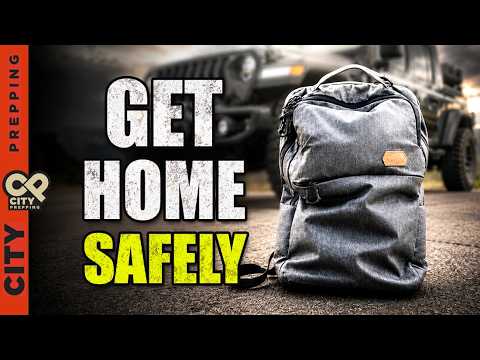
[@CityPrepping] How to Build a Get Home Bag 2026
· 6 min read
![[@CityPrepping] Summarizer](https://summaries.pages.dev/img/logo.webp)
Link: https://youtu.be/uXKbI96_i98
Duration: 24 min
Transcript: Download plain text
Short Summary
Host Chris, a Southern California–based prepper, walks listeners through how to build a get home bag optimized for an average 15–20 mile walk home. He emphasizes mobility over survival, weight discipline, and climate-specific items like sun protection, and covers water, food, footwear, navigation, medical, communication, self-protection, and weather gear. He wraps up with a recommended training protocol of progressively longer walks to test and trim the kit.
Key Quotes
- "A get home bag, on the other hand, it has one job, get you home quickly. And that means every pound matters." (00:02:00)
- "Every item that I'm going to go over in this bag, it has to earn its place." (00:02:17)
- "I would avoid attempting to carry enough water to get home. Each gallon of water weighs 8 lbs." (00:06:51)
- "I have friends that are law enforcement, and I don't know how many times I've heard them explain just pay attention to what's going on around you. That's 90% of avoiding a situation you don't want to be in." (00:18:12)
- "And if you remember anything about this bag, it's this. The purpose of a get home bag is mobility. Every item has to earn its place." (00:23:52)
Detailed Summary
Get Home Bag Build with Chris (Southern California Prepper)
Core Concept
- A get home bag has one job: get you home quickly, unlike a bugout bag designed for multi-day evacuation.
- The average U.S. one-way commute is 15–16 miles, and Chris plans his travel framework around covering 15–20 miles in a day.
- Walking 20–30 miles means every pound matters, so every item must significantly improve his chances of getting home safely or it doesn't go in the bag.
Water Strategy
- Each gallon of water weighs 8 lbs, so he carries only enough to reach the next water source, not all the way home.
- He prefers stainless steel containers over plastic to avoid microplastics released when plastic heats up, and notes a stainless steel canteen can be boiled over a fire.
- A 1 gallon plastic water jug is staged in the back of his car for emergencies.
- A new lightweight water key from "Urban Prepper" is used to access industrial water spigots on building sides.
- Kit includes a mini Sawyer filter (bag, filter, flush syringe) in a Ziploc, plus water purification tablets.
Food
- A 3,600-calorie ration bar designed for long-term hot-climate storage is shown, and Chris eats some before heading out.
- Bag staples include trail mix, beef jerky, and peanut butter pouches, rotated at least once per quarter (especially in hot weather).
- Cliff energy chews provide 50 mg of caffeine as a simple-carb pick-me-up.
Clothing & Footwear
- Sun protection is critical in Southern California: hat with neck cover, neck gator, SPF long-sleeve shirt, and sunscreen; winter adds a light jacket, beanie, or light rain jacket.
- Footwear is broken-in walking shoes (not hiking shoes, given suburban/urban sprawl), merino wool hiking socks, and Dr. Scholl's insoles.
- A staged trunk box holds a knee brace (for a left knee injury), neck gator, hat, hiking pants, SPF shirt, poncho, extra water bladder, survival tarp, sunscreen, and foot powder.
Navigation
- Carry a compass and a map; AAA sells local maps, and a state map (e.g., California) is recommended for trips an hour or more away.
- Free apps like Google Maps and Gaia Map can be pre-downloaded as offline maps for regular routes.
Power & Light
- A 28-watt portable solar panel recharges a phone and battery bank on multi-day hikes (first item cut to save weight).
- A USB-C rechargeable headlamp with red light is preferred because red light doesn't draw attention at night.
- A 25–26-year-old Leatherman Wave multi-tool is a long-trusted item, though weighty.
Medical & Emergency Tools
- A tourniquet is stored in a top pocket for quick access, especially important because firearms are also carried.
- Medical kit includes band-aids, antiseptic, moleskin, blister kits, gloves, and an N95 mask for wildfire smoke.
- A Bick lighter is wrapped in duct/Gorilla tape as a fire starter.
Communication
- Chris relies on the newest iPhone with satellite texting for his urban/suburban area.
- The Garmin mini InReach is recommended as an alternative where satellite texting isn't available.
- Ham radios stay in his vehicle (he has a license) and remain useful because cell towers often have backup power after disasters.
Self-Protection
- Situational awareness is paramount; law enforcement friends cite paying attention as 90% of avoiding unwanted situations.
- He recommends avoiding crowds and traveling during daylight when walking home.
- Pepper spray is sealed in a Ziploc to prevent accidental discharge from ruining bag contents.
- Chris holds a CCW license and carries a firearm on his person (not locked in the vehicle), noting firearm carry is a personal decision requiring training and attention to state laws.
Weather Protection
- On standby outside the bag: a tarp and large rain poncho.
- Inside the bag: a sleep bivvie (designed to keep you alive, not necessarily warm), a small rain poncho (chosen over a larger one to save weight), and a contractor-grade garbage bag that can be cut into a makeshift poncho or shelter.
Everyday Carry
- Always on his person: cell phone, wallet with AirTag, keys, phone battery charger, Benchmade Bugout pocket knife, firearm, and flashlight.
- AirTags are kept on both wallet and bag so lost items can be tracked via nearby iPhones, which has helped him several times.
- Citing FBI stats, 70–75% of firearm engagements occur in dark nighttime environments, so he keeps a flashlight in his left pocket to keep his right hand free to access a firearm on his hip.
Training Protocol
- Walk down the street first, then progress to a couple of miles, then five, then ten miles to identify which items earn their place versus which are excess weight.