[@ChrisWillx] Plague Outbreak Day 1: "A Lab Explodes In Russia" - Annie Jacobsen
![[@ChrisWillx] Summarizer](https://summaries.pages.dev/img/logo.webp)
Link: https://youtu.be/LaSq6lvf_wM
Duration: 11 min
Transcript: Download plain text
Short Summary
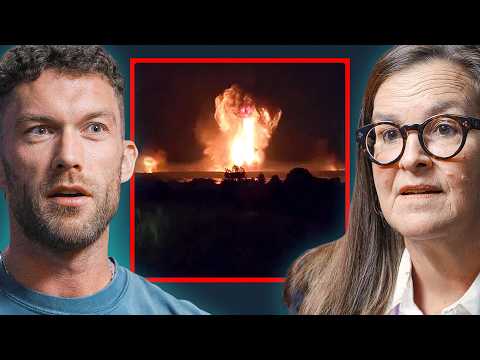
The episode features a guest walking through a day-one war-game scenario centered on an explosion at Vector Lab in Russia that triggers the release of a genetically modified pneumonic plague pathogen. The discussion covers Vector Lab's Soviet bioweapons history, the U.S. intelligence apparatus (NSA, NRO, MASINT sensors) used to monitor the facility, and the critical 12-to-36-hour containment window experts say is required to avert a pandemic.
Key Quotes
- "every sort of expert in any of those agencies told me was Annie if you can stop something with 12 to 24 hours 12 24 to 36 hours if you can stop it in his tracks you can prevent a pandemic but of course because biological weapons are illegal no one wants to admit they have biological weapons in their freezers and so" (00:02:05)
- "forgot to change the air filter and it got out and it killed a hundred people in the town" (00:03:14)
- "A wicked problem in defense department nomenclature is a problem that only creates more problems with its solution. And by the time you deploy the air quote solution, new problems have been created." (00:06:05)
- "And then you have a really interesting um collection component called mason which is measurement and signal signature intelligence and it's sniffing." (00:07:20)
- "A pathogen is a germ that will kill you. Germs are germs. We all have germs. We germs in our guts. But a pathogen is a dangerous, deadly germ. Potentially potentially virus. Bacteria. Plague is bacteria, not virus." (00:09:43)
Detailed Summary
Episode Overview
A guest-authored war-game scenario is presented in interview form, using a hypothetical explosion at Russia's Vector Lab as the catalyst for a biological incident that could escalate into a pandemic if not contained within roughly 12 to 36 hours.
Vector Lab and the Scenario Setup
- The scenario begins with an explosion at Vector Lab in Russia, deliberately chosen because a similar explosion actually occurred at the facility in 2019.
- Vector Lab is described as a BSL4 facility where the majority of the Soviet bioweapons program was conducted during the Cold War.
- It is located in the science city of Koltsovo, about 8 miles from Novosibirsk, Siberia; Novosibirsk is Russia's third-largest city after Moscow and St. Petersburg with a population of 1.6 million.
- Unlike the real 2019 event, the scenario envisions a release of a genetically modified pneumonic plague pathogen.
Containment Timing and Historical Precedent
- Experts told the guest that containing an outbreak within 12 to 24 hours (or 24 to 36 hours) could prevent a pandemic.
- In 1979 in Sverdlovsk, Russia, an engineer milling anthrax into powder forgot to change an air filter, causing an escape that killed about 100 people; the Soviets denied the incident for decades, blaming contaminated meat.
U.S. Intelligence Monitoring Apparatus
- The U.S. maintains geosynchronous satellites monitoring Vector Lab specifically because the facility sits only a few miles from an ICBM installation in Novosibirsk, so the Department of Defense says it would instantly detect an explosion there.
- The guest characterizes such biothreat scenarios as a "wicked problem" in Defense Department nomenclature, defined as a problem whose solution only creates additional new problems.
- U.S. collection involves NSA for SIGINT, the National Reconnaissance Office (NRO) for satellite imagery, and MASINT (Measurement and Signature Intelligence) sensors covertly placed in sewers, walls, signs, drones, vehicles, or sprinkler systems to detect chemical or biological signatures.
- Chemical-sniffing sensors mounted on drones, vehicles, or sprinkler systems are monitored for signature changes tied to chemicals Russia would deploy to mitigate an aerosol release, such as industrial ammonia versions comparable to household ammonia or rubbing alcohol used on pathogen spills.
Authoritarian Response and Outbreak Investigation
- During COVID, trucks were observed in Iran driving down streets spraying an unknown chemical with government personnel, a response the guest notes is possible in a totalitarian country but not in a city like Austin, Texas.
- A billion-dollar industry would be mobilized to determine whether a lab leak occurred, whether people are dying, and how and why it happened.
- The first task is identifying the pathogen and whether it is a virus or a bacterium, a distinction the guest says most people do not know; plague is caused by bacteria, not a virus.
- A pathogen is defined as a dangerous, deadly germ, distinguished from ordinary germs humans normally carry.