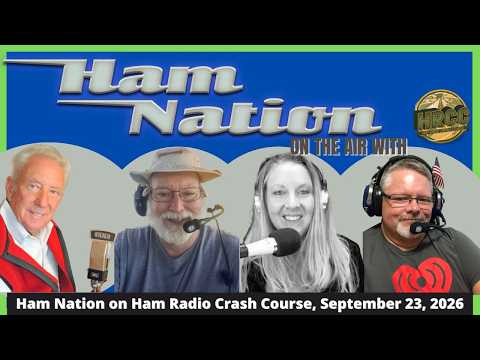
[@HamRadioCrashCourse] Ham Nation #632: HamCation Awards & Giving Away An ICOM ID-50A!
Link: https://youtu.be/i66rBI3SjNk
Duration: 94 min
Transcript: Download plain text
Short Summary
Ham Nation 632 aired September 23, 2026 with hosts Don, Gordo, Amanda, Randy, and guest Michael Collie (W4RL) covering Powerpole connector tips, the upcoming Hamation 2027 in Orlando, ISS SSTV, space weather, and Randy's ChatGPT-assisted ESP32 GPS tracker project. The wide-ranging episode also included Newsline Report 2551, the September Icom ID-50A giveaway winners, emergency-preparedness discussion, and a roundtable where panelists shared memories of their first radios and a vintage QSL-card book spanning the 1940s through the 1970s.
Key Quotes
- "The big problem is if it pulls right out on the black lead and you don't realize it or it's not making a good connection, your red lead is going to 12 volts positive, but it doesn't see the battery, but it looks at your new radio, your new ICOM transceiver, and it says, "Oh, wait a minute. I can get to uh 12 volts by going through the antenna outer braid coax and that goes to and you got the idea and you're drawing a lot of current on a circuit that should not be there." (00:10:20)
- "nominations are actually open until November 1st. Uh so please go uh sign up somebody you know for one of the three awards." (00:27:07)
- "Emergency communications were activated and expected to stay in place in Indonesia through to the 24th of September following eruptions at an NORATO earlier in the month." (00:31:43)
- "Archaeologists believe the wheel had not even been invented yet when the sanctuary known as Kahonepe was carved into the bedrock almost 12,000 years ago in what is now the Turkish province of Shaoler. Special event station TC8 KHT will be the first ham radio activation at the site since its creation around 9,400 BC." (00:34:01)
- "Buying a bow fang does not make you set." (02:04:05)
Detailed Summary
Ham Nation Episode 632 — September 23, 2026: Detailed Summary
Show Opening and Hosts
Ham Nation episode 632 aired September 23, 2026, with hosts Don, Gordo, Amanda, Randy, and later guest Michael Collie (W4RL) joining via Skype alongside Josh. The episode was a wide-ranging weekly discussion covering connector troubleshooting, an upcoming hamfest, space weather, satellite events, and a hands-on GPS tracking project.
- Gordo reported he is in Southern California preparing for a possible hurricane brush in a few days, with local news reporting higher chances than expected.
- Don noted the Atlantic hurricane season has been uncommonly light, with roughly only one tropical storm that eventually made landfall in Texas.
- Amanda mentioned Don's birthday is Friday and his sister was born 48 hours later (the 27th), and that she has three laptops currently updating ahead of a VE session on Friday.
- Amanda reported Don had a birthday package waiting at the post office for him to pick up.
Powerpole Connectors Segment (Gordo and Randy)
Gordo introduced Powerpole connectors, the standard for many DC power installations, and noted that many solar/battery setups work fine for 6–8 months before developing problems. Randy contributed technical details on crimping, polarity, and tool selection.
- Powerpole ratings of 15, 30, and 45 amps are commonly available; Gordo prefers the 30 amp version for typical loads of 10–15 amps, sometimes reaching 20 amps.
- A properly crimped Powerpole on ~14 gauge wire leaves a small intentional divot from being squeezed tightly; solder should flow back through the insulation, but solder on the silver connector face prevents the audible "click" of proper seating.
- A properly installed Powerpole should not pull out of its housing when the wire is tugged — if it does, the crimp was inadequate.
- Randy's polarity mnemonic: viewed from the rear, red is on the right with the blade going down; from the front, read the letter "A" — red on right.
- Cheap overseas Powerpole copies tend to fracture under pressure and have broken springs; reputable (likely USA-made) connectors are recommended.
- A loose black (negative) lead on a new ICOM transceiver can cause the radio to seek its 12V return through the antenna's outer coax braid, drawing heavy current on an unintended path; the same effect in modern vehicles with no chassis ground reduces transmitter power output.
- Solar example: a good panel read 3A at ~12V initially, dropped to 2A at 12.8V the next day, then showed 18V — indicating a poor connection reading panel voltage instead of battery voltage.
- Outdoor contacts develop corrosion and should be unplugged/replugged roughly every week and buffed shiny with a nail file or sandpaper; gold-plated contacts (similar to gold-plated PL-259s) were suggested as a corrosion-resistant improvement.
- Near saltwater, silver contacts build resistance quickly; Deoxit or dielectric compound is recommended.
- Randy built a Powerpole polarity checker using a red/green LED and a ~470K current-limiting resistor inside heat shrink.
- Recommended tools include a Harbor Freight straight pick set (under $2) for seating small-gauge wires and prying up the hook end to remove wires, plus a jeweler's screwdriver (though it risks slipping and stabbing a finger).
- Gordo demonstrated a DIY voltmeter module built into an Altoids tin, similar to commercial units sold at Hamfest for a few dollars.
Hamation 2027 and Awards (Guest Michael Collie, W4RL)
Michael Collie (W4RL) joined to discuss Hamation 2027, scheduled for February 12–14, 2027 in Orlando, Florida (Valentine's Day weekend), which will be the 80th actual show in the event's 81-year history after one COVID cancellation. The theme is "80 years of connecting generations of ham radio operators."
- The inaugural banquet last year drew nearly 120 attendees and will be held again in 2027.
- The show accommodates 200+ RVs with hookups, an indoor swap area with 250+ tables, 300+ outdoor tailgaters, and 40+ forums over two days.
- Three annual awards are presented: Carol Perry Educator of the Year, Gordon West Ham Ambassador of the Year, and the Amateur Radio Hero Award.
- Nominations are open via the website's award-specific forms through approximately November 1st; the awards committee follows up with submissions afterward.
- The Amateur Radio Hero Award recognizes hams who assist public safety during disasters; the inaugural 2026 award went to Ambrose, a ham in India.
- Amanda noted the chat room refers to Gordon West as "the granddaddy Elmer," reflecting his decades-long role as an amateur radio mentor.
Icom Ad and September Giveaways
Icom's mid-show advertisement highlighted several current products, followed by announcement of the September handheld giveaway winners.
- Icom products featured included the IC-75, IC-7760 HF/50 MHz transceiver, IC-PW2 1kW HF/50 MHz linear amplifier, RC-7760 remote controller, IC-7300, and IC-9700 VHF/UHF/1.2 GHz transceiver.
- Up to five RC-7760 remote controllers can be registered to an RF deck, though only one is active at a time.
- The September giveaway ID-50A handheld was won by David C. (NI7RO).
- Swag pack winners were Cody B. (K3KLB), Mark O. (N7WHW), and Jerry R. (KJ5JHM).
Amateur Radio Newsline Report 2551
The week's news highlights covered international emergency activations, a 50th anniversary celebration, and an unusual special event station.
- Indonesian hams (ORARI) activated emergency communications nets in response to volcanic eruptions, expected to remain active through September 24th.
- ORARI cleared 7.110 MHz (phone) and 7.100 MHz (JS8), plus Lapan A2 satellite uplinks/downlinks of 145.880 MHz and 435.880 MHz.
- YB1BTM, chairman of IARU Region 3's disaster communications committee, asked amateurs to keep those frequencies clear.
- The Gibraltar Amateur Radio Society is celebrating its 50th anniversary alongside 8 years of licensing in the British Overseas Territory under the ZB2 prefix (originally issued to the RAF Amateur Radio Club).
- A one-week May special event used call sign ZB2FTY; the Gibraltar Philatelic Bureau will issue a 50p commemorative coin and four postage stamps on or about November 20th.
- Special event station TC8KHT activated the ~12,000-year-old Karahone sanctuary in Şanlıurfa Province, Turkey on September 18–20 (grid KM97PC), using CW, SSB, FT8, FT4, and QO-100; any single contact qualifies for the free Karahone Heritage Award.
Space Weather with Dr. Tamitha Skov (WX6SW)
Dr. Tamitha Skov delivered the weekly space weather outlook, covering solar activity, flare probabilities, and aurora forecasts for the upcoming week.
- The sun was spotless on the 19th, then produced three new sunspots on the 20th, including region 4532; flare activity is rising as a coronal hole rotates into Earth view.
- Farside region 4530 is firing large solar storms (seen by STEREO-A) and will rotate into Earth view in about 1–1.5 weeks, offering operators a temporary reprieve.
- Solar Orbiter is not positioned to view the far side from the east limb, so observers rely on JOVIAL/HMI helioseismology for farside imaging.
- The current coronal hole is better formed than on its last rotation and may deliver slightly faster solar wind.
- High-latitude aurora photographers could see up to ~10% chance of minor storming around the 23rd; on the 24th, areas around 55°+ latitude could see up to ~20% chance of minor geomagnetic storming.
- Mid-latitudes will likely remain unsettled through the 23rd and possibly active by the 24th, with about a 10% chance of minor storming if the stream is stronger than expected.
- Aurora is unlikely south of Toronto due to light pollution and the upcoming full moon.
- Solar flux is in the triple digits and expected to climb as new regions rotate in.
- About a 5% chance of M-class flares (R1–R2 radio blackout); essentially no chance of X-class.
- Radiation outlook is in the green (D1 normal, S0 quiet).
ISS SSTV Event — Series 33
The hosts previewed the upcoming Slow Scan TV event from the International Space Station, including frequency, schedule, and Doppler correction guidance.
- Series 33 begins Friday, September 23, 2026 around 2:00 AM West Coast time and runs for five days, transmitting on 437.550 MHz (70 cm) using Robot 36 mode (36-second picture plus 2-minute rest) — a change from the usual 2 m band.
- Doppler correction requires tuning in 5 kHz steps: +10 kHz on horizon approach, +5 kHz, 0 overhead, then -5 kHz and -10 kHz as the satellite passes away.
- Submitting at least one image to the Aries group's website earns a certificate after the event.
Randy's ESP32 GPS Tracker Project
Randy walked through his standalone GPS tracker project, built for an upcoming cruise with ChatGPT acting as a co-developer starting from his initial user requirements.
- Specs include an ESP32-S3 with native USB support and a 3.5–4.3 inch color display, u-blox M10 GNSS receiver, removable SD card, USB connection, rechargeable power bank, and buttons or touchscreen.
- Logged data includes date/time, latitude, longitude, speed, and battery level; the device appears as a USB mass storage device when plugged into a PC, with files compatible with Google Maps/Google Earth.
- Randy had limited Arduino IDE experience (a couple of simple Nano projects several years ago); setup involved installing libraries (e.g., GFX), choosing board type/baud rate, with the AI providing a step-by-step walkthrough.
- ChatGPT repeatedly warned not to connect 5V to the GPS module (use 3.3V); it initially misread a wiring photo but corrected itself after a clearer image was provided.
- The Waveshare display powered up with a factory test screen; the GPS initially gave a "very strong valid fix."
- Display seconds skipped (e.g., 17, 18, 19, 20, 22, 22, 24, 25) due to I²C bus timing; after ~8 iterations and uploading a ~45-second video for AI frame-by-frame analysis, ChatGPT recommended switching from I²C to GPS serial data directly.
- At 10-second logging intervals, points are ~51 m apart at 10 knots (~103 m at 20 knots), about 8,640 records (~1 MB) per day.
- Sketch compilation took ~3 minutes; Randy estimated roughly 6 hours of total work for setup, display, GPS, and SD logging.
- To prevent SD corruption on laptop removal, Randy asked AI to set up the module's Wi-Fi as an access point serving a file directory web page (disabled by default, toggled briefly per a ham buddy's suggestion from Grass Valley).
- Latest uploaded file (version 4) covered a 5-hour 36-minute window with 2020 records at exact 10-second intervals, zero missing/duplicate timestamps; typical GPS age ~1 second.
- Indoor GPS puck antenna saw 14–25 satellites (median 19) with positional accuracy of 1–2.7 m (median 1.4 m).
- Approximate component costs: board ~$50, GPS module ~$25, ESP32 display ~$10 or less.
Antenna Plans with Josh
Randy outlined a comparative antenna test plan to be analyzed by ChatGPT after deployment.
- Randy plans to run three antennas on the TinyGS and have ChatGPT analyze the log differences: a UHF Moxon running outside, a beam pointed fixed at 45° north, and an Eggbeater antenna ordered from Halibit Electronics.
Emergency Preparedness and First-Radio Roundtable
The hosts and guest Michael Collie discussed emergency communications preparedness, the history of call-sign lookups, and shared memories of their first amateur radios.
- Amateur radio quality of life improved significantly with real-time internet call-sign lookups; earlier hams used printed call books and even visited FCC buildings in person for exams.
- A stack of 1930s–40s QSL cards showed two hams spent weeks exchanging postal mail to coordinate schedules and bands before making contact.
- Recommended monitoring bands for emergency preparedness: AM, FM, shortwave, CB, ham, and GMRS; a shortwave receiver with a telescoping antenna is a good starting point.
- Owning a radio without education and a proper antenna is inadequate — batteries will die and the radio will be unusable.
- A shortwave radio receiver is a recommended fallback if global internet becomes unavailable.
- Gordo's first radio was an Icom IC-2AT (modifiable for the marine band).
- Donnie's first was a Radio Shack HTX202 in 1995 at age 35, where he found Amateur Radio News Line.
- Michael's first was a Ranger 2950 (10/11 meters) at age 16 from AES in Orlando.
- Randy's first was a Heathkit DX20/DX40 from a radio club auction (replacement transformer ~$5–$6), used as a crystal-controlled novice radio in 1968.
- Josh's first was a Yaesu FT-60 from HRO Anaheim at age 23–24, after first meeting Bob.
- Jeff's first was a Poxing 2-meter radio (a brand predating Baofeng) for $99; he and Amanda lived in a 400 sq ft apartment paying $425 rent at the time.
- In PSK31/RTTY/VarAC, uppercase letters use longer bit patterns than common lowercase characters, so typing in caps measurably slows transmission.
- An AI-generated image based on a screenshot of the host circulated online; the hand visibly sticks out of the orange as a giveaway.
Vintage QSL Cards Book Discussion
A featured book contained a chronological collection of QSL cards from a single operator's estate, demonstrating how ham radio activity correlated with mid-20th-century world events.
- The book catalogs QSL cards from a single estate spanning the 1940s through the 1960s/70s, organized chronologically.
- The book's author did not know about ham radio but purchased a large box of QSL cards at a flea market because they looked neat.
- The book correlated the operator's QSL contacts with world events of the era, revealing that contacts clustered to regions where significant world events were unfolding.
License Class Growth and Ham Radio Interest Trends
The Rio Hondo Amateur Radio Club's recent license class growth illustrated the fluctuating nature of interest in the hobby.
- The Rio Hondo Amateur Radio Club's first license class had ~5 people; the second class grew to ~80 people, requiring the club to organize multiple cadres to handle instruction.
- Interest in ham radio fluctuates like a roller coaster, with world and national politics playing a significant role in driving those fluctuations.
Jeff's Elk Hunt and Portable Operation in Colorado
Jeff shared a recent personal milestone that combined outdoor adventure with portable ham radio operation.
- Jeff successfully harvested his first elk ever using a black powder muzzleloader after a few days of hunting.
- Following the hunt, the group camped and operated portable ham radio in Colorado.
Operating Updates and Acknowledgments
Several operating announcements and viewer contributions closed out the episode.
- Don indicated he would get on DMR on 14 after the show closed.
- Tom Wyky was operating around 7192 kHz on 40 meters.
- Chris contributed a super chat that was acknowledged by the host.
Show Wrap-Up and Upcoming Episode
The hosts teased the next episode and confirmed the show's return schedule.
- The next Ham Nation episode is scheduled for October 21st, the closest show to Halloween, with one host planning to dress as the "ham radio witch."
- The program will return in two weeks.
- The ARES nationwide SET exercise typically occurs the first weekend of October, with HF groups practicing traffic passing — recommended listening for emergency-preparedness-minded amateurs.