[@hubermanlab] Using AI to Increase Your Intelligence & Enrich Humanity | Dr. Fei-Fei Li
![[@hubermanlab] Summarizer](https://summaries.pages.dev/img/logo.webp)
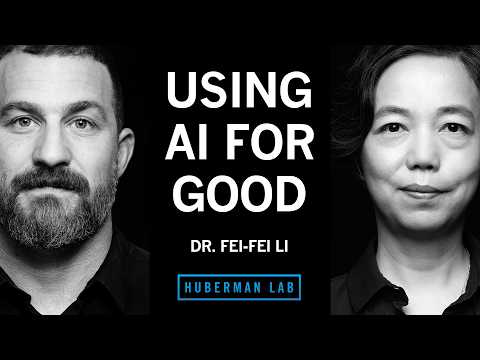
Link: https://youtu.be/N5AQFYtqx8Q
Duration: 128 min
Transcript: Download plain text
Short Summary
Dr. Fei-Fei Li, the Stanford computer scientist widely known as the "godmother of AI" and co-founder of World Labs, joins host Andrew Huberman for a wide-ranging interview on human-centered AI. The conversation covers the arc from vision-inspired neural networks through ImageNet and transformers to spatial intelligence and embodied robotics, alongside critiques of polarized AI discourse. Dr. Li advocates for collective guidance of the technology and for uplifting what she calls the "forgotten population" of teachers, parents, and students.</short><detailed>## Episode Overview This Huberman Lab episode is an interview with Dr. Fei-Fei Li, the Stanford professor and AI researcher often called the "godmother of AI" and co-founder of World Labs. The wide-ranging conversation traces AI's intellectual arc, explores the philosophy of human-centered AI design, critiques current media discourse, and focuses heavily on the impact of AI on children and educators.
AI's Arc and the Rise of Generative Models
- Dr. Li recounts the trajectory from vision-inspired neural networks through ImageNet and the rise of transformers to today's generative video and world models, marking a fundamentally different phase of computing.
- She frames language models as just one chapter, with spatial and physical intelligence as the next frontier.
World Labs and Spatial Intelligence
- World Labs was co-founded at the beginning of 2024 by Dr. Li alongside multiple co-founders drawn from the Stanford community, and she describes it as her life's work.
- The company generates 3D and 4D worlds from text, pictures, or sketches, blending real-world capture with imagined environments for creators, robot training, architecture, healthcare, education, and industry.
- The team started heavily with PhDs and is now transitioning from model-focused work to building products in entertainment, design, and robotics.
- Dr. Li met with Ben Affleck to discuss AI tools for filmmaking, and World Labs is actively working with the VFX industry to empower rather than displace creators; short movies and nearly feature-length films have already been assembled using AI tools from both US and Asian companies.
Philosophy of Human-Centered AI
- Dr. Li argues humanity should collectively decide how the future of robotics is imagined, rather than letting companies or investors dictate a world of metal-style robots.
- She proposes positive use cases such as spongy, balloon-like healthcare robots with more contours and multitasking capability than rigid metal robots, including a child-guardian robot that can alert authorities or physically protect kids on the way to school.
- She also envisions an AI avatar that accompanies children online to spot predatory behavior beyond what parents can oversee.
- She credits Steve Jobs (whom she recalls walking shoeless around downtown Palo Alto with a hippie look) with humanizing computers through rounded edges, pocket-fit size, and cultural touches like Bob Dylan on the Apple landing page.
- Host Andrew Huberman argues technologists need a modern Steve Jobs-like collaborator to soften public perception of AI, and claims media framing of AI as "coming for us" is a financial-motive trick.
Critique of AI Discourse and Media
- Dr. Li criticizes current public discourse as unbalanced, split between extreme doomerism and extreme utopianism, and calls for middle-ground collective guidance of the technology.
- She worries AI rhetoric puts the public in a reactive position while multistakeholders are excluded from designing the future together.
- She notes traditional media operates on a 12 to 24-hour news cycle and does not care about the long arc of benevolent AI collaborations.
- Huberman points out that human-interest stories, such as AI helping cure a dog's cancer or diagnosing a child's mysterious symptoms, get far less attention than hype-driven narratives.
- Stanford has launched a Human-Centered AI Institute, and many entrepreneurs are building AI startups for drug discovery, healthcare, aging, and mental health.
AI, Children, and Education
- Dr. Li identifies as an educator and technologist and frames teachers, parents, and students as the most forgotten population by policymakers, technologists, and investors.
- She has children in the 7-to-20 age range and considers how kids feel about AI a critical issue, describing kids as curious, massively entertained by the technology, and already starting to use it.
- She argues Silicon Valley is not doing teachers and parents a service; they are being lectured at, berated, and looked down upon when they should be uplifted and resourced.
- K-12 and K-16 teachers are described as bearing the most important critical burden of society.
- When ChatGPT launched in November 2022, Dr. Li emailed the principal of her child's elementary school to offer a guest lecture for students and teachers, noting that no Silicon Valley investors or multi-billion/trillion-dollar companies thought first about neighborhood teachers and parents.
- Her recommendation is to show teachers what is actually happening with AI rather than just answering questions about cheating, because teachers are smart and eager to adapt.
- She frames moments of technological change as simultaneously moments of opportunity and loss, and characterizes creators as reskilling and upskilling to use AI tools.
Outlook
- Dr. Li identifies as an optimist in humanity, arguing that across the arc of human history, society has by and large advanced for the better despite atrocities and setbacks.
- Her stance is that technology should make jobs better and superpower creativity rather than take jobs away.
Host Notes
- Huberman promotes his first book, "Protocols: An Operating Manual for the Human Body," developed over more than five years and 30 years of research, available at protocolsbook.com.
- He also mentions the free monthly Huberman Lab neural network newsletter, which includes podcast summaries and 1-3 page protocol PDFs covering sleep, dopamine, deliberate cold exposure, cardiovascular training, and resistance training.</detailed><tags><item>ai</item><item>robotics</item><item>education</item><item>world labs</item><item>fei-fei li</item><item>spatial intelligence</item><item>human-centered ai</item><item>silicon valley</item><item>kids and ai</item><item>media discourse</item></tags><notable_section_indexes><item>0</item><item>1</item></notable_section_indexes>
Key Quotes
- "Now, I'm not denying the atrocities. I'm not denying the setbacks. I'm not denying this. But fundamentally I'm a optimist in humanity. I look at kids, they're curious. Of course, they get massively entertained by this technology, but they also are starting to use it." (00:00:20)
- "which is the source of AI's data, let's be very clear what is internet. Internet is not some random thing. Internet is the biggest collection of human behavior in multimodal forms." (00:38:51)
- "In fact, as neuroscientists, if I ask you which brain area did that thought come from, you don't know, right? Is it Broa? Is it V1? Is it motor? Is it preffrontal? We don't know. Maybe it's diffused everywhere because that thought is so personalized, so special. You can call it creativity, you can call it emotion, you can call it whatever you want. You can call it cat 231 whatever name you can give it that thought is not captured therefore it's not on the internet therefore AI has not seen it" (00:40:54)
- "I think one of the most important thing Andrew that as a neuroscientist and also faculty we know is agency is so important for humanity. You know that boils down to motivation, agency and dignity at every individual level. And I think we need to recognize that we need to think about AI as a tool that helps us in our agency. It does it should not take away our agency and people who lead in today's AI should not try to talk like that this this work will take away agency from people." (00:49:00)
- "we can avoid harm. What I would not like to see is one person or or a few people coming from industry and telling everybody what to do. I think that would be dangerous because market forces are different from uh societal norms and culture and heritage are different from uh education and ethics and and these are multistakeholder problems to solve together." (02:06:56)
Detailed Summary
Episode Overview
This Huberman Lab episode is a wide-ranging interview between host Andrew Huberman and Dr. Fei-Fei Li, the Stanford computer scientist often called the "godmother of AI" and director of the Stanford Institute for Human-Centered Artificial Intelligence. The conversation traces AI's intellectual arc, critiques polarized public discourse, and emphasizes the technology's impact on children and educators.
- The episode functions as both a technical history and a philosophy-of-design conversation, moving from neural-network origins to spatial intelligence and embodied robotics.
- Dr. Li repeatedly anchors the discussion in human-centered AI, arguing that multistakeholder collaboration, not corporate or investor priorities alone, should shape the technology's trajectory.
- The interview closes with a focus on what Dr. Li calls the "forgotten population": teachers, parents, and students in K-12 and K-16 education.
Guest Background and Credentials
Dr. Fei-Fei Li is introduced as one of the most prominent figures in modern AI, with a career spanning Stanford, the ImageNet dataset, and her new venture World Labs. Her position as director of the Stanford Institute for Human-Centered Artificial Intelligence is highlighted as central to her public role.
- She is widely known by the moniker "godmother of AI," a title Huberman uses early in the conversation to frame her outsized influence on the field.
- She co-founded World Labs alongside collaborators drawn from the Stanford community, marking a shift from academic AI research to building consumer-facing spatial intelligence products.
- She identifies simultaneously as an educator and a technologist, a dual identity that shapes her insistence on prioritizing classrooms and parents over investor narratives.
AI's Arc: From Vision to Generative Models
Dr. Li traces the modern AI timeline through three major inflection points: vision-inspired neural networks, the ImageNet era, and the rise of transformers. She positions these phases as escalating chapters rather than replacements of one another.
- Vision-inspired neural networks were an early attempt to model human perception in machines, drawing on the biological inspiration of how the visual cortex processes information.
- The ImageNet project, which Li is closely associated with, helped catalyze the deep-learning revolution by providing a large-scale labeled dataset for training visual recognition systems.
- The transformer architecture unlocked generative capabilities, transforming AI from a discriminative tool into one that can produce text, images, and video.
- Today's generative video and world models represent what Li describes as a fundamentally different phase of computing, in which machines can synthesize novel environments rather than just classify inputs.
- Language models, in her framing, are just one chapter in the broader AI story, with spatial and physical intelligence constituting the next frontier.
ImageNet and the Data Revolution
The ImageNet dataset is treated as a pivotal moment that reshaped the AI research community and laid the groundwork for the deep-learning era. Li's connection to it anchors her credibility as a foundational figure in modern computer vision.
- ImageNet's scale and diversity of labeled images allowed researchers to train neural networks that could recognize thousands of object categories with unprecedented accuracy.
- The dataset helped spark competitions and benchmark culture that drove rapid algorithmic progress in the early 2010s.
- It also illustrated the importance of large, curated data resources, a lesson that continues to influence how AI labs build foundation models today.
Transformers and the Generative Era
The transformer architecture is positioned as the second great inflection point in modern AI, enabling large language models and the broader generative movement. Li treats this as a paradigm shift rather than an incremental improvement.
- Transformers introduced mechanisms for handling sequential data with attention, allowing models to scale in ways previous architectures could not.
- The generative era that followed produced models capable of writing, drawing, and composing, expanding AI's role from analytic tool to creative collaborator.
- Li frames current generative video tools as a stepping stone toward richer world models that understand geometry, physics, and spatial relationships.
Human vs. Machine Cognition
A recurring thread in the early conversation contrasts how humans and AI systems perceive, reason, and learn. Li emphasizes that biological cognition remains a benchmark and inspiration for machine intelligence.
- Human perception integrates vision, language, memory, and motor control in ways that current AI systems cannot fully replicate.
- Li's lifelong research interest in vision stems from a desire to understand what she calls the "most important intelligence" of the human species, even though she notes language gets more attention.
- The contrast between human and machine cognition underlies her argument that AI should be designed to augment, rather than replace, human capabilities.
AI in Scientific Discovery and Medicine
The conversation shifts to AI's emerging role as a tool for accelerating research and clinical care. Li highlights medicine and drug discovery as areas where she expects measurable near-term impact.
- AI is being applied to drug discovery pipelines, helping researchers identify candidate molecules and predict biological interactions faster than traditional methods.
- Entrepreneurs building AI startups are targeting healthcare, aging, and mental health as high-impact domains where models can assist with diagnosis, monitoring, and treatment.
- Huberman underscores that human-interest stories such as AI helping cure a dog's cancer or diagnosing a child's mysterious symptoms get far less media attention than hype-driven narratives.
World Labs and Spatial Intelligence
World Labs is presented as Li's life work and the practical instantiation of her spatial-intelligence thesis. The company is positioned as defining the next chapter of AI beyond language.
- World Labs was co-founded at the beginning of 2024 by Li alongside multiple co-founders drawn from the Stanford community.
- The company generates 3D and 4D worlds from text, pictures, or sketches, blending real-world capture with imagined environments.
- Use cases span creators, robot training, architecture, healthcare, education, and industry, with anticipated products in entertainment, design, and robotics.
- The team started heavily with PhDs and is now transitioning from model-focused research to building consumer-facing products.
- Li met with Ben Affleck to discuss AI tools for filmmaking, and World Labs is actively working with the VFX industry to empower rather than displace creators.
- Short movies and nearly feature-length films have already been assembled using AI tools from both US and Asian companies, indicating the technology's near-term maturity for entertainment workflows.
Embodied Robotics and Human-Centered Design
The discussion turns to the long road toward embodied robotics, with Li advocating that humans collectively decide what robots should look and act like. She pushes back against defaulting to metal humanoid forms.
- Li argues humanity should have the agency to collectively decide how the future of robotics is imagined, rather than letting companies or investors dictate a world of metal-style robots.
- She proposes positive use cases such as spongy, balloon-like healthcare robots with more contours and multitasking capability than rigid metal robots.
- One concrete example she offers is a child-guardian robot that can alert authorities or physically protect kids on the way to school.
- She also envisions an AI avatar that accompanies children online to spot predatory behavior beyond what parents can oversee.
- Li credits Steve Jobs, whom she recalls walking shoeless around downtown Palo Alto with a hippie look, with humanizing computers through rounded edges, pocket-fit size, and cultural touches like Bob Dylan on the Apple landing page.
- Huberman argues technologists need a modern Steve Jobs-like collaborator to soften public perception of AI, and claims media framing of AI as "coming for us" is a financial-motive trick.
Governance Challenges Ahead
A dedicated thread addresses how AI should be governed and who should be at the table. Li warns that current discourse leaves the public reactive rather than participatory.
- Li worries AI rhetoric puts the public in a reactive position while multistakeholders, including teachers, parents, and civic leaders, are excluded from designing the future together.
- She calls for collective guidance of the technology as a middle path between extreme doomerism and extreme utopianism.
- Traditional media operates on a 12 to 24-hour news cycle and does not care about the long arc of benevolent AI collaborations, which Li flags as a structural obstacle to thoughtful governance.
- Stanford's launch of a Human-Centered AI Institute is presented as one institutional effort to formalize this multistakeholder approach.
Critique of AI Discourse and Media
Li and Huberman both critique the binary nature of mainstream AI coverage. Li in particular argues that the loudest voices dominate at the expense of nuance.
- Current public discourse is split between extreme doomerism, which predicts catastrophe, and extreme utopianism, which promises salvation, with little room for measured analysis.
- Human-interest stories with concrete health or scientific outcomes get far less attention than hype-driven narratives about AI replacing or threatening humans.
- The financial incentives of media coverage, Huberman argues, push outlets toward fear-based framing because outrage and threat generate more engagement than measured progress.
- Li argues for middle-ground collective guidance of the technology, treating AI's rollout as a shared civic project rather than a winner-takes-all race.
AI, Children, and Education
A central focus of the episode is how AI is reshaping childhood and what schools should do about it. Li is unusually pointed about Silicon Valley's failures toward educators.
- Li frames teachers, parents, and students as the most forgotten population by policymakers, technologists, and investors.
- She has children in the 7-to-20 age range and considers how kids feel about AI a critical issue, describing kids as curious, massively entertained by the technology, and already starting to use it.
- She argues Silicon Valley is not doing teachers and parents a service; they are being lectured at, berated, and looked down upon when they should be uplifted and resourced.
- K-12 and K-16 teachers are described as bearing the most important critical burden of society, a phrase Li uses to elevate their role in technological transitions.
- When ChatGPT launched in November 2022, Li emailed the principal of her child's elementary school to offer a guest lecture for students and teachers.
- She notes that no Silicon Valley investors or multi-billion/trillion-dollar companies thought first about neighborhood teachers and parents during that launch moment.
- Her recommendation is to show teachers what is actually happening with AI rather than just answering questions about cheating, because teachers are smart and eager to adapt.
- She frames moments of technological change as simultaneously moments of opportunity and loss, and characterizes creators as reskilling and upskilling to use AI tools.
Outlook and Optimism
Li closes with a stance she describes as optimistic about humanity even when realistic about AI's risks. She ties this to a long historical view of technological change.
- Li identifies as an optimist in humanity, arguing that across the arc of human history, society has by and large advanced for the better despite atrocities and setbacks.
- Her stance is that technology should make jobs better and superpower creativity rather than take jobs away.
- Creators are described as reskilling and upskilling to use AI tools, suggesting that displacement narratives undersell the adaptive capacity of creative workers.
Host Notes
Huberman closes with promotional material for his own work, framed as supplements for listeners who want structured protocols.
- Huberman promotes his first book, "Protocols: An Operating Manual for the Human Body," developed over more than five years and 30 years of research, available at protocolsbook.com.
- He also mentions the free monthly Huberman Lab neural network newsletter, which includes podcast summaries and 1-3 page protocol PDFs covering sleep, dopamine, deliberate cold exposure, cardiovascular training, and resistance training.