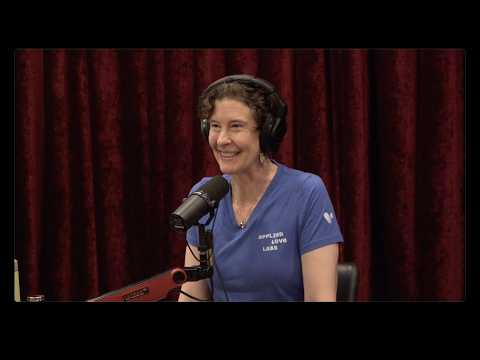
[@joerogan] Joe Rogan Experience #2496 - Julia Mossbridge
![[@joerogan] Summarizer](https://summaries.pages.dev/img/logo.webp)
Link: https://youtu.be/6si_KIa9yZM
Duration: 162 min
Transcript: Download plain text
Short Summary
Julia Mossbridge, PhD, a cognitive neuroscientist with a Northwestern PhD, joins Joe Rogan to discuss her research on precognition, telepathy, and consciousness, including groundbreaking studies with non-speaking autistic children who demonstrated telepathic abilities. The episode covers her findings on gender differences in psychic abilities, brain lesion research showing how suppressing the left orbital frontal cortex increases psychic performance, and her personal history with intelligence community gifted programs. The conversation explores how academia suppresses unconventional research, consciousness as a radio-filter model, UFO disclosure, and what Mossbridge calls the "love revolution" for human connection.
Key Quotes
- "I agree it's fascinating. I'm not sure it matters. So I mean my experience has been that um sort of regardless of how much time I spend studying it and how much I see it and how much I can test different controls to make sure it's not this that or the other thing and that it really is getting information from the future or it really is telepathy. Um people still kind of don't uh in the science world tend to just ignore it or it actually is actively suppressed." (00:02:06)
- "The world would be a lot better place if more people were curious and if you embraced it and not and just squash that that insecurity that makes you want to like puff your chest up and see I don't think you can squash it like I get I also think the world would be better place if more people were curious but I think the solution is I don't think any squashing anything works like I I think I think you have to work through it." (00:05:20)
- "It was very specific, you know, it wasn't like you don't have to be metaphorical about it. What does it mean that Shane lost her watch on the playground the next day?" (00:29:58)
- "I really do think there's something to the more you look into physics, the more you look into mind. I mean, all the the physicists from Did you ever read that book? Uh, how the hippies saved physics?" (01:01:29)
- "I kept looking at this and saying, well, it might be non-local in space, but if it It could be non-local in time. And by that I mean that if you put an electron or a photon in there, it could be interfering from uh the future like with another electron or another photon that happens in the future." (01:31:34)
Detailed Summary
Joe Rogan Experience #2271 – Julia Mossbridge, PhD
Episode Overview
Julia Mossbridge, PhD, a cognitive neuroscientist with training in computer science and a PhD from Northwestern, joined Joe Rogan for a wide-ranging conversation about precognition, telepathy, consciousness, and exceptional human performance. She currently leads Applied Love Labs, a nonprofit founded in 2019 that develops technology-based interventions for self-love and time perspective, and authored the book Have a Nice Disclosure.
Academia and Research Suppression
Julia argues that the grant system in academia undermines genuine discovery, as researchers typically complete about three-quarters of their work before writing proposals so papers can be published immediately upon receiving funding.
- She was told by supportive mentors to remove "psychic stuff" from her resume to make it "perfectly good for academia," which contributed to her leaving traditional academia.
- Dean Radin advised her to establish academic credibility at Northwestern before investigating psychic phenomena.
- She values science as being about discovery, not knowing, and prefers building things with research rather than remaining purely academic.
- Joe Rogan echoed concerns that ego in academia creates barriers to pursuing unconventional topics like psychics and premonition.
- Julia notes the intelligence community has openly studied psychic phenomena since the 1950s, while UFO phenomena only recently gained mainstream acceptance—a cultural order of acceptance she finds "interesting."
Precognition Research and Gender Differences
Julia conducted a meta-analysis compiling and analyzing 26 studies from the prior 40 years examining physiological changes that predict random future events.
- Men's skin conductance spiked before correct answers (anticipating winning), while women showed an opposite or muted pattern.
- The gender difference may be linked to gambling addiction rates being 2-3 times higher in men than women.
- Tasks involving winning showed the gender effect strongly, while tasks involving seeing scary versus neutral pictures showed precognition effects in both men and women equally.
- Julia replicated these findings using heart rhythm measurements in addition to skin conductance studies.
Morris Freeman's Lesion Research on Psychic Performance
Morris Freeman, a neurologist in Canada, conducted experiments on stroke patients and their ability to influence objects with their minds using intention.
- Stroke patients with lesions in the left frontal orbital cortex appeared more "psychic" and could statistically significantly move a computer cursor using intention.
- Those with lesions elsewhere in the brain could not produce the same effect.
- The cursor was controlled by a random number generator that deviated left or right, and participants changed the output by 5-10% more often than chance.
- Freeman replicated findings using transcranial magnetic stimulation (TMS) on regular people without strokes, turning down activity in the left orbital frontal area to enable the same effect.
- The mechanism: the left orbital frontal area inhibits the right hemisphere, and suppressing it allows enhanced psychic performance.
Telepathy Research with Non-Speaking Autistic Individuals
Julia has been conducting telepathy research with non-speaking autistic individuals who helped design study stimuli, requesting videos, music, and words with senders in another room approximately 30 yards away with a closed door.
- In a Zoom experiment during COVID preparations, the researcher was in Virginia, Maria Welch (speech and language pathologist) was with the student in Illinois, and Jeff Tarant (co-investigator/neuroscientist) was in Oregon.
- The student accurately described the target video as "a beautiful sky"—tree tops with artist-enhanced northern lights in time-lapse format—without receiving multiple choice options.
- The researcher stated it was statistically nearly incalculable for the student to correctly describe that specific video out of all possible videos in the world.
- Gifted students who appeared in the Telepathy Tapes demonstrated abilities including spelling out answers for teacher Maria and using archaic words like "alarizes" (only documented in the 1600s).
- One student identified a probable lung transplant donor who died that day for a grandmother; the family won't know for a year if the identification was correct.
The Beach Ball Timeline Phenomenon
Participants in the telepathy study independently developed techniques to improve their performance that researchers had not suggested.
- Participant 4 first proposed slamming a beach ball on the ground before trials to "focus on it in time" and "go to the right timeline" after failing a trial and believing he was "on a different timeline."
- Participant 5 independently suggested the identical beach ball slam technique without being present during the earlier discussion—during a 20-minute break at home with his mother.
- Multiple participants independently discussed meeting "on the hill" psychically, a recurring theme not taught or introduced by researchers.
- Participant 4 believed he was "on a different timeline," suggesting an intuitive understanding of precognition as branching reality.
Personal Background: Farmhouse, Family, and Early Precognition
Julia grew up in an old farmhouse in Libertyville, Illinois where ball lightning appeared inside the house, leaving a brown burn mark in the corner of her mother's room.
- Her father was a theoretical physicist at the University of Chicago who discovered or showed the electron layer on the moon and had severe OCD.
- Julia had her first precognitive dream at age 7, predicting her friend Shane would lose her watch on the playground the next day, which occurred exactly as predicted.
- Her father dismissed the dream as a coincidence, while her mother suggested keeping a dream journal instead.
- Julia describes thinking in pictures and feelings rather than an internal verbal monologue, which she believes enables her remote viewing ability.
- She met Jeff Tarant, a co-investigator and neuroscientist, through Kai Dickens, creator of the Telepathy Tapes.
Quantum Physics and the Consciousness Connection
The episode explores a hypothesis that photons may serve as a link between mind and matter because they exist in a less physical dimension than other particles.
- Researchers propose that particles could be non-local in time—interfering with other particles from the future that haven't been emitted yet.
- An experimental design examined the first 30 seconds of light emission, then randomly decided whether to turn the light off or leave it on for another 2 minutes, testing whether early photons could predict the future choice.
- A friend at UC Berkeley replicated the experiment with their own equipment over the course of a year and confirmed the same result.
- When a detector is placed at one slit to determine which path a photon takes, the interference pattern disappears, demonstrating the observer effect.
- The speaker argues photons are related to mind because gaining knowledge about the system changes the photon's behavior.
Intelligence Community Gifted Programs
Julia participated in the SOORE program in 1980-81, a predecessor to GATE (Gifted and Talented Education), and was pulled out weekly in seventh grade to see counselors in a small room with covered windows, experiencing memory blackouts each time.
- The intelligence community ran gifted programs looking for exceptional cognitive ability, leadership ability, creative ability, and psychic ability in children.
- The programs gave students "weird drinks" (described as a pink chalky drink) with unknown contents and no parental consent.
- At age 20, Julia was hired at Lockheed Martin for a word processing job and experienced no memory of the day between the morning interview and quitting at night with shaking hands and crying.
- Non-speaking autistic kids report being distracted by telepathic information—they perceive spirits and know things they couldn't otherwise know.
Consciousness, Psilocybin, and the Brain
Neuroscience still lacks basic understanding of the neural code, how neurons communicate, how we learn, and how we represent things in memory.
- Psilocybin dampens brain activity rather than increasing it, which is counterintuitive to the assumption it "turns on" the mind.
- The filter theory of consciousness proposes consciousness is like a radio signal and the brain filters it, explaining how reduced brain activity can produce richer experiences.
- William James described infancy as "blooming, buzzing confusion" before language acquisition.
- Julia describes flow as a "mental martial art"—anything difficult requiring concentration that puts one in a state of timelessness.
- The speaker hypothesizes that non-speaking in autism is not about something atrophied but rather a slight neurological difference that affects language processing.
Human Connection, Ego, and Love
Both speakers discuss how male ego often drives dominance over narrative and enforces orthodoxy, with men being more susceptible to always trying to prove they're alpha, which prevents good listening.
- Curious people make better listeners because they don't need to prove their intelligence or dominate conversations.
- Martial artists are among the least insecure people because they deal with insecurity daily through training—jiu-jitsu training from white belt to black belt requires getting humiliated thousands of times.
- At age 24, Julia was a woman in a male-dominated field and needed to establish boundaries; postmenopausal women have significantly more confidence and are no longer playing the game of needing to prove themselves.
- Julia believes the human problem is that no one knows how to be with themselves or others in harmony, and while people try various ways to solve it—drugs, prayer, dominance/accumulation, phone addiction—only love works.
- Physical activities that are difficult are recommended as the best way to take someone out of their own thoughts and clean the mind, with yoga being one of the best methods because it requires willpower, concentration, balancing, sweating, and straining.
UFO Disclosure and Government Research
The episode discusses recovered materials from crashes in 1976 containing strange alloys with non-standard atomic layering that would cost billions of dollars to manufacture.
- Gary Nolan has examined physical characteristics of alien materials along with those who have studied crash samples.
- Diana Pulka's work discusses recovered materials from aliens as potential "donations" rather than random artifacts, describing them as potential guideposts that humanity can learn from.
- One hypothesis is that beings described as "grays" may be future humans who evolved with frail bodies, large heads, telepathic communication, and no gender.
- Anna Brady-Esta, former National Science Foundation, created American Deep Tech, an investment fund attempting to reverse engineer UFOs using principles like alternative propulsion, time travel, and spacetime metrics.
Applied Love Labs and the Time Machine App
Julia founded Applied Love Labs in 2019 and built the Time Machine app (timeachine.lo) that prompts users to record messages for their future selves.
- The app has been used at Cook County Jail and with several native tribes.
- Time travel therapy involves mentally revisiting past experiences while accompanied by a wiser adult self who provides validation and reassurance.
- Eric Wargo discusses the concept that the creative muse could come from the future, suggesting ideas function as a life form that manifests in physical form.
- Birth and death experiences function as "resets" that allow people to connect with what really matters, and modern life provides fewer such instructions.
- Marshall McLuhan wrote in the 1960s that "Human beings are the sex organs of the machine world."
Key References and Cultural Context
The conversation references several works and thinkers relevant to consciousness and creativity research.
- Steven Pressfield wrote The War of Art about creativity as a force that must be summoned through daily work and intention.
- The book How the Hippies Saved Physics covers 1970s physicists who believed quantum mechanics reveals it as mind looking into mind.
- The episode notes that government-backed gifted programs may have experimented on children without proper consent, raising ethical concerns about historical research practices.
- Julia narrated her own audiobook because she believes listeners can tell when it's actually the author versus a professional narrator.