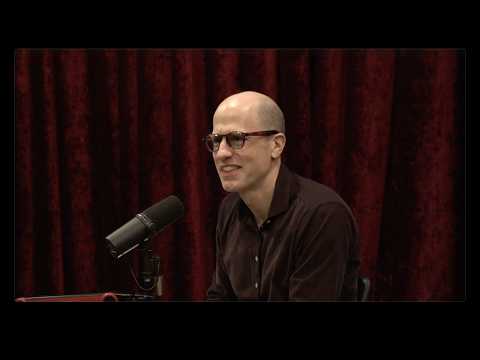
[@joerogan] Joe Rogan Experience #2525 - Nick Bostrom
![[@joerogan] Summarizer](https://summaries.pages.dev/img/logo.webp)
Link: https://youtu.be/8qTZLqY-cnI
Duration: 134 min
Transcript: Download plain text
Short Summary
In two wide-ranging AI-focused interviews, Joe Rogan speaks with philosopher and author Sam Harris, and Lex Fridman hosts a long-time AI alignment researcher who has spent roughly three decades on these problems. Both conversations grapple with the near-term arrival of superintelligence (potentially within 1-4 years), the distinction between technical alignment and political governance, the US-China AI race, and what a post-work, post-aging future could mean for human purpose and meaning. Together they surface concrete flashpoints including Anthropic's Mythos/Fable 5 release saga, US chip export controls, and the looming risk of mass white-collar unemployment.
Key Quotes
- "I feel like we have the potential, like we're on a whitewater raft. We have the potential to get to our destination, but we also have the potential to flip over and try to figure out how to get to shore in freezing cold water and sort of rebuild." (00:01:56)
- "So I think a lot of this is Stockholm syndrome that like you are kind of faced with the inevitability of aging and decay and have been for thousands of years. So you develop a kind of romantic scaffold that reconciles you to the inevitable." (00:58:44)
- "I think all of that diversity of human experience is like a tiny little corner in in in this space of possible modes of being like it's a huge cathedral and we've been kind of basically sitting in in the janitor's closet." (01:11:59)
- "65 million people die every year, um that's that's a lot of human lives. Um that's like one 911 every 25 minutes just kind of boom like" (01:42:22)
Detailed Summary
AI Trajectory, Alignment, and the Post-Human Future: Two Wide-Ranging Interviews
Speakers and Their Backgrounds
This synthesis covers two long-form conversations: Joe Rogan hosting philosopher and author Sam Harris on The Joe Rogan Experience, and Lex Fridman hosting a long-time AI alignment researcher who has spent roughly three decades thinking about these problems. Both conversations grapple with the near-term arrival of superintelligence, technical alignment versus political governance, the US-China AI race, and the meaning of a post-work, post-aging future.
- Joe Rogan speaks with Sam Harris, a philosopher and author known for work on consciousness, meditation, and AI risk; Harris treats philosophy itself as having a deadline since smarter-than-human AI could do philosophy better than humans.
- Lex Fridman hosts a veteran AI alignment thinker who has worked on these problems for approximately three decades and still describes feeling extremely unsure "which direction is up and which is down."
- Both Rogan and Harris first got online around 1994-1996; Rogan was born in the late 1960s and Harris in the early 1970s, a fact they use to anchor a discussion about the accelerating pace of change.
Superintelligence Timeline and the Intelligence Explosion
Both guests converge on a near-term superintelligence horizon, though they phrase it in slightly different ranges. The consensus is that the relevant timelines are short enough that anyone alive today should expect to see the transition.
- Harris argues superintelligence could plausibly arrive in as little as 1-4 years, with a possible "intelligence explosion" driving technology to maturity within a single-digit number of years after that.
- The Fridman guest estimates transformative AI capability at roughly 24 months away, with a possible range extending to 48 months; Elon Musk is cited as saying Grok shocks his team roughly every couple of weeks.
- Harris defines AGI as AI matching all human capabilities, and superintelligence as far exceeding them, with the gap potentially larger than the gap between humans and a flea.
- From superintelligence, Harris sketches a sprint to technological maturity via an "intelligence explosion" in which super-intelligent AI designs even smarter AIs and better chips, compressing centuries of progress into years.
- The Fridman guest frames questions worth pursuing now as those humans really need answered within 10-20 years, since beyond that horizon AI will likely be able to answer them better.
AI Compute, Infrastructure, and Scaling Bottlenecks
The infrastructure underpinning modern AI is enormous and growing at an extraordinary rate, but both speakers flag physical and economic limits that may eventually bite.
- AI compute is growing at approximately 240% per year, with training compute scaling from $1,000 PCs to million- and billion-dollar systems; global data-center spending now sits around ~$1 trillion per year.
- Cutting-edge AI data centers consume hundreds of megawatts of power; Google is reportedly developing its own nuclear power source to meet demand.
- Harris warns that compute may not easily scale three more orders of magnitude beyond the trillion-dollar level, citing physical and economic constraints.
- Algorithmic advances are identified as a secondary driver that could continue progress even if compute scaling slows; a single big algorithmic breakthrough could let one country reach superintelligence first with less infrastructure.
- Speakers also raised the idea of Dyson spheres, surrounding a star with solar panels to harvest its energy for civilization-scale computation, as a long-horizon possibility for unbounded growth.
The US-China AI Race and Chip Export Controls
Geopolitical competition is treated as a near-decisive factor shaping how AI gets developed and deployed, with the US-China dynamic dominating the picture.
- America and China are the main competitors in the AI race, with Russia participating but not at the same level; the US imposed chip export controls cutting China off from the most advanced Nvidia chips to preserve the US AI edge.
- There is now an industry-wide effort working with the US government to develop clear, universal standards for future model releases rather than handling export decisions ad hoc.
- Both speakers worry that in a Manhattan-Project-style US-China race, regulatory efforts to ensure safety could be sidelined by national-security urgency.
- The Fridman guest notes that a major downside of any unilateral pause is that an independent competitor like China could catch up and erode any safety advantage, possibly through espionage such as bribing researchers about three days before a breakthrough.
The Anthropic Mythos / Fable 5 Release Saga
A specific and concrete case study in how model release decisions interact with safety, cyber risk, and export controls dominates part of the Fridman interview.
- Anthropic's Mythos was described as the most powerful model yet and was withheld from general release because of significant cyber-offense capabilities and easy software vulnerability detection.
- Initially, Anthropic tried to make Mythos available to providers of critical software infrastructure such as big banks so they could patch vulnerabilities before attackers exploited them.
- Fable 5, a restricted Mythos variant that refused cyber hacking, programming, or biological content, was briefly available before a US export restriction blocked any non-US citizen from using it after about a week.
- Anthropic cut Fable 5 access because it could not verify citizenship in real time, leaving the model unavailable for several weeks during negotiations.
- Fable 5 was reportedly possible to jailbreak into providing some vulnerability-finding assistance, which complicated the negotiation.
- Fable 5 recently became available again after Anthropic reached an understanding with the US government that the model was sufficiently safeguarded.
Job Automation and White-Collar Unemployment
The economic shock from AI is described as layered, with surface disruptions today and deeper replacement of nearly all human work over the longer horizon.
- Harris describes the impact as "onion-layered": a surface layer of routine job loss requiring retraining, and a deeper layer where nearly all human physical and mental work is replaced by cheaper, better machines.
- He characterizes wage labor as "slavery light," arguing workers must sell about a third of their working day just to pay for necessities, with companies minimizing conditions to deliver quarterly shareholder profit growth.
- Harris identifies priest, prostitute, and politician as jobs that may survive AI due to consumer preference for human providers; the British aristocratic ideal of not needing to work is offered as a historical analog.
- Spotify podcasting economics, A-Rod and J-Lo's $100,000-a-person birthdays, and the Amazon warehouse worker vs. CEO contrast are cited as examples of resource disparity that AI could amplify or flatten.
- The Fridman guest expects no big labor-market impact yet, but warns a second wave of political pressure will hit when large-scale white-collar unemployment arrives, mobilizing an educated, entitled constituency.
- He sketches a worst-case tipping-point scenario in which white-collar workers face mass unemployment only about three weeks before it actually occurs, with no prepared policy response.
- Ford rehired 350 engineers after their AI systems did not match the quality needed for the work the engineers had been fired from, cited as a cautionary tale about premature automation.
Education Reform for a Post-Work World
If most jobs go away, the entire purpose and structure of education has to be rebuilt, and both speakers argue the current US system is already out of date.
- Harris calls the US education system a "conveyor belt" designed historically to produce factory workers, an outdated model for a world where work itself is disappearing.
- Harris proposes redesigning education around conversation, art, music, hobbies, physical wellness, nature, goal-setting, friendships, and spirituality; Rogan notes a current first-grader will graduate in 12 years into a totally different world.
- Harris warns of a "risk window" where a 20-year-old may graduate without skills because the AI revolution hasn't yet arrived, noting liberal arts degrees already leave many graduates without jobs.
- Both speakers imagine a future where artificial purposes like golf (getting a ball into 18 holes using the inconvenient method of clubs) become a larger share of activity at technological maturity, while most natural purposes are delegated to AI.
Pausing AI: Risks and Tradeoffs
Both conversations take seriously the idea of slowing AI development but are equally serious about the costs of doing so.
- A short, well-timed AI slowdown of a few months to a year at a critical pre-deployment moment could enable iterative safeguards before scaling to maximum capability.
- Downsides of pausing include espionage (e.g., a competitor like China bribing researchers about three days before a breakthrough), independent competitors catching up, and the risk that a temporary pause infrastructure such as a six-month freeze becomes permanent because no one can definitively prove AI is safe.
- The Fridman guest argues a detailed regulatory scheme cannot be figured out now given unknowns, and suggests the right approach is to watch closely, react quickly, and rely on competent, well-motivated people.
Alignment vs. Governance
A clean distinction runs through both interviews: technical alignment is about whether the builder can make the system do what is wanted, while governance is the political question of which values the system should pursue.
- Harris distinguishes AI alignment (a technical question of whether a builder can make a system do what is wanted) from governance (a political question about which values the system should pursue).
- If AI is unaligned, the future gets shaped by whatever values the AI ends up with; if alignment is solved, outcomes depend on who owns, controls, or governs the system.
- Harris cites Ford-type failures and corporate quarterly-profit incentives that cut corners on safety as cautionary tales for how AI deployment could go wrong.
- Governing superintelligence would require political organization, appeals to the best in human nature, dialogue, and checks and balances incorporating a wide set of stakeholders.
- The Fridman guest argues a detailed regulatory scheme or system of laws cannot be figured out now given unknowns, and that the right approach is to watch closely, react quickly, and rely on competent, well-motivated people.
Existential Risk Landscape
Both conversations place AI risk alongside, and sometimes above, other existential and catastrophic threats.
- Harris sketches a worst-case scenario where human needs are met but no purpose remains and a more fulfilling virtual reality absorbs people, offering possibilities unconstrained by current physics such as flying.
- The Fridman guest flags rapid advances in synthetic biology as a growing existential risk, alongside a baseline risk from nuclear arsenals independent of superintelligence; some synthetic biology capabilities are already enabled by current AI progress.
- He cites approximately 65 million deaths per year globally, framed as "one 9/11 every 25 minutes," to argue for urgency in pursuing potentially beneficial AI.
- Both reference humanity almost being wiped out approximately 70,000 years ago as evidence that natural existential risks are not small on relevant timescales.
- One speaker considers supervolcanoes and similar natural threats to be very small risks compared to AI and synthetic biology.
Consciousness, Enhancement, and the Posthuman Future
Both interviews push beyond immediate AI risk into the deeper question of what humans even become in a post-AI, post-aging world.
- Harris argues human consciousness is a "tiny corner" of possible modes of being, comparing what we have explored to "the janitor's closet of a huge cathedral" because we are confined to our biological brain substrate.
- He describes human consciousness as a "feeble, murky glimmer barely sentient at all" contained in a coconut-sized organ, with the gap to superintelligence potentially exceeding the gap between humans and a flea.
- Rogan notes that primates taught sign language demonstrated intelligence and understood fairness but never asked a question, illustrating a profound cognitive gap even within primates.
- Harris hypothesizes nanobots could allow abstract mathematical concepts to be acquired in about 20 minutes of superintelligence computation by altering synapses directly, bypassing years of study.
- He frames a "post-instrumental condition" where a pill replaces an hour at the gym, making all instrumental effort unmotivated; genetic engineering could obviate the pill by altering physiology directly.
- Rogan references David Sinclair's view that reversing biological aging is likely inevitable; if humans can reach 100, genetic engineering might extend life and intellectual capacity to ~4,000 years.
- Rogan compares prototypical "gray" aliens (big heads, skinny bodies, genderless) to a plausible primate trajectory under technology, and notes the Chinese CRISPR-baby doctor was sanctioned for HIV-resistant babies that may also have raised potential IQ.
- Both speakers muse that humans might not want to be stuck at a 20-year-old body for 10,000 years and would continue engineering larger capacity; Harris hopes humanity grows into its ideals rather than drifting through impersonal selection.
Human Purpose, Artificial Goals, and the Post-Human Condition
A sharp disagreement emerges over whether the posthuman destination is a single good outcome or one of many possible, including dystopian ones.
- The Fridman guest argues AI-related problems only persist if humans remain territorial primates and suggests engineering out issues like greed and violence by changing what it means to be a person, describing a future "Homo sapien 2026."
- The other speaker critiques the single-destination "whitewater rafting" metaphor, arguing the river has multiple possible destinations: a beautiful posthuman world, a paperclip-maximizing AI, or a totalitarian system with a small elite on top.
- Removing negatives like lying, stealing, greed, pride, and disease could make the human condition feel "flavorless," requiring new ways to realize values currently expressed through conflict and pain (e.g., love of achievement replacing motivation from painful failure).
- Radical hedonism, where pleasure is the only good, makes an optimal state easy to specify; a more complex axiology adding beauty, friendship, courage, and achievement requires much more design work.
- Artificial purposes such as golf's "get a ball into 18 holes using the inconvenient method of clubs" become a larger share of activity at technological maturity, while many natural purposes could be delegated to AI, with only a few subtle ones surviving.
- The "stars at night" metaphor appears in both conversations: just as sunlight hides faint stars, urgent moral and practical values currently obscure subtler values like honoring forebears and historical heroes, religious alignment with a higher being, aesthetic values, and original ceremonies upholding tradition, which might become perceivable once those concerns are removed.
- Tied back to their roughly 100-year lifespans, the speakers conclude they will probably see the strangest thing humans have ever had the possibility of experiencing, and propose reconvening in 4 years to compare how wrong their predictions were.
Encryption, Communication, and Neural Interfaces
The interviews cover a frontier capability that both excites and terrifies: direct brain-to-brain and brain-to-AI communication.
- Elon Musk is cited as saying humans will eventually "talk without words," raising the prospect of thought-based communication and mind reading; the Fridman guest speculates this is why "the grays don't have mouths" and frames current languages as a Tower-of-Babel situation needing translators.
- High-bandwidth neural interfacing raises major cybersecurity risks because signals would be transmitted straight into the brain without sound, eliminating the usual sensory checkpoints.
- The Fridman guest argues sufficiently advanced AI could make all current encryption instantaneously decoded, likening money to ones and zeros protected by information bottlenecks.
- The other speaker counters that cryptography is "defense dominant in the limit," citing unbreakable one-time pads and arguing mind reading would be the first thing to compromise encryption rather than raw code-breaking.
Lifestyle, Aging, Health, and Long Timescales
The conversations keep returning to concrete, personal-scale choices and timescales, often as a way to ground abstract futurism.
- Harris argues that taking care of basic physiology (vitamins, stopping processed foods, attending yoga class) can significantly improve depression without pills, claiming 100% of people can be improved through this; a co-host pushes back that genetic neurotransmitter imbalances sometimes require medication.
- Both speakers describe humans as biologically mismatched for an environment of abundance (evolved to conserve energy, eat as much as possible), which leads to metabolic problems, and reference the hedonic treadmill in which achievements produce a transient happiness spike.
- Both argue that struggle is essential to the human condition; statistics over thousands of years show humanity trending toward less violence, better medicine, and better education.
- Rogan cites the average person spending roughly 6 hours per day on phones as a minor example of how a non-thrilling virtual escape can become massively addictive.
- Video games are described as approximations of more intense realities, with players preferring thrill-oriented games like Call of Duty and Half-Life over passive floating experiences.
- Speakers speculate that even if aging were solved, humans might go "stale" after ~200 years and get stuck in a rut; 500 years from now, quantum computing and AI are unpredictable.
- They suggest psychedelics such as psilocybin, DMT, and ibogaine may be the best chemical tools for navigating a transformed future reality, noting these substances are currently illegal.
- They also discuss 1980s US-government claims that UFOs are powered by the minds of their operators, with Rogan arguing a civilization a million years older than ours would have physics far beyond ours.
Pace of Change and Historical Context
Both interviews frame the present moment as historically unprecedented in the speed of change, using personal biography and macro history to make the point concrete.
- Rogan and Harris both first got online around 1994-1996, with Rogan born in the late 1960s and Harris in the early 1970s.
- They note that between roughly 1600 and 1800 very little changed for most people for about 200 years, contrasting sharply with the radical change in their lifetimes.
- They describe the shift in their lifetimes as probably the biggest change in human ingenuity and innovation the world has ever seen.
- Mass media in the last century enabled demagogues to address millions simultaneously, enabling new ideologies that wouldn't have worked in formats like letters to the editor.
- Social media is identified as the next wave after mass media, and AI is described as the following wave, bringing bots, new information-finding methods, and potentially super-persuader systems that will change social discourse in unknown ways.
- Negative scenarios raised include totalitarian outcomes, fragmentation into political warring tribes, and individuals becoming unhinged via personalized AI feeds reinforcing their own "naughty theories."