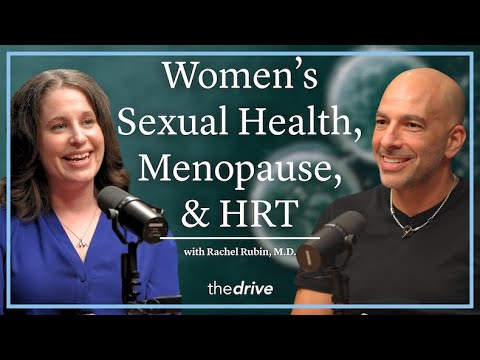
[@PeterAttiaMD] 348 ‒ Women’s sexual health, menopause, and hormone replacement therapy (HRT)
![[@PeterAttiaMD] Summarizer](https://summaries.pages.dev/img/logo.webp)
Link: https://youtu.be/W0XW6av2wLQ
Short Summary
This YouTube video transcript features a discussion about menopause, hormone therapy (HRT), and women's health, arguing that misconceptions about HRT from the Women's Health Initiative (WHI) have negatively impacted women's healthcare by scaring an entire generation of doctors away from prescribing it. The guest highlights the benefits of HRT, including decreased risks of colon cancer, fractures, and diabetes, and stresses the importance of considering testosterone in women's hormone balance, advocating for individualized approaches and pushing for more research in the area to improve women's overall well-being and challenge the patriarchal biases still prevalent within the field of medicine.
Key Quotes
Here are five quotes extracted from the transcript that represent valuable insights or strong opinions:
-
"They misinterpreted the data so drastically and scared everybody with so much fear that you actually have an entire generation that has forgotten how to prescribe hormone therapy."
-
"If a penis shriveled up at age 52, we'd probably have a vaccine sponsored by Fizer, right? This is this is they created Viagra, they would create this this vaccine. No one even tells."
-
"We love to gaslight women and say, 'Well, if you have your period, your hormones are normal.' And the reality is is that's not true."
-
"If everybody in Medicare eligibility used vaginal estrogen, we would save Medicare between 6 and 22 billion dollar a year...This is a huge economic and mortality problem that we are dealing with and no one cares."
-
"We're killing women by trying to protect them."
Detailed Summary
Okay, here's a detailed summary of the YouTube video transcript in bullet points, highlighting the key topics, arguments, and information discussed.
I. Introduction and Guest Background
- The video is a podcast episode hosted by Peter Attia, featuring Dr. Rachel Rubin, a urologist specializing in sexual medicine and women's health.
- Dr. Rubin explains that urology is about quality of life, dealing with urination and sexual function issues. She emphasizes that urology is not just about men's health but about the genitourinary tracts of all people.
- Dr. Rubin's focus on women's health stems from a desire to address the lack of information and the abundance of misinformation surrounding female sexual health.
II. Menopause: The "Empty Gas Tank" Analogy
- Menopause is described as a "castration event," where women experience a sudden and significant loss of sex hormones (estrogen, progesterone, and testosterone) around age 52.
- This is contrasted with the gradual decline in hormones that men experience.
- Perrymenopause is characterized by erratic hormone fluctuations, leading to a range of symptoms.
- Dr. Rubin uses a "gas tank" analogy: Men experience a decrease in their "gas tank," while women experience an empty "gas tank" in menopause.
- The fluctuating levels of estrogen, progesterone, FSH, and LH during perrymenopause create chaotic symptoms, sometimes due to hormone excess and sometimes due to deficiency.
III. Hormone Physiology and Menstrual Cycle
- The video breaks down the menstrual cycle, explaining the roles of estrogen, progesterone, FSH (follicle-stimulating hormone), and LH (luteinizing hormone).
- Estrogen levels rise during the first half of the cycle, leading to ovulation triggered by an LH surge.
- After ovulation, the egg's shell produces progesterone, which prepares the uterine lining for potential pregnancy.
- If fertilization doesn't occur, the progesterone levels drop, causing the uterine lining to shed (menstruation).
- During pmenopause, the body tries to produce hormones but struggles, resulting in erratic hormone fluctuations.
IV. The Risks of Hormone Deficiency Post-Menopause
- The video discusses the risks associated with long-term hormone deficiency after menopause, including:
- Genital and urinary microbiome changes, increasing the risk of UTIs and pelvic pain.
- Osteoporosis and hip fractures, which are associated with high mortality.
- Increased risk of dementia and Alzheimer's disease.
- Increased risk of heart disease (the number one killer of women).
- Increased risk of colon cancer.
- While mental health can worsen during perrymenopause, there are long-term implications to mental health if a woman is hormone deficient.
V. The Women's Health Initiative (WHI) and Its Misinterpretation
- The NIH conducted the Women's Health Initiative (WHI) to examine the effects of HRT.
- The WHI study was prematurely stopped due to concerns about an increased risk of breast cancer, blood clots, and cardiovascular disease. This was done even before the study was published.
- The WHI's findings were misinterpreted, leading to a sharp decline in HRT use and a generation of doctors who are not trained in hormone therapy.
- The WHI only used one type of hormone therapy: synthetic estrogen and progestin (similar to birth control pills).
- The study showed that HRT decreased the risk of colon cancer, fractures, and diabetes, and even decreased overall mortality and cancer-specific mortality.
- Women on estrogen alone had a decreased risk of getting and dying from breast cancer in the WHI.
- The absolute risk increase for breast cancer with synthetic progestin and estrogen was only 0.1% (one additional case per 1,000 women).
VI. The Lost Generation of Women and the Failure to Train Doctors
- The WHI caused a lost generation of women who were unnecessarily deprived of HRT and suffered excess mortality, disability, and sexual side effects.
- There's also a failure to train a generation of doctors in menopause management.
- Less than 6% of internal medicine, OB/GYN, or family practice doctors receive even an hour of menopause education during their training.
- Psychiatrists have been told that their malpractice insurance won't cover hormone prescriptions, even though they prescribe progesterone-based drugs for postpartum depression.
- Menopause medicine is a tiny room in gynecology and should be whole body medicine.
VII. The Role of Testosterone in Women's Health
- Testosterone declines with age in women, starting in their 30s.
- Testosterone is essential for libido, genital health, and urinary tract function.
- Birth control pills lower testosterone levels by turning off the ovaries, with no replacement of the lost hormone.
- There is global consensus that testosterone can effectively treat low libido in postmenopausal women.
- There is no FDA approved product for women's testosterone except in Australia.
- Common side effects of testosterone therapy in women include acne and increased hair growth.
- The speaker uses FDA-approved testosterone for men at doses about one-tenth the dose, rubbed on the leg.
VIII. How to Administer Testosterone Topically
- A topical version of an androgel type product is used for dosing at a smaller amount.
- Use a 1% generic testosterone gel called Testum
- Men use the entire tube for their chest every day, but that is not recommended.
- It can be taken using a syringe at 0.5 mL
- It can take 3 to 5 months before patients notice the positive changes.
IX. The Failure to Approve a Testosterone Product for Women
- The FDA required five more years and a billion dollars worth of research for a female product, but testosterone product's benchmarks for men were six months.
- The fact that the label on estrogen products includes stroke, blood clots, probable dementia, and breast cancer is untrue, so it should be removed.
X. A Paternalistic Problem That Is Not Getting Any Better
- The speaker brings up that women's health research continues to fall behind as time goes on.
- We met with the chief medical officer of the FDA, but they said that a third party needs to come and say that labeling should be removed.
- There's no industry to remove the labeling on estrogen products because the WHI destroyed it.
- In the EU, the testosterone label was removed that it doesn't worsen cardiovascular disease, so the standards are different from men and women.
- The box on estrogen is only getting further away, women are getting killed trying to protect them.
XI. Navigating Hormone Therapy in the Real World
- Doctors are not going to give patients what they need if they don't ask for it themselves.
- There are still doctors saying to their patients that they have to change their relationship for life.
XII. Treatment Playbook
- It's important to stack hormones (start one, and then continue to another)
- It's not possible to prescribe to everyone because everyone responds differently.
- The most commonly reported success women have on this treatment is better sleep.
- The speaker likes that a third of women react to the progesterone like it's candy, so they like guzzling it.
XIII. Progesterone coded IUD
- Progesterone is often used vaginally instead of orally to help with side effects.
- They are good in pmenopause because it stops the bleeding, which can happen at anytime.
- Synthetic progesterines can have mood side effects, so they're not completely benign.
XIV. Estradiol
- Estradiol is E2, but there's estrone E1, and estriol E3.
- FDA only approves E2
- Biestrogen is an 8020 of estriol and estradiol
- Dr. Rubin views compound stores as the "dark alley."
- The speaker doesn't prescribe compounded version because they can't be certain if the top is the same as the bottom of the bottle.
XV. Systemic vs Local
- The difference is that local is to treat genital and urinary symptoms of menopause.
XVI. Ways to get estradiol
- patches, gels, rings, and oral tablets
XVII. Topical Applications
- It is good to start with patches because you can slowly titrate to higher and higher doses.
- Many patients have issues with topical gels because they take a little bit to dry.
- Two types of rings can be prescribed.
XVIII. Ring Application
- Rings stay inside the body for 3 months
- There is a feim ring that needs progesterone to protect the uterus.
- Fem ring is 0.05 and 0.1.
- E-ring is a 2mg. Does not need progesterone to protect the uterus.
- It's important to get sensitive estradiol levels.
- It's important to get LCMS instead of Eliza based assays.
XIX. Key Takeaways
- There needs to be humility on the medicine side, it is always evolving and it is able to be changed.
- The key is that every doctor who sees a woman that age needs to learn how to write these prescriptions.
- Menopause has the worst PR campaign in the history of the universe.
XX. Symptoms
- Every body part has hormone receptors, but there needs to be lubrication (eyes, ears, vaginas)
XXI. Questions to ask
- The speaker asks what are you afraid of, which helps to ask what product should be used.
XXII. Questions on Estrogen and Progesterone for Breast Cancer Patients
- Patients need to do their own research, not because of social media.
- Need to be working with your oncologists to get the right results.
This detailed summary captures the core messages and information shared in the YouTube video transcript.