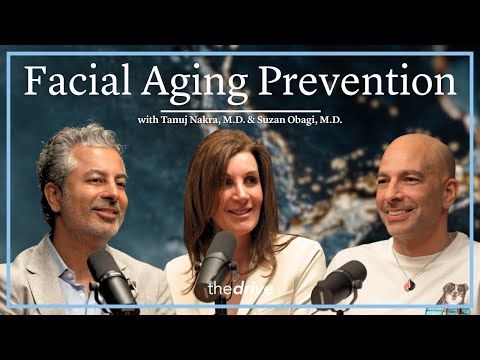
[@PeterAttiaMD] Aging Prevention: How to Stay Ahead of Facial Aging | Tanuj Nakra, M.D. & Suzan Obagi, M.D.
![[@PeterAttiaMD] Summarizer](https://summaries.pages.dev/img/logo.webp)
Link: https://youtu.be/0UigeHnCEoU
Short Summary
Number One Action Item/Takeaway:
Use mineral sunscreen daily.
Executive Summary:
The most important step for preventative skincare is using mineral sunscreen daily due to the ineffectiveness and potential harm of chemical sunscreens. Mineral sunscreens, while requiring more effort to apply, offer superior and safer protection against sun damage. It is imperative to choose a sunscreen with mineral ingredients rather than chemical ones, despite the increased cost and application effort.
Key Quotes
Here are five direct quotes that I found particularly insightful or interesting from the provided transcript:
-
"After saying this for 15 years, I think the FDA just a couple weeks ago finally told the companies they must do animal safety studies. It's about time." - This highlights the long-standing concerns about the safety of chemical sunscreens and the slow pace of regulatory action.
-
"When those chemical sunscreens absorb those harmful rays, whether it's UVB or UVA, the cells uh well, the chemicals absorb them and they neutralize those rays, but they cause reactive oxygen species... So, you're really causing more damage and probably causing these cells to become more atypical atypical over time." - This presents a counterintuitive argument that chemical sunscreens may actually contribute to skin damage through the creation of reactive oxygen species.
-
"Vitamin C also regulates the tyrrosen kinus pathway which is sort of a scientific way of saying that complexion which is you know people talk about wanting to have good complexion. What does that mean? Complexion is something that across societies, no matter what your Fitzpatrick scale is, people like to have a good complexion." - This breaks down the science behind how vitamin C contributes to a desireable complexion with even skin tone.
-
"So you can go to Walgreens and spend $6 on Aquafor, which is basically petroleum jelly, and put it on your face nightly, and your skin will look better in 30 days, guaranteed, because your skin will thicken and a lot of the fine lines and crinkles will actually start to disappear because your skin is being more hydrated." - This gives a real world and surprisingly inexpensive solution to skin care that is often overlooked.
-
"the skin being the largest organ in your body is very unique. It's very good at keeping things out or from the inside coming out as well...So they have shown that the level of vitamin C that you can achieve in the skin by topical application far exceeds what you can do by ingesting it. the amount you would have to ingest. Sure." This highlights the power of direct application of helpful ingredients to the skin over ingesting them through diet.
Detailed Summary
Here's a detailed summary of the YouTube video transcript, focusing on the key topics, arguments, and information discussed, excluding sponsor announcements or other advertisements:
Key Topics:
- Preventive Skincare
- Sunscreen (Mineral vs. Chemical)
- Retinoids (Retinoic Acid vs. Retinaldahyde)
- Vitamin C Serums
- Moisturization
- Daily Skincare Routines (AM and PM)
Arguments and Information:
- Sunscreen:
- Wearing sunscreen is essential for preventing skin aging (lines, wrinkles). A randomized 4-year Australian study supports this.
- Mineral sunscreens (zinc oxide, titanium dioxide) are preferred over chemical sunscreens (avoenzone, oxyenzone) due to concerns about hormone disruption and potential infertility.
- The FDA has belatedly asked companies to perform safety studies on chemical sunscreens.
- Chemical sunscreens degrade quickly (within an hour in strong sun), making them less effective than perceived.
- Chemical sunscreens absorb harmful rays but may create reactive oxygen species that damage DNA.
- Skin cancer rates are increasing despite sunscreen use, potentially due to ineffective chemical sunscreens.
- Mineral sunscreens may be more difficult to blend in, but ultimately safer and better protection.
- SPF 50 or below is the recommended to use with mineral sunscreen.
- Retinoids:
- Retinoids are a crucial step in preventive skincare.
- Initial redness and irritation from retinoic acid can be overcome with consistent use (though some may quit).
- Alternating between retinaldahyde (5 days a week) and retinoic acid (2 days a week) can ease the introduction.
- While retinoids can initially increase light sensitivity, the skin becomes less sensitive over time with continued use.
- Retinoids may help repair some sun-induced DNA damage.
- Apply retinoids all over the face, including under the eyes (carefully) and occasionally on the upper eyelid and neck.
- Fingertip unit is a good measurement.
- Vitamin C:
- Vitamin C is an important antioxidant for skin health, ideally applied topically.
- Vitamin C serums can be unstable and degrade easily. Feric acid can be used to stabilize it.
- More expensive vitamin C formulations are often more stable due to specialized manufacturing techniques.
- Vitamin C is a precursor for collagen synthesis, and it also regulates the tyrrosen kinus pathway which is important for even skin tone (complexion).
- Moisturization:
- Deep moisturization helps maintain skin barrier function and thicken the skin, reducing fine lines.
- Inexpensive moisturizers like petroleum jelly (Aquafor) can be effective.
- Moisturization, especially overnight, is beneficial for skin aesthetics.
- Daily Skincare Routines:
- AM Routine: Cleanser (gentle, separate from body soap), Vitamin C serum, Sunscreen. An AHA or PHA product might also be good to use before sunscreen.
- PM Routine: Cleanser, Retinoid (retinoic acid).
- Apply products from thinnest to thickest consistency.
- Ingesting vs. Topical Application of Antioxidants:
- Topical application of vitamin C achieves much higher concentrations in the skin than oral ingestion.