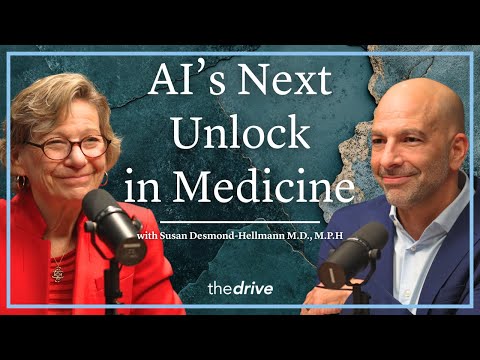
[@PeterAttiaMD] AI Transforming Medicine: The Next Big Healthcare Unlock | Susan Desmond-Hellmann M.D., M.P.H
![[@PeterAttiaMD] Summarizer](https://summaries.pages.dev/img/logo.webp)
Link: https://youtu.be/_dc9d22Oeio
Short Summary
The Nobel Prize for AI-driven protein folding significantly accelerates pre-clinical drug development by illuminating previously unseen opportunities for therapeutic intervention. While a crucial advancement, the next major breakthrough in medicine likely lies in identifying better biomarkers and outcome measures, such as a "viral load" equivalent, to shorten clinical trials and enable personalized treatment strategies.
Key Quotes
Here are four quotes extracted from the provided transcript, highlighting key insights:
-
"Yeah, I do. so far. Yeah. And and so what do you think would be the next mega unlock? Would it be on the data front? Uh would it be a predictive model? Like how could we shorten a clinical trial by 60%. You know, anything where AI can help us with outcome measures. Outcome measures." - This captures the speaker's optimism about the potential of AI, beyond protein folding, to significantly improve clinical trial efficiency through better outcome measures.
-
"I want a viral load for everything. You know, I don't want a 2x2. We need a good biioarker. We need a good biioarker for more things..." - The speaker emphasizes the need for more precise biomarkers like viral load, which enabled rapid progress in HIV treatment, as opposed to less informative measures.
-
"I think it appears to be the problem because if they did, I think it would work." - The speaker is saying that with liquid biopsies, the core issue appears to be the relatively low amount of tumor DNA shed into the bloodstream.
-
"There's a way when you go when you go through the four leading causes of cancer death, two of them don't need to be on the list. Colon cancer and prostate cancer don't need to be on the list. A lung is going to be a hard, you know, I think we can reduce it a lot, but it's going to be awfully tough and breast is still really tough cuz it's not haladian." - This highlights the preventability of certain cancers like colon and prostate, contrasting them with the greater challenges posed by lung and breast cancer.
Detailed Summary
Okay, here's a detailed summary of the YouTube video transcript, presented in bullet points, highlighting key topics, arguments, and information:
I. Nobel Prize for AI-Driven Protein Folding Analysis
- Significance: The Nobel Prize awarded for AI-driven protein folding analysis is significant because it accelerates the process of figuring out what to do in drug discovery (pre-clinical research).
- Impact on Biotechnology: This advancement shines a light on a larger "mountain of opportunity" in drug development, allowing researchers to see and exploit potential targets more effectively.
- Overall Assessment: The speaker views the Nobel Prize recognition as positive and believes it's an important contribution.
II. AI's Most Important Contribution to Medicine So Far
- The speaker believes that AI's contribution to protein folding is the most important contribution AI has made to medicine so far.
III. Next "Mega Unlock" for AI in Medicine
- Focus: The next major breakthrough will likely involve AI improving outcome measures in clinical trials.
- Analogy: Using viral load as an example, the speaker emphasizes the power of having clear, quantifiable biomarkers. The speaker wants a viral load for everything, not just a 2x2.
- Breast Cancer Subtypes: The speaker discusses the different subtypes of breast cancer (ER+, ER-, HER2+, triple negative), pointing out there are likely even more (potentially 15 or more). AI could facilitate smaller, more targeted clinical trials (e.g., 10 patients per subtype) if effective biomarkers are identified.
- Ideal Scenario: AI could help identify therapies that "switch on" and "switch off" specific pathways, creating clear clinical benefit. Measuring the "switch off" is especially valuable, as exemplified by viral load monitoring.
IV. Liquid Biopsies
- Current Pessimism: The speaker expresses negativity regarding the current state of liquid biopsies, based on the available data.
- Sensitivity Issue: The main problem is that tumors may not shed enough DNA into the bloodstream to enable reliable detection.
- AI's Potential: While AI could potentially help, the underlying issue of insufficient DNA shedding makes the problem inherently difficult.
- Early Detection Challenges: The speaker cautions against underestimating the difficulty of early cancer detection in general.
- Examples of Successful Early Detection:
- Colonoscopy for colon cancer
- Pap smear/HPV vaccine for cervical cancer
- Spiral CT for lung cancer
V. PSA and Prostate Cancer
- Nuance Required: PSA testing can be valuable, but only when interpreted with additional information like PSA density, PSA velocity, prostate volume, and serial measurements. PSA alone is unreliable.
- Refined Approach: Stratifying PSA results based on PSA density can help predict the likelihood of different Gleason scores, guiding decisions on further testing (PHI, 4K, multi-parametric MRI).
- Missed Opportunity: Too many men are dying of prostate cancer, which shouldn't be the third leading cause of cancer death. Simplifying the interpretation of PSA results could save lives.
- Opportunity for Innovation: There is an opportunity to create a more turn-key product that simplifies PSA testing and interpretation for patients.
VI. Cancer Mortality and Prevention
- Preventable Deaths: Deaths from colon cancer and prostate cancer should ideally be eliminated through improved screening and prevention.
- More Difficult Cancers: Lung cancer is more challenging to prevent entirely, although risk can be significantly reduced. Breast cancer presents ongoing challenges due to its complex progression (not as simple as polyp removal).
VII. Breast Cancer Liquid Biopsy (Specific Focus)
- Specific Question: Focusing specifically on breast cancer, what type of biomarker (protein, DNA, RNA) would be the earliest signature in the blood?
- Speaker's Guess: The speaker believes it would be interesting to look at protein.
- Potential Impact: A reliable liquid biopsy for breast cancer would be a "tremendous" advancement, transforming treatment.