[@PeterAttiaMD] From the Front Lines of Africa’s AIDS Crisis | Susan Desmond-Hellmann M.D., M.P.H
![[@PeterAttiaMD] Summarizer](https://summaries.pages.dev/img/logo.webp)
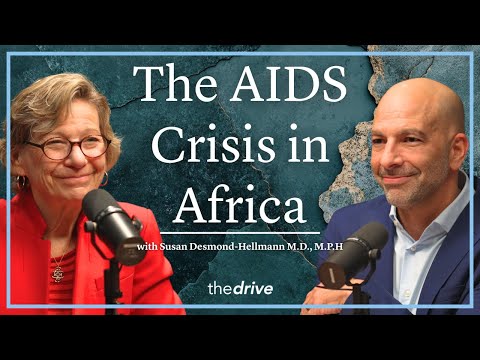
Link: https://youtu.be/r0daB5ODpw8
Short Summary
After obtaining a master's in public health, the speaker became an oncologist for the AIDS clinic at UCSF and was later approached by the Rockefeller Foundation to study heterosexual HIV transmission in Uganda during the late 1980s/early 1990s. The experience was deeply impactful, exposing them to the devastating AIDS epidemic and high rates of Kaposi's sarcoma, ultimately driving them to triage patients and find ways to cope with the overwhelming grief while contributing to the public health response.
Key Quotes
Here are four quotes extracted from the transcript:
- "If you were a 16-year-old girl and you went to the STD clinic, you had a 50% chance of being HIV positive. 16. And most of those girls was their first and only sexual partner. So what that meant is it was Russian roulette to have sex in Uganda then."
- "The feeling of being scared and sad in San Francisco in 1982. Multiply that by a thousand in 1989. It was terrifying."
- "If you had capacity saroma on your soft pallet in on the roof of your mouth, you had HIV. 100% predictive."
- "I love interacting with people. I love getting to know the patients who I care for and it makes me happy to think I'm helping. Helping might be helping them get better. helping might be helping with their pain or they can talk about dying with me because it doesn't make me scared. Um so I get a lot of joy in trying to contribute. Um and even if I feel overwhelmed and if I step back and think how can how can we cope with this? Um my coping is more is leaning in."
Detailed Summary
Here is a detailed summary of the YouTube video transcript, organized into bullet points:
Context and Background
- The speaker, after getting a master's degree in public health, became the oncologist for the AIDS clinic at UCSF's university hospital.
- She treated patients with Kaposi's Sarcoma (KS) at Moffett.
- Her husband, an immunologist in ID, worked in a lab in immunology.
- The Rockefeller Foundation approached two chiefs of medicine at UCSF with concerns about heterosexual transmission of HIV in Africa.
- They were skeptical about African HIV, some believing it might be unreported homosexual activity.
- The Rockefeller Foundation offered a grant to study heterosexual transmission of HIV through an epidemiological and contact tracing lens, focusing on the potential link between STDs and increased HIV risk.
Uganda Experience (Late 1980s - Early 1990s)
- The study took the speaker and her husband to Uganda in 1989-1991.
- The prevalence of HIV/AIDS was extremely high in Uganda at that time.
- In the country as a whole HIV prevalence was double digits.
- The infection rate among 16-year-old girls attending STD clinics was around 50%, often from their first sexual encounter.
- The situation was described as worse than Russian roulette.
- The coffin-making business was thriving due to the high death rate.
- The speaker compares the feeling of being scared in San Francisco in 1982 multiplied by a thousand.
- The speaker describes that 1/3 of AIDS patients would have Kaposi's Sarcoma.
- Returning to her KS clinic in San Francisco after six months in Uganda, she found all her patients were dead.
Kaposi's Sarcoma (KS) and HIV in Uganda
- Clinical observation: KS on the soft palate was 100% predictive of HIV in Uganda, indicating severe immunosuppression.
- KS could be a proxy for weakened immune system.
- Patients would often die from pneumonia and cexia
- The speaker emphasized that early detection and treatment of KS was essential in resource-limited settings.
Knowledge of HIV at the Time
- The virus had been identified by Gallo and others.
- The speaker and her colleagues knew about the clinical syndromes associated with HIV.
- They quickly recognized that they were seeing heterosexual transmission.
- Untreated STDs, especially those causing open lesions like herpes and chancroid, were identified as a major factor in high transmission rates due to increased viral load.
Public Health Response in Uganda
- The Ugandan government, led by President Museveni, was receptive to the science and epidemiology of HIV/AIDS.
- Museveni promoted a "zero grazing" campaign (one partner) to encourage safer sex practices.
- Condom distribution efforts were underway.
Mortality and Triage
- The speaker estimates potentially a million people in Uganda may have died annually from AIDS.
- She felt overwhelmed by the scope of the crisis.
- She describes using a triage system similar to what is used in the military, prioritizing the sickest patients for limited chemotherapy resources.
- If patients were too healthy to walk, they were deemed "too healthy" for treatment at that moment, due to limited resources.
Personal Coping Mechanisms
- The speaker emphasizes her love for people and her desire to help, finding joy in contributing even in difficult circumstances.
- She copes by "leaning in" and engaging actively, rather than withdrawing.
- She acknowledges her husband's more introverted nature and their mutual support.
- They took breaks and went on trips to maintain their spirits, going to Greece and on a safari.
Treatment
- Old chemotherapies like vinchristrine and bleomycin were reasonably good against KS and used in Uganda.
- Taxol was approved after the speaker left Uganda.