[@PeterAttiaMD] The Evolution of Beauty | Tanuj Nakra, M.D. & Suzan Obagi, M.D.
![[@PeterAttiaMD] Summarizer](https://summaries.pages.dev/img/logo.webp)
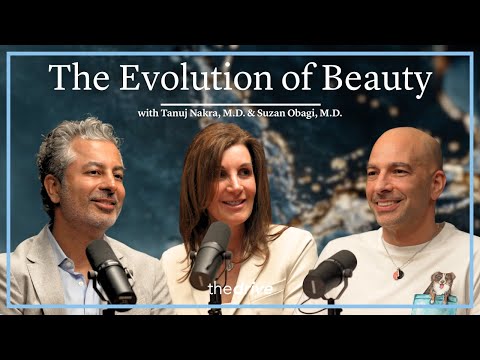
Link: https://youtu.be/9JViescma2s
Short Summary
Number One Action Item/Takeaway:
Understand the evolutionary basis of beauty standards (symmetry, facial proportions, sexual dimorphism) to better understand the underlying drivers of attraction and how societal influences overlay these fundamentals.
Executive Summary:
Humans are genetically predisposed to appreciate beauty based on factors like facial symmetry, proportions, and sexual dimorphism, which subconsciously signal health and fertility. While societal factors influence specific beauty trends, these fundamental aspects are universally attractive across cultures and have evolutionary roots tied to mate selection and genetic fitness.
Key Quotes
Here are five quotes extracted from the YouTube transcript:
-
"These newborn infants who've not yet been influenced by society, preferentially we're looking at the beautiful faces. And so that that natural drive for us to appreciate beauty is present even at birth."
-
"The fundamentals are that all humans across ethnicities all over the world have been studied and they appreciate certain features of beauty. So there's symmetry of the face, um facial proportion, and then um they also appreciate uh sexual dimmorphisms."
-
"If you look at even different races and look at a beautiful person in each of those, they actually all have similar measurements. So there are these masks that you can superimpose onto any image and really dissect down every single angle whether it's the cheek angle, the jawline angle, the shape of the nose, the eyes, and all of you. If you look at that across different races, they all have that same kind of measurement that they hit."
-
"We were working our massitors. We were working our jawline. Our pallets were not as high. Our jawline was a lot wider. Our teeth were stronger. And then as we have changed our diet and everything is cooked and we don't have to make as much effort to chew it, you actually get more crowding in your of your teeth. Your jawline is a little bit less strong. Your pallet changes."
-
"Evolutionarily, you know, mother nature is not helping us with our appearance. Our appearance was supposed to carry us through until about 20 or 25 at which point, you know, your kids are old. you know, most people were procreating at 14 and then at 25 their kids were at the point where they were getting ready to procreate and then, you know, you're led off to let led out to pasture at that point basically."
Detailed Summary
Here's a detailed summary of the YouTube video transcript, focusing on the key topics and arguments:
-
Evolutionary Basis of Beauty:
- The discussion revolves around whether there's an evolutionary explanation for our perception of beauty, especially considering we're living longer than our evolutionary design intended.
- The point is made that in Darwinian terms, attractiveness is primarily for reproduction, which raises the question of why we still care about it beyond our reproductive years.
-
Genetic Hardwiring for Beauty:
- Humans are genetically programmed to appreciate beauty. A study by Judith Langlaw (University of Texas) showed that newborn infants preferentially looked at faces considered beautiful.
- This innate appreciation suggests a universal definition of beauty that transcends time.
-
Universal Standards of Beauty:
- There are both genetic/biological and societal layers to beauty appreciation.
- The "fundamentals" of beauty are consistent across ethnicities and cultures.
- Three main categories:
- Symmetry: Suggests good development and healthy genetics.
- Facial Proportion/Averageness: Composite of average facial features is universally considered attractive, also indicative of healthy genetics.
- Sexual Dimorphism: Strong jaws in men, full lips/big eyes in women connote high testosterone/estrogen levels, signifying fertility.
-
Social Conditioning vs. Genetic Predisposition:
- Social conditioning (fashion, hairstyles, etc.) influences beauty standards, but these are layered on top of the underlying genetic basis.
- Examples: Cindy Crawford, despite changing beauty trends, is widely considered beautiful because she embodies the universal features like symmetry and facial proportion.
-
Racial Similarities in Beauty:
- Despite racial differences, measurements related to symmetry, facial thirds and fifths, and angles of facial features are similar in people considered beautiful across different races.
-
Evolutionary Preservation of Beauty:
- It's logical to assume beauty would become a highly preserved trait due to its importance in mate selection.
- The question is posed: are humans becoming monotonically more attractive over time?
-
Dietary Changes and Facial Structure:
- Modern diets, requiring less chewing, have impacted facial structure:
- Weaker jawlines.
- Narrower Palates
- Crowding of teeth
- Historically, stronger jawlines and more developed facial muscles were common due to the need to chew tougher foods.
- Modern diets, requiring less chewing, have impacted facial structure:
-
Changing Genetic Pool and Mating Priorities:
- Increased global mobility and exposure to diverse faces through social media have expanded the "genetic pool" we're exposed to compared to our evolutionary history.
- Modern mate selection prioritizes factors beyond physical appearance, such as shared values and the potential for a good partnership/parenting.
-
Evolutionary Timeframe and Modern Longevity:
- Historically, attractiveness was most important up to around age 20-25, aligning with reproductive years.
- Advancements in longevity and healthspan mean we're "fighting" our evolutionary programming to maintain attractiveness for much longer. Our bodies weren't "designed" for the lifespans we now experience.