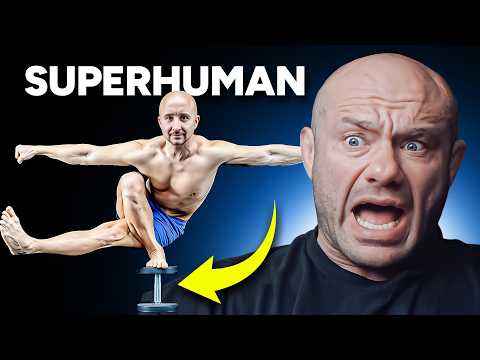
[@RenaissancePeriodization] Exercise Scientist Critiques Modern Calisthenics — It’s Flat-Out Insane!
![[@RenaissancePeriodization] Summarizer](https://summaries.pages.dev/img/logo.webp)
Link: https://youtu.be/aOfqOdi8lVc
Short Summary
Dr. Mike from RP Strength reviews impressive calisthenics feats, emphasizing the combination of strength, balance, and body control required. He highlights key figures like Hannibal for King and suggests incorporating weight training to further enhance strength and overall calisthenics performance.
Key Quotes
Here are five direct quotes from the YouTube transcript that represent particularly valuable insights or strong opinions:
-
"So, if you're going to do real convincing pull-ups and get all the benefits of growth, of joint health, of mobility, and of being able to tell people with a straight face, I can do XYZ numbers of pull-ups, and of course getting a big training effect for all your other calisthenics moves, you're going to want to go all the way down to a dead hang almost every time, if not every time." (Highlights proper form importance for maximizing benefits.)
-
"Balance is really big. And remember, balance is hugely genetically determined, but you can train it on the margins substantially by, drum roll, training balance. And here's the thing about balance. It has huge task specificity." (Addresses the role of genetics in balance, but stresses the importance and task specificity of training it.)
-
"So every time you see somebody do a body weight movement, it's not just the force production that's required. It's the force production in the face of balance requirements that makes it really, really, really, really, really, really tough. And of course, concommentably, very, very impressive." (Explains why seemingly simple bodyweight exercises can be incredibly challenging due to balance demands.)
-
"So, when you want to do calisthenics, don't do it for the strength. You can get all the strength of calisthenics and then some just training with modified powerlifting or power building split. What you're going to do if you want to do calisthenics is you're going to get a lot stronger and learn how to balance and position your own body to pull off the technique." (Clarifies that weight training is superior for pure strength gains and that calisthenics is primarily about strength combined with body control.)
-
"So, if you're to a point where you can do 20 or 30 of all of the moves, reps and pull-ups and dips and all combinations thereof and all the all the weird stuff, once you can do that, adding weight to the bar is real smart because it gives you that next push that your body weight alone isn't heavy enough to give you. And that's that big unlock." (Suggests that when a person can perform 20 or 30 reps, it is time to add weight.)
Detailed Summary
Here's a detailed summary of the YouTube video transcript, broken down into bullet points:
Key Topics:
- Calisthenics: An overview of calisthenics, impressive feats of bodyweight strength, training methodologies, and how calisthenics compares to weightlifting.
- Impressive Calisthenics Feats: The video showcases various impressive calisthenics exercises and movements performed by athletes, focusing on the strength, balance, and control required.
- Training Principles: Discussion of the importance of specificity vs. overload in training for calisthenics. Emphasizes the benefit of supplementing calisthenics with weight training for increased strength and progress.
- The Calisthenics Physique: Acknowledges that while calisthenics can contribute to a well-developed physique, the extraordinary results are influenced by genetics.
- Injury Management/Safety: Touched upon briefly, but the video emphasizes that some calisthenics moves are high-risk and require careful training and consideration of joint stress.
- RP Strength Products (Hyper Belt): A promotional segment for the RP Strength Hyper Belt, highlighting its adjustability, comfort, and core support.
Arguments & Information Discussed:
- Hannibal for King: Celebrated as a pioneer of modern calisthenics, known for his unique and intense pull-up variations.
- Discussion of his pull-ups to the lower abdominal region and the seamless transition between pulling and pushing.
- Emphasis on the importance of full range of motion (locking out at the bottom of pull-ups) for maximum benefit.
- Chris Heria: Recognized as a prominent figure in calisthenics.
- Showcasing of his balance-focused moves, particularly the one-handed "dragon flag" or "candlestick" variation.
- Discussion of the genetic component of balance and how specific training can improve it for particular calisthenics exercises.
- Partial Incline Press (Insectoid Scorpion Man Push-Up): Analyzes the biomechanics, highlighting the involvement of front deltoids and lower pecs.
- Emphasis on the importance of balance and stability in performing such complex movements, which can limit peak force production.
- Suggestion to build up strength by inclining bench pressing.
- Scott (Alcoholic Calisthenics Athlete):
- Showcasing of his impressive sternum pull-ups and physique.
- Discussion of the genetic component of muscle shape and ab definition.
- Emphasis of hypertrophy of the abs by having to use them as a requirement of performing the movements.
- Connective Tissue Strength: Notes that new calisthenics moves really test your connective tissue integrity through your wrists and that it should be approached with caution.
- Strength vs. Technique: Stresses that while impressive calisthenics requires strength, it's the combination of strength, bodyweight control, and technique that makes it remarkable.
- The Value of Weight Training: Argues that for optimal strength development, weight training (barbells, free weights) is superior to bodyweight training alone.
- Suggests using weight training to get stronger and then use the extra strength to perform the complex calisthenic techniques easier.
- Recommends incorporating weighted pull-ups, dips, and other exercises to progressively overload the muscles and connective tissues.
- Steep Steepki (Weighted Calisthenics): Highlights his impressive weighted pull-ups to illustrate the benefits of combining weight training with calisthenics.
- Argues that adding weight allows for progressive overload when bodyweight alone becomes insufficient.
- Balance & Control on Rings: Showcases a person performing calisthenics moves on unattached rings, emphasizing the extreme balance and control required.
- High-Risk Nature of Calisthenics: Acknowledges the high-risk nature of some calisthenics moves, especially those performed at height, requiring "gargantuan testicles."
- Training Recommendations:
- Prioritize the actual calisthenics movements for technique and control.
- Incorporate resistance training (weights) to build strength and reinforce joints.
- Develop balance and coordination within the calisthenics environment.
- Final Rating: Dr. Mike rates calisthenics as "amazing people with abs and thumbs of steel out of 12."