[@RenaissancePeriodization] My NEW Training Program To Rebuild My Body After Surgery
![[@RenaissancePeriodization] Summarizer](https://summaries.pages.dev/img/logo.webp)
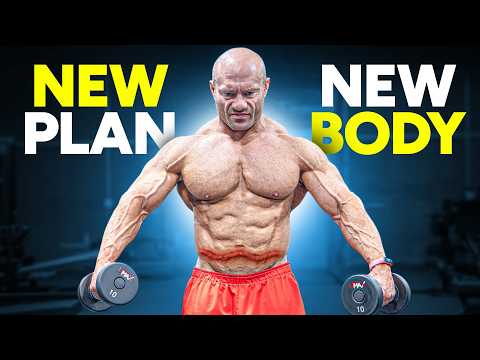
Link: https://youtu.be/gMv3fsvn--I
Short Summary
Here's the summary and the top takeaway from the video transcript:
-
Number One Action Item/Takeaway: Prioritize muscle groups and structure your program to strategically sequence exercises, considering frequency, order, and rest days for optimal muscle growth and recovery, especially prioritizing weaker areas.
-
Executive Summary: Dr. Mike outlines a 6-day weightlifting program focused on prioritizing upper back width, shoulder size, biceps, triceps, forearm, and calf size while maintaining existing leg size. The program is strategically structured with a pull, push, legs split with considerations to exercise order and rest days to emphasize weaker muscle groups and allow for proper recovery.
Key Quotes
Here are 5 direct quotes from the video transcript that provide valuable insights:
-
"The elephant fat injections into my cock definitely have taken hold. It has rendered my cock both insensate and useless, but boy is it large and that's all that matters." (This statement appears to be an attempt at dark humor. It is a surprising statement that highlights a willingness to discuss controversial and graphic topics).
-
"One cool thing we know from exercise and sport science is that once you've been big in a muscle group, getting back to that same size and even a little bit beyond does not take much work." (This quote provides a valuable insight into muscle memory and how it simplifies regaining lost muscle mass).
-
"...every single person you meet with a hugely genetically advanced body part when they train it, they gets incredibly sore. And like it's curious every also everyone who has a body part that doesn't grow just can't get sore or is very very you have to put in the volume like crazy or just adapts after two weeks and stops getting on my back earlier% started getting sore like my back progress has been insane." (This quote suggests a possible correlation between muscle soreness and muscle growth, especially in the context of genetic predisposition, which is an interesting observation and opinion).
-
"That's the thing is like you can think you know it all. To paraphrase Nate Nate Diaz, you don't. You don't. Um, you can always learn better technique. You can always learn mind muscle connection. These things take sometimes years and decades to develop. And then when you do, your training becomes so efficient because the stimulus to fatigue ratio climbs. You don't need as many sets to do the job. Kind of crazy." (This quote emphasizes the importance of continuous learning and improvement in training technique, highlighting the long-term benefits of refining mind-muscle connection).
-
"Another thing is that's unusual about this program just to call out is like why would I train my legs after shoulders and biceps on the same day? The answer is first of all priority. I need bigger shoulders and biceps more than I need big legs. And your legs, you could train even less than this and still get them back to their old time. Yes. And almost everyone could do shoulders and biceps for four legs and still get a great leg workout. The opposite is Yes." (This quote explains the unconventional approach of prioritizing specific muscle groups and strategically placing leg training after upper body work due to systemic fatigue. It reveals a unique understanding of program design).
Detailed Summary
Here's a detailed summary of the YouTube video transcript, presented in bullet points, excluding sponsorships and advertisements:
Overall Program Design
- Dr. Mike discusses his new training program designed for his physique "comeback" after reconstructive surgery.
- The program prioritizes improving upper back width, shoulder size, biceps, triceps, forearm and calf size while bringing his legs back up to standard.
- The program is built within the RP Hypertrophy app (shown in graphics).
- It's a 6-day program but demonstrated with the first 3 days, as the next 3 days are similar.
- The schedule is 3 days on, followed by 1-2 days off (or 3 days if extra recovery is needed), making a 4-week program last about 6 weeks.
- Program is based on a "pull, push, legs" split, but with an emphasis on lateral deltoids and biceps.
Day 1: Back, Delts, Biceps
- Back (7 sets total):
- Pull-ups: 3 straight sets of 5-15 reps (sometimes weighted). Focus on hardcore, full range of motion.
- Pull-downs: 3 straight sets of 15-20 reps, using a different grip. Variation for muscles still being worked, but easier on joints.
- Cable Flexion Row: 1 set, 20 reps, occasionally a myo-rep set (30 total reps with short rests). Focuses on width, reduces systemic fatigue allowing more energy for other muscles.
- Delts (4 sets total):
- Seated Dumbbell Laterals (slight incline): 1 straight set of ~20 reps, then 3 myo-rep matched sets. High volume to address weakest body part. Delts are key for physique silhouette.
- Biceps (1 set total):
- Cable Bicep Curls: 1 myo-rep set of 30 total reps. Not as homeostatically disruptive, allowing for sufficient stimulation and recovery before Day 3 biceps training.
Day 2: Chest, Triceps, Forearms
- Chest (2 sets total):
- Smith Machine Incline Press: 2 sets, "Jerry presses" (high clavicle touch, elbows back, up and forward). Chest is sensitive to volume.
- Triceps (5 sets total):
- Smith Machine Skullcrushers: 1 straight set of 15-20 reps, followed by 2 myo-rep matched sets.
- Incline Dumbbell Press: 2 sets. The triceps are forced to become the limiting factor.
- Forearms (1 set total):
- Freeotion Bar Wrist Curls: 1 myo-rep set of 60 total reps.
Day 3: Delts, Calves, Biceps, Quads, Hams, Glutes (Legs +)
- Rationale: Amalgamation of muscle groups. Calf training can interfere with legs. Must hit delts, biceps, quads, hams, and glutes. Legs have been big previously and do not take much work to get back to that same size or even a little bit beyond.
- Delts (4 sets total):
- Atlantis Laterals Machine: 4 sets (1 anchor set, 3 myo-rep matched sets), ~20 reps per set (80 total).
- Calves (3 sets total):
- Belt Squat Calves: 3 sets, each with myo-rep breaks.
- Biceps (3 sets total):
- Lying Dumbbell Curls: 3 sets (anchor set, 2 myo-rep matched sets).
- Hams (2 sets total):
- Stiff-Legged Deadlifts: 2 sets, big deficit, super slow. May try no lockout in the future.
- Quads (2 sets total):
- Belt Squats: 2 sets (1 anchor set, 1 myo-rep matched set), starting with 15 reps, working up to 20.
- Glutes/Quads (1 set total):
- Barbell Lunges: 1 myo-rep set, working up to ~40 steps.
Key Concepts and Philosophies
- Myo-Rep Matching: Using a straight set as an anchor, then performing subsequent sets with the same rep number, but with mini-breaks to achieve that number.
- Volume & Recovery: Balancing high volume with adequate recovery. Recognizing that more volume is generally beneficial if recovery is possible.
- Mind-Muscle Connection: Emphasizing the importance of connecting with the targeted muscles, allowing for more efficient training with fewer sets.
- Stimulus to Fatigue Ratio: Striving to maximize muscle stimulation while minimizing systemic fatigue.
- Exercise Order: Intentionally ordering exercises to either pre-exhaust specific muscles or minimize interference between muscle groups (e.g., calves between delts and biceps).
- Prioritization: Intentionally biasing the program towards upper body development while allowing legs to maintain or slightly increase in size. Prioritizing muscles that need more development first.
- Soreness: Believes soreness has a huge profound connection predictively to growth.
- Individualization: Program is tailored for Dr. Mike's specific needs and weaknesses, acknowledging that others may need to adjust exercise selection and volume.
- Pull Push Legs Split: logically intelligent with an extra rest day added in.
- Lateral delts and biceps hit on leg days: allows for a rest day between them.
Jared's Input
- Jared confirms he also does high delt volume.
- Jared emphasizes the importance of lateral deltoid training.
- He also praises the logical flow and nuances of Dr. Mike's program design, and the understanding on why the muscles are being hit in the specified order.