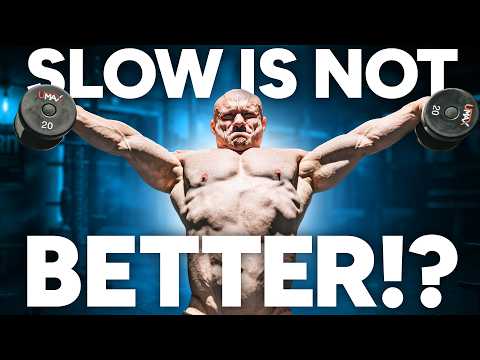
[@RenaissancePeriodization] Rep Speed for Muscle Growth: Did I Overhype Slow Reps?
· 3 min read
![[@RenaissancePeriodization] Summarizer](https://summaries.pages.dev/img/logo.webp)
Link: https://youtu.be/reiB9uQ6O4E
Short Summary
Dr. Mike Israel clarifies a common misunderstanding that he and Jared Feather advocate for "super slow" training for everyone. While they frequently cue slower eccentrics, especially during instructional sessions with pro-bodybuilders and new clients, this is primarily for safety, improving mind-muscle connection, and facilitating on-the-fly technique adjustments. They assert that once trainees are proficient and safe, faster eccentrics are equally effective for muscle growth, a finding supported by scientific literature.
Key Quotes
Key Quotes
- "folks very understandably assume that Jared and I are pro slow, that we think this is the way to train for everyone. But we flubbed. it's our bad."
- "going slower is safer categorically."
- "if you're confident that you won't get hurt, you can connect just fine with your muscles, and your technique, the actual pattern of movement is rock solid, not just a free-for-all, feel free to go as fast on the eentric as you like."
- "controlled concentrics that are intentionally slow kind of just suck the life out of you. They're not fun."
Detailed Summary
- Dr. Mike admits to being wrong about the perception that he and Jared Feather universally recommend "super slow" training.
- The misconception arose from their consistent cues to clients, particularly pro-bodybuilders and new trainees, to perform slower eccentric phases and pauses at the bottom of movements.
- They explain that these specific cues are given for three primary reasons:
- Safety: Slower movements reduce kinetic energy, minimizing injury risk, especially for strong athletes with potentially lagging tendon integrity.
- Mind-Muscle Connection: A slower pace helps trainees better connect with and activate target muscles (e.g., quads over glutes).
- Technique Adjustment: Slower movements provide opportunities for immediate, on-the-fly technical corrections from coaches, making each rep an instructional moment. This is crucial for new clients learning their training approach.
- Faster eccentrics are perfectly acceptable once safety, proper technique, and mind-muscle connection are established.
- Scientific literature consistently shows that eccentric phases between 1 and 6 seconds yield similar muscle growth (hypertrophy) benefits, provided sets are taken to muscular failure.
- Slow eccentrics remain beneficial for learning new techniques, enhancing safety, improving mind-muscle connection, or simply for adding training variation.
- For the concentric (lifting) phase, moving as fast as possible is generally fine with a slight increase in risk; a 1-2 second concentric is good for less risk.
- Intentionally slow concentrics are generally not recommended as they can be demotivating and do not offer superior hypertrophy benefits.
- Crucially, during the eccentric phase, muscles must actively resist the weight, not just "dump" it, to achieve full muscle growth benefits.
- The RP Hypertrophy app is mentioned as a tool that demonstrates initial reps with a slightly slower cadence for learning, allowing users to increase speed as proficiency grows.