[@RenaissancePeriodization] Why Your Favorite Exercise Might Be Useless For Muscle Growth
· 5 min read
![[@RenaissancePeriodization] Summarizer](https://summaries.pages.dev/img/logo.webp)
Link: https://youtu.be/EjMQr20GQkI
Duration: 20 min
Transcript: Download plain text
Short Summary
This episode explains how body proportions (limb and torso length) cause build-exercise mismatches that limit muscle growth on common lifts. It walks through specific fixes for lat pulldowns, bent-over rows, and stiff-legged deadlifts, plus alternative exercises for non-standard body types. The framing targets hypertrophy trainees whose height, femur, arm, or torso dimensions deviate from the average.
Key Quotes
- "most hack squats are pretty good but leg presses are fucking industry-wide disaster. Most leg presses are angled wrong, the range of motion is cut super short, the back pad is angled wrong. It's like a giant attempt at a sick joke to get you a lower back workout instead of a quad workout." (00:06:43)
- "They just don't care if your torso is a single point in Euclidean space or like the longest line ever in the universe." (00:04:18)
- "Your spinal erectors need to be bigger and strong." (00:13:55)
- "There is no exercise you have to do. There are no must do exercises. That is a myth." (00:18:34)
- "Effort. That part always be on you." (00:20:29)
Detailed Summary
Build-Exercise Mismatch Overview
- A mismatch occurs when an exercise's target muscle isn't the muscle being stimulated most, commonly affecting lifters whose height, femur, arm, or torso length deviates substantially from average — even on basic compound lifts.
- The concept is central to hypertrophy training and exercise selection.
Lat Pulldown & Vertical Pulling
- On a lat pulldown machine, users who are too short have the machine bottom out before the bar reaches the chest, eliminating peak contraction; users who are too tall lose the deep top stretch because elbows are only half-bent.
- A V-bar attachment sits roughly 3–4 inches lower than a straight bar, which both increases the lat stretch and lets shorter users reach it without jumping.
- The lengthened partials portion (pulling to eye level) is the range that produces the most muscle growth, so users with non-adjustable machines should continue partial reps there.
- For tall users, leaning back 15–30 degrees — especially with a wider grip — can provide an adequate lat stretch.
- Pull-ups adapt to any body mechanics and serve as a universal replacement; assisted pull-ups and kinder machines are alternatives, and short users can hang cable attachments off the assisted pull-up machine to get full range of motion.
Barbell Curls
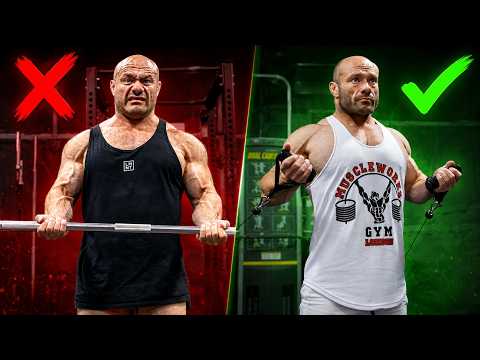
- For barbell curl discomfort from poor wrist/elbow mechanics, the EZ bar (used inside or outside grip) is a major fix, and some users can use it permanently in place of barbell curls.
Bent-Over Rows
- Lifters with very long torsos fatigue their spinal erectors progressively during bent-over rows, causing back rounding across reps and eventual failure driven by lost posture and reduced neural drive, not pulling strength.
- Because the bottom portion of the movement (closer to the stretched position) produces more growth, long-arm lifters doing bent rows lose tension at the bottom to complete the lift, effectively turning every rep into a cambered-bar row.
- Advanced technique for long-arm lifters: start each rep at 90° of hip flexion and finish at 45°, using the improving leverage as the bar is pulled up.
- To build erectors that limit row performance, trainees should train deadlifts, stiff-legged deadlifts, good mornings, and flexion rows.
- For tall lifters with long arms and a short torso who struggle with rows, the suggested fix is to superset regular rows with partial reps: perform strict reps until unable to touch the tummy, then reset and pull halfway for additional reps to increase time in the lengthened position.
Stiff-Legged Deadlifts
- Stiff-legged deadlifts fail to load the hamstrings at sufficient stretch for lifters with long arms, short torsos, and very flexible hamstrings, because the plates hit the floor before the hamstrings reach a painful stretch under load.
- Fixes include: pushing the chest up at the bottom to tilt the hips, using a snatch or super-snatch wide grip to functionally shorten the arms, cueing an arched back with hips and knees pushed back, and loading 25 lb plates to gain 2–3 extra inches of travel.
- The speaker reports from personal experience that roughly 6 extra inches of functional arm shortening on the stiff-legged deadlift makes a large difference in hamstring stretch.
- A sign the lift is effectively training the hamstrings: a painful stretch at the bottom of every rep, with the lifter unable to walk for a week after three sets.
- Recommended replacements when the lift can't be made to work: good mornings, 45-degree back raises, and Smith machine hamstring leans.