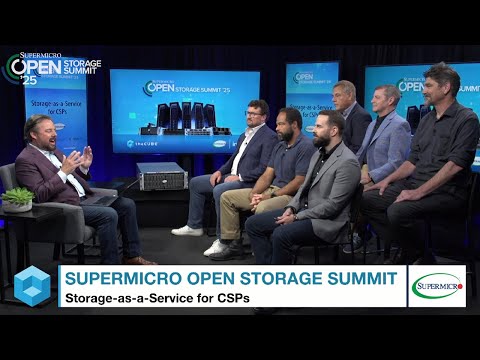
[@ServeTheHomeVideo] Storage-as-a-Service for CSPs - Open Storage Summit 2025 Session 3
![[@ServeTheHomeVideo] Summarizer](https://summaries.pages.dev/img/logo.webp)
Link: https://youtu.be/eJn3LiwEoOQ
Short Summary
Okay, here's the requested summary and takeaway:
Number One Takeaway:
Cloud Service Providers (CSPs) should strategically align storage media (SSD, HDD, Tape) with specific workloads to optimize performance, cost, and efficiency while maintaining security and scalability.
Executive Summary:
This Super Micro Open Storage Summit panel highlights the evolving landscape of storage as a service from the perspective of Cloud Service Providers (CSPs). The discussion emphasizes the shift towards flexible, scalable, secure, and intelligent storage consumption models that enable digital transformation, driven by factors like cost, efficiency, and simplified management. Leading technology vendors provide insights into how their solutions address these key requirements for CSPs.
Key Quotes
Here are five quotes extracted from the YouTube video transcript that I found particularly insightful:
-
"This discussion reveals why storage as a service is becoming a foundational pillar of digital transformation initiatives in hybrid cloud architectures." - This highlights the critical role of storage as a service in modern IT strategies.
-
"The goal here is having from a cyber point of view data immutability being able to offer the air gap having that kind of multi-layer protection and then of course the resiliency and ability to restore and recover uh that data." - This emphasizes the importance of robust cyber security measures in storage as a service offerings, including immutability, air gaps, and recovery capabilities.
-
"Competing with hyperscalers is really tough. Um you can't build typically at that scale with as many choices. And so um enabling you to do that uh to establish a discrete uh high performance block storage tier uh can unlock new revenue streams and can improve customer experience and can enable you to take on a broader range of workloads." - This concisely captures the competitive pressures faced by CSPs and how specialized storage solutions can create advantages.
-
"You also have power users and they need to be able to access the system and get the bandwidth that you promised. So you have to optimize and preferential access for some user and make sure the bad actors are not taking advantage." - This points out the need for robust quality of service controls to prioritize access and prevent resource abuse in object storage systems.
-
"So even though flash and SSD could cover the entire range of storage operations uh from a disk perspective inside of the data center, we won't see that as a good decision for financially and economically uh by operators." - This states an important economic consideration for service providers and users of storage as a service, explaining why different types of storage technologies are used and are relevant from hot to cold tiers.
Detailed Summary
Here's a detailed summary of the YouTube video transcript, focusing on the key topics, arguments, and information discussed:
Overall Topic: Storage as a Service (STaaS) from a Cloud Service Provider (CSP) perspective.
Key Arguments/Points:
- Transformation to STaaS: Explores the shift from traditional capital-intensive storage models to flexible consumption-based services delivered by CSPs.
- Drivers of the Shift: Highlights key factors driving the adoption of STaaS:
- Cost efficiency
- Scalability
- Security
- Standardization
- Simplified management
- CSP Technologies: Discusses how CSPs are leveraging technologies like AI-powered optimization and SLAs to deliver cloud experiences across on-premise, edge, and public cloud environments.
- Digital Transformation Foundation: Positions STaaS as a critical element of digital transformation initiatives within hybrid cloud architectures.
- Benefits of STaaS: Emphasizes the flexibility, security, and intelligence of STaaS models, empowering enterprises in a data-driven world.
- Importance of Multiple Perspectives: Highlighting the need for diverse views from various stakeholders, particularly with the rise of AI.
Panelist Insights:
-
Cliff Madrew (Iron Mountain/Ironcloud):
- Discussed Iron Mountain's evolution from physical records management to digital storage and IT asset lifecycle management.
- Focuses on bridging the gap between physical and digital assets.
- Emphasizes a five-step journey for digital transformation: asset assessment, digitization, automation, data extraction, and governance.
- Highlights Ironcloud's cyber resiliency and focus on protected data storage, including air-gapped storage.
- Stresses the importance of TCO (Total Cost of Ownership) considerations and balancing protection across different workloads.
- Foundation built around Scalability, Standards and Security/Protection
-
Georgio Regini (Scality):
- Describes Scality as a software-defined object storage company focused on large deployments (petabytes to exabytes).
- Key use cases: cloud infrastructure, AI, and immutable backups.
- Security and scalability are paramount, including handling hundreds of millions of customers and billions of buckets.
- Emphasizes economics, data durability, and offering a single view of all storage activity.
- Advocates a unified platform for diverse use cases, such as backup, video streaming, and long-term archiving.
- Outlines the architecture of Ironcloud (connector, storage servers, tape) and data lifecycle management with extended data management.
-
Rex Manso (Light Bits Labs):
- Light Bits Labs focuses on high-speed, low-latency block storage via NVMe over TCP.
- Emphasizes cost efficiency, resiliency, and high performance for CSPs competing with hyperscalers.
- Aims for twice the performance and half the cost of traditional SAN storage.
- Offers disaggregated, software-defined block storage over Ethernet.
- Integrates with a variety of hypervisors and orchestration platforms.
- Focuses on easy adoption and broad availability on commodity parts.
- Offers multi-tenant capabilities, quality of service, and scalability.
-
Mark Iskra (Intel):
- Intel helps CSPs with a wide range of performance requirements, from high-IO AI training to glacial storage.
- Many CSPs prefer to build their own storage solutions for differentiation and telemetry needs.
- Cost sensitivity and the need for efficiency are key.
- Importance of white box solutions, high density, and a wide range of power/component options.
- Reliability, durability, and security (including data-in-use encryption) are crucial.
- Intel supports CSPs through silicon, partnerships, and open-source projects.
- Xeon 6 processors offer industry-leading PCIe Gen 5 lanes and MR DIMMs.
- Intel emphasizes accelerators (QAT, AVX, IAA) and open-source APIs.
- Highlights Intel's contributions to Kubernetes and IO resource isolation.
-
Mark Tangway (Western Digital/WD):
- Western Digital focuses on aligning storage media technology (SSD, HDD, tape) to the right workloads for optimal TCO.
- SSD/Flash for hot workloads, HDD for warm, and tape for cold.
- HDDs offer high performance and sufficient capacity for a wide range of warm workloads.
- Hard drives continue to see innovation for increases in capacity and density.
- Innovation is constantly being done on hard drives like HelioSeal and triple stage actuators.
- HDD capacities projected to reach 100TB by 2030.
-
Paul Mloud (Super Micro):
- Super Micro offers a building block approach, delivering everything needed inside a data center.
- Relies on diverse partnerships to adapt to rapid market changes.
- Focuses on delivering solutions for the cloud that emphasize economy of scale.
- Offers a wide range of storage components for both block and object storage.
- Building upon open standards for integrations with solutions.
- Focuses on power efficiency and techniques like direct liquid cooling.
-
Design Considerations (Cliff): Know your workload, understand the specific standards around the data, Security at the core of everything,
Key Takeaways:
- STaaS is a fundamental shift in how enterprises consume and manage data, driven by cost, efficiency, scalability, and security needs.
- CSPs are adopting advanced technologies and flexible architectures to meet evolving workload demands.
- The panelists emphasized the importance of choosing the correct mix of storage mediums to meet workload needs while ensuring costs align with customer margins.
- Partnerships and open standards are essential for building robust and scalable STaaS solutions.
- Security must be at the core of design considerations.