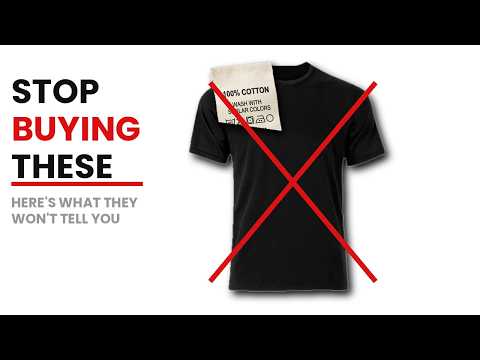
[Shift Fashion Group] You Will Never Look at T Shirts the Same
Link: https://youtu.be/CMoZjcpgivM
Duration: 31 min
Short Summary
This episode provides comprehensive education on cotton fiber quality, spinning methods, and knit construction, explaining why micronaire (3.7-4.2), ring-spun yarn, and interlock knits create superior garments. The speaker details common manufacturing shortcuts that compromise durability, including tubular fits, loose stitch spacing, silicone coatings, and poor collar geometry that causes 90% of shirt failures at the collar. Key quality indicators like wavy hems, collar puckering, and fabric grain angles help consumers identify poorly constructed shirts that lack proper pre-shrinking, elastic in ribbing, and appropriate AQL standards.
Key Quotes
- "This is a product that is meant to be disposable. Once you see this, you cannot unsee this." (00:00:09)
- "Most people look at the tag and see 100% cotton and think they're safe, but that's like seeing 100% beef on a burger. It says the plant, but says nothing about the grade." (00:00:44)
- "If you've ever found mystery holes in your clothing, that's because that fiber lacked the strength to stand up to your washing machine." (00:00:50)
- "They rely on the fact that you can't tell the difference." (00:00:01)
- "This isn't a guide. This is a point of no return." (00:00:17)
Detailed Summary
Cotton Fiber Quality
The sweet spot for standard cotton micronaire is 3.7 to 4.2, with upland cotton averaging around 27 grams per tex while high-grade ELS cotton reaches 40+ g/tex—nearly 50% stronger. Upland cotton makes up 90% of the world's supply due to easy growth, despite scoring low on quality metrics, while Pima cotton is described as the gold standard for performance-to-value ratio. The combing process removes approximately 15% of cotton fiber, which gets recycled into products like cotton balls and Q-tips.
Spinning and Yarn Construction
Open-end spinning produces rough, stiff fabric; ring-spun and compact ring-spun are the gold standard, with compact using vacuum to create nearly hairless yarn. The sweet spot for high-quality modern t-shirt yarn count is 30-40 singles; luxury dress shirts use 60 and above. GSM (grams per square meter) alone does not indicate luxury—200 gsm can be achieved with thick loosely knit yarn or fine tightly knit yarn, resulting in drastically different products.
Knit Types and Fabric Quality
An estimated 99% of the world's t-shirts use single jersey knit, knit on circular machines with a technical face (smooth side) and technical back (loops), offering lightweight construction with natural mechanical stretch. Interlock knit uses two sets of needles to create identical fabric on both sides, producing superior stability and less stretch over time. Loose knit construction saves brands money but causes fibers to migrate to the surface, rub together, and form pills after wear and washing.
Dyeing and Finishing
Reactive dyes change the molecular structure of cotton and bond to the fiber, producing colors that last significantly longer than pigment or sulfur dyes which only sit on the fabric surface. Luxury brands use mercerization or liquid ammonia treatment to change cotton fibers from flat bean-shaped to rounded, resulting in smoother, softer fabric with slight sheen and deeper colors. Silicone emulsion coating applied to cheaper knits gives a soft, buttery feeling in stores but leaves an oily residue and washes off after two to three home washes, changing the shirt's feel.
Shrinkage and Pre-Shrinking
Unpre-shrunk cotton knit fabric can shrink upwards of 10% during first wash because cotton fibers relax and return to their natural kinked state after being pulled straight during knitting and spinning. Proper fabric mills pre-shrink fabric using steam pre-shrinking (to relax fibers with steam) or compacting/sanforization (to force knit tighter together), limiting shrinkage during consumer washes.
Collar Construction Failures
90% of shirt failures occur at the collar due to design flaws and material choice—traditional pattern makers use rectangular ribbing which cannot accommodate the complex two-curve geometry of the human neck (front curve, back curve, and transition at the trapezius muscle). Good pattern makers put two seams, one on each trapezius muscle, to eliminate excess fabric in the collar. 100% cotton collar ribbing deforms and never returns to its original shape because cotton lacks mechanical stretch and recovery; elastic yarn like spandex (elastane) or serona must be included in ribbing to bring it back into shape.
Shirt Construction Details
A forward leaning shoulder seam running from the back of the collar over the shoulder balances the shirt and prevents it from rolling forward or backward. Using a backward shoulder seam with heavier weight fabric pulls the shirt down on the back and up on the throat, pressing on the neck all day. Deep armholes anchor the sleeve to the body, causing the shirt to lift whenever the arm is raised, while high armholes prevent this movement.
Cost-Cutting Measures to Avoid
Tubular fits (common from Gildan) eliminate side seams (saving 2 sewing steps) as a cost-cutting measure but torquing and twisting over time since humans are not shaped like pop cans. By spacing stitches further apart, factories can run machines faster and produce more garments, but this results in less durable garments.
Construction Stitches
T-shirt construction uses overlock stitch for side seams, two-needle cover stitch for bottom hem and sleeves, and chain stitch for shoulder seams (chain stitch provides more mechanical stretch to prevent seam breaking). Quality brands add neck tape across both shoulders to cover the seam and improve comfort.
Quality Indicators
Wavy bottom hem indicates rushed production; demonstrated example showed approximately half inch difference between ends of the hem. Wavy collar results from uneven feeding into sewing machine causing puckering. Fabric grain cut and sewn at an angle indicates a product designed to be disposable.
Manufacturing Tolerances and Quality Standards
Most brands set manufacturing tolerance at half inch on flat measurements; for example, a chest designed at 18 inches can range from 17.5 to 18.5 inches. AQL (acceptable quality level) is a statistical tool to check bulk production defects; rocket parts and medical instruments require zero AQL while fast fashion typically lacks quality standards. Precision costs money: high tolerance products require slower factory speeds, more rejected pieces, and lower profit margins; brands set AQL based on customer expectations (tight for $1,000 shirts, loose for $5 shirts).
Full Transcript
Show transcript
Day after day, we are bombarded with ads from brands claiming everything [music] is premium or luxury. They rely on the fact that you can't tell the difference. This is a product that is meant to be disposable. Once you see this, you cannot unsee this. This isn't a guide. This is a point of no return. Once you learn how to audit the architecture of a garment, you will stop seeing premium basics and you'll start seeing the reality of what you're holding in front of you. To understand the truth, we have to go deeper than the surface. We aren't just looking at the fit and the color, but we're going to be stripping it down to a molecular level. Starting with the very DNA of the fabric, the cotton fiber. Most people look at the tag and see 100% cotton and think they're safe, but that's like seeing 100% beef on a burger. It says the plant, but says nothing about the grade. On one end, we have upling cotton. On the other end, we have extra long staple fiber cotton like puma or sea island cotton. But what is the difference and why does it matter? It really comes down to the big three units of measure. We have staple length, micronare, and grams protects. Staple length matters because the way you create yarn is through twist and friction. The longer the fibers, the less hairy ends that you'll have and the smoother and more durable yarn. Micronair measures fiber finness and maturity. If staple length is how long, micronair is how thick. For standard cotton, the sweet spot is 3.7 to 4.2. Strength is the final unit of measure measured in grams per text. The average for upland cotton is around 27 g per text, making it quite fragile. True high-grade ELS cotton can hit upwards of 40 g per text or higher, making it almost 50% stronger. If you've ever found mystery holes in your clothing, that's because that fiber lacked the strength to stand up to your washing machine. Now that you know how it's measured, let's talk about the four most well-known types you'll come across. This is up cotton. This makes up 90% of the world's cotton supply. As you can see, they're quite short fibers. It also scores low on almost every metric, but because it grows easily, it's become the industrial standard. Next we have Pimac cotton. Sometimes called sepa cotton. Pimac cotton is the gold standard when it comes to cotton fibers itself. It offers the best performance to value ratio. Beyond that you have specialty fibers. You have Giza cotton from Egypt and Sea Island cotton from the West Indies. These fibers are the best of the best, but they're also the rarest. Understand that when you're looking for these fibers, you're going to be reaching diminishing returns when it comes to performance to value ratio. The last most common type is chief value cotton or CBC cotton. This is a blend of cotton and chopped up polyester. You usually find this at a 60% cotton, 40% polyester ratio, and factories use the worst quality up cotton to make this. Some brands will market this as their performance or softline, but in reality, it traps heat and pills horribly. I want to leave you with two warnings here. You've likely heard the term Egyptian cotton. If it doesn't explicitly state that it is Giza cotton, it's most likely just cheap upland cotton grown in Egypt. This is difficult to catch, but if the price is probably too good to be true, the fiber quality probably is too. Now that you know how the different fibers work, let's actually talk about the yarn itself. Every yarn starts off with a process called carting. This is a mechanical cleaning process that lines all the fibers into rough rope called sliber. The problem with just carding is it leaves in the shorter, weaker fibers. In standard garments, this is where they stop. This results in a fabric that might feel good in the stores with the help of some chemical softeners, but quickly becomes fuzzy and scratchy against the skin. For higher tier garments, the cotton must be combed. The way the combing process works is they'll actually clamp the fibers on one side, essentially run mechanical bristles through it. This is going to remove the shorter, weaker fibers, and what you're left with on this side, as you can see, are more lines, stronger fibers that will lead to a significantly stronger and smoother yarn. It does cost more though because you're removing about 15% of your product and typically this stuff is recycled into stuff like cotton balls or Q-tips. What you're left with are stronger, more uniform and aligned fibers that will twist into a stronger, finer yarn. Before we talk about how we spin, we have to talk about what we're trying to achieve, which is the singles count. The singles or yarn count is a measure of how fine a yarn is. Think of it as a scale of finness. The higher the number, the finer the yarn. You have 30 to 40. Think of this as a sweet spot for a highquality modern-day t-shirt. On the higher end, you have 60 and up. These are super fine yarns. They're typically reserved for luxury dress shirts. Let's talk about the methods and how we actually spin the yarn. First, you have open-end spinning. This is the fast industrial method. If your shirt feels rough and stiff, it's probably made using this method. Next, you have ring spun and compact ring spun. This is the oldest method and still the gold standard. Compact spinning takes that even further by using a vacuum to pull in all those stray fibers to create a yarn that's almost hairless and almost cool to the touch. Another method you'll find and a more modern method, it's called vortex spinning or MVS. This uses air jets to tightly wrap the cotton fibers so tight that it's almost impossible to pull out. It makes a very good pillres resistant fabric. The trade-off is though that the yarns are often stiffer and not as soft and plush as a ring spun yarn. As you can see with this yarn here, I'm actually going to show you what I mean that's held together with friction. If I twist it the opposite direction, I can actually pull it apart. And these are the cotton fibers that are being held together based off of the length here. This is a ELS cotton. Once you have your singles, you have to look at the ply. Most t-shirts are going to be what's called a single ply yarn, which is a single strand. This is the industry standard. When you get to higherend yarns, [music] they're going to be using what's called two ply, which is basically two yarns spun together. This matters because what's called torquing yarn because it's twisted. It's unbalanced. It naturally wants to untwist itself. If you ever seen a t-shirt that starts twisting towards the stomach after one wash, that is a single ply yarn trying to untwist itself. In a two ply yarn, the two strands counteract that twisting force. So, you end up with a shirt that stays balanced and square. For an even finer finish, really high-end mills will do what's called gassing, where they run the yarn through a flame and basically burn off all the tiny little fuzz bits, so you're left with a yarn that is super ultra smooth. One final warning about the term ringspun. A lot of brands know that consumers are starting to look for that term ringspun cotton. So to check a marketing check box, sometimes brands will use very lowquality cotton and still put it through the ringspun process just to check that box. So if you see a shirt that still says ringspun cotton, but it's rough, it's scratchy, and it's thick, it's most likely there just to check that marketing check box. Now that you've learned about how yarn is, let's actually talk about the knit itself. You may have heard of the terms woven and knit before. While a woven is like a basket with interlacing yarns, a knit, which is what t-shirts use, is going to be a series of interlocking loops. This is the architecture of a garment and it will determine whether your shirt is going to last years or turn into a sheer twisted mess after one wash. Most t-shirts are going to be using what's called a single jersey knit. This is knit on a circular knitting machine. It is a simple knit with a technical face, which is going to be the smooth side, and a technical back, which is going to have all the loops. It's lightweight and has a natural mechanical stretch to it, which is why it's the fault for t-shirts. I would say 99% of the world's t-shirts are using a single jersey knit. However, if you want the top tier stability, look for a interlock knit. Think of it as a double-sided jersey. It's created using two sets of needles and you're basically knitting two layers of fabric into one. This makes a fabric that is identical on both sides. An interlock knit does not curl at the edges like a single jersey does and leads to fabric that has significantly less stretch out over time. If a shirt feels substantial and bouncy rather than thin and limp, it's most likely a interlock knit. The quality of the knit depends on the tension. A loose knit is a major red flag. Brands do this to save money. By using less yarn and stretching the loops further, they create more fabric for less cost. It feels light in the store, but because the loops are loose, those fibers can migrate to the surface, rub together, and create those knowing balls that we call pills. A tightknit locks those fibers down and prevents those fibers from migrating. But it consumes more raw material, which is what makes it more expensive. This leads us into one of the most misunderstood terms in fashion, GSM, which stands for grams per square meter. A lot of luxury brands would like to say that heavy weight means luxury, but that is not the case. All it means is the fabric is heavier. You can reach 200 gsm using a thick open-end yarn that's loosely knit. [music] But you can also reach 200 gsm by using a fine tightknit yarn. And they're going to lead to drastically different products. Now that you've knit your fabric, you have to add color to it. And that's done through a process called dying. For cotton, you're going to have three main dye types. You're going to have pigment dyes which sit on the surface of the cotton fibers and are often washed off to give that vintage look. Next, you have sulfur dyes. These are very common dyes that brands will use because they are cheap, they're effective, and they give really deep blacks. The problem with sulfur dyes is just like pigment dyes, they only sit on the surface of the fabric and over time. They will fade like that and it'll lead to a shirt that's going to look very sad in your closet over time. The last and the gold standard for dyes for cotton is what's called reactive dyes. Reactive dyes actually change the molecular structure of the cotton itself and bonds to the fiber. This is going to lead to colors that will last a significantly longer time in your closet and it's something that will age with you. Let's talk about shrinkage. Even with the best fibers and a tight knit, shrinkage is something that will still happen when it comes to cotton knits. And the reason behind that is the cotton fiber itself. The cotton fibers are not perfectly straight. They have little kinks and bends in them. And when you're doing the entire process of knitting and spinning that yarn, it's being pulled straight that entire way. So the moment that yarn hits water, those cotton fibers want to relax and go back to their natural state and that's what causes shrinkage. A lot of brands will skip any pre-shrinking steps and will actually sell you a shirt with that fabric not shrunk because again you get to make more shirts and that means more profits. proper fabric mills will pre-shrink that fabric. And there's several ways to do that. One is going to be steam pre-shrinking, which hits the fibers with steam to relax those fibers. And another step is going to be called compacting or samurization. What that does is it forces that knit to be tighter together. So when you do have that initial wash, you're limiting the amount it will shrink. Sometimes if a brand doesn't pre-shrink the fabric, it can shrink upwards of 10%. That is why you get a shirt that fits perfect in the store and then you wash at home and it turns into a crop top. Now that you know about the architecture of the knit itself, let's talk about finishes. This is the step where brands either evolve the fabric or hide its flaws. When it comes to finishes, there are three main processes. You're either going to coat the fiber, you're going to remove the fuzz, or you're going to chemically alter the fiber structure itself. The first most common way the brands will finish the fabric is by coating the fibers. This is often done with cheaper knits because it makes that shirt feel soft in the store. And this is done by using silicone emulsions. They're literally coating every single fiber in a microscopic layer of silicone. It gives that kind of soft, buttery feeling in the store, but it also leaves a little oily residue on your fingers. If you feel that in the stores, just know that that shirt is going to feel very different after two to three washes. The second method of finishing is going to be removing the surface fuzz, and that's done by using enzymes. These enzymes basically eat away at the surface fuzz on the layer of fabric. That leaves you with a softer, smoother surface. And the last method which a lot of luxury brands do is actually evolving the fiber itself. So when you look at the cotton fiber, it's more bean-shaped than circular. So what brands will do, and you'll see this with a lot of luxury brands here, I'll grab one here. As you can see with this label here, it says mercerized. Luxury brands will either go through the process of mercerization or the process of using liquid ammonia to change the chemical structure of the fiber itself. It'll take it from a flat almost bean shape to a more rounded shape. This leads to fibers that are smoother, softer. The fabric will have a little bit of sheen on it, but also reach deeper, darker colors. So if you see mercerized or liquid ammonia treated, that's usually going to be associated with higherend products because that process is costly. Now that you know what makes the fabric, we have to transform it into a three-dimensional object. [music] A brand can use the world's best pimacotton, but if they don't understand human geometry, it's just never going to sit right. Before we even look at the seams, we have to look at what's called drape. Drape is how that fabric actually falls and conforms over the body. And this is where the GSM strap really hits hard. A lot of brands are trying to do heavyweight fabric these days. That heavyweight fabric is often going to be stiffer and a lot of brands don't understand that. What you end up with is a lot of sleeves that are sticking out like wings because that heavyweight fabric will only bend at a certain place. So, the placement of that shoulder seam is going to be very important for how that sleeve drapes on your body. So, whenever you're in stores and you're trying on shirts, look at how that fabric falls on your body. Does it look good on you or does it look like a giant cardboard box? Cuz they're trying to force a fabric into a shape that was never designed to. A little bit of a warning here for this next part because once you see this, you cannot unsee this. And that [music] is bacon neck on a ribbing. 90% of the time, shirts will fail at the collar. And that's going to be because of two reasons. The design of the collar and the material choice. Let's go over the design of the collar first. Traditionally, pattern makers are taught to make ribbing like simple rectangles. What you end up with [music] is a piece of ribbing that looks like this. The issue is that the human neck is not a perfect cylinder. It's actually a series of two complex curves. You have your front curve and then your back curve. And the transition point happens right at your trapezius muscle. And that's where the ribbing needs to make a basically hard left turn or hard right turn. The issue by using a rectangle is that they're trying to force that ribbing into a collar shape. And as you can see here, when you try to force a rectangle into a collar shape, that excess fabric here needs to go somewhere. And by only having a rectangular shape, you are left with ribbing that will gape like this. You'll see it over here. Typically, you're going to see it all on one side of a shirt. What good pattern makers do is they understand the human anatomy and the need to accommodate for that excess fabric. [music] So what they will do is actually put two seams, one on each trapezius muscle to get rid of that excess fabric. So if I were to take this right here and basically do a turn, I have leftover fabric here. I can pinch and cut. And if I do that twice, you're getting rid of that excess fabric. However, even if you do that, if the brand does not account for the shrinkage, as you can see with the shirt here, you can still have those seams, here, and here. But because the brand never accounted for shrinkage, you are still left with all this excess fabric. But this is a good example of a technical team knowing what they're doing, but the manufacturing team making shortcuts. You can see the shirt is faded, probably using sulfur dyes. We have bacon neck here. So, even though the team knew what to do with the collar, it still failed. Now that you know what's important for good collar shape, let's talk about the collar materials. Everyone loves 100% cotton, but in the collar is not where you want it. Sure, the ribbing structure itself has mechanical stretch to it, but when you use 100% cotton, as you can see here, it will deform and it will never go back to its original shape. That's because cotton itself lacks mechanical stretch. What you want is an elastic yarn that will cause the ribbing to pull back. As you can see here, that elastic yarn can either be spandex, otherwise known as elastain, or you can use a material such as serona, [music] but you absolutely must have some sort of mechanical elastic yarn to bring that ribbing back into shape. Next time you're in the store, pay attention to these things. Look at the collar itself. If it looks like this already when it's brand new, it's just going to get worse. Leave it alone. If it doesn't have the two seams at the back, try the shirt on. A lot of the times you're going to see it starting to pucker on one side. Again, it's just going to get worse from there. Give the ribbing itself a little bit of tug. If it doesn't have the recovery to pull itself back or when you pull it and you don't see a little bit of shimmer in there from the spandex, that collar is probably not going to last as well. Next, let's talk about the shoulder seam. A lot of brands will default to a center shoulder seam that runs right across the top of the shoulder like this. They do that because it looks good on the hanger. The issue is that it ignores human anatomy. The human shoulder actually rolls forward a little bit. And when you have a center shoulder seam, that shoulder seam either wants to migrate forward or backwards. It doesn't sit in its place. Some brands will use a backwards facing shoulder seam. And you can use that for lighter weight fabrics because it gives you a cleaner front. However, when brands try to use a backward shoulder seam like this on a heavier weight fabric, now that shoulder seam is behind the peak of your shoulder and it wants to fall down. What ends up happening is the weight of the fabric is going to pull down on your back and this is actually going to pull up on your throat. So, if you have any heavier weight shirts and they have a backward shoulder seam, one thing you'll notice is it'll press on your neck all day. So that shoulder seam placement is very important. The proper shoulder seam placement to basically carry the garment itself is a forward leaning shoulder seam that goes from the back of the collar and rides over the shoulder almost like a like a little backpack. That's going to balance the shirt on your shoulders and it's going to prevent it from rolling forward and it's going to prevent it from rolling back. Next, let's talk about the armhole. This is actually one of the hardest parts to get right. A lot of brands will use a very deep armhole because it's easy to manufacture and fits most body types. The issue is that when you have a deep armhole, you're basically anchoring your sleeve to your body. Whenever you lift your arm up, your shirt will also go up. A brand that understands the anatomy will have a high armhole. So, you can essentially lift your arms up and the shirt won't move too much. Now that you understand the importance of shoulder seams and arms holes, let's go over the different body shapes. First, you're going to have your column shape, otherwise known as a classic or standard fit. This is your Swiss Army knife of body shapes. It's cut square from the armhole down. If done right, this is going to be the most versatile for the most bodies and in most situations. Next, you're going to have a A-line cut. You'll see this in like a true classic tea where it goes from the armpit and actually a lines out. This is good if you have a lot of visceral fat and have a belly you need to cover. The issue is that when you try to use a heavier weight or stiffer fabric with a a line, it almost looks like a pebble dress where it'll balloon out. The next is going to be an oversized boxy fit like this t-shirt. This is very in right now and this is what a lot of brands are trying to do. You're going to be using a heavier weight fabric. You're going to make it very boxy. This is very simple to execute and it's very trendy. Next up is going to be the actual tapered fit. I'm wearing a tapered fit here. And what's going to be it's going to be largest at the chest and the shoulders. Then it's going to taper in on the side seam around the waist and then bigger around the hips as well. It gives a more European fit and it's going to be good for fit body types or more slender build. The last that you're going to have is what's going to be called a tubular [music] fit. There's two types of tubular that you'll have. You'll have one which is a loop wheel tubular, but in 2026, a lot of tubular fits you'll find from Gilden, and those are done just to purely save costs. There's no side seams, so you're saving two sewing steps. And the big problem with a lot of those tubular fits is that over time they will torque and they will twist. So I would avoid tubular fits at all cost because again as human beings we are not shaped like pop cans. We need side seams for these shirts to fit us and conform to our bodies. At the end of the day just remember that trends come and go but nothing looks better than a well-fitting shirt. Now that we've talked about the ingredients and the engineering, let's talk about the craftsmanship itself. You can have the best cotton in the world and the most advanced patterns, but if you don't put it together well, what's the point? When it comes to craftsmanship, one of the first things we need to cover is what's called SPI. That's stitches per inch. Think of it like nails holding a house together. You can use the minimal amount of nails to barely piece it together and may it stand for a day probably, but it's not going to stand the test of time. That goes for the same thing when it comes to the stitches. By spacing those stitches apart, factories can run their sewing machines faster and produce more garments. But that leads to a garment that's not going to be as durable. Hear that that cracking? Whereas you take a look at this shirt, they have the right stitch density for that seam point where I can stretch it and I don't have to worry about those stitches breaking. Next up is actually going to be the type of stitches themselves. That can be an entire hourong video, but we'll cover the basics. Most t-shirts are going to be sewn at the side seams using what's called a overlock stitch. At the bottom hem and your sleeves, you're going to have what's called a cover stitch. In this case, it's a two needle cover stitch. That's what's going to hold over the folded fabric. Next up, on the shoulder seam, a lot of times you'll have what's called a chain stitch as shown over here. That chain stitch has more mechanical stretch in it, so it prevents that seam from breaking. Whereas this shirt, again, mass manufacturing just uses a overlock seam as well. It's going to be a lot more uncomfortable on the shoulder. A good brand or a good designer will put neck tape across both shoulders so you're covering that seam to make it more comfortable. Now that you know some seam basics, let's go over how to visually inspect a garment. You guys already know about the collar and how to inspect that. Another way you can inspect a garment is look at this bottom hem. If in the case of this bottom hem, it's all wavy here. And you can see it's not straight at all. It's longer on this end than on the other end. It's about half an inch difference between this end and that end. That's going to be one of the ways that you can tell the garment has been rushed because if they can't even get this one seam right, chances are you're going to find more points of failure on the rest of the garment. Another way you can inspect is, is there going to be a lot of loose threads? Another way you can see poor construction is around the collar. Again, if this is all wavy, this is caused by uneven feeding into the sewing machine, which causes a lot of that puckering. And in the case of this shirt, if you look at the fabric grain itself, meaning the direction of that knit, when I look at this knit itself, the actual lines, and this might be hard to see on camera, but the knit itself grain lies like that. So, they've cut it off angle. They're sewing it off angle. This is a product that is meant to be disposable. The last part of craftsmanship comes to manufacturing tolerances and what's called AQL. If you've ever bought two of the exact same shirt and they fit completely differently, that is what's called manufacturing tolerances. Every single garment is going to have what's called a measurement chart and their base specs. And a brand is going to define what is the chest on a garment supposed to be? what is the body length supposed to be? And based off of those measurements, a brand will set their tolerances because garments are handmade, you will have some variation between it, especially at scale. How tight a manufacturing tolerance is depends on each brand. For most brands, they set that manufacturing tolerance at half an inch on a flat measurement. That means if your chest is supposed to be 18 in, it could be up to 18 1/2 or 17 1/2 in. And that tolerance could mean that a shirt fits smaller or larger than the original design. Good high-quality brands have tighter tolerances, sometimes a/4 of an inch, sometimes 1/8 of an inch, so that every single shirt fits as close to the master and pattern as possible. Those measurement tolerances is going to lead us into what we call AQL, the acceptable quality level. Every single brand is going to determine their own acceptable quality level. But it is a statistical tool to check for defects in your bulk production to see whether or not that the bulk production meets your quality standard or fails your quality standard. And that is based off of these charts here that determine how many pieces to randomly sample and what is the pass or fail percentage. On one end of the spectrum for AQL, you have rocket parts or medical instruments. The AQL of these is zero. There is no margin of error. On the flip side, you're going to have fast fashion that probably doesn't even have a quality standard. But why do brands actually have this AQL standard in the first place? That is because precision costs money. If you want a very high tolerance product, you are going to have to run your factories slower, reject more pieces, accept lower profit margins or higher costs. So, brands will determine their AQL level based off of their customer expectations. If you are selling a $1,000 shirt, you're probably going to have to have very tight AQL standards. If you're selling a really cheap shirt for $5, your AQL standard is going to be a lot looser to accommodate your customer base. One final warning when it comes to cotton shirts. Sometimes you'll see a brand putting dry clean only on that care label. This can be because of two reasons. One, a brand is trying to perceive themsel as more premium than they are. Or two, they are absolutely terrified of their own fabric and want to assign any blame to you, the customer. or the dry cleaner themsel. We've now dismantled the t-shirt from the very fiber to the math on the factory floor. You know more than the person selling you the garment, and you probably know more than the person actually designing the garment. Next time you're in the store, don't look at the price. Don't look at the label first. Feel the weight of that fabric. Look at the knit structure. Look at how it was made. Because once you understand the engineering behind a t-shirt, you'll never be able to unsee it and you will become the auditor of your own closet. Thank you. See you next time.
![[@ShiftFashionGroup] Summarizer](https://summaries.pages.dev/img/logo.webp)