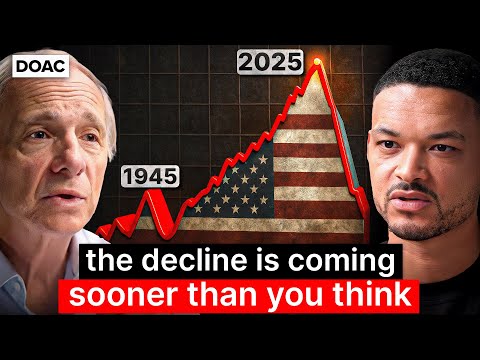
[@TheDiaryOfACEO] Ray Dalio: We’re Heading Into Very, Very Dark Times! America & The UK’s Decline Is Coming!
![[@TheDiaryofaCEO] Summarizer](https://summaries.pages.dev/img/logo.webp)
Link: https://youtu.be/49RT6SQ8n0Y
Short Summary
Number One Takeaway: Understand the cyclical nature of life and history to better navigate your personal journey and the world around you. This includes understanding your own nature and finding a path that aligns with it.
Executive Summary: Ray Dalio emphasizes the importance of understanding how life cycles work to navigate an adventurous journey that is suitable to your nature. He explores five big forces – money/debt, internal conflict, geopolitical conflict, acts of nature, and man's inventiveness – which repeat through history, affecting individuals and nations. Dalio encourages individuals to build financial strength and flexibility, remain open-minded, and learn how to leverage themselves for greater productivity, while acknowledging potential societal challenges ahead.
Key Quotes
Okay, here are 5 direct quotes from the transcript that I found particularly insightful:
- "Pain plus reflection equals progress."
- "We're 80 years from World War II. And you're seeing the symptoms."
- "A smart rabbit has three holes."
- "Make your work and your passion the same thing."
- "I say uh the importance of being open-minded and assertive at the same time. Um I I watch people becoming so tied to their own opinions like this is the greatest tragedy of mankind. The greatest transgen of mankind because it so easily can be fixed is holding a strong opinion that is wrong that you could have made right better if you were open to learning more."
Detailed Summary
Here is a detailed summary of the YouTube video transcript, focusing on the key topics, arguments, and information discussed.
-
Ray Dalio's Background & Purpose:
- Founder of Bridgewater Associates, the world's largest hedge fund ($150 billion managed).
- Studied historical cycles to predict financial crashes and warn about the future.
- Wants to pass along knowledge and principles gained throughout his life.
-
Five Big Forces Shaping History:
- Money, Debt, and Economy: Creates wealth and opportunity gaps. Debt fuels spending but must be repaid. High debt relative to income squeezes spending.
- Internal Conflict: Social and political conflict (left vs. right) arising from wealth and opportunity gaps. Lack of trust in the system can lead to internal conflicts.
- Geopolitical Conflict: Cycle of great power conflicts (wars). Winners of wars establish the new world order until a rising power challenges the existing one. Monetary, political, and geopolitical orders break down cyclically.
- Acts of Nature: Droughts, floods, pandemics have significant impacts, sometimes more than wars.
- Man's Inventiveness (Technology): Drives per capita income and living standards but interacts with the other four forces and is not always benificial. The winner of the technology war determines the new world order.
-
Optimism/Pessimism about the UK & US:
- UK: Not optimistic due to high debt, internal conflict, geopolitical factors, and a less conducive culture for inventiveness/entrepreneurship than the US. The UK is also facing a millionaire exodus.
- US: Also facing issues related to debt, internal conflict (political polarization), geopolitical conflict (US vs. China), climate change, and the technology war. Democracy is at risk due to people not believing in the system.
-
Advice for Individuals:
- Understand the life cycle: Understand your nature, find the path that suits it, and learn to navigate the ups and downs.
- Financial Strength: Build financial strength, flexibility, and knowledge.
- Open-mindedness: Be open-minded.
-
On 'Nature' and Entrepreneurship:
- People have innate preferences and inclinations.
- Entrepreneurship is a suitable path for some natures, not others.
- The US has a culture that is conducive to entrepreneurship and inventiveness.
-
The UK's Financial Problems:
- Government has a debt problem.
- Decline since World War II.
- Capital markets less developed than the US.
-
The Significance of Capital Markets:
- Capital markets enable talented people by providing them with resources (money).
- Enabling talented people is more important than money itself.
-
Debt and Internal Conflict:
- Most countries are dealing with internal political problems due to wealth and opportunity gaps.
-
The Importance of Staying Out of Wars:
- It's always better to be in a place that's not in a war.
-
The Technology War:
- The US and China are the main players in the technology competition.
- The winner of the technology war will win the economic and geopolitical war.
- Historical example: Nuclear weapons won World War II.
-
The Potential Fall of the US as a Dominant Power:
- More than conceivable that the US could lose its dominant position in the next 50-100 years.
- The US faces numerous challenges and it's uncertain if the system can overcome them.
-
The Two Americas:
- A small percentage of the US population (1-10%) is doing exceptionally well.
- A significant portion (60%) of Americans have limited reading abilities.
- The US is divided.
-
Trump and Political Division:
- Trump represents the "red states" and sees the debt and internal conflict problems.
- Cutting food stamp programs may alienate some supporters.
-
Fixing the UK:
- Requires a strong political middle.
- Needs a strong middle class to drive productivity.
- Must make the UK a better place with equal opportunity.
- Must be patriotic and "in it".
- It's a difficult challenge.
-
UK vs. US: A Realistic Perspective:
- The UK situation is not healthy.
- The US situation is very risky.
- People are moving to places that are civil, creative, and where people aren't at war with each other.
-
Potential Political Revolutions:
- Legal and parliamentary systems may not resolve disputes satisfactorily.
- Potential for a strong leader to take control (autocracy).
- Historical parallel: Democracies turning into autocracies in the 1930s (Italy, Germany, Spain, Japan).
-
The Key Challenges Facing the US:
- Debt
- Internal conflict
- Changing world order
- Geopolitical conflict (potential for nuclear war)
- Climate
- Technology war
-
China's Rise:
- Unlikely that either the US or China will become the clearly dominant power for a long time.
- The quickest way to dominance is through war, which is dangerous.
-
Time Frames and Historical Cycles:
- Long-term cycles (approximately 80 years) are like life cycles.
- Symptoms can indicate where a country is in its life cycle.
- The world is 80 years from WWII, and symptoms of change are visible.
-
Individual Action in the Face of Global Risks:
- Be aware of the situation and risks.
- Build financial strength.
- Develop knowledge.
- Be able to move to a better place (adaptability).
-
Flexibility and Mobility:
- Flexibility and the ability to move capital are valuable.
- Owning a home (tying up capital) may limit flexibility.
-
Advice for Children (Earning, Spending, Saving):
- Make your work and your passion the same thing, but consider the financial implications.
- Meaningful work and meaningful relationships bring happiness.
- There's little correlation between happiness and money beyond a basic level.
- Community is the highest level of correlation with happiness.
-
Wealth and Different Life Stages:
- Yes, play the game differently at different stages.
- Early life: Learning and experiencing are most important.
- Late life: Transition well-being and wealth.
- Surround yourself with the people who are the best people to learn from
-
Early Life & Key Decisions:
- Dalio hated school and preferred practical experience.
- Investing in the stock market at age 12 sparked his interest.
- Attending Harvard Business School opened his eyes to the world.
-
Nixon's Devaluation and the Oil Shock:
- Dalio learned from Nixon's decision to remove the dollar from the gold standard.
- The oil shock of 1973 led to his role as director of commodities at a brokerage firm.
-
The Founding of Bridgewater:
- Getting fired from a brokerage firm led to clients paying him for advice and the formation of Bridgewater in 1975.
-
Pain and Reflection:
- "Pain plus reflection equals progress."
- Best learnings come from pain.
- Develop principles to deal with reality better.
-
The Power of Computerized Decision Making:
- Dalio computerized decision rules and backtested them.
- Built AI decision-making systems.
-
How to Deal with Pain:
- Calm down and get centered.
- Meditation can be beneficial.
- Understand how reality works and develop principles.
-
Understanding Emotions:
- Recognize how emotions influence decisions.
- Align conscious and subconscious minds.
- Meditation helps bring conscious and subconscious states into alignment.
-
The Role of Transcendental Meditation:
- Enormously significant in Dalio's success.
- Helps to see things in a different way.
- Serenity prayer: Accept what you can't control, control what you can, and know the difference.
-
Dealing with Tragedy:
- The loss of a son was the worst possible event.
- Meditation and reflection were invaluable.
- The life cycle includes advances and setbacks.
-
Religion and Spirituality:
- Dalio is spiritual but not religious.
- Religions are a mix of superstitions and spirituality.
- Karma: Do unto others as you would have them do unto you.
- We're all part of a greater whole.
-
Successful Life Factors:
- Dreams
- Understanding nature
- Aspiration
- Understanding reality (Transcendental Meditation)
- Hard work
- Determination
-
The Importance of Hard Work:
- Hard work gives you strength and power.
-
Open-mindedness & Assertion:
- The greatest tragedy is holding a wrong opinion that you could have corrected.
- Treat different opinions with curiosity, not as a fight.
-
Radical Open-mindedness:
- "Decision making is a two-step process first take in then decide"
- "Smart people stress test my thinking"
-
Failures and Learning:
- Lost money in 1982 due to a miscalculation about the debt crisis.
- Learned humility, fear of being wrong, and the importance of diversification.
- Radical open-mindedness led to success.
-
Becoming a Better Decision Maker:
- Get smart people to interrogate your thinking.
- Know how to leverage yourself.
- Pick the right people with good character and capabilities and Orchestrate them well.
- Get more out of a minute/day, not how to work harder.
- Team should have meaningful work and meaningful relationships
-
Meaningful Work and Relationships:
- Create meaningful work and relationships through radical truthfulness and radical transparency.
-
Building a Strong Team (Bridgewater Example):
- Policy: Talk behind someone's back three times, you're out.
- Radical transparency: Everyone can see why decisions are made.
- Create meaningful relationships (parties, funerals, baby showers, clubs).
-
Idea Meritocracy:
- Ensure the best idea wins, not just the CEO's.
-
The Fragmentation of Large Businesses:
- Groups larger than 75-100 people often lose personal relationships and cohesiveness.
- Organizational reality is that villages are built within the business.
- Village cultures are built and the good ones spread to the whole system.
-
Hiring Exceptional People:
- Systematize the hiring process.
- Data-driven approach: Track personality and background traits.
- Evaluation continues after hiring (ongoing learning).
- How do they adapt to your culture?
-
Key Timeframes for Employee Evaluation:
- Culture fit evaluation: 18 months.
- Strength/weakness assessment: 18-24 months.
-
The Impact of AI:
- AI is a fantastic tool for leveraging knowledge and decision-making.
- Can exacerbate inequality by creating winners and losers.
- May eliminate many jobs.
-
The Future of Work:
- Most people need to be productive and prosperous for a healthy society.
- Redistribution policy is needed, but not just of money (usefulness is important).
- The ability to reach agreement on this is uncertain.
-
Historical Precedents (AI & Robotics):
- Evolution from the agricultural age to the age of intelligence.
- Machines have replaced physical labor, now replacing mental labor.
- Intelligence is more important than anything.
-
Hope and Human Nature:
- Excited about the fast forward.
- Concerned about human nature (greed, power hunger).
- Human nature will determine how people deal with each other.
- Spirituality and thinking about the collective good are essential.
- Focus on what is good/kind vs what is "correct"
-
Recommended Books:
- Richard Dawkins, River Out of Eden (evolution).
- Will and Ariel Durant, Lessons from History (historical insights).
- Joseph Campbell, The Hero with a Thousand Faces (human nature and the life journey).
-
Evolution and Human Evolution:
- Everything is evolving, including species and human nature.
-
Broad Curiosity and Understanding Reality:
- Interrelated.
-
Passing on Knowledge:
- Dalio's goal is to pass along knowledge and make a difference in people's lives.