[@TuckerCarlson] Ben Shapiro to America: Shut Up and Eat Your Goyslop
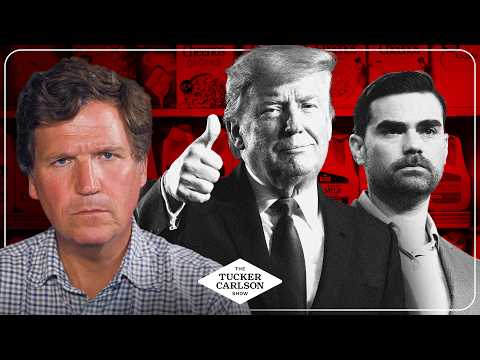
Link: https://youtu.be/vlBA19kSBh8
Duration: 81 min
Transcript: Download plain text
Short Summary
This is an interview with Katherine Austin Fitts, a former U.S. Treasury Department official and former head of Hamilton Securities Group, hosted by Tucker Carlson. They discuss rising grocery and energy prices, a decades-long "financial coup d'etat" involving bailouts, predatory lending, and missing federal funds, and the rise of digital social-credit systems and stablecoins. Fitts urges political disengagement, arguing that only by stepping away from destructive state and local machinery can ordinary Americans reverse current policy outcomes.
Key Quotes
- "Grocery prices are insane. They're still rising. Addressing this problem should be the number one priority of every elected leader. End the stupid foreign wars and focus on this issue. It's one of the main reasons socialists are gaining power." (00:00:29)
- "12% of the United States population served in the military during World War II. Over 16 million Americans joined the armed forces out of a total national population of about 130 million people. Roughly one out of every eight Americans wore a uniform. We don't have that today. And people are still whining and complaining." (00:30:17)
- "Privatization, Tucker, is when I transfer an asset or involve uh corporations in a service at a market price. Piratization is when I transfer an asset to a private party at 10 cents on the dollar." (00:44:12)
- "What the government wants to do and and what the Treasury and the central banks want is they want an automatic third lock. So you don't have to go through the bank and not only can you apply sanctions and know your customer and money laundering laws, you can apply a full-blown social credit system, right? So I can make up a hugely complex rule system for Tucker and his kids and his grandkids. I can I can customize it for each one of you and I can give you incentives and I can give you rules and unless you do exactly what I say, I can turn off your money or I can apply negative interest rates to your money or positive interest rates, I can raise your taxes without anybody having any say about it." (01:07:26)
- "according to the Levy Institute, there were $29 trillion on the bailouts. And what did we see? Um, we saw a group of financial institutions engage in massive mortgage fraud and financial fraud. As a result, we had $29 trillion of bailings which does run up the debt quite quite a certain amount." (00:46:42)
Detailed Summary
Episode Summary: Tucker Carlson on Inflation, Financial Corruption, and the Digital Control System
Opening Monologue: Grocery Prices as the Central Political Issue
The episode opens with Tucker Carlson reacting to a Matt Walsh (Daily Wire) tweet calling grocery prices "insane," arguing that elected leaders' number-one priority should be addressing food affordability, paired with ending foreign wars.
- Carlson insists inflation is real and verifiable to ordinary shoppers, even though official measures (CPI) are, in his words, "intentionally skewed, designed to hide the truth."
- He argues the U.S. has shifted from being perceived as a "rich country" to an "expensive country," where citizens worry about affording housing, food, insurance, medical costs, and cars.
- Carlson frames affordability as a wedge issue capable of uniting constituencies that normally disagree, including young people, retirees, and independents.
Historical Parallel: 1928 and the Socialist Threat
Carlson reaches back nearly a century to make the case that food prices have historically been a defining political issue in America.
- He cites Herbert Hoover's 1928 campaign slogan "a chicken in every pot," promising lower food prices the year before the Great Depression.
- Carlson notes that socialist Norman Thomas—described as a Presbyterian minister and "wet liberal"—ran that same year and lost, "probably because Herbert Hoover took the threat seriously."
- He claims he is "not a socialist" but agrees that leaders should prioritize grocery affordability as a top-line political concern.
- The framing positions food inflation as a potential catalyst for major political realignment rather than a passing economic nuisance.
Critique of Neoconservative Media Response
Carlson attacks right-wing commentators who dismissed concerns about food prices, portraying them as detached from ordinary Americans' lived experience.
- Carlson claims Ben Shapiro and Mark Levin attacked Walsh's tweet, with Levin citing Taco Bell burritos as "pretty cheap."
- He characterizes the neoconservative worldview as "cancerous," with its defining feature being a "hatred of Americans."
- Carlson notes that Ben Shapiro attended Harvard Law School and had a special Facebook deal, positioning Shapiro as a vehicle for larger interests rather than an organic media figure.
- The broader argument is that establishment-aligned media figures are defending elite interests while gaslighting consumers about basic cost-of-living increases.
Military Decline and the Iran War Debate
Carlson ties the affordability crisis to broader national decline and an unpopular war footing, contrasting today's America with the WWII generation.
- He argues today's young Americans are "gravely worse off" than past generations, citing visible decline and the absence of a military draft in contrast to WWII, when about 12% of the population (16 million of 130 million, roughly 1 in 8) served.
- Carlson claims Israel pushed Trump into a war with Iran at the end of February that no American supported, and that critics were quickly labeled antisemitic.
- He disputes media reports of an Iranian assassination attempt on Trump using a MANPADS missile at the NATO summit in Ankara, calling it propaganda to restart major combat operations.
- The framing connects foreign military engagement, economic strain, and elite indifference into a single narrative of national mismanagement.
Guest Introduction: Katherine Austin Fitts
The episode introduces Katherine Austin Fitts as a former U.S. Treasury Department official and former head of Hamilton Securities Group, which served as lead financial adviser to HUD.
- Fitts brings what Carlson describes as a longitudinal view of U.S. economic policy and personal experience with federal financial machinery.
- Carlson compares current restructuring to post-Soviet Russia (summer 1991 collapse), where state industries ended up concentrated in a small group within roughly 10 years; Fitts calls that period "the rape of Russia."
- The comparison frames the U.S. situation not as ordinary policy failure but as a deliberate wealth-transfer operation modeled on post-Soviet looting.
Financial Coup d'État and "Piratization"
Fitts attributes inflation to a decades-long restructuring built on a debt-based currency that forces huge expenses, alongside an intentional consolidation of ownership she calls a "financial coup d'etat."
- She distinguishes privatization (asset transfer at market price) from "piratization"—transfer to private parties at roughly 10 cents on the dollar—arguing the global consolidation is closer to plunder than legitimate market activity.
- Fitts recounts a 2001 London presentation with Wall Street Journal reporter Anne Williamson and commentator John Lachland, showing the same firms ran consolidation playbooks in Eastern Europe, Russia, and the United States.
- According to the Levy Institute, $29 trillion was committed to bailouts of financial institutions that engaged in mortgage fraud and emerged from the crisis with greater market share and monopoly pricing power.
- The argument recasts the 2008 financial crisis not as a failure rescued by government, but as a successful extraction operation rewarded with public funds.
Missing Federal Money, Predatory Lending, and Post-1995 Policy Trifecta
Fitts draws on her HUD experience to argue that trillions of dollars have disappeared from federal systems, while predatory lending became a deliberate policy tool.
- Hamilton Securities stopped money from disappearing at HUD; afterward, the firm and officials faced 18 audits, 12 tracks of litigation, smear campaigns, and physical harassment.
- Litigation began in 1995, with the case repeatedly cancelled on the eve of trial until 2004—a nine-year pattern of procedural delay.
- A failed 1995 budget effort triggered a 3-week government shutdown under Clinton; afterward roughly $21 trillion went missing from federal systems, compounded by $29 trillion in bailouts.
- Laws changed in 1979–1980 enabled usury-like lending; Fitts cites a JP Morgan Chase credit card arriving unsolicited with a $300 limit, $50 signup fee, and 30% interest—roughly 50% effective.
- Fitts identifies the post-1995 policy trifecta as OxyContin approval and pill mills, predatory HUD mortgage lending, and expansion of private prisons.
- She accuses the Sacklers of flooding Appalachia—the region that disproportionately fought wars—with opioids while war advocates said nothing, tying financial predation directly to the communities that bore military burdens.
Population Control Strategies
Fitts argues that predatory lending, narcotics trafficking, and pill mills function as explicit policies to lower life expectancy and balance the budget without fiscal discipline.
- She cites Jared Kushner saying on a podcast that he is "the first generation to live forever, the last generation to not live forever," and Sean Parker saying as a billionaire he "will live to 145."
- Fitts argues this is impossible for the whole population and that oligarchs believe they no longer need large populations due to robotics and automation.
- Carlson references an Iran Contra–era claim that a group discussed exploding a suitcase nuke in Chicago as a distraction, framing war as a tool for domestic population control.
- Fitts cites a scientist on her network who described a proposed pesticide liability shield as an extinction-level event because of its possible effect on female fertility.
- She argues recent Washington policy outcomes demonstrate a bipartisan commitment to depopulation, extending the argument beyond pharmaceuticals into agriculture and environmental regulation.
Digital Currency and the Social Credit System
Carlson and Fitts claim elites are using stablecoins and digital tokens to bring billions of retail customers worldwide into U.S. Treasury and stock/bond markets, with the goal of building a full social-credit system.
- The stated goal is raising U.S. global stock-market share from 70% to 90% via 24/7 trading and 20x margin offerings, drawing in 4 billion retail customers worldwide.
- Fitts describes the "third lock" framework: a manual third lock (banks enforcing sanctions, KYC rules) is used today, but the goal is an automatic third lock enabling a full social-credit system with per-individual rule customization, account freezing, negative/positive interest rates, and automated taxation.
- The Treasury Secretary reportedly bragged about seizing $1 billion in Iranian wallets, raising doubts about why 4 billion people would voluntarily opt in.
- Fitts notes the Clarity Act—a key legal infrastructure for the plan—likely will not pass this year, a collapse she called "remarkable" given how central it is to the strategy.
- The argument positions digital currency not as innovation but as a control architecture designed to replace banking, taxation, and political dissent with automated enforcement.
Federal Spending and the War Budget
Fitts argues the U.S. federal budget is structurally unbalanced and that the war budget is the principal driver of national debt.
- Federal government spends $7 trillion per year but takes in only $5 trillion, leaving a $2 trillion structural gap.
- $1.5 trillion goes to a defense/war budget that, Fitts argues, cannot defeat a "second- or third-rate" military or open the Strait of Hormuz, through which about 20% of world energy flows.
- Carlson argues foreign wars are the main driver of U.S. national debt and that Mark Levin pushes wars on behalf of a foreign country's interests.
- The structural framing connects war spending, energy dependency, and debt growth into a single fiscal crisis.
Energy Markets and Looming Price Risk
Fitts warns that energy reserves have been drawn down globally, leaving the U.S. vulnerable to a price spike and tying current policy to a "pro gas dollar" strategy.
- China has cut energy imports in half and is not drawing reserves, easing pressure on the global oil market in the short term—a move Fitts says did the Trump administration "a huge favor."
- Japan has run down its reserves, and U.S. reserves are below levels that threaten strategic-reserve infrastructure.
- U.S. strategy aims to replace the petro dollar with a "pro gas dollar" by bottlenecking trade routes and sabotaging foreign energy to build U.S. LNG market share; the U.S. is now a net energy exporter making large sums selling LNG into Asia.
- With reserves exhausted, Fitts calls $7/gallon gasoline "easily imaginable."
- Gold has dropped $1,000 per ounce since spring even as the dollar weakens, which Fitts calls nonsensical but attributes to normal war-period volatility tied to liquidity flows into Treasuries and short-term bonds.
Proposed Response: Political Disengagement
Fitts argues meaningful solutions require disengaging from destructive state and local machinery rather than attempting to reform Washington from within.
- She argues that if 5% or 10% of people disengaged from destructive state and local machinery, the possibilities for reversal would be enormous, especially with new technology.
- Fitts references Carlson's "10 principles to save America" as part of the solution framing.
- She said meaningful solutions require people to stop hoping to reform Washington and instead disengage to protect themselves.
- Carlson concludes by asking what cause today's leaders could credibly ask young Americans to die for, given current military reluctance and economic decline, urging leaders to focus on helping "the people thrive."
- The closing argument reframes political action not as voting or campaigning but as withdrawal from institutions perceived as extractive, coupled with local self-organization.