[@TuckerCarlson] BREAKING: Merchant of Death Warns Russia Is Preparing for a Devastating Attack on Western Europe
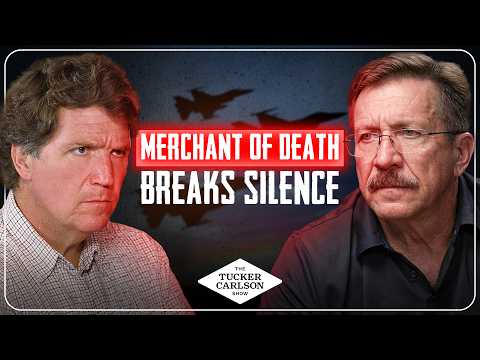
Link: https://youtu.be/arch7KLd9Yk
Duration: 63 min
Transcript: Download plain text
Short Summary
Tucker Carlson interviews Viktor Bout, the Russian arms dealer who was exchanged for Brittney Griner after nearly 12 years in a US prison, covering the Ukraine conflict, European politics, and US-Russia relations. Bout argues Russia will finish the war militarily on its own terms, characterizes European leaders as out-of-touch globalists, and advocates for US-Russia cooperation in space and science rather than weapons spending.
Key Quotes
- "In our military doctrine, there is a uh postulate or formula where if we feel that any attacks against us are threatening our existence, we will answer with a nuclear weapons. And believe me, Russia have second to the known nuclear and most modern arsenal in the world. We definitely with the one missiles can completely obliterate and destroy all life on the territory like England or France you know and that's definitely we don't want to go this way" (00:13:37)
- "Well Trump can stop this war very quickly. The Ukraine heavily depends on two factors. Without these two factors they can't uh fight even a day. First of all, this is a Starlink which is the uh you know key communication system. If you switch it off, then Ukrainian army has no any communication, has no any control of their drones. They can't attack deep inside Russia." (00:39:30)
- "every body exchange between the Russia and Ukraine usually goes like recent one Russia transfer it about 27 bodies uh Russia transferred to Ukraine about thousand bodies and received back about 27 bodies of fallen soldiers and this proportion tells you about the huge uh basically demographic problem." (00:30:33)
- "accordingly recent polls which is done by the by the western journal of by the western organization I think it was American and British uh they found and they double checked several times that the over 80% want the peace deal with Russia this is" (00:31:44)
- "Russia may be the last I would say hold out which is by fighting in the front lines of this conflict. Not only defending our future, our sovereignty, but maybe future of entire humanity, the way we know it, the way we want it to be in the future." (00:24:35)
Detailed Summary
Tucker Carlson Interviews Viktor Bout: Ukraine War, European Decline, and US-Russia Relations
Interviewee Background
Tucker Carlson interviews Viktor Bout, the Russian arms dealer known internationally as the "Merchant of Death," shortly after his release from a US prison in a high-profile prisoner swap. Bout reflects on his imprisonment, the terms of his exchange, and his views on the geopolitical landscape that awaited him.
- Viktor Bout spent almost 12 years of a 14-year US prison term before being released in a Biden-era prisoner exchange for women's basketball player Brittney Griner, who had been detained in Russia over a "small quantity of CBD oil."
- Bout characterized the exchange as an "insult," saying he expected to be traded for Paul Whelan and noting he would have been released in about 4 years anyway as a "product with an expiring date."
Ukrainian Drone Warfare and Battlefield
Bout describes a transformed Ukrainian battlefield dominated by mass-produced long-range drones, with casualty ratios he claims heavily favor Russia. He argues that rapid tactical innovation and decentralized manufacturing have made Ukraine's drone threat far more potent than commonly understood in the West.
- Ukrainian troops can now launch up to 500-600 long-range drones simultaneously with ranges over 1,500 kilometers (~1,000 miles), produced in factories relocated from Ukraine to Europe.
- Russia and Ukraine exchanged approximately 1,000 bodies for 27 bodies in a recent body swap, which Bout cites as evidence of massive Ukrainian manpower losses.
- Casualty ratios are reportedly at least 3:1, possibly 5:1 against Ukraine.
- Drone tactics reportedly change every two weeks due to rapid innovation, with many units running their own 3D-printing workshops for parts and microchip control units.
Zelensky's Political Legitimacy
Bout challenges the legal foundation of Ukrainian President Volodymyr Zelensky's continued rule, arguing his term has lapsed and that public opinion polls point toward a desire for peace rather than continued fighting. He frames this as a key obstacle to any negotiated settlement.
- Zelensky's presidential term has expired and he refused to announce new elections, while Ukrainian parliamentary terms have also lapsed, raising questions about legal authority to sign any peace deal.
- Western (American and British) polling reportedly shows over 80% of Ukrainians want a peace deal with Russia.
Trump-Putin Diplomacy and War's Future
The conversation turns to the failed Anchorage summit between Donald Trump and Vladimir Putin and what Bout sees as Washington's continued leverage over Ukraine's war-fighting capacity. He outlines specific technical chokepoints Trump could use to end the conflict quickly.
- A Putin-Trump summit took place in Anchorage, Alaska in August, where Trump made promises to settle the conflict that Russia accepted but has seen no follow-through.
- Russia now says it will finish the conflict militarily on its own.
- Trump could end the war within a day by cutting off two dependencies: Starlink communications (used for drone control) and US satellite intelligence sharing.
- Trump has refused new weapons deliveries but is completing Biden-era shipments, and has indicated openness to approving new packages if purchased.
European Politics and Energy Crisis
Bout portrays Europe as a continent in managed decline, sacrificing industrial competitiveness and national sovereignty in pursuit of globalist orthodoxy. He argues that the loss of cheap Russian energy, combined with remilitarization, is hollowing out European economies.
- The speaker claims the recent Romanian election was manipulated to install a government aligned with Brussels/globalist leadership.
- Europe allegedly committed "economic suicide" by cutting Russian pipeline gas and is now forced to buy LNG at higher prices, making German industry uncompetitive.
- The German automotive industry is for the first time in 80 years on its "final death bed," with former Volkswagen and Audi plants converted to weapons-production lines.
- Germany introduced a law requiring men to register at military recruiting points before leaving the country, with leaders openly stating they want the strongest army in Europe within three years.
- Finland and Switzerland recently joined NATO, prompting Russia to form a new military district along its approximately 1,500-mile border with Finland.
Historical and Religious Framing
The interview took place on a date of deep historical significance for Russia, and Bout uses that occasion to draw parallels between the current conflict and the existential struggle of World War II. He frames the war in civilizational and religious terms, invoking demographic anxieties and historical grievances.
- The interview occurred on Russia's national remembrance day for June 22, 1941, when Germany attacked the Soviet Union at 4:00 AM; Bout's own grandfather died fighting at the Battle of Kursk.
- Bout frames the conflict as a "religious war," warning that European civilization in France, Germany, and Britain is being demolished by uncontrolled immigration and a globalist "great replacement" agenda.
- He claims Zelensky brought Bandera movement remains from Europe for reburial, sparking a conflict with Poland, and that Bandera forces killed over 100,000 Poles in ethnic cleansing.
- Bout claims Zelensky's grandfather was a colonel in the Red Army who fought Nazi Germans.
Alleged Ukrainian Atrocities and Conduct
Bout levels a series of serious allegations against Ukrainian forces, including attacks on civilian targets, the use of prohibited weapons, and mistreatment of prisoners. He also claims that Western-supplied arms have been diverted to hostile non-state actors.
- Alleged attacks include a drone strike on a Lugansk college dormitory killing 21 students (with journalists disproving claims of military presence), and a strike on a bus carrying the coach of the Belarusian/Russian soccer team traveling to a Black Sea resort.
- Alleged use of forbidden weapons including poisonous gas, white phosphorus, and attempts to spread biological agents.
- Alleged treatment of Russian POWs includes forced sterilization, organ harvesting, swastika placement, and on-the-spot executions with footage posted online.
- Ukraine allegedly sold Western-supplied weapons on the black market to Hamas, Hezbollah, and Mexican cartels.
Bout's Views on America and Globalism
In his closing reflections, Bout argues that the United States itself has been a casualty of the same globalist ideology he blames for Europe's decline, and proposes a redirected US-Russia partnership focused on civilian exploration rather than arms races.
- Bout claims America was used as a "test ground" for globalist policies—de-industrialization, sexual revolution, drugs, and LGBT/transgender agenda—that then spread worldwide.
- He claims George Soros invested over 30 years cultivating current European leaders from their teens onward.
- Bout advocates US-Russia cooperation in space exploration, science, and medicine instead of spending on weapons capable of "destroying the planet 100 or 200 times," citing Russian-origin inventions like the Sikorski helicopter.