[@TuckerCarlson] BREAKING: U.S. Resumes Strikes on Iran. A Clean Exit Is Unlikely. Tucker and John Mearsheimer React.
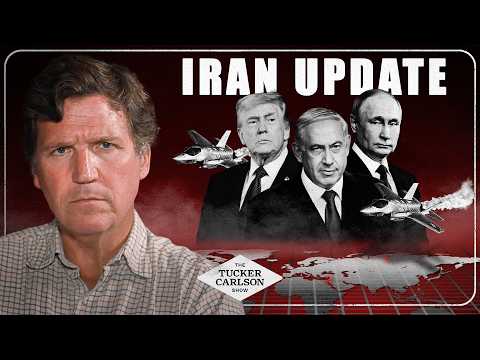
Link: https://youtu.be/TQvZaBQuT80
Duration: 149 min
Transcript: Download plain text
Short Summary
Professor John Mearsheimer of the University of Chicago discusses his analysis of US foreign policy failures in Iran and Ukraine, arguing that American actions have strengthened adversaries while weakening US global standing. The episode covers the Israeli lobby's influence on US decision-making, Mearsheimer's predictions of Russian victory in Ukraine with nuclear escalation risks, and historical lessons about empire, nationalism, and great power competition. Mearsheimer, who graduated from West Point in 1970 and has taught at Chicago since 1982, evaluates the current geopolitical moment as one of profound historical change.
Key Quotes
- "What you do will be done to you." (00:21:45)
- "The two principal obstacles to aggression today are number one, nuclear weapons and number two, nationalism." (01:23:24)
- "Russia views what's happening in Ukraine as an existential threat." (00:48:58)
- "Benjamin Netanyahu was in charge." (00:15:15)
Detailed Summary
Detailed Summary: Professor John Mearsheimer on US Foreign Policy Failures
Introduction: Professor Mearsheimer's Background and Central Thesis
Professor John Mearsheimer, a University of Chicago international relations scholar since 1982 and a 1970 West Point graduate who served as an Air Force officer, discusses his analysis of US foreign policy failures in Iran and Ukraine. Mearsheimer argues that American actions have strengthened adversaries while weakening US global standing, and describes the current moment as one of the most interesting of his life as someone who assesses the world for a living, believing history will record this period as profound change, not just a bump in the road.
- Mearsheimer and Stephen Walt co-authored a 2007 book arguing that Israel and the lobby were two main driving forces behind the decision to invade Iraq
- Israeli Prime Ministers Barak and Netanyahu implored the US to take down Saddam, and President Clinton said in 2006 that every Israeli politician he knew thought Saddam was such a great threat he should be removed even without WMD
- Mearsheimer was attacked as a Nazi and anti-Semite for his 2007 book and was largely written out of mainstream discourse, not invited to write New York Times op-eds for years
- The host states Mearsheimer was considered threat number one by AIPAC and the American media because he is not a bigot but an eminently reasonable man who understands the facts
US-Iran War and Limits of American Power
The episode opens with discussion of US and Israeli military strikes on Iran that began in late February with a news blackout preventing public knowledge of casualties and war progress. Despite President Trump's claims that the US has destroyed Iran's navy, air force, anti-aircraft equipment, radar equipment, and leadership, Iran continues exercising power through energy prices and military strikes. The speaker argues this war demonstrates three limits of American power: military power, economic power, and moral authority.
- US Central Command announced the strikes would continue for several days
- Iran controls the Strait of Hormuz, which handles approximately one-fifth of global commodities including energy and petrochemicals, giving Iran economic leverage over the US economy through global oil pricing
- President Trump made 38 announcements since March 23rd claiming an imminent Iran deal was close, all of which proved untrue
- The US basing structure in the Gulf has been destroyed or badly damaged, and the alliance with six Gulf states has been wrecked
- Some Gulf states may become closer to Iran given the US inability to protect them from Iranian threats
Israel-Iran Conflict and Regional Dynamics
The episode discusses how Iran initiated hostilities against Israel on February 28th from a position of weakness and has since gained the upper hand. Israel did not strike first, and Iran has signaled willingness to escalate further with the US. Average Israeli support for the war was 93%, with many Israelis believing they control everything and need no one.
- The June 2024 12-day war between Israel and Iran occurred from June 13th to June 25th, initiated by Israel while Iran was in the middle of negotiations
- The Abraham Accords represented an arrangement where Gulf states would align with Israel and send trillions in foreign direct investment to the US in exchange for American protection, which did not materialize
- Israel is described as the most flagrant welfare case in world history, and without US support would be "literally done"
Trump's Predicament and US Military Options
President Trump is described as desperate for an Iran settlement due to economic consequences if the straits remain closed, with risks of Democratic takeover of Congress by November threatening impeachment. US military options against Iran are severely limited: boots on the ground are out, the air war was tried before without success and depleted precious weaponry, and nuclear weapons are not viable.
- Trump publicly said "terrible things" about Prime Minister Netanyahu on June 1st and is pressuring Israel in unprecedented ways because he cannot pressure Iran
- Neither Israel nor the US has demonstrated the capability to penetrate Iran and eliminate its nuclear enrichment capability
- The four original US demands against Iran—missiles, support for Hezbollah/Houthis/Hamas, nuclear program, and regime change—have not been achieved
Ceasefire Terms and Negotiations
Trump is seeking a 30 or 60-day ceasefire as an initial step before negotiating nuclear issues, reparations, and overall sanctions. Iran demands four conditions for a ceasefire: cessation of hostilities in Lebanon, opening of the Strait of Hormuz, return of $24 billion in frozen assets, and removal of sanctions on oil sales.
- Nuclear issues, control of the strait, reparations, and overall sanctions will be deferred to a second round of negotiations
- Iran possesses highly enriched uranium up to 60% purity, which can be easily converted to weapons-grade material and used to build a nuclear bomb
- General Qasem Soleimani was killed in Iraq approximately 6 years ago after flying commercially for negotiations, which is described as a colossal mistake by the US
- Trump's withdrawal from the JCPOA nuclear deal in 2018 is noted, with Trump now arguing that nuclear deals require many years to negotiate
Russia-Ukraine War Analysis and Outcomes
Mearsheimer predicts Putin will win in Ukraine, Ukraine will become a dysfunctional rump state, NATO will be wrecked, and the US-European transatlantic relationship will be badly damaged. Russia made clear since 2008 that NATO expansion to include Ukraine was an existential threat that would not be allowed; war broke out in February 2022.
- Ukraine launched two successful offensives in 2022 (Kharkiv and Kherson) and a major counteroffensive in June 2023, but drones have made it very difficult for either side to advance
- The speaker predicts a frozen conflict where Russia will end up controlling Luhansk (fully), Donetsk (85%), Zaporizhzhia (75%), and Kherson (75%), with potential for Russia to also take Odessa and Kharkiv
- Ukraine invaded Russia in August 2024 with US support, and in February 2025 attacked Russia's nuclear bomber force (one leg of the strategic nuclear triad) with US intelligence support
- Putin mobilized approximately 300,000 troops in September 2022
- Boris Johnson, with US support, convinced Ukraine to walk away from negotiations in Istanbul in early 2022
- General Milley, Chairman of the Joint Chiefs of Staff, assessed in late 2022 that Ukraine had reached its high water mark and recommended cutting a deal, but was silenced from making further arguments
Nuclear Escalation Risks in the Ukraine War
Mearsheimer states the worst outcome in both conflicts is the possibility of nuclear weapons being used, and sees a serious possibility this will happen in the Ukraine war. Putin faces widespread criticism inside Russia that he has not waged the war vigorously enough, creating pressure to escalate.
- Sergey Karaganov proposed escalation strategy in February 2022 as an outlier; by 2024-2025, overwhelming majority of Russian elite and broader population agreed with his view that Russia should attack Eastern Europe with conventional weapons, then use limited nuclear strikes if needed to stop attacks on Russian territory
- Russia views the Ukraine war as an existential threat, analogous to how Cuba was categorically unacceptable to the US during the Cuban Missile Crisis
- Tucker Carlson argues Western leaders would welcome Russian attacks on the Baltics or Eastern Europe because it would justify direct war on Russia
- The speaker claims there has been very little coverage in American press of Ukrainian/European/American attacks on the Russian homeland
Israeli Lobby and Foreign Policy Influence
The host criticizes Washington foreign policy institutions (Brookings Institution, CNN, Atlantic Council) for failing to anticipate that attacking Iran would strengthen it and weaken the US. The Israel lobby went to enormous lengths to suppress Mearsheimer's book: Abe Foxman wrote a book attacking it before publication, Google cancelled a scheduled talk, and the Chicago Council on Foreign Relations also cancelled a talk.
- The host claims the same people who pushed for war with Iran have spent the last 5 years pushing the US to go to war with Russia through the Ukraine conflict
- Steve Kornacki wrote a book explaining how many Americans in the foreign policy establishment with family roots in Eastern Europe, Ukraine, or Russia are deeply committed to supporting Ukraine against Russia
- The influence of Israel on the American foreign policy establishment cannot be underestimated because Israel wants the US militarily involved worldwide to serve as a fire department if Israel gets into trouble
- The Quincy Institute advocates for restraint in foreign policy, which raises the hackles of the Israel lobby
- Elbridge Colby works mainly on China issues and is described as a restrainer interested in a restrained foreign policy who opposed the Iraq War in 2003
- Israeli intelligence is tracking Steve Witkoff and Elbridge Colby according to a New York Times article
- The Cuban-American community wields significant influence inside the United States on Cuba policy, similar to the Israel lobby
Historical Analysis: Empires, Nationalism, and Great Power Competition
The unipolar moment (US dominance) ran from approximately 1992 until about 2017. Putin delivered a famous speech at Munich in 2007 making clear he was sick and tired of how the West was treating Russia. Nationalism is described as the most powerful political ideology, fundamentally about sovereignty and self-determination.
- Great empires (British, Belgian, French, Dutch) collapsed primarily due to nationalism and the economic costs that arose after the industrial revolution made colonies liabilities rather than assets
- The three major 20th-century powers (Germany, United States, Soviet Union/Russia) did not have major empires, while Britain, France, and Belgium maintained colonies that provided minimal economic benefit
- The two principal obstacles to aggression today are nuclear weapons and nationalism
- Overreach and territorial overreach always weakens a nation
- The Soviet economy began declining in the mid-1960s and accelerated in the early 1980s due to fundamental flaws, eventually leading to Soviet collapse
- Occupying Eastern Europe was incredibly expensive for the Soviets and the people did not want them there
Ukraine and European Security Dynamics
Ukraine views Russia as an existential threat because the Russians are closer than ever and have taken Ukrainian territory. Eastern European countries including Romanians, Hungarians, and Poles are completely afraid of the Russians. The Ukraine conflict has done enormous damage to NATO and the American military footprint in Europe is shrinking.
- US troops in Europe will be remarkably few in the foreseeable future as Europe is priority number three behind Asia and the Middle East
- Poland and Germany have strong incentives to develop nuclear weapons as the US military presence shrinks
- Mearsheimer argues the Israeli government and its agents in the United States are pushing the US government toward outcomes that will hurt the United States
Drone Warfare and Military Evolution
By 2024-2026, drones became the most important weapon affecting battlefield events, surpassing artillery, and the US military is now scrambling to address the drone threat. This was demonstrated in the Ukraine war since 2024.
- Drones have made it very difficult for either side to advance in the Ukraine conflict
- Speaker John Mearsheimer describes Israel's pattern of using diplomatic negotiations as a lure to assassinate leaders across the Middle East, stating there is no question the US has moved in the same direction
Conclusion: Profound Historical Change
Mearsheimer describes this moment as one of the most interesting of his life as someone who assesses the world for a living, and believes history will record this period as profound change, not just a bump in the road. The episode concludes with discussion of how foreign policy establishments have failed to anticipate outcomes and the role of various lobbies in shaping American decision-making.