[@ChrisWillx] Polyvagal Theory: Why You Feel So Anxious All The Time - Dr Stephen Porges
![[@ChrisWillx] Summarizer](https://summaries.pages.dev/img/logo.webp)
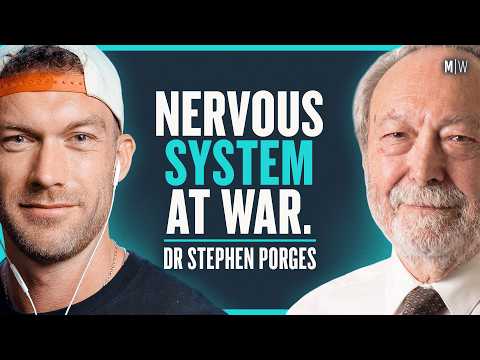
Link: https://youtu.be/V5A9q4HZ1Ro
Duration: 113 min
Transcript: Download plain text
Short Summary
Host Chris interviews Stephen Porges, the 81-year-old creator of polyvagal theory and author of more than 400 peer-reviewed papers, in Austin, Texas about how the autonomic nervous system shapes perception, connection, and resilience. The conversation weaves together the theory's NICU origins, interventions like the Safe and Sound Protocol and tilt tables, and Chris's first-person two-year recovery from mold, Lyme, EBV, CMV, and long COVID, alongside discussions of transgenerational trauma and stellate ganglion blocks.
Key Quotes
- "It's really quite simple. is that our underlying physiological state affects how we perceive the world, how we interact with others and how receptical we are to others engaging us." (00:00:19)
- "Anxiety is the body being in a defensive state. Simple as that. We don't need the word anxiety. We don't even need many of the words that we associate as emotion." (01:04:17)
- "80% of the fibers of the vagus are sending sensory information to the brain. 80%. It's a it's an internal surveillance system of our body. Our body craves that information." (01:14:03)
- "polyagal theory was never about the nerve. It was about the organization of this integrated brain stem system. They just don't understand what it's about." (01:46:12)
- "Your body is in a chronic state of defense. It's as simple as that." (01:40:28)
Detailed Summary
Episode Overview
This long-form interview, recorded in Austin, Texas, features host Chris in conversation with Stephen Porges, the 81-year-old creator of polyvagal theory, author of more than 400 peer-reviewed papers, and originator of the 1969 quantitative work on heart rate variability. The discussion weaves Porges's theoretical framework together with Chris's first-person recovery story from mold toxicity, EBV, CMV, Lyme, and long COVID, while also covering trauma, co-regulation, and clinical interventions.
- Porges brings more than 30 years of polyvagal theory development to the conversation, which is grounded in both NICU research and broader clinical work.
- The host's health journey, spanning two years of recovery, gives the discussion a concrete experiential layer rather than remaining purely theoretical.
Origins of Polyvagal Theory
Porges's foundational work began in clinical observation with preterm babies, where he encountered a physiological puzzle that challenged conventional wisdom about the vagus nerve. Phylogenetic analysis then revealed a mammalian innovation that reshaped his understanding of autonomic function.
- Porges began working in NICUs with preterm babies in 1994 and 1995, where he observed a "vagal paradox": the same vagal nerve linked to health and restoration could slow heart rate so dramatically that it compromised oxygen delivery to the brain.
- A neonatologist wrote to him arguing "too much of a good thing is bad"; Porges rejected this framing as inconsistent with how evolved systems work.
- He turned to phylogenetic analysis and identified a distinct mammalian shift: a new ventral vagal system linked to the muscles of the voice, face, and head that broadcasts visceral states and enables co-regulation.
- The mammalian system allowed mobilization without fear (play, dance) and removed immobilization as a requirement for physiological calming.
Core Concepts: Safety, Threat, and the Social Engagement System
Polyvagal theory centers on a counterintuitive claim: that our physiological state precedes and shapes our psychological experience of the world. The role of the vagus nerve is fundamentally sensory rather than purely motor.
- Polyvagal theory holds that an individual's underlying physiological state shapes how they perceive the world, interact with others, and how receptive they are to engagement.
- Humans behave like plants reading ecological signals but mistakenly attribute outcomes to personal intention; culture's "you can do it" messaging can shut down neurophysiological feedback loops.
- 80% of vagus nerve fibers carry sensory information from body to brain, with only 20% traveling downward, making the vagus an internal surveillance system the body craves.
- Safety is not the absence of threat — safety requires positive signals, just as threat requires signals.
The Ventral Vagus as Choreographer
One of the theory's most distinctive concepts frames the ventral vagus as a kind of biological choreographer that reorganizes older defense strategies into social ones. Without this orchestration, the nervous system defaults to more primitive survival patterns.
- Responses proceed in three stages: a reflex, an awareness of the body's response, and a conscious association of that awareness with good or bad things.
- The ventral vagus acts as a choreographer that repurposes fight/flight into play and immobilization into intimacy and restoration; without it, people oscillate between hyper- and hypoarousal like decorticate animals.
- A paradoxical relaxation response can sabotage healing when higher brain structures interpret parasympathetic calm as vulnerability and bounce the person back out the top of their window of tolerance.
Trauma, Anxiety, and Retuning
Porges reframes what looks like locked-in temperament or personality as a physiological state that has been tuned into chronic defensiveness. This has direct implications for how anxiety and trauma reactions are understood.
- People with histories of unsafe individuals or abusive trauma may react adversely to prosocial cues like melodic voices because the body has linked those sensations to past harm.
- What looks like a locked-in temperament is more often a physiological state that has been retuned into chronic defensiveness.
- Anxiety is rarely "outside" us — it is the body in a defensive state, and "anxious people" remain anxious even after the cited trigger task is finished, indicating the mobilization is internally generated.
- The ventral side of the body is the side of evolutionary vulnerability, so bracing the arms inward is partly symbolic protection of the brachial vein; even cats expose their bellies only in safe contexts.
Transgenerational Trauma
Porges discusses how trauma patterns persist across generations, while explicitly rejecting the need for epigenetic inheritance as an explanation. Cultural transmission alone, he argues, sufficiently accounts for inherited trauma dynamics.
- Research is referenced indicating that deeply traumatized baby mice require three generations to return to a normal nervous system state.
- Porges prefers the term "transgenerational" over "intergenerational" trauma, arguing cultural transmission alone — without epigenetics — sufficiently explains inherited trauma patterns.
- The UK is described as a transgenerationally traumatized environment, citing boarding schools stripping children of childhood as the training ground for elite leaders.
- A book on the UK's "damaged elite" argues prime ministers and other leaders have bodies locked into states of defense, compromising their capacity for compassion.
Stellate Ganglion Blocks (SGBs)
The conversation covers SGBs as an emerging clinical intervention for trauma and PTSD, with specific attention to patient selection. Porges identifies a clear clinical boundary for when the intervention is and is not appropriate.
- Eugene Lipov is identified as one of the originators of SGBs.
- The proposed mechanism downregulates overextended sympathetic nervous system activity, allowing the parasympathetic vagus to express itself and dampen fight-or-flight.
- SGBs are described as useful mainly for trauma/PTSD patients locked in fight-or-flight, but potentially not helpful for those in shutdown, withdrawal, or immobilization.
Interventions: Safe and Sound Protocol, Tilt Tables, and Breathing
Porges details several specific interventions he personally uses or has developed, including a mass-market audio protocol, a physical training device, and resonance breathing techniques. His personal regimen at 81 serves as a concrete demonstration of these principles.
- The Safe and Sound Protocol has been used by a few hundred thousand people and mimics the acoustic features of a mother's voice (a 1500–3500 Hz band, with 500–3000 Hz also effective) to broadcast calmness.
- The protocol is used alongside EMDR and CBT, not as a standalone cure but to make clients more accessible to the primary intervention; listening time is gradually extended from a few seconds or a minute to longer periods.
- Porges, 81, uses a "back swing" tilt table daily — 70 degrees down and 70 degrees up, about 5 minutes of inverted exercise plus 30 rapid tilts on each breath — as a workout for his baroreceptors.
- He takes L-carnitine (after prostate cancer radiation left him unable to climb stairs; the next day he did two miles on an elliptical) and lecithin/phosphatidylcholine plus fish oil for vagal neurotransmission.
- Resonance breathing around 0.12 Hz (or 4.5 breaths per minute for the host using a M.alth lamp) is recommended over TV-distracted treadmill exercise.
The Host's First-Person Health Journey
Chris's two-year recovery from multiple chronic conditions serves as a lived test case for the polyvagal framework. The interview details specific symptoms, clinical findings, and the philosophical shift the experience produced.
- About nine months before the interview, Chris released a health vlog tracking long COVID, chronic fatigue, Lyme, CMV, EBV, mold exposure in a house with every polymorphism associated with mold toxicity, and heavy metals.
- During illness he was tired by 7 PM every night, never felt recovered from sleep, hated the smell of standing water, and couldn't tolerate silence or music; word recall, working memory, and mood were impaired while performing professionally for millions weekly.
- A February tilt table test produced full vasovagal syncope at 11 minutes, with his heart stopping for 5 seconds.
- Chris reports spending two years piecing himself back together, developing dysautonomia, and heading into his first 7-day meditation retreat to recalibrate his autonomic system.
- A friend in Bali argued that the uncertainty of not knowing whether one will recover is what separates "having a hard time" from "having a life-changing difficulty."
- The experience cultivated greater compassion and humility, including recognizing that even seemingly elective behaviors (e.g., someone who never stops talking about themselves) likely stem from past trauma or genetic predisposition.
- The condition is framed as "the system does not have resilience," with recovery focused on moving the system into less vulnerable states; daily demands such as recording podcasts must be evaluated on whether they are nourishing or sapping, and even the container of work itself may contribute to symptom expression.
Defending Polyvagal Theory
Porges addresses the academic criticism of his theory head-on, attributing it to misrepresentation rather than substantive disagreement. He has built an AI tool specifically to vet criticisms against the theory's actual claims.
- Porges asserts that criticisms of polyvagal theory have been misrepresentations rather than substantive objections, with critics misinterpreting the theory's focus on integrated brain stem organization rather than the vagus nerve itself.
- The ventral vagus nucleus is an older structure that predates mammals, but cardioinhibitory fibers did not appear in that system until mammals evolved.
- Porges has built an "AI polyvagal scholar" tool with a fidelity-to-theory rule; submitted criticisms are rejected because they misstate the theory.
- The theory has evolved over nearly 30 years, with two papers on mammalian organizational architecture currently being finalized.
- Porges notes the clinical world gave polyvagal theory its traction because it works for clinicians, while the neuroscience world is too siloed to grasp its organizing principles.
- Porges is "extraordinarily confident" the theory will survive him by far, even if he is no longer around.
Safety, Threat Detection, and Co-regulation
Chris raises a direct challenge: can a nervous system be too safe? Porges rejects the premise, arguing that a well-regulated system is the same one that can detect and respond to threat.
- Chris raised the concern that a nervous system feeling too safe might fail to detect signals of danger, asking whether people can be "too safe."
- Porges responded that a healthy nervous system with the capacity to connect, love, share, and trust is usually the same nervous system that can detect threat.
- A well-regulated system enabling co-regulation tends to be the same system that can adjust and navigate a complex world.
- Co-regulation is described as the biological basis of love — humans literally regulate each other's nervous systems — and men who have never experienced consistent co-regulation may struggle with vulnerability in ways that ripple into modern cultural and political dynamics.
- Porges labeled Chris as "polyvagal informed," describing it as seeing the world through the lens that physiological state is a major component of behavior, feelings, and identity.
Broader Cultural and Clinical Concerns
The conversation extends beyond individual therapy to address systemic and cultural signals that shape collective nervous system states. Porges also shares a personal case study of his own acoustic neuroma.
- School-shooting responses such as arming teachers and installing metal detectors send profound signals to children's developing nervous systems, and live-streamed assassinations raise the question of whether humans are built to witness such events.
- In a preschool experiment, algorithmically modulated music caused children to gravitate toward the speakers and socialize; the same music without modulation left them solitary, and other music had no effect.
- Most health research has been done on males because females' greater variability interferes with cause-and-effect establishment in clinical trials — leaving sex differences in nervous system functioning understudied.
- Out of roughly 1,150 episodes the host has recorded, fewer than 10 have addressed palliative care or end-of-life issues.
- Porges personally avoided surgery for an acoustic neuroma discovered in 2002, used high-dose fish oil based on inflammatory-component literature, and saw his tinnitus disappear.