[@TuckerCarlson] Jay Dyer: Demons in Hollywood, CIA, Secret Societies, Lone Gunmen, Epstein & Attacks on Christianity
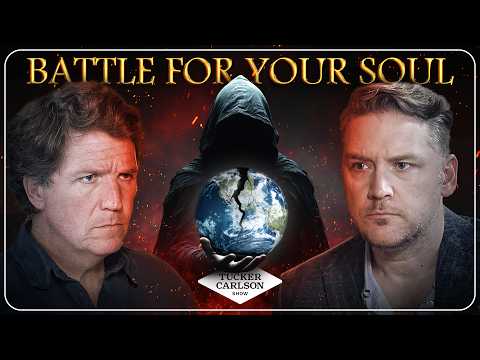
Link: https://youtu.be/8-VqMQHz54k
Duration: 117 min
Transcript: Download plain text
Short Summary
This is a multi-hour Orthodox Christian interview/podcast episode featuring guest Jay Dyer — a former Baptist-turned-Calvinist-turned-Catholic who converted to Eastern Orthodoxy about a decade ago — alongside Father Christos, an Orthodox priest. The conversation weaves Byzantine theology, patristic history, and a critique of Protestant evangelicalism with extensive conspiratorial commentary on the "global elite," Trilateral Commission figures like Epstein and Rockefeller, transhumanist technocracy, and occult influences in Hollywood and intelligence agencies. The hosts frame modern cultural shifts through an Orthodox theological lens, arguing demonic spiritual forces underpin both geopolitical events and movements like charismatic Christianity and Christian Zionism.
Key Quotes
- "And he said, when you decrystianize the state you don't get liberty. You get another cult that runs the state. Exactly." (00:52:52)
- "So we don't believe that the kingdom of God is postponed to the end of the world. We think that at the first advent, as Christ says, many times in the gospel, the kingdom is here, the kingdoms in your midst, the kingdom is the presence of the Holy spirit." (00:51:16)
- "If things don't have essences, well, then they don't actually have genders, right, objectively, because everything is just a name." (00:20:09)
- "It's a massively powerful delusion because it replaces traditional Christianity with the idea that something akin to voodoo, basically, if you study voodoe, uh, it's very, very similar to charismaticism" (00:46:06)
- "We thought we were in a secular society We were actually given an entire religious mythology through Hollywood" (01:09:14)
Detailed Summary
<think>The user wants a detailed markdown summary of this long-form transcript about an Orthodox Christian podcast featuring Jay Dyer and Father Christos. I need to:
- Use only the supplied structured summary and section digests
- Not invent facts, transitions, quotes, motives, or context
- Optimize for richness and scanability
- Output: Markdown only
- At least 10 section headings using '##'
- Each section should start with 1-2 narrative sentences
- Include at least 30 bullets total
- Bullets must focus on substantive claims, disagreements, mechanisms, examples, chronology, names, numbers, and outcomes
- Avoid sponsor copy, banter, repeated praise, meta commentary, and filler
- Prefer concrete details over generic abstraction
Let me structure this with rich sections covering:
- Episode Overview
- Guest Backgrounds (Jay Dyer, Father Christos)
- Byzantine Christianity & First Millennium
- Critique of Protestantism/Evangelicalism
- Nominalism & Postmodernism
- Theosis & Orthodox Distinctives
- Church-State Symphonia & Reformation
- Esoteric Hollywood & Media
- Global Elite & Deep State
- Transhumanism & Occult Networks
- Conspiracy-Laced Commentary (Rothschilds, Trilateral, assassinations)
- Demonic Power & Weaponized Occultism
- Charismatic Christianity as "Voodoo"
- Orthodox Eschatology vs Christian Zionism
- Online Apologetics & Modern Conversions
I should consolidate the sponsor mentions into one section to keep them brief, and try to weave in concrete numbers, names, and dates from the source material.
Let me draft this now, aiming for substantial detail in each section with named individuals, specific dates, and concrete claims. I'll make sure each bullet is a complete sentence with substantive information.</think>## Episode Overview
A lengthy Orthodox Christian podcast episode combining theology, intellectual history, and conspiratorial commentary in two segments. The first features Jay Dyer, an Orthodox convert and author of Esoteric Hollywood, interviewed about Byzantine Christianity, Reformation critique, and occult symbolism in media. The second features an unnamed Orthodox priest (Father Christos) and two unnamed hosts discussing the "global elite," transhumanism, and Orthodox eschatology. The episode frames modern cultural and geopolitical shifts as manifestations of spiritual and demonic forces.
Guest Backgrounds
- Jay Dyer was raised Baptist, converted to Roman Catholicism around age 20–21 after reading Augustine's City of God, and joined the Eastern Orthodox Church about ten years prior to the recording following roughly 8–10 years of patristic study.
- During college, Dyer publicly debated an atheist professor in his sophomore year while studying Aquinas and scholastic/medieval thought, and identifies as a former avid Calvinist who concluded Calvinism is antithetical to the first millennium of Christianity.
- Father Christos is an Orthodox priest who articulates the church's "already-not-yet" eschatology, partial preterism, and Orthodox sacramental/liturgical framework in contrast to evangelical and Catholic positions.
Byzantine Christianity and the First Millennium
- Dyer characterizes the Byzantine Empire as the most successful empire in history, flourishing on a gold standard from Constantine in the 4th century until its fall to Muslims.
- He accuses Western education of deliberately suppressing the medieval period between Constantine and the Renaissance, crediting Voltaire with coining "dark ages" as part of an atheistic French revolutionary polemic.
- All seven or eight ecumenical councils of the first millennium were held in the East, called by the Byzantine emperor though the Pope or his legates were present, in an essentially Eastern Orthodox theological ethos.
- Named patristic figures include the Cappadocian Fathers (Basil, Gregory of Nazianzus, Gregory of Nyssa), Cyril of Alexandria, Maximus the Confessor, and John of Damascus.
- Trinity and Christology are identified as foundational doctrines developed in this era and still governing all subsequent Christianity.
Critique of Protestantism and Evangelicalism
- Evangelicalism is described as a "truncated, deviant form" of Christianity focused on personal salvation that cannot effect society.
- Dispensational theology underpinning evangelical Zionism is labeled totally incompatible with the New Testament and a deliberate retreat from cultural engagement.
- Dyer claims very wealthy families, including the Rockefellers, bought up mainline Protestant denominations about a hundred years ago, turning them into effective NGOs and investing in the UN and World Council of Churches to convert Christianity into soft power.
- Alistair McGrath (described as Anglican, based in England) is credited with a landmark work arguing Luther's doctrine of salvation is absent from the first 1,500 years of Christianity.
- Protestant evangelicalism is characterized as historically unsettled, requiring each generation to reinvent the wheel, and the early Church Fathers upheld bishops, relics, and the Eucharist—elements Dyer says do not align with the Protestant Reformation.
Nominalism and the Road to Postmodernism
- William of Ockham is identified as the first nominalist (of the famous razor), who challenged the essentialist view from Plato and Aristotle that things have essences.
- Gabriel Biel carried nominalism into Luther, who used it to argue God can declare a sinner righteous legally despite the person's actual wickedness, per Heiko Oberman's Harvest of Medieval Theology.
- A progression is traced from nominalism through Hume, Kant, and the Enlightenment to postmodernism and current gender-identity ideology, even citing Terrence McKenna ("things just have names") as a contemporary echo.
- Luther leaned on Isaiah's "menstrual rags" language about human sin in developing his forensic doctrine of justification.
Theosis, Liturgy, and Orthodox Distinctives
- Salvation in the Orthodox tradition is not a legal change but actual participation in God's uncreated energies (theosis), supported by 2 Peter ("partakers of the divine nature"), Paul's language in Thessalonians, and John 17.
- The medieval Latin tradition shifted to "created grace," which differs from the Orthodox doctrine grounded in the Incarnation.
- The Orthodox Church treats the Bible as a liturgical document tied to structured worship, while Protestantism treats it as a devotional guide.
- The word "liturgy" derives from Greek for "offering" and traces through David's Psalms to early Christian altar worship (Hebrews 13).
- The Dura Europos synagogue (early 200s AD, Syria) and Roman catacombs are cited as evidence that early liturgical imagery and altar-based worship predated the New Testament canon, which Orthodoxy did not solidify until the 6th–7th centuries.
- The Orthodox Church rests on three pillars: apostolic succession, Tradition, and Scripture, and restricts communion to baptized Orthodox Christians who have gone through priestly confession.
- Lent and fasting (including almsgiving and increased confession) are more rigorous in Orthodoxy than in Catholic practice.
Church-State Symphonia and the Reformation
- The Byzantine double-headed eagle symbolizes church and state as one body with two distinct heads, embodying Symphonia between the two.
- In the 11th century the papacy also became a state, formalized by the Dictatus Papae.
- The English Reformation featured a battle between Presbyterian (Calvinist Republican) and monarchist (Anglican) visions, with Henry VIII breaking with Rome over personal relationship issues.
- Luther's Reformation succeeded in part because German princes resented sending money to Rome and being ruled by Italy.
- Calvinism is critiqued as Christologically errant, treating salvation as a legal/dispositional change rather than an ontological transformation; its iconoclasm and Republicanism also clash with Byzantine tradition.
- Dyer describes himself as a former libertarian Calvinist who believed the state should be "out of everything" before becoming Orthodox.
- Plato argued democracy devolves into mobocracy and, in The Republic, proposed 20 years of mathematical study for rulers before governance.
- Plato's late-life Council of Night is compared to Henry Kissinger's "wise men" and a "debased" modern echo via Jeffrey Epstein.
Esoteric Hollywood and Media Propaganda
- Dyer's Esoteric Hollywood analyzes religious symbolism in popular art, claiming Ian Fleming drew on personal black-ops experience to create James Bond as Cold War iconographic propaganda for the Western nihilistic/Nietzschean Übermensch against the Soviet collective.
- Hegel is described as influenced by Kabbalistic pillars (mercy/severity) and dialectical synthesis, with Jacques Attali cited on the Cold War as managed dialectic.
- Essays analyze Kubrick, Spielberg, David Lynch, and Hitchcock for sex-cult/religious symbology themes, with Edward Bernays allegedly calling Hollywood history's greatest propaganda engine.
- Dostoevsky is credited with predicting Bolshevik outcomes; The Simpsons is cited for allegedly predictive "prophecies" deemed statistically beyond chance.
- The internet itself is described as Cold War cryptography that became mainstream infrastructure.
- Under the UK Official Secrets Act, intelligence workers couldn't disclose service but could write novels, producing authors like William Somerset Maugham, Graham Greene, Ian Fleming, and Joseph Conrad (whose The Secret Agent is noted as an early revolutionary-era spy story).
Global Elite, Deep State, and Trilateral Commission
- The "deep state" is defined as a breakaway national-security apparatus wielding tremendous influence over U.S. domestic and foreign policy.
- The Trilateral Commission was reportedly created for Brzezinski at Kissinger's suggestion to David Rockefeller, with Epstein later serving as Rockefeller's legatee (per a Bannon interview).
- Epstein's alleged network is said to involve weapons trafficking, blackmail, human trafficking, money laundering, and "engineered chaos," with examples tied to Somalia and the Greek debt crisis.
- Angleton of the CIA reportedly had a documented secret relationship with Mossad per JFK files; false-flag recruitment and "Murder, Inc." (used by the Sicilian mafia and sometimes the U.S. government) are cited alongside Operation Underworld.
- A Rothschild biography (by Morton) is cited for the claim that the Rothschilds crashed the London stock market on false news at the Battle of Waterloo, then bought in once the truth emerged.
- Following Carroll Quigley, Protestant and Jewish banking interests are described as funding the French Revolution, with Lord Rothschild allegedly wiring 1 million to Lenin (alongside Warburgs and Schiffs funding Trotsky).
- Lord Rothschild is quoted as vowing long-term retribution against Russian Christians.
- One host characterizes Justin Trudeau as someone who "systematically destroys" Canada, describing it as the world's second largest country with the most natural resources on Earth.
Transhumanism, Theosophy, and Occult Networks
- One host runs a YouTube "Global Elite book series" that has been operating for 10 years, identifying recurring "commandments of the elite": overpopulation fears, demand for global governance, unified world religion, and full-spectrum surveillance.
- Klaus Schwab's "The Fourth Industrial Revolution" (published just before COVID) is described as predicting crises enabling a "Skynet"-style IoT-governed one-world order with rationing and austerity.
- Jacques Attali's "A Brief History of the Future" (2006) predicted transhumanism, a "global brain/golem" where individuality dissolves, with Attali described as "the Kissinger of France," advising French presidents including Macron.
- H.G. Wells is described as declaring himself a Luciferian in God, the Invisible King and as a chief propagandist for the Rothschild/Milner/Fabian socialist and technocracy circles.
- Arthur C. Clarke (said to be friends with Aleister Crowley) is treated as a key figure: Childhood's End depicts a demonic "Overlord" delivering salvation through technology; 2001/2010 reads the Cold War as producing a dialectical synthesis uniting Soviet and Western scientific elites into a "technocratic priest class."
- Julian Huxley is credited with coining "transhumanism" and with The Perennial Philosophy arguing any theology permitting significant individuality must be erased into a unified, controllable "blob."
- Ray Kurzweil is cited for singularity-as-apotheosis; Hegel's Omega Point and Teilhard de Chardin's "noosphere" are cited as parallel end-state concepts.
- Aleister Crowley (said to have worked for British intelligence) and Madame Blavatsky are tied to the same Fabian/Milner/Rothschild circle, with Crowley reportedly directing followers to read Blavatsky.
- Whitney Webb's book on the Adnan Khashoggi operation (including yacht filming) is referenced as documentation of elite networks.
Demonic Power and Weaponized Occultism
- The hosts argue that transgression releases real demonic power and that people worship demons not from perversity but because the practices produce tangible results, citing the Incas, Mayas, Aztecs, and Vikings sacrificing children/virgins to rain gods and claiming "it actually rains" afterward.
- Michael Aquino wrote the U.S. Army's "Mind War" psychological warfare doctrine in the 1980s and authored a book applying Egyptian sorcery principles to military psy-ops.
- The hosts claim the CIA ran a 1970s program adjacent to Project Stargate dedicated to studying Satanism and the occult to weaponize those ideas.
- The speakers raise questions about the origins of nuclear technology, noting J. Robert Oppenheimer's engagement with esoteric matters and portraying Jack Parsons (a Crowley associate) as framing the splitting of the atom as a ritualistic release of energy.
- In the Orthodox tradition cited, thoughts/inspirations come from one of three sources—one's innate spirit, God directly, or the angelic/demonic realm—and "Logos/Logithmoid" thought-forms are typically classified as demonic.
Charismatic Christianity as "Voodoo"
- Father Seraphim Rose's "Orthodoxy and the Religion of the Future" (1970s) is cited as warning about coming mass delusions tied to yoga, Hinduism, New Age practices, and the charismatic movement, and crediting Blavatsky's ideology with popularizing yoga in the West.
- The hosts assert charismatic Christianity has spread into the Roman Catholic Church and Protestant evangelical world, and is the type of Christianity growing massively in Africa, Latin America, and South America.
- They compare charismaticism directly to voodoo, arguing both treat subjective ecstatic experience as trumping traditional Christian doctrine.
- Margaret Lee, founder of the Shakers (a Quaker schism), is cited as an example of ecstatic experience leading to claims that women should be prophetesses and that sex is bad; the cult is described as having "died out," with only "three" Shakers remaining.
- The speakers connect 1960s counterculture movements, women priests/bishops, and gay priests/bishops to a kind of "sterility" causing cults to die out, citing a minor prophet (Amos or Hosea) warning that sterility is a curse.
Orthodox Eschatology vs. Christian Zionism
- Father Christos emphasizes the Orthodox "already-not-yet" eschatology: the kingdom of God arrived at the first Advent, and end times are a present reality, not a postponed future event.
- He identifies as a partial preterist, citing sermons on Matthew 24 and Luke 21 that treat the destruction of the temple in 70 AD as the fulfillment of kingdom prophecy.
- Using type/antitype reasoning, the Orthodox view treats the Old Testament temple (showbread, lampstand) as fulfilled in the Church—the true temple—so one would not return to types once the reality has come.
- He cites Psalm 110 as referenced in the New Testament for Christ's ascension, not the end of the world, indicating Christ's reign began at the ascension.
- Referencing Daniel 2, he claims the Roman Empire—the empire under which the Messiah was born—became essentially the Orthodox Catholic Church within three centuries.
- He contrasts this with evangelical interpretations associated with John Hagee and the "seven blood moons of Israel," which the host mocks with a "blood moon pies" joke.
- Israel is characterized as an "atheist nation-state in the Middle East" created by the Rothschilds and the UN in 1948, and worship-oriented attention to it is rejected as incompatible with Orthodox duty.
- Father Christos critiques Augustine's view that marital sex always involves venial sin, contrasting it with the Orthodox view of "many goods"—holding that married life is good with its own graces and can, per some monastics, achieve higher sanctity ("I desire mercy, not sacrifice").
Lone-Gunman Tools and Intelligence Operations
- The hosts raise the question of whether intelligence agencies use suggestible "lone-gunman tools" to assassinate public figures, citing Sirhan Sirhan, Oswald, Shinzo Abe, and Charlie Kirk as examples.
- The hosts describe a "fake conservative side" as unable to diagnose what is happening due to lacking spiritual components and being averse to ideas of subversion and conspiracy.
Online Apologetics and Modern Conversions
- Online religious apologetics has existed since around 2000–2001, originally on cassette tapes and MP3s on Windows Media Player.
- Crowder and Ben Shapiro are credited with popularizing debate formats that fueled intense online religious debate.
- Schools have phased out debate teams (a "premium on obedience"), according to Dyer.
- Internet debate culture is described as a major contributor to the rise of Orthodox converts in America over the past 5–7 years, giving Orthodoxy a hearing "for the first time maybe ever in American history."
Sponsor Mentions
- The Vulnerable People Project is promoted as helping Christians in the Holy Land, with gifts of $33 providing a day of protection in the West Bank and $83 sustaining a full month; listeners are directed to savewestbankchristians.com.
- The Hallow app is described as the world's #1 prayer app, releasing a July study on saints including Saint Paul, Ruth, and Joan of Arc.