[@alux] Counterfeit Capitals The Billion Dollar Fake Money Empires
![[@alux] Summarizer](https://summaries.pages.dev/img/logo.webp)
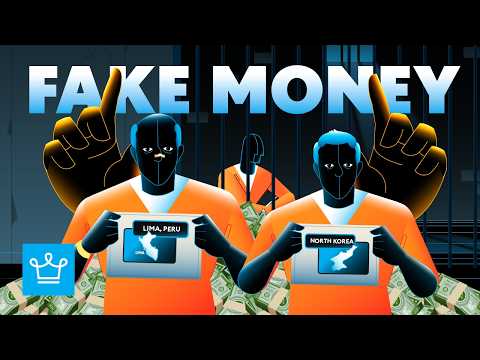
Link: https://youtu.be/pzA6w1iInsY
Short Summary
Number One Takeaway:
Develop your financial acumen and critical thinking skills to avoid being deceived by counterfeits, whether currency, goods, or documents.
Executive Summary:
Counterfeiting is a pervasive global industry involving fake currency, goods, and documents, driven by factors like economic hardship, corruption, and demand. The best defense is increased awareness, financial literacy, and critical thinking to protect yourself from scams, fraud, and loss.
Key Quotes
Here are four quotes that I consider valuable from the transcript:
-
"Now, counterfeiting is a half a trillion dollar industry that runs alongside the legal one using the same ports, trade routes, factories, and banking systems that handle legitimate goods. The only difference is who's getting paid and who's taking the risk." - This highlights the disturbing integration of counterfeiting into the global economy and the difficulty in separating the illicit from the legitimate.
-
"At the end of the Civil War, 1/3 to 1/2 of all US currency in circulation was believed to be fake. That's the whole reason the Secret Service was established. Not for presidential protection, no, but for protecting the nation's money supply." - This is a surprising historical data point that underscores the severity of the counterfeiting problem in the US and the original purpose of a well-known government agency.
-
"A successful counterfeiting hub comes down to two things, okay? What drives it and what enables it. The drivers are human things like motive, desperation, creativity, and opportunity. The enablers are structural like state resources, precision, geography, and corruption." - This quote provides a framework for understanding how counterfeiting thrives in specific locations, highlighting the interplay between individual initiative and systemic factors.
-
"Every fake bill, forged passport, or knockoff product exists for the same reason the real ones do. Because somebody needs what it offers. For counterfeits, the goal isn't to get rich once. It's to build a system that can keep running even when a few pieces get shut down." - This quote offers a deeper understanding of the demand for counterfeits, and the motivation of counterfeiters: that they are not interested in a one-time score, but establishing a resilient business.
Detailed Summary
Here's a detailed summary of the YouTube video transcript, focusing on the key points and arguments, excluding advertisements:
-
Introduction:
- Counterfeiting is a massive, half-trillion-dollar industry that parallels the legitimate economy.
- It operates through the same trade routes, factories, and banking systems.
- Focus is on who profits and who bears the risk.
- Counterfeit networks fall into two categories: fake currency and fake goods.
- Fake currency requires precision, matching security features to fool detection systems.
- Fake goods require volume, satisfying global demand for luxury at a discount.
-
Fake Money: History & Operation Bernhard:
- Counterfeiting dates back to the 7th century B.C.E. with the first coins in Lydia.
- It continued through history, including large-scale paper money counterfeiting in the Song Dynasty.
- The US became a major counterfeiting hub after the Civil War, leading to the creation of the Secret Service (originally for protecting currency, not the president).
- Operation Bernhard: Nazi Germany's massive counterfeiting scheme during WWII.
- Goal: Flood Britain with fake banknotes to cause inflation and fund intelligence operations.
- Forced skilled prisoners in concentration camps to produce high-quality counterfeit British pounds.
- The counterfeits were so good, they fooled the Bank of England.
- Impact: Shook the Bank of England, leading to the withdrawal of higher denomination notes and a delay in their reintroduction.
-
Modern Counterfeiting Hubs: Drivers & Enablers:
- Success depends on:
- Drivers (human factors): Motive, desperation, creativity, opportunity
- Enablers (structural factors): State resources, precision, geography, corruption
- Top counterfeit currencies: US Dollar (specifically the $20 bill), 50 Euro note, Indian 500 note.
- Reasons for counterfeiting US Dollar: World's reserve currency, internationally accepted, high face value.
- Four cities are the counterfeit currency capitals: North Korea, Lima, Bogota, and Logos.
- Success depends on:
-
North Korea: State-Sponsored Counterfeiting:
- Room 39 of the ruling party directs the operation.
- "Supernotes": High-quality counterfeit US $100 bills almost indistinguishable from genuine currency.
- Identified through forensic analysis and serial number patterns.
- Motivated by bypassing sanctions, funding imports, and buying luxury goods for the elite.
- Exposed through incidents like North Korean officials being caught passing or depositing supernotes.
- US Treasury publicly accused North Korea, leading to sanctions and financial actions.
-
Lima, Peru: Precision & Decentralization:
- Sophisticated, non-state-backed operation.
- Emerged during Peru's economic turmoil in the late 80s/early 90s when the dollar became widely used.
- Network run by multiple organizations in small, specialized workshops (engraving, printing, cutting, aging).
- Difficult to shut down due to compartmentalization.
- Smuggled through Colombia and Ecuador to the US, Canada, Europe, and Asia.
- Uses both offset lithographic printing and sources the cotton linen blend used in real US currency.
- Counterfeiters are trained in printing and security documents and carefully age the bills.
- Peruvian notes are good enough to fool some older-generation banknote sorting machines.
-
Bogota, Colombia: Volume & Logistics:
- Focuses on high-volume production and rapid distribution.
- Operations are opposite of Lima's, running large-scale print shops, and moving the money as fast as possible
- Emerged as the Colombian peso stabilized, while other South American currencies weakened.
- US dollars became a safe haven in those countries.
- Hidden print shops in Bogota and rural areas.
- Counterfeit money is mixed with other stolen or fake goods.
- Benefits from direct highway and freight routes into neighboring countries.
- Despite raids, new operations constantly emerge.
-
Logos, Nigeria: Forged Documents:
- Expertise in forging documents (passports, visas, driver's licenses, birth certificates, etc.).
- Skilled forgers replicate holograms, security threads, watermarks, and machine-readable zones.
- Started in the 80s/90s due to Nigeria's oil boom and subsequent bust, leading citizens to seek work abroad.
- Strict visa requirements created a market for fake travel papers.
- Uses altered documents initially but evolved to sophisticated forgeries with computer technology.
- Sustained by migration demand, regional smuggling routes, and visual border inspections in West/Central Africa.
- British passports are the most forged, ironically due to their advanced security features and global recognition.
- Forgery operations run out of apartments, internet cafes, and print shops.
- Provides a "one-stop service center" for fake identities and documents.
-
Conclusion:
- Counterfeiting thrives because there is a demand for what it offers.
- Counterfeiters aim to build resilient systems that can withstand disruptions.
- Next chapter will focus on fake luxury goods.