[@alux] How a Steel Box Created Globalization And Broke Your Town
![[@alux] Summarizer](https://summaries.pages.dev/img/logo.webp)
Link: https://youtu.be/wUNzeKKuyIY
Short Summary
Here's a breakdown of the video transcript:
-
Number One Action Item/Takeaway: Understanding the strategic importance of key ocean routes (chokepoints) is crucial for navigating global power and economics in the future. These routes control the flow of the global economy and will influence energy and data networks.
-
Executive Summary: The shipping container revolutionized global trade, leading to mass globalization, de-industrialization in developed countries, and the rise of manufacturing hubs in developing nations. This transformation, along with policies and technology, created a "just in time" supply chain, making the world vulnerable to disruptions and highlighting the strategic importance of key ocean routes for future energy and data networks.
Key Quotes
Here are five quotes from the transcript that represent valuable insights and data points:
-
"It costs $5 to ship a fridge 7,000 miles from China to LA. If you ordered that fridge from a local warehouse, you'd pay at least 10 times that for delivery. That is how optimized the shipping industry is." - This highlights the incredible efficiency and cost-effectiveness of the modern shipping industry.
-
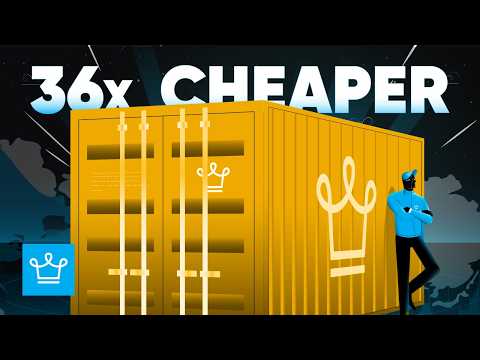
"Before containerization, it cost $5.83 per ton to load cargo. Now, it's 16¢ per ton. That's a 36x decrease in price and handling costs alone." - This quantifies the dramatic reduction in costs brought about by containerization.
-
"These days, a single container can move through more than 20 countries without ever being opened. That's going from a factory in the middle of China, across Eurasia by rail, onto a cargo ship in Europe, across the Indian Ocean, through the Suez Canal, ending up in a store in rural Africa, all without ever being unpacked." - This illustrates the seamless global logistics enabled by containers.
-
"Malcolm's invention made the system so cheap that labor costs, not geography, became the main dictator of factory locations." - This explains how containerization shifted manufacturing to locations with cheaper labor, leading to de-industrialization in developed countries.
-
"The invention and movement of shipping have acted like this mold and set the blueprint roots for future power control and global economics." - This emphasizes how the shipping industry has had an outsized impact on the development of trade routes and digital and energy networks.
Detailed Summary
Okay, here's a detailed bullet-point summary of the YouTube video transcript, focusing on the key arguments and information:
Key Argument:
- The invention of the shipping container revolutionized global trade, leading to mass globalization, shifting economic power, and influencing the future of digital and energy infrastructure.
Before Containerization (Pre-1956):
- Cargo handling was slow, expensive, and manual ("break bulk" system).
- Cost $5.83 per ton to load cargo before containerization.
- Cargo was packed in various forms (sacks, barrels, crates) depending on the product.
- Goods were stored in warehouses at ports, requiring sorting and reloading at each stop.
- Ships carried mixed cargo for multiple customers/ports.
- Global manufacturing was not as efficient and many goods were luxuries.
Malcolm McLean and the Invention of the Shipping Container:
- Malcolm McLean, a trucking entrepreneur, was frustrated by the inefficiency of loading cargo onto ships.
- He envisioned entire truck trailers being lifted onto ships.
- In 1955, he sold his trucking company and bought Pan-Atlantic Steamship Company.
- McLean standardized container dimensions and created a system for seamless transfer between ships, trains, and trucks.
- He converted World War II oil tankers to carry containers.
- The first container ship, the Ideal X, sailed in 1956 from New Jersey to Houston, carrying 58 containers.
- Loading time reduced from days to hours.
- By the 1960s, McLean renamed his company to Sealand and helped draft ISO 668, the basis of global shipping standards.
Impact of Containerization on Global Trade:
- Cost reduced to $0.16 per ton to load cargo after containerization, a 36x decrease.
- Made labor costs the main determinant of factory locations, not geography.
- Shifted production to countries with cheap labor (China, Vietnam, Mexico, Bangladesh).
- Deindustrialization of rich countries led to job losses and economic decline in smaller towns.
- Globalization gave us cheap goods but expensive lives as costs increased for housing, healthcare, and education.
The "Just-in-Time" Trade Model:
- Containerization facilitated the adoption of the "just-in-time" inventory model.
- Originated with Toyota in post-WWII Japan.
- Reduced the need for large inventories, but increased reliance on efficient and uninterrupted shipping.
- Requires precise tracking and fast shipping.
Vulnerabilities of the Containerized Supply Chain:
- COVID-19 pandemic: Factory shutdowns, port congestion, and increased demand led to shortages and skyrocketing shipping costs.
- The Ever Given Suez Canal blockage: Disrupted global trade and highlighted the fragility of the system.
- Political targeting: Houthi rebel attacks in the Red Sea increased shipping times and costs.
Strategic Ocean Choke Points:
- Narrow ocean routes control the flow of the global economy.
- Examples: Strait of Malacca, Suez Canal, Panama Canal, South China Sea, English Channel, Strait of Gibraltar.
- Control of these routes grants power over world prices and supply.
- Geopolitical tensions in these areas create risks for global trade.
The Future: Undersea Cables and Strategic Routes:
- Undersea data cables carry 99% of the world's internet traffic and follow old shipping routes.
- Countries are moving toward clean energy, and undersea electricity cables are being built.
- Hydrogen pipelines are planned to connect green energy sources.
- Data centers are built close to these cables for cheaper and more efficient data transfer.
- The invention of the shipping container created cities that will control digital and energy resources.