[@alux] How Getting Rich Has Evolved Across Time
![[@alux] Summarizer](https://summaries.pages.dev/img/logo.webp)
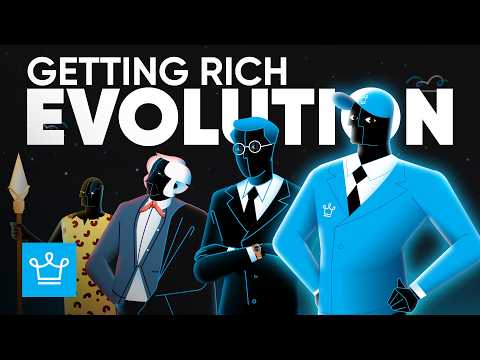
Link: https://youtu.be/kKha5X7oB8o
Short Summary
Here's the breakdown of the video transcript:
-
Number one most important action item/takeaway: Embrace the future by learning to effectively integrate and utilize AI into your life and work, as this is the current key to building wealth.
-
Executive Summary: The path to wealth has constantly evolved throughout history, driven by technological advancements and shifts in societal structures. Today, in the age of intelligence, mastering AI and integrating it into various aspects of life is crucial for building wealth and shaping the future.
Key Quotes
Okay, here are 4 direct quotes from the YouTube video transcript that represent key insights:
-
"Because the truth is, the rules of wealth are in constant evolution, and the richest people have always been the ones to know how to spot the next big thing."
-
"In the information age, you don't need ships or trains. You need servers, cloud infrastructure, and an army of computer engineers."
-
"If you want to build wealth in the modern day like it's never been possible before in history, there's only one way to do it, and that is with AI."
-
"Right now, you're watching the groundwork being laid for something much bigger. Which brings us to bigger questions like where do we go from here?"
Detailed Summary
Here's a detailed summary of the video transcript, presented in bullet points:
-
Introduction: The video explores how wealth creation has evolved throughout history and attempts to predict what wealth will look like in the future.
-
The Agricultural Age (14,000 Years Ago):
- Wealth was based on controlling land, water, and labor.
- Richest people were tribal leaders, warlords, and early kings.
- Wealth manifested as surplus grain, loyal servants, and multiple wives.
- Alliances became important as civilizations grew.
-
The Age of Empire and Conquest (5,000 Years Ago):
- Wealth shifted from land ownership to military power.
- Richest individuals were those who won wars, collected tribute, and enslaved enemies (Pharaohs, Emperors, Generals).
- Expansion of borders meant more land, more people controlled, and more taxes.
- Conquest was the primary economic driver.
- Wealth brought palaces, rare goods, entertainers, soldiers, and historical recognition.
-
The Age of Trade and Exploration (1400s):
- Wealth was generated through global trade routes and control of valuable commodities.
- The Dutch East India Company is cited as an example of a powerful entity.
- Risk-taking, capital management, negotiation skills, and maritime capabilities were crucial.
- Trade turned merchants into aristocrats.
-
The Industrial Age (1800s):
- Wealth shifted to industrialists who owned the means of production (factories, mills, refineries).
- Examples: Cornelius Vanderbilt (railroads), Andrew Carnegie (steel), and John D. Rockefeller (oil).
- Success depended on building quickly and cheaply, dominating industries, and aggressive expansion.
- Early versions of modern luxury items were available to the rich.
-
The Information Age (Mid-20th Century - Present):
- Wealth creation centered on building systems, platforms, and code that connect the world.
- Examples: Bill Gates, Steve Jobs, and Jeff Bezos.
- Software products could reach billions at minimal cost.
- Key success factors: Timing, product-market fit, capturing user attention and behavior.
- Smart homes, private jets, biohacking labs, and location independence were hallmarks of wealth.
-
The Age of Intelligence (Present):
- AI is fundamentally changing traditional products and industries.
- Companies like Google, Microsoft, OpenAI, and Nvidia are racing to dominate the AI landscape.
- Wealth resides in owning data, building foundation models, and providing tools that power other tools.
- Skills required: Systems thinking, creativity, simplifying complex ideas, and working alongside AI.
-
Future Predictions:
- Next 5 Years: Mastery of AI, automating workflows, generating income from digital assets, and scaling influence with machines will be key to wealth.
- 50 Years: Companies controlling human well-being or energy may be the most valuable. The digital world may be more prominent than the physical world.
- 500 Years: Wealth may not be defined by money if basic necessities are accessible to all. Exclusivity may be measured in access and influence. The richest may live in private simulations, travel the galaxy, and achieve immortality or digital consciousness.
-
Concluding Thoughts: Adaptation and embracing the future are crucial to staying in the game of wealth creation.