[@alux] The Smartest Way to Invest $1 Million

Link: https://youtu.be/nwgAOcsaDNI
Duration: 19 min
Transcript: Download plain text
Short Summary
No interviewee is identified in this evidence, so no background can be given; instead, this is a narrated, example-driven personal-finance guide. The episode walks through a hypothetical $1 million windfall, arguing first to pay down expensive debt (a $20,000 balance at 20% costs about $4,000 a year) and to hold a $60,000 reserve, then to invest most of the rest. It then tests lump-sum investing against dollar cost averaging with Vanguard research and real market windows, proposes a $600,000 stock / $340,000 bond / $60,000 cash split, and stress-tests that plan through crashes, rebalancing, sequence-of-returns risk, and a 3.9% safe withdrawal rate from Morning Star's 2025 study.
Key Quotes
- "If you've got 20,000 of debt charging 20% interest, that's roughly 4,000 a year just to keep the same balance hanging around." (00:01:11)
- "Vanguard found that investing immediately beats spreading out purchases roughly twothirds of the time in the comparisons studied." (00:07:04)
- "You don't have to become a landlord simply because you can now afford to become one." (00:11:26)
- "That percentage point has made a difference of roughly $554,000." (00:11:58)
- "That's why an average return isn't enough to tell you how much you can live on." (00:16:39)
Detailed Summary
Detailed Summary
Scope and setup
- The episode is a narrated, example-driven personal-finance guide built around a single hypothetical scenario: what to do with a $1 million windfall. No interviewee is identified in the evidence, so there is no guest background to report; the voice is instructional and uses one running example throughout.
- The stated goal is to turn the million into a workable long-term plan rather than a headline number, and to make the reader comfortable actually owning the result.
Step 1: Clear expensive debt before investing
- Paying off debt comes first because the interest is a guaranteed negative return: $20,000 of debt at 20% interest costs roughly $4,000 a year just to hold the balance, and no investment reliably beats that with certainty.
- A cheap fixed-rate mortgage is more complicated: it feels good and may lower monthly expenses, but paying it off could leave you owning a paid-off house with little cash — you still own the value, yet you cannot access $10K without borrowing again or selling the property.
Step 2: Build the emergency reserve
- Set aside $60,000 for emergencies and known near-term expenses, held in an insured bank account within its protection limits or a short-term government bill, so an unexpected bill does not force selling investments when they are down.
- The right number depends on income stability, dependents, and expenses, so $60,000 is a working figure rather than a universal rule.
- Caution can be overdone: leaving the whole $1 million earning nothing for 10 years with 3% average inflation means it buys about what $744,000 buys today, so the remaining $940,000 can go to work while needed money stays accessible.
Step 3: Lump sum vs. dollar cost averaging (with real numbers)
- The comparison uses the S&P 500 and two strategies over the full $1 million: invest everything at once, or invest $200K at the start of each year for 5 years (dollar cost averaging), with dividends reinvested, uninvested cash earning short-term Treasury bill interest, and taxes and fees excluded using nominal dollars.
- January 2000 start (before the dot-com crash): investing the whole million at once left about $626,000 by the end of 2002 — nearly $375,000 disappeared even with dividends reinvested — and about $889,000 by the end of 2004. Buying $200K a year left roughly $897,000 by end of 2002 (about $419,000 in shares plus $478,000 in cash with interest) and about $1.18 million by end of 2004.
- January 2003 start (ahead of several strong years): investing immediately produced roughly $1.82 million by end of 2007, while buying $200,000 each year produced about $1.44 million, so being cautious left behind about $47,000 as waiting money earned interest but missed much larger market gains.
- Vanguard research found investing immediately beats spreading purchases roughly two-thirds of the time in the comparisons studied, but its main test used a much shorter 3-month buying schedule, so it is not a win rate for the 5-year example; the chosen start dates were deliberately selected to show contrasting outcomes no investor could have known in advance.
- Behavioral caveat: if investing everything at once would make you panic-sell after the first big drop, a fixed buying schedule can help you stick with it — but the important part is following the schedule even when news makes the next purchase feel terrible. If you do spread purchases, pick dates in advance and give the process an end, because a crash after your final purchase still hits the whole amount.
Step 4: The proposed allocation
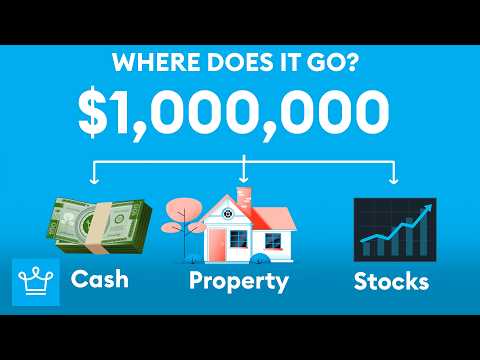
- The $1 million is split into $600,000 into broad stock funds, $340,000 into high-quality bonds, and the $60,000 reserve, which accounts for the full million.
- These proportions are explicitly a starting point rather than a magic formula, to be stress-tested against a bad scenario to check whether you would actually be comfortable owning it.
- Diversification is not automatic: adding more funds is not necessarily adding more variety, since a technology fund bought alongside a broad US fund can buy many of the same companies twice, so investors should check what they own underneath the fund names.
- Your job counts as a holding: a tech worker holding employer shares and technology funds can have one industry hit income and portfolio at once — concentration is a hidden risk that does not appear on the investment account screen.
Step 5: Bonds are not automatically safe
- A struggling company can offer an attractive rate precisely because there is a real chance of not getting everything back, and long bonds can fall sharply in price if sold before maturity as interest rates change.
- In 2022 both the S&P 500 and the 10-year US Treasury bond series used for the research lost about 18%, so holding bonds does not mean every bad stock market year is covered.
- For this plan the lean is toward high-quality bonds with shorter or medium repayment periods, with inflation-linked government bonds possibly helping with rising prices even though they can fall in market value before maturity.
Step 6: Access to complicated investments is not an obligation
- A private deal can lock money up for years, cost more, and be much harder to sell when plans change.
- Spending $400,000 on a single rental property puts 40% of the million into one space before buying costs and repairs — a bigger bet on one building than any individual company inside a broad stock fund.
Step 7: Fees, compounding, and paying for advice
- A 1% annual fee on $1 million costs $10,000 in the first year alone, potentially before fees inside the investments.
- Compounding cuts both ways: a million growing at an assumed 6% a year for 20 years reaches about $3.21 million, versus about $2.65 million at 5% — a difference of roughly $554,000.
- Advice can be worth paying for when taxes or complicated finances are involved, so ask what it costs, what it includes, whether it must be paid every year, and which accounts make sense where you live given taxes and access restrictions.
Step 8: Stress test of the plan
- Bad scenario: if shares fall 40% and bonds fall 10% with cash flat, the $600,000 in shares becomes $360,000 and the bonds fall to $306,000; adding the $60,000 reserve gives $726,000 — a $274,000 loss even in a diversified plan.
- If seeing that loss would make you sell everything, you probably need less in stocks.
- The $60,000 reserve can cover the $40,000 needed for a year without selling shares if income stops, buying time to find income or adjust plans.
Step 9: Rebalancing
- If the $600,000 shareholding rises 40% while bonds and cash stay flat, stocks become $840,000 out of $1.24 million and rise from 60% to almost 68% of the portfolio without the investor choosing more risk.
- Restoring the 60% mix means moving $96,000 out of stocks into the rest of the plan, done on a chosen review schedule, with taxes considered and new money used for withdrawals where possible.
- Write the investment rules down before anything dramatic happens, because during a crash many people will argue for abandoning the plan.
Step 10: Withdrawals and sequence-of-returns risk
- The naive calculation assumes a 7% return on $1 million supports $70,000 of annual spending, but returns do not arrive like a salary.
- Sequence example: withdrawing $50,000 at the end of each year from $1 million ends at $870,000 if the portfolio gains 20% then loses 20%, but only $850,000 if the order is reversed — $20,000 worse with the same two returns.
- Without withdrawals, both paths would have ended at $960,000, showing that taking money out after an early loss leaves less invested to benefit from the recovery, and that an average return cannot tell you how much you can live on.
- Morning Star's 2025 study arrived at a starting withdrawal rate of 3.9%, which on $1 million equals $39,000 in the first year before personal taxes; the study allowed spending to rise with inflation and aimed for money to remain in 90% of modeled outcomes over 30 years, but it did not promise the original million would still be intact — and at age 40 the money may be needed for much longer than 30 years.
- In this example the investor's earnings still cover the bills, so a starting withdrawal of $20,000 a year before tax (2% of the starting million) could fund a sabbatical, longer time off, or a postponed goal, and stays flexible enough to cut in a bad year.
Key takeaways
- Pay off expensive debt, hold an insured $60,000 reserve, invest the long-term portion once you have decided your risk level, and only spread purchases if you need the psychological help.
- Treat the $600K / $340K / $60K split as a starting point to be stress-tested, written down, reviewed on a schedule, and rebalanced with taxes and new cash in mind.
- Keep fees low, don't confuse a headline average return with a spending plan, and use sequence-aware withdrawal rates (Morning Star's 3.9%, or 2% if income still covers bills) rather than the naive 7%-of-a-million rule.