[@hubermanlab] Access the Sublime & Live Your Best Life | Robert Greene

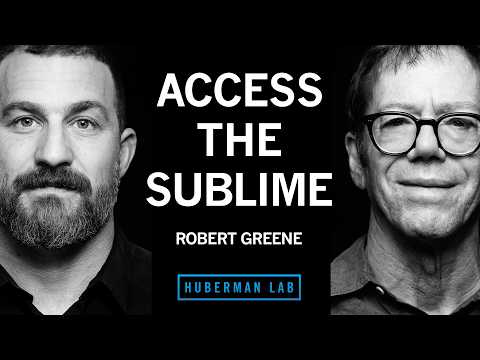
Link: https://youtu.be/y-fRFiTrrg4
Duration: 138 min
Transcript: Download plain text
Short Summary
Andrew Huberman hosts Robert Green, the neuroscientist and author of The 48 Laws of Power, The Laws of Human Nature and Mastery, to discuss his new book on the sublime. Green, a former laboratory scientist who shut his lab down around 2023-24 and who survived a stroke, explains how recovering the sublime became the project of his later career after psychedelic use and a near-death experience left him unable to travel. The conversation covers attention, time perception, the love sublime, religion and science, handwriting, and practical daily exercises for finding meaning.
Key Quotes
- "The sublime is a mix of pain and pleasure. The pain is it's outside my comfort zone. It's not what I'm familiar with, but the pleasure is the newness of it, the novelty, the excitement that it generates." (00:06:16)
- "the feeling starts coming over me that the sublime is part of our everyday life. It's everywhere around us, right?" (00:11:13)
- "He said if a human being were truly awake, there would not be wars. We would not be killing each other. Would not be all this misery that we inflict on fellow humans, right?" (00:19:40)
- "But if you're climbing the mountain and you're like filming it and looking at it and look and navigating through it, you're not you're not experiencing the mountain itself. So the technology is actually a major roadblock to experiencing the sublime." (01:00:40)
- "The point of the book is that the need for a transcendent experiences which what the sublime is about in many ways is as important a need to humans as clothing as shelter as companionship as anything else." (01:08:29)
Detailed Summary
Episode focus and Green’s book map
Andrew Huberman interviews neuroscientist and author Robert Green about recovering the “sublime” in ordinary perception and his new book on the subject, referenced as both The Law of the Sublime and The Art of the Sublime. The conversation moves from Green’s stroke and near-death experience to attention, love, religion, science, handwriting, and practical exercises for recovering a richer sense of time.
- Green is also the author of The 48 Laws of Power, The Laws of Human Nature, The Art of Seduction, and Mastery.
- He distinguishes his books by subject: The 48 Laws of Power concerns how the world is constructed and how to navigate it; Mastery concerns mentorship and realizing unique gifts; and The Laws of Human Nature provides principles for understanding oneself and others.
- The new book is instead about the quality of day-to-day experience rather than success, influence, or power. Unlike his earlier books, each chapter ends with exercises intended to be incorporated into ordinary routines.
- Green argues that the need for transcendent experience is as fundamental as clothing, shelter, and companionship. He wants access to the sublime to be possible for people living in small apartments, rather than an elite experience available mainly to the wealthy.
From laboratory scientist to full-time observer
Green closed his laboratory around 2023–24 after his postdocs moved on, but he describes the loss of the laboratory as a change in rhythm rather than a rejection of science. He contrasts the immediacy of observing nature with the slower, more social work of turning observations into publications and presenting seminars.
- A laboratory scientist’s official work is to convert microscope observations into papers for evaluation, but Green considers the observation itself the real adventure.
- Writing papers and giving seminars operate at a different speed, spatial scale, and set of brain circuits from laboratory work.
- He is not categorically anti-technology: instruments such as Hubble and the Vera Rubin telescope can reveal sublime realities when the purpose is contemplation rather than reporting back or accumulating social capital.
- Now in his late 60s, Green notes that stroke survivors of his age can have reduced life expectancy. Because the book took seven years, he cannot readily commit to another project of that length.
What Green means by the sublime
Green describes the sublime as movement beyond the familiar boundaries of the ego into a state where the person and the activity become temporarily unified. His “circle of consciousness” model treats each exit from that circle as a doorway into a different form of transcendence.
- He derives “sublime” from the Latin sub limen, meaning “the threshold of a door,” and treats the concept as a mixture of pain and pleasure: the pain of leaving one’s comfort zone and the pleasure of novelty.
- The circle of experience is broad at birth because nearly everything is unfamiliar. It contracts with age until ordinary life feels flat and imagination goes unused.
- A cup is ordinarily perceived as a tool for drinking. In a sublime state—sometimes under drugs and sometimes near death—its shape, color, handle, and material become visible apart from its use value.
- Green describes the sublime as a transcendent flow state resembling an out-of-body experience. He uses chess, Einstein’s relativity, painting, and piano playing as examples in which the conscious self seems to dissolve into the activity.
- He connects this state with inspiration: ideas can arrive without logical order, “as if someone were breathing inside you,” which also explains the linguistic root of “inspired.”
- The book also addresses the darker side of transcendence, including what Green calls “sublimely evil.” A central chapter, “Escape the Prison of the Ego: The Love Sublime,” asks whether the experience can arise through another person.
Psychedelics, Huxley, and altered perception
Green describes extensive psychedelic use as part of his personal history, while carefully distinguishing his own views from Aldous Huxley’s. For him, psychedelics are one possible route to a wider perceptual window, not the definition of the sublime itself.
- In his late teens and early 20s, Green took many drugs and had a peyote experience in Mendocino on the Northern California coast that permanently affected how he sees everyday things.
- He says cannabis can make something “go off” in the brain, allowing him to see a familiar object as it is rather than solely in terms of its use, much as he did as a child.
- The idea of “doors of perception” and the championing of LSD belong to Huxley’s work, not Green’s. Green was also heavily involved with psychedelics and says the conversation may return to them.
- Huxley’s account of the mind as a funnel that filters incoming information becomes important in the later discussion of habituation and narrowed attention.
The stroke, near-death experience, and a second birth
Green’s stroke reorganized both his body and the project that became the book. Instead of completing the ambitious travel-and-psychedelic plan he had imagined, he wrote from an office after recovering the capacity to perceive ordinary life as extraordinary.
- When Green first conceived the book roughly 20 years earlier, the plan was to take psychedelics, experience ayahuasca, travel to the Amazon, swim with dolphins, and see chimpanzees in the Gobi National Forest.
- He can no longer travel and walks with poor balance, so the book had to be written in his office. He describes himself as “a bird in a cage that had to find a way to sing inside its cage.”
- On the first day after his stroke in a hospital bed, the world appeared as though he had just been born: blue sky, passing clouds, birds, and swaying trees were beautiful and incandescent.
- That radiance faded as what he calls the “shadow of death” passed over him. His near-death experience eventually brought the sublime back in a very concrete form.
- Back at home, he found the same quality among insects, flowers, and trees in his own backyard, supporting the book’s thesis that the sublime is not confined to rare landscapes or extraordinary events.
- After surgery to remove a cancerous melanoma from his eye, skin was taken from his ear to replace it. Ten days later, the graft was growing back, which Green treats as evidence that ordinary life is filled with quasi-miracles.
- Green situates the body within approximately 800 million years of evolution, noting that eyes, optic nerves, and the nervous system emerged during the Cambrian explosion.
- The stroke affected the right side of his brain. Green’s explanation is that the left hemisphere handles language, logic, and reasoning, while the right is more holistic and emotional; afterward, he experienced less emotional control and greater empathy for people who were disabled or helpless.
Illness as a forced gift
Huberman and Green consider whether the sublime requires only contemplating altered perception or whether default perception must actually change. Their examples suggest that illness can force an irreversible change in how familiar surroundings are experienced.
- Two weeks before the recording, Huberman visited the Esalen Institute in Big Sur, where co-founder Michael Murphy, then 96, had suffered a blackout and a fall of uncertain cause, possibly a stroke.
- Murphy remained clear-headed and mobile, but the “pixelation of the world” had changed. Familiar surroundings now revealed colors and shapes that had previously gone unnoticed.
- Green cites artists whose visual deficits produced unusual perceptual results, including Chuck Close’s work at a different spatial scale and the distorted figures of El Greco, often attributed to an eye condition resembling a concave mirror.
- Green and Murphy did not merely imagine different perception; it was forced upon them, and they converted the disruption into a gift that became part of Green’s book.
Gurdjieff, Uspensky, and the discipline of attention
Gurdjieff’s historical experiment provides one of the episode’s central practical frameworks: human attention may be the defining feature that separates reflective consciousness from animal-like reaction to immediate surroundings. Uspensky’s account shows both the promise and difficulty of sustaining that attention.
- Around the turn of the 20th century, the Armenian mystic Gurdjieff traveled among esoteric communities across the Middle East and Far East because he believed they were about to disappear and wanted to preserve their secrets in a new philosophy.
- His central claim was that “what makes a human being human is our attention.” Whereas animals attend mainly to what is immediately before them and to survival, people can attend to the sky or speculate about what lies beyond a mountain.
- Gurdjieff argued that most people are “sleepwalking” through life. If people were truly awake, he maintained, there would be no wars, no killing, and none of the misery humans inflict on one another.
- His “self-remembering” exercise asks a person to focus deeply on the present moment while consciously telling themself that they are remembering it.
- Gurdjieff claimed that people would not really remember something from three years earlier because they had not been paying attention when it happened.
- Uspensky, a deeply depressed and suicidal Russian mystic, applied the exercise to a vase of flowers. His mind wandered after about 30 seconds, but after a minute the flowers began to look different, and he resolved to remember them three years later.
- After months of practice, Uspensky walked outside and found houses looking almost alive and intense. He then discovered that he had fallen asleep and, three hours later, was in a tobacconist on the opposite side of Moscow or St. Petersburg; Huberman was unsure which city.
- Huberman argues that sustained attention and meditation can alter perception and neurology without drugs. He meditates for 40 minutes every morning, says the practice changes his sense of time, and notes parallels in Tibetan and Zen Buddhist traditions.
- Huberman invokes Huxley’s description of drugs as “a wonderful gateway,” but the historical examples emphasize that disciplined focus can open similar perceptual doors without psychedelics.
The neuroscience of narrowing and changing perception
The discussion treats perception as a dynamic process rather than a transparent record of the external world. Eye movements, filtering, story-making, and altered chemistry can all change what a stable object appears to be.
- In experiments with reversible eye paralysis, an object can disappear and reappear because the nervous system depends on eye movements, including saccades, to construct a stable percept.
- When people keep their gaze fixed on the same location, the percept can change substantially even though the object’s physical properties remain unchanged. Huberman compares this with a smell fading as it becomes familiar in a room.
- The brain filters and prunes incoming information to create continuity and familiarity rather than allowing chaotic sensory input to overwhelm the mind.
- Huxley’s “funnel” metaphor describes this filtering process. Green and Huberman argue that seeing a mug, vase, or bouquet of flowers as beautiful but trivial often reflects the absence of a story rather than an inherent property of the object.
- Huberman cautions that MDMA is medically risky and notes that a listener can hear a song, fall in love with it, and repeat it for four hours. Such malleability raises the question of what makes one meaning more valid than another.
- Green says humans create emotions through what they see and expresses frustration with contemporary culture’s increasingly rational self-image. He regards AI as a machine programmed by humans, not a conscious entity, even when scientists anthropomorphize it.
Space, time, and the “space-time filter”
Huberman proposes that perception can be examined through the infinite spatial and temporal scales available for observation. The “space-time filter” describes the resolution and speed at which a brain samples the world, rather than the physics of spacetime itself.
- The filter can be imagined as a camera with a particular frame rate and pixel density. A fixed frame rate determines how much information is gathered from each moment.
- Berkeley awe researcher Dacher Keltner found that awe commonly arises when a person transitions quickly from a small spatial scale to a vast one, as when walking through a forest and suddenly reaching an open vista.
- The reverse transition—vast scale to small scale—can also produce awe, although Huberman says the small-to-large direction is more common.
- Huberman’s example of changing the frame rate is watching an espresso pour in extreme temporal detail. Green objects that no one could maintain that level of attention all day.
- Having lived in California for 51 years, Huberman describes stopping along Highway 101 to inspect old barbed-wire fence lines and imagining an entire day devoted to the interface between wire and wood.
Dying, dissolving constructions, and expanded time
Near-death experiences provide the episode’s starkest example of the mind losing its ordinary constructions of self and time. Both the personal examples and the historical record show consciousness becoming unusually vivid as the brain itself begins to fail.
- Huberman’s graduate adviser Barbara, who died of cancer at 50 while married to a scientist and mother of two daughters, focused on minute details during her final conversation, about a week before her death.
- One of those details was the movement of the curls of her bright red-haired daughter’s hair as she entered the room. Huberman says, “Her frame rate was changing.”
- Barbara remained calm, present, and non-anxious. Huberman describes her final state as an avalanche of new and beautiful information, as though she extracted what seemed like years of experience in a short period.
- Because the brain is dying along with the body, constructions such as time, vision, and the self can begin to dissolve. Near-death experiencers often report the ego, abstract time, and social pressures losing their solidity, producing ecstasy or liberation.
- Huberman offers an approximate figure that about 85% of near-death experiences are positive, while acknowledging that the remaining accounts are often hellish rather than angelic.
- Albert Heim, a 19th-century Swiss alpine climber, was the first to systematically study near-death experiences. At 21, he fell about 100 feet and felt years of his life pass during roughly 15 seconds of falling.
- After Heim published his account, hundreds of similar reports arrived from people who survived falls or Golden Gate Bridge jumps; some said that 10 seconds felt like five years.
- Watching an aquarium or the ocean places the mind in a state where it can neither control nor predict what happens next. The speakers suggest that this “unlatching” of expectation opens additional perception.
Encounters with other species and their time
The sublime is also found beyond the human world, but close contact with other species changes the human sense of duration and possibility. Octopuses, cuttlefish, insects, dogs, and plants each expose the arbitrariness of human time scales.
- The filmmaker behind My Octopus Teacher cold-dove off South Africa, where he had grown up, and free-dived through a kelp forest to meet a female octopus over six to eight months.
- The octopus grabbed his arm, and the two floated together in what he describes as a love or erotic relationship. Its closeness created an experience of sharing another creature’s world rather than merely observing it.
- An octopus generally lives no more than about three years. Green’s octopus was attacked by a shark, lost limbs that later regrew, laid eggs, and died; because her lifespan was so compressed and eventful, being near her made the filmmaker feel as though he were living in “her time.”
- Insects live roughly a month, so their experience of duration differs profoundly from a human’s. Green suggests that plants offer another route into alien time, pointing to his mother’s work as an avid gardener.
- A dog can also entrain a person to a different rhythm because the daily walk becomes a non-negotiable requirement shared by human and animal.
- A San Diego researcher once kept about 40 cuttlefish and called them “little underwater Hufflepuff monkeys.” Cuttlefish can camouflage half their bodies, and wild males sometimes imitate females to enter groups of females and mate—a behavior described in the literature as “sneaky.”
- Humans remain bound to a 24-hour circadian rhythm regardless of these other scales, although individual sleep needs vary.
Slowness, attention, and technology
Huberman and Green argue that constant digital stimulation narrows attention to a single fast rhythm of novelty. Slowing down is presented not as a retreat from life but as a way to regain independent perception and deliberate action.
- Excessive social media use locks people into one space-time relationship and a repeated expectation of dopamine-driven updating. Splintered attention makes people more vulnerable to advertising and gimmicks and harder to think deeply.
- Huberman says that leaving a phone behind for a weekend, keeping it out of the bedroom for a full night, or avoiding it for the first 30 minutes after waking significantly improves the rest of the day.
- Green keeps his phone in a drawer and out of the room while working and relating to others. He acknowledges the temptation and addiction while saying he is getting better at maintaining that boundary.
- The brain forms new pathways through slow, incremental learning, making the person responsible for the landscape of the mind.
- Olympic freestyle skiing gold medalist Eileen Gu said she trains her mind by slowing down, examining her thinking, and pressure-testing her beliefs. Huberman interprets her speed as the product of that underlying slowness.
- Denver Broncos quarterback John Elway said everything appeared to slow down on the football field, allowing him to see precisely where players were moving. Green argues that mastery can literally slow experience enough to reveal details others miss.
- Their mutual friend Rick Ruben Hill tells artists to stop thinking about how they will be judged so they can produce their best work, which then tends to be perceived in the best way.
- Filming oneself at a concert puts experience and performance into competing modes, detracting from the experience itself. Likewise, a reporter using a phone in a storm may communicate the storm while remaining in the experience of reporting rather than in the storm.
- Green describes this technological fragmentation with the phrase “fractionates ourselves.” Huberman identifies the broader human problem as absorption in drama on one side and numbing out on the other.
Music, flow, and altered time
Music offers Green a direct route into the sublime because it produces a flow state in which patterns, rhythm, and the composer’s mind become temporarily visible. His own memories connect this experience to both classical music and the counterculture of his youth.
- While traveling back from Topeka in a chauffeured limousine, Green listened to Scarlatti performed by pianist Horowitz and tried to enter the interior of each note.
- The resulting flow altered his experience of time and allowed him to perceive rhythmic structures, patterns, and something of the composer’s mind.
- As a college student in the 1970s, Green reached a comparable immersive state during Grateful Dead concerts.
- He argues that instrumental music reaches back to preverbal roots: birds sing, and human language probably evolved partly from musical vocalization. For that reason, he regards music as an essence of human emotion and consciousness.
The hand, handwriting, and language
Green’s writing process makes the hand central both practically and conceptually. Handwriting, speech, gesture, and grammar are presented as interacting systems that shape consciousness itself.
- Green wrote the book in more than 100 notebooks by hand. When a draft was good enough, he ran it through Whisper transcription, printed the output, and edited it by hand again.
- He then dictated a final version and hand-edited it once more, describing the process as intense because every stage changed his relationship to the material.
- Handwriting engages the brain differently from typing or screen work and produces a different flow of time. Dictation felt even more alienating because the hands were removed from the act of creation.
- Green calls transcription tools primitive despite sophisticated AI because they do not add punctuation correctly and do not exactly capture what was said.
- He finds the physical movement of hand and ink sensual. He collects fountain pens and colored inks from the Italian company Visconti, whose “Homo sapiens” model is his favorite pen.
- His inks include sepia, black, turquoise, red, and green. Sepia—a brown-yellow—is his favorite and the one to which he usually returns regardless of mood.
- Sepia ink comes from cuttlefish; the Latin name for cuttlefish is sepia. Green works with Sepia bandensis, the dwarf cuttlefish, whose ink matches the color he prefers.
- UCSF neurosurgery chair and speech-and-epilepsy expert Eddie Chang told Green that the brain’s hand representation is not merely adjacent to language areas but nested within them. Green found it harder to enunciate during his first audiobook recording when he stopped himself from gesturing, an effect Chang linked to feedback between hand movement and speech.
- Italians gesture while speaking, and observation shows that hands become still when people carefully formulate and mentally punctuate sentences but move spontaneously once verbal flow begins. Language is saturated with hand metaphors such as “I grasp an idea.”
- Green argues that grammar constrains consciousness: subject-object structures encourage causal thought, while past, present, and future tenses encourage sequential thought. His thought experiment of an alien intelligence with a different grammatical structure is intended to show that human language can restrict what humans are able to think.
Childhood time and Nabokov
Huberman attributes the unusual intensity of childhood to intervals in which thought does not interrupt experience. Nabokov’s memoirized childhood supplies the book’s literary example of time lived from within rather than observed from outside.
- Huberman says a child can experience a full minute without a thought, producing a rhythm of time markedly different from adult life. He contrasts this with today’s “Instagram model,” in which attention is broken into millions of tiny splinters and time feels “way too fast.”
- The new book uses Vladimir Nabokov, who was preoccupied with childhood, as an example of a magical Russian childhood involving a wealthy father, a country villa, and intense butterfly study.
- Nabokov’s life then fractured repeatedly: his father was murdered after the Russian Revolution, the family fled Russia, his mother died in a Berlin apartment, he escaped with his Jewish wife to New York, and his brother died in a concentration camp.
- Under Stalin, Nabokov could not return to Russia. Only memory remained, without photographs or memorabilia, making recollection itself the surviving form of his childhood.
- In Nabokov’s metaphor, a child is inside the river of time and feels its flow, whereas an adult stands on the shoreline looking toward the past or future. He recalled that “we’re all alive at the same time… all these humans bathing in this river at the same time.”
Finding a life’s task through childhood evidence
Both Green and Huberman connect the search for a life’s task to early experiences that precede parental and institutional direction. The method presented is archaeological: excavate moments of intrinsic excitement and use frustration to identify what does not belong.
- Mastery argues that some distinctive early event portends what a person should explore for the rest of life, and the new book includes a chapter devoted to the “life’s task.”
- Green and Huberman each remember a third-grade teacher writing “carpenter” on the board and asking how many words could be made from the letters. Green concluded that he had to be a writer, while Huberman’s fixation on the sounds and mechanics of words led to the same conclusion.
- After Mastery appeared, readers in their 20s repeatedly told Huberman they had no idea what their life’s task was. Green says people in their 20s ask him the same question.
- Huberman argues that parents, teachers, and schools funnel young people toward prescribed careers and fill their heads with competing voices until they can no longer hear their own “impulse voices,” a phrase associated with Abraham Maslow.
- He also invokes Howard Gardner’s five frames of intelligence, arguing that each person has a particular dominant mode and that childhood moments can reveal it.
- Huberman describes investigating a calling as an archaeology dig for “little fossils of information.” The first step is asking about the earliest memories and what genuinely excited the person, rather than what adults told them to like.
- A second diagnostic question is what the person hates or feels repelled by. For Huberman, warning signs include work performed for other people’s egos, political games, or currying favor with a boss instead of delivering results.
- Huberman never remained in one job for more than 11 months, which led him to conclude that writing books was the only profession available to him because it effectively had no boss.
- He advises treating frustration as an inner voice saying “this isn’t you,” reframing it as evidence that a wrong path has been chosen.
- Identifying a life’s task can take days to weeks of committed work involving journaling, autobiographical writing, and sustained exploration of childhood memories that were not shaped by other people’s expectations.
The “neuros sublime” and post-stroke emotional change
Huberman connects his own post-stroke experience to the way the brain constructs the world. The chapter on the “neuros sublime” treats neurological damage not only as loss but also as an unexpected route into unusual perception.
- After his stroke, Huberman became more emotional and less able to regulate emotion, experiencing sudden unexplained crying and waves of ecstasy.
- He attributes these changes to damage on the right side of the brain, which he describes as the more holistic and emotional side, while the left supports language, logic, and reasoning.
- The “neuros sublime” chapter examines how the brain constructs the world around us and includes the experience of Jill Bolte Taylor’s stroke.
Love, vulnerability, and the “Love Sublime”
Green presents love as the setting in which physical and spiritual experience combine most completely. The obstacle is not lack of feeling but the defensive withdrawal that accompanies the risk of being hurt.
- In the “Love Sublime,” the other person shifts from being an object to becoming a subject whose inner experience can be felt. Green calls this the ultimate human experience.
- Falling in love involves fear, surrender of defenses, and the risk of abandonment, so both partners unconsciously pull back. Most people therefore never reach complete vulnerability.
- If one partner falls completely, the other is invited to fall as well. When one withdraws, the other senses it primally and stops falling in turn.
- Green describes fear of abandonment as a primal, horrible emotion rooted in early childhood. Modern culture, he argues, does not want people in love and demeans love as sentimental and old-fashioned.
- Loving while dropping defenses becomes, in Green’s account, a rebellion against narcissism and self-protection rather than a naive fantasy.
- Western ideas of love trace to 13th-century courtly love described by troubadours. Because that love was both physical and spiritual, it was potentially sacrilegious: only Christ was supposed to provide spiritual experience.
- Green argues that rejection and hurt can make a person grow. Refusing every “fall” protects against pain but prevents a deeper form of development.
- He describes an internal “demon” that tells a person to mistrust the other person, reinforced by friends’ doubts and social pressure against making a fool of oneself.
- He calls incel culture the ultimate extreme of this cynicism and hardness and notes an analogous movement among women that he could not name.
- Green argues that alienation from the opposite sex and treating women as enemies is ultimately fear of oneself. Every man has a feminine side shaped by his early relationship with his mother and also carries estrogen, so splitting off that femininity makes him his own enemy.
- He explicitly says he is not arguing against homosexual relationships and describes the integration of a man’s feminine side and a woman’s masculine side as potentially complete and wondrous.
- Green claims love has been relegated to “the idiots path.” Huberman explicitly disagrees—“I don’t believe that”—while acknowledging that this is how it may appear from the outside.
- Green also links self-protection to the requirement that every experience, including love, be reported and shared publicly. He praised a public-facing friend who married in a stealth way with only their closest people present because the marriage belonged to them rather than to an audience.
Religion, mortality, and the secular sublime
Green does not present the secular sublime as a simple replacement for religious belief. Instead, he examines what religion historically supplied and argues that science and direct experience can serve some of the same psychological functions.
- Green notes that Buddhism has no concept of a higher being; you yourself are Buddha because “Buddha is mind, mind is Buddhist.” He says some elements of Christianity operate in a similar way.
- His chapter on pagan religion argues that early indigenous spirituality treated the desire for transcendence and connection to something higher as both a deep human need and a source of the sublime.
- Human awareness of death creates a problem animals do not share: animals may intuit death but do not contemplate mortality, while people can think about it in a way that “cripples” them.
- Green argues that religion satisfied that awareness for centuries and helped preserve some degree of sanity within human civilization.
- In the 14th-century Western world, God permeated everything, including food and ordinary acts. He sees the modern loss of this all-encompassing sacred framework as a major cultural change.
- Religion began fading from Western experience in the 18th century alongside the Enlightenment, certain philosophical developments, the rise of science, and the Industrial Revolution.
- In the 19th century, frightened by the changing world, people rebelled and produced the Romantic movement. Romantic poets and philosophers brought “sublime” into the language and popularized a worldly version of it.
- Green says the loss of religion and transcendence is “partially making people insane now,” disconnecting them from their bodies, lives, and environments. He describes the contemporary world as a mad house while noting that he is not a believer.
- Green nevertheless argues that science has a deep spiritual component: studying the human brain, the cosmos, and the Big Bang can function as a spiritual experience. Transcendence can therefore be recovered without organized religion.
“Stolen spirituality” and the perverting of the non-human
Green’s reflexive thesis is that humanity repeatedly takes what is not human and contorts it into a human project. He treats this as a source of fascination rather than a fully resolved theory.
- Green calls the pattern “stolen spirituality”: humans seize something nonhuman and reshape it into something about themselves.
- Huberman focused on the word “perverted” and suggested that a major barrier to the sublime may be excessive attention to human affairs. The world may be losing its mind because it is constantly monitoring what other humans are doing.
- Raised Jewish, Green reread the Gospel of Matthew and found its account of love beautiful, particularly Christ’s command to love the person who is not one’s neighbor—the one furthest away and marginalized.
- He asks how a religion of love became a source of division, hatred, polarization, and victimization. His answer is that humans repeatedly distort what they receive.
- He cites Pier Paolo Pasolini, an Italian director who was homosexual, Marxist, and nearly an atheist despite his Italian Catholic background. Pasolini’s The Gospel According to St. Matthew used the Gospel’s actual words in chronological order and nonprofessional actors, including a 19-year-old Spanish mathematics student as Christ.
Science, alien worlds, and the scale of existence
The episode uses reports about exoplanets and fossils to show how scientific knowledge can enlarge the sublime beyond anything ordinary culture makes visible. Green argues that science is itself a sublime human creation.
- One newspaper article described candidate planets orbiting a star much larger than the Sun that burns more slowly. The planets were depicted as perfectly round, free of the meteor impacts visible on Earth, and positioned at an ideal distance from their star.
- Green interpreted those conditions as favorable to water and evolving life—a possible “paradise of evolution.”
- It took almost 4 billion years for intelligent life to evolve on Earth. Green suggests this may explain why humans have not encountered other intelligent alien civilizations, while the longer-lived candidate systems may have had much more time for life to develop.
- A second article, written by “Arthur,” described an exceptionally preserved early-bird fossil discovered in China and discussed different forms of flight, including pterosaurs, which were flying reptiles rather than dinosaurs, while noting that birds themselves evolved from dinosaurs.
- Green says immersing oneself in the “insane” realities revealed by science can change one’s mind and relationship to other people and to life.
- Recognizing that life on Earth was a thin and precarious experiment that almost failed changes how ordinary things appear. Humans become sublime partly because they can uncover what is not human and the laws governing the universe.
- Science itself is a sublime phenomenon assembled from hundreds of thousands of research papers. In Green’s formulation, humans are not merely the ugly part of the sublime; they are its creators.
- Green remembers the early-2000s internet as a realm of freedom comparable to a giant human brain. He even connected with someone in Thailand interested in Nietzsche and John Coltrane, but says the internet has since become “very ugly and very dark.”
- He nevertheless retains the possibility that technology could be sublime and lead to a paradise. His concern is how its uses and incentives are being shaped, not the mere existence of machines.
Dersu Duru, environmental intelligence, and awakened senses
The book’s account of Dersu Duru illustrates intelligence developed through sustained contact with a dangerous environment. The practical lesson is that modern urban life can allow sensory capacities to atrophy, but those capacities can be reawakened.
- The book recounts a Russian geographer sent around the turn of the 20th century to map the Siberian Taiga, where he meets Dersu Duru, a hunter and trapper of the Oroch, or “Gold,” culture.
- Duru’s culture was on the brink of extinction, and the geographer invited him to join the expedition as a scout.
- Duru could read the sky and climate, predict approaching weather, and interpret signals from birds. His environmental intelligence exceeded that of the trained expedition members.
- When the group heard a tiger growling, the frightened geographer raised his rifle. Duru ordered him to put it down, approached the tiger he called Ama, told it they meant no harm and respected its forest, and the animal walked away.
- Duru was eventually murdered by people stealing his traplines, demonstrating the vulnerability of a way of life rooted in a specific environment.
- Green argues that limited sensory life in towns and cities constricts thought because intelligence is modeled on sensory experience. Seeing the same things repeatedly allows the mind to atrophy.
- Human creativity originally developed because people had to see, think, and feel their way through dangerous environments. Combining scientific culture with those restored sensory capacities could make humans “insanely powerful” and less destructive.
- Atrophied senses are not permanently dead. They can be reawakened by entering a desert, mountain, ocean, or even one’s own backyard and allowing the environment to inhabit the mind.
- Green’s illustrative extreme is a Wall Street stockbroker with profoundly atrophied senses who would suddenly open up if given LSD or peyote. The dormant capacity, in his view, could be awakened immediately.
- Because the brain tends to exclude alternatives while focusing on one thing, focusing on drama and numbing temporarily removes other possibilities; focusing on curiosity and heightened sensitivity can exclude destructive options.
- The central practical recommendation is to slow down and move deliberately rather than automatically adopting the time scale and rhythm of whoever happens to be present.
Green’s morning practice and the practical route to the sublime
The conversation closes with concrete routines rather than an abstract prescription. Green’s own daily practice combines meditation, light, and a symbolic balancing of drama against numbness.
- Green begins the day with a short meditation and sunlight. He then holds an implanted image of a thin tightrope that he must walk.
- On one side of the tightrope lies the slide into drama; on the other lies numbing out. The image gives him a way to notice which direction his attention is taking before becoming absorbed by it.
- With enough psychological distance, the tightrope becomes a flat surface on which he can rest and remain present rather than being forced into either extreme.
- Meditation and handwriting are presented as simple practices with unusual depth, because both alter attention, time, and the relationship between sensation and language.
- Reawakening the senses requires environmental contact, not merely intellectual analysis. A backyard can provide what a desert or ocean might provide if attention slows enough to register it.
- The social equivalent of the tightrope is removing the phone from the bedroom or workroom. Doing so is difficult because the habit is addictive, but Green reports that the rest of the day becomes noticeably different.
Career arcs, intensity, and concentrated focus
The discussion connects the sublime to the structure of a life’s work and asks whether extraordinary focus explains both major achievement and early death. Green distinguishes timeless intensity from a life organized around self-advancement.
- Huberman observed that historical figures who burned with intense focus and charisma often died young, speculating that their energy was packed into a beam too dense to sustain. Green replied that the sublime often appears as intensity concentrated in one particular moment.
- A recurring framing device invokes earlier podcast guest Martin Bard’s work on mitochondria, particularly the idea of directing biological energy toward chosen endeavors.
- 50 Cent underwent a near-death experience that altered him and gave him access to a new kind of energy. Green spent six months alongside him studying him, and the new book’s final chapter is called “The Sublime.”
- Albert Einstein did not die young, and Green uses contrasting careers to illustrate different structures of brilliance. Biologists can have long cumulative careers, while mathematicians often experience a “quick burn.”
- Green says mathematicians tend to make their greatest discoveries in their 20s and early 30s, after which output “just kind of dries up.” The Fields Medal’s age limit of 40 reinforces the youth of that trajectory.
- Peers of child prodigies eventually catch up, showing that early brilliance need not remain permanently unmatched.
- Green argues that master manipulators such as Bismarck and some Caesars offer nothing sublime in their experience. Their power does not make the person or the moment transcendent.
Future work and the episode’s closing themes
Green’s next projects move from visible experience toward what cannot be directly seen. The final discussion also reflects on how the book was written during a period of social and technological disruption.
- Green’s next book will concern “the invisible”: forces that powerfully shape life but cannot be seen, because seeing them would alter the experience itself. His example is the future, which is unknown even though small present trends are creating it.
- He plans to crystallize those present trends into an understanding of where events are heading, inspired by historical figures who seemed to live outside their own time.
- The planned book will be shorter than the current one and centered on negative space—what is missing from a picture rather than what occupies it. Green has already begun drawing its examples by hand.
- He is also considering fiction as an “insane challenge” that would activate a different part of his brain and let him enter the minds of technology’s leading figures more directly.
- Green believes the technology world is misguided and that humans have created a “slightly monstrous future.” He has personally met some of the technology “overlords” to investigate the psychology and origins behind that thinking.
- Huberman said he read The Law of the Sublime as a portal into richer experience and noted that Green wrote it over seven years while what he called “the maddening of madness” was taking over the world.
- After reading Mastery, Huberman made it a goal to identify people whose lives and careers could serve as models for parts of his own. Green said he had effectively apprenticed himself to Huberman without asking permission, calling him “a giant in this world.”
- The episode’s unifying prescription is attention: remove constant stimulation, move more slowly, inhabit sensory environments directly, practice sustained focus, and remain alert to the non-human world. Green presents these not as aesthetic luxuries but as routes to a larger and more humane life.