[@Area52Investigations] Astronauts & Aliens: The Full Story
Link: https://youtu.be/IClps-J_jWk
Duration: 55 min
Transcript: Download plain text
Short Summary
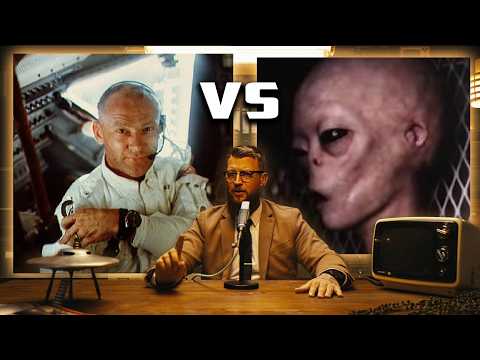
The host, a magician for his entire adult life, tests astronaut and test-pilot UFO testimony against three conditions — competence, sincerity, and having something to lose — tracing roughly 25 witnesses across 70 years with newly released Pentagon debriefing files and an exclusive Gordon Cooper interview. Cooper, the youngest of the Mercury Seven and the last American to orbit Earth alone, saw metallic saucers over West Germany in 1951 and later watched a craft land on film at Edwards Air Force Base. The episode runs from Kenneth Arnold's 1947 "flying saucer" sighting to the Apollo 17 photograph that the Department of War opened a case on in 2026.
Key Quotes
- "testimony isn't a weak form of knowledge sitting on top of the strong stuff. It's actually the foundation." (00:03:55)
- "I said there was something out in front of me or outside the spacecraft that I couldn't identify and I've never been able to identify it. And I don't think anyone ever will." (00:19:10)
- "All Apollo and Gemini flights were followed, both at a distance and sometimes quite closely by space vehicles of extraterrestrial origin. Every time it occurred, the astronauts informed mission control, who then ordered absolute silence. Absolute silence." (00:34:44)
- "I think that we are not alone in the universe. I believe that someone or something of extraterrestrial origin has visited Earth." (00:37:04)
- "I have seen a a snake out there, 6, 7, 8 ft long. It is rubbery because it has internal waves in it, and it follows you for a rather long period of time." (00:40:22)
Detailed Summary
Detailed Episode Summary
How the Episode Tests UFO Testimony
The episode treats astronaut and test-pilot UFO encounters as a problem in evaluating testimony rather than as automatic proof of extraterrestrial visitation. The host follows roughly 25 witnesses across about 70 years, using newly released Pentagon debriefing files, historical photographs, and an exclusive Gordon Cooper interview.
- The host, a magician throughout his adult life, invokes the maxim that scientists are among the easiest audiences to fool because they trust their own observations. His central concern is how testimony should be weighted when the witnesses’ careers depend on observational reliability.
- He proposes three conditions for credible testimony: the witness must be competent to observe, sincere in the account, and have something to lose by speaking. Astronauts and test pilots are presented as unusually strong candidates because of their training, simulator hours, and professional accountability.
- Australian philosopher C. A. J. Cody’s early-1990s book on the epistemology of testimony supplies the claim that testimony is not merely a weak substitute for knowledge but is a foundation of knowledge itself.
- The episode moves chronologically from test pilots before NASA through Mercury, Gemini, Apollo, Skylab, the Soviet program, the Space Shuttle era, and modern reports from Chinese, American, and Russian crews.
- The final yardstick remains unchanged: for each witness, ask whether the person was competent, sincere, and had something to lose by reporting what they saw.
Why Astronaut Selections Matter
NASA’s selection process provides the basis for the episode’s confidence in astronaut testimony, while alleged instructions to remain silent introduce the first suggestion of institutional suppression. The historical account then establishes the public and governmental context into which those later reports emerged.
- In 1959, before anyone had flown in space, NASA reviewed the service records of more than 500 military test pilots. Selection focused on qualities such as maintaining a steady heart rate and describing precisely what was in front of them, and seven men were chosen for the Mercury program.
- The United States and Soviet Union subsequently selected hundreds more astronauts by broadly similar standards. Despite that emphasis on disciplined observation, the episode says that a surprising number returned from orbit with stories of things they could not identify.
- An Apollo-era engineer is quoted as claiming that all astronauts were told to keep quiet about what they saw. The episode treats this as part of the broader pattern of official denial or containment rather than as a settled, documented fact.
- Kenneth Arnold’s June 24, 1947 sighting near Mount Rainier in Washington State marks the episode’s starting point. He reported nine bright objects moving faster than 1,000 miles per hour and described their motion to a reporter as resembling a saucer skipping across water, helping popularize the term “flying saucers.”
- Two weeks after Arnold’s sighting, Roswell Army Airfield issued a press release claiming it had recovered a flying disc, then retracted that claim the next day. The episode uses the reversal as an early example of how extraordinary claims could be publicly raised and then officially withdrawn.
- Air Force investigations operated under the code names Sign and Grudge and later Project Blue Book, which began in 1952. In January 1953, the CIA-convened Robertson panel recommended reducing public interest in UFOs and stripping away the subject’s aura of mystery.
- Scott Kelly, who spent almost a year in orbit, recalled that Navy pilots who reported a UFO were given the call sign “Alien.” According to the episode, that designation stayed with them for the rest of their careers.
Test Pilots Before NASA: Slayton and Cooper
Before the space programs began, military test pilots supplied some of the earliest technically trained witnesses. Their accounts also introduce the episode’s central tension between anomalous observations and conventional explanations such as aircraft, balloons, seed pods, or optical effects.
- Deke Slayton’s December 12, 1951 sighting occurred while he was flying a P-51 Mustang near Minneapolis at roughly 10,000 feet. He first assumed the object was a weather balloon, but on a second pass it appeared to be a saucer tilted about 45 degrees before climbing away at a similar angle and accelerating beyond his piston-engine fighter.
- Slayton had no gun-camera film to photograph the object, but he filed an official report within days. He became one of the Mercury Seven in 1959, was grounded before flying by a heart condition in 1962, later became NASA’s director of flight crew operations, and finally flew on the 1975 Apollo-Soyuz mission at age 51.
- Gordon Cooper, the youngest member of the Mercury Seven and the last American to orbit Earth alone, saw metallic, saucer-shaped objects at high altitude over West Germany in 1951. The objects appeared over roughly a day and a half and could reportedly outmaneuver fighters sent to intercept them.
- A report from Cooper was answered months later with the explanation that the objects were probably high-flying seed pods. The episode presents this as a mundane interpretation offered in place of a clearer identification.
- Six years after the German sighting, Cooper was managing a project at Edwards Air Force Base. A camera crew filmed a saucer-shaped craft deploy three landing-gear assemblies, land on the dry lake bed, lift off, retract the gear into its wheel wells, and depart at high speed.
- The film was sent to Washington, and Cooper said he never saw it again. He compared the filmed craft with the objects from 1951, describing both as a double-saucer or lenticular shape.
- Cooper argued that this shape could handle its bow and trailing waves without producing a shock wave, allowing silent, high-speed atmospheric flight and travel into and out of atmospheres. The counterpoint offered is that Edwards was a heavily classified flight-test center where the X-1 had broken the sound barrier, so an unfamiliar aircraft remains a plausible explanation.
- The October 1957 launch of Sputnik marks the episode’s larger chronological transition. Before Sputnik, unusual objects could still be treated as part of an active aircraft-testing environment; afterward, the sky increasingly became a front line of the Cold War.
Mercury and the “Fireflies”
Mercury established that a human could survive in orbit, and several early astronauts described luminous objects surrounding their capsules. The official explanations mostly concerned particles or debris, yet the episode retains the reports because they show which unusual observations could be explained and which remained uncertain.
- During his February 1962 flight, John Glenn—the first American to orbit Earth—saw glowing specks around his capsule and called them “fireflies.” Pentagon-released audio records him describing a shower of brightly lit objects, separated by approximately seven or eight feet and swirling around the capsule.
- Scott Carpenter reported white particles during the May 24, 1962 Aurora 7 mission that looked “exactly like snowflakes.” Wally Schirra described “little white objects” coming from his capsule in October 1962.
- Gordon Cooper encountered similar lights during the final Mercury flight on May 15, 1963, a 22-orbit mission. He called them “John’s fireflies,” explicitly linking his observation to Glenn’s.
- NASA has generally attributed these reports to thruster particles, paint chips from the capsule, or objects released from inside the spacecraft. The host labels the cases “space particles” and treats them as debunked.
- The episode nevertheless argues that explaining cases such as Mercury’s is useful because it isolates the observations that cannot be similarly explained. A reproduced radio exchange shows an unidentified report—“Seven, go ahead… Got bogey at 10:00 high”—followed by Houston asking the crew to say again.
Gemini: Learning to Work in Orbit
Gemini shifted the program from proving human survival to practicing sustained operations in space. Its longer missions, larger crews, rendezvous work, and spacewalks produced several reports that were either photographed, witnessed by another astronaut, or transmitted directly to mission control.
- Gemini missions used two-person crews, lasted as long as two weeks, and added spacewalks, rendezvous, and docking after Mercury had demonstrated that astronauts could survive in orbit.
- During Gemini 4 in June 1965, commander Jim McDivitt saw a white cylinder with an arm or pole extending from one end over the Pacific near Hawaii while Ed White slept after the first American spacewalk. McDivitt photographed it with two cameras and fired his thrusters because he feared a collision.
- McDivitt later said that he had never identified the object and doubted anyone ever would. Its size, apparent proximity, and the use of two cameras make it one of the episode’s more concrete photographic cases.
- Frank Borman and Jim Lovell’s Gemini 7 mission lasted 14 days and doubled partly as a medical experiment in a cabin no larger than the front seat of a small car. When Borman reported a “bogey,” mission control first asked whether it was the spent booster; the crew confirmed that the booster was also visible, leaving another object unexplained.
- Eleven days into Gemini 7, Wally Schirra and Tom Stafford arrived in Gemini 6 and brought the two spacecraft within a few feet of each other in the first rendezvous in history. Four people were then flying side by side at about 17,500 miles per hour.
- Before returning home, Schirra played “Jingle Bells” on a small harmonica he had smuggled aboard, while Stafford rang a set of sleigh bells. The episode identifies them as the first musical instruments played in space, and both are now held by the Smithsonian.
The Gemini 11 “Wingman” Dispute
The clearest photographic dispute in the episode concerns an object photographed during Gemini 11 in September 1966. NORAD supplied an official identification, but a later specialist analysis challenged that conclusion using measurements and multiple variables.
- Pete Conrad and Dick Gordon observed a yellow-orange object that appeared to hold position relative to Gemini 11. They nicknamed it the “Wingman” and took three photographs.
- NORAD officially identified the object as the Soviet satellite Proton 3, estimated to be about 450 kilometers away.
- Bruce Macabee, a photographic expert from the era, analyzed the Gemini 11 images through multiple variables and measurements. His roughly 19-page file, linked in the video description, concluded that the object could not have been the Russian satellite identified by NORAD.
- The episode treats Macabee’s analysis as a strong countercase rather than as proof of an extraterrestrial craft. Its value is that it demonstrates how a conventional identification can be tested against the imagery rather than accepted automatically.
Apollo 8 Through Apollo 11
Apollo introduced periods in which a crew could become completely unobservable from Earth. These reports were therefore harder to verify immediately, particularly when they occurred during the radio shadow behind the Moon.
- When a spacecraft passed behind the Moon, the Moon’s mass blocked radio and tracking for about 45 minutes of every two-hour orbit. NASA called this condition “loss of signal,” creating recurring windows in which crews were alone with no ground observation.
- On Christmas Day 1968, Frank Borman, Jim Lovell, and Bill Anders became the first people to leave Earth’s orbit and circle another world. After the engine that would return them to Earth was fired, Lovell radioed, “Roger. Please be informed there is a Santa Claus.”
- During Apollo 10 in May 1969, Tom Stafford, John Young, and Gene Cernan took the lunar module to within about 15 kilometers of the lunar surface. On the far side, within the radio shadow, the crew heard a strange whistling in their headsets for about an hour, which Cernan called “outer space type music.”
- On the journey to the Moon during Apollo 11, Buzz Aldrin saw a light outside the window moving along with the spacecraft. After the upper stage performed an evasive maneuver to avoid the Moon, Houston’s back room placed the object about 6,000 miles away.
- Aldrin concluded that the light was one of the upper stage’s four jettisoned panels. He continued to say that he did not believe it had been an alien spacecraft, making Apollo 11 an example of a report that received a specific conventional explanation.
Apollo 12 Through Apollo 17
The later Apollo debriefings contain repeated reports of flashes and streaks, culminating in a substantial Apollo 17 file with three separate periods of phenomena. The episode also presents a disputed account of command module pilot Ron Evans being told that he had “company” while alone in lunar orbit.
- At an Apollo 12 medical debriefing held in the Pentagon, Pete Conrad, Richard Gordon, and Alan Bean described the same phenomenon: flashes and streaks of light in the darkness while they tried to sleep.
- The Apollo 14 crew characterized the streaks as very sharp and instantaneous and reported both single and double shots. Apollo 16 reported a single flash shortly after loss of signal while the crew viewed a horizon illuminated by solar corona or zodiacal light.
- The Pentagon’s Apollo 17 file is the most substantial document in the release. It covers the December 1972 mission with Gene Cernan, Harrison Schmitt, and Ron Evans, the last crewed lunar landing.
- The Apollo 17 file describes three separate stretches of reported phenomena: approximately nine minutes on day one, three hours on day two, and six minutes on day three. The reported objects included bright, jagged, angular fragments that tumbled past the spacecraft and caught the light.
- According to a secondhand account from Joanne Donaldson, a former NASA biomedical engineer, CAPCOM asked Evans whether he was lonely while alone in lunar orbit. Evans replied, “No, I got company”; the episode says staff were instructed to continue the mission normally, avoid discussing the anomaly outside the command, and cut the public audio feed.
- Evans later described a cigar-shaped object approximately 40 feet long orbiting the Moon. That version survives only through secondhand accounts, and the episode notes that no recording of the original CAPCOM exchange could be found.
Skylab and Claims of an Institutional Cover-Up
Skylab extended the testimony into America’s first space station, where astronauts reported unusually bright objects and moving lights. The episode also introduces two prominent figures who claimed that astronaut encounters were followed by extraterrestrial craft and covered up through official silence.
- Skylab was built from an unused Saturn V upper stage and housed three crews during 1973 and 1974. Their Pentagon debriefings supplied further reports of objects seen from the station.
- On the second crew, Jack Lousma reported a large red object outside the window. He compared it to a star but said it was far brighter than Jupiter.
- Commander Gerald Carr reported flashing lights outside Skylab on the final crew. Unlike a fixed star, the lights appeared to move relative to the station.
- Maurice Chatelain, a French-born engineer who moved to the United States in 1955, worked for NASA contractor Ryan Electronics and held 11 patents, including a radar landing system used on the Ranger and Surveyor lunar missions. His book cover identifies him as the NASA scientist who designed and built the Apollo communications system.
- Chatelain wrote in 1979 that all Apollo and Gemini flights were followed by space vehicles of extraterrestrial origin and that mission control ordered absolute silence. In 1978, Mercury astronaut Gordon Cooper wrote to the United Nations stating that such vehicles and their crews were visiting from other planets.
The Soviet Program, Salyut 6, and Mir
Soviet disclosure practices made verification more difficult because failures were concealed and sighting information often reached the West late through translations. The most detailed case in the episode concerns Viktor Afanasyev’s 1990–1991 Mir mission and the film and cameras reportedly confiscated after his return.
- The Soviet space program sometimes announced crews only after launch, concealed failures, and passed most sighting information to the West late and secondhand. As a result, Freedom of Information Act requests were often ineffective for verifying Soviet accounts.
- In 1981 aboard Salyut 6, cosmonaut Vladimir Kovalyonok described an unexplainable object that seemed impossible under the laws of physics. The account survives only in print rather than in an accessible original recording.
- Musa Manarov and Viktor Afanasyev launched on Soyuz TM-11 in December 1990 for a five-month mission aboard Mir. The Soviet Union still existed at launch but had dissolved by the end of the following year.
- Manarov reportedly filmed material from Mir in March 1991. Afanasyev described an unidentified object turning toward his spacecraft and tailing it for half an orbit, remaining visible on the light side and disappearing completely when it entered Earth’s shadow.
- Afanasyev characterized the object as a metal engineering structure about 40 meters long, with inner holes, openings, and small wing-like projections. He said it was photographed from a distance of approximately 23 to 28 meters and maintained that something of extraterrestrial origin had visited Earth.
- After returning to Earth, Afanasyev was debriefed, instructed never to reveal what he knew, and had his cameras and film confiscated. His photographs and voice transmissions have never been released.
- A commonly circulated account dates the incident to a 1979 Salyut 6 mission, but the episode identifies that as a misdating: Afanasyev’s first flight was to Mir beginning in December 1990.
The Shuttle Era and Gordon Cooper’s Position
Space Shuttle veterans supplied additional reports, including Story Musgrave’s account of a long, flexible object. Cooper’s 1999 interviews connected his own experiences to broader claims about astronaut silence, alien visitation, and the credibility of McDivitt’s unidentified Gemini object.
- Story Musgrave was the only astronaut to fly on all five Space Shuttle orbiters. A former Marine and trauma surgeon, he flew six missions between 1983 and 1996 and repaired Hubble during a 1993 spacewalk.
- On the 1995 television program Sightings, Musgrave said he had seen a rubbery snake six to eight feet long on two missions and that it followed his spacecraft. The encounter left him convinced that other life exists, ranging from single-celled organisms to civilizations that may have endured for a million years.
- Musgrave also said he does not believe the government is hiding UFO information. The host argues that this makes his account notable because Musgrave has no apparent product or financial incentive to sell the story.
- In 1999, Gordon Cooper gave a series of interviews about UFOs and aliens. The host says one such interview reached him through an auction and covered Cooper’s pilot sightings, the Edwards landing film, his letter to the United Nations, and why other astronauts remain silent.
- Cooper said astronauts who reported contact were told to shut up and that stories sold by people such as “Nightland Choir” were completely fictitious.
- Cooper said that, to his knowledge, Jim McDivitt was the only astronaut who could have encountered an unidentified object in space. He attributed McDivitt’s inability to identify it to sunlight glinting so brightly off the object, and noted that McDivitt never saw it again.
- Cooper stated that he believes UFOs exist, that other planets are habitable, and that aliens visit Earth. He argued that humanity is largely ready for contact, apart from isolated cases of hysteria.
Modern Reports from China and NASA
Reports after the Shuttle era shifted from American archival cases to spacecraft sounds and lights reported by Chinese and Russian crews. They also included prominent public statements whose evidentiary status varies from firsthand observation to second-hand claims.
- In October 2003, Yang Liwei became the first person China sent into space alone aboard Shenzhou V. During the flight, he heard knocking on the hull, comparing the sound to someone striking an iron bucket with a wooden hammer, although he saw nothing through the porthole.
- The host argues that because sound cannot travel through the vacuum of space, the knocking must have traveled through the spacecraft structure, meaning something physically contacted the hull. Yang said crews on later Chinese missions heard similar sounds.
- In 2005, ISS commander Leroy Chiao saw five lights fly past during a spacewalk 230 miles above Earth while the station traveled at 17,000 miles per hour. The formation resembled an inverted check mark and appeared during the transition from night to day.
- Chiao had no opportunity to photograph the lights before sunrise made them vanish. His account therefore remains a direct visual report without supporting imagery.
- Edgar Mitchell, the sixth man to walk on the Moon during Apollo 14 and a native of Roswell, said on a UK rock radio station in 2008 that the UFO phenomenon was real and had been covered up by the U.S. government for a long time.
- The host notes that Mitchell’s assertion was not based on a firsthand sighting but on information supplied by people in military and intelligence circles.
- Scott Kelly, who completed four space flights and spent a year in space, told NASA’s 2023 public UFO meeting that his radar officer in the back of a Tomcat was convinced they had flown past a UFO. Kelly did not see the object himself, and it ultimately turned out to be a balloon.
The Contested Gemini and Apollo Photographs
Several images remain disputed because their provenance, interpretation, or official treatment does not align cleanly with the surrounding testimony. These cases range from a Gemini 11 print judged authentic by one expert but considered a reproduction by the host to an Apollo 17 image that prompted a formal inquiry in 2026.
- The episode examines a Gemini 11 lithograph discussed in Ed Wilson’s The Simpkinson NASA Archive. The print was found hidden and buried in an auction and depicts a flying saucer hovering over Earth with the caption “strange object as seen by the Gemini 11 crew.”
- Ed Wilson subjected the print to rigorous testing and determined it was authentic. The host openly says his own conviction that it is genuine is fairly low, arguing that “as seen by” signals a reproduction rather than a direct photograph.
- The host suggests that an illustrator may have embellished the anomalous object recorded in the Gemini 11 flight log. Because the underlying image of Earth exists without the saucer, he notes that the object would have had to appear and disappear within an approximately 90-second frame.
- The host finds it strange that a NASA engineer would hide the print, offering a prank, an inside joke, or even a birthday card as possibilities without claiming to know the answer. He doubts one will ever emerge.
- A separate contested Gemini 11 image appeared to show a giant UFO hovering over Earth and was potentially taken by NASA. The episode says it was shelved for 50 years.
- The episode also recounts the Artemis II pilots flying around the Moon, returning, and landing in the ocean. After meeting Donald Trump in the Oval Office, where Trump mentioned UFOs or UAPs, one pilot reportedly gave the other a glance and said, “They saw things that you wouldn’t believe.”
- The final image discussed contains three points of light and was taken during Apollo 17 in December 1972. It remained in NASA’s archive for decades before the Pentagon released it in May.
- The release note said there was no consensus on what the Apollo 17 photograph showed, while early analysis suggested that it depicted a physical object. According to the episode, the Department of War subsequently opened a case on the image.
- The episode notes the delay explicitly: a photograph from the last human mission to the Moon sat in a public archive for 54 years before the United States military formally opened an inquiry into it in 2026.
Recurring Patterns and the Major Disagreements
The episode does not settle the cases into a single pro- or anti-UFO conclusion. Instead, it identifies recurring reporting patterns, isolates three specific disputes, and leaves several evidentiary questions unresolved.
- Across 70 years and two rival space programs, reports were handled inconsistently. Some were filed officially or released immediately, others became jokes, and some remained withheld for decades.
- Witness descriptions varied widely, including “a snake,” “a beer can,” and “a firefly.” The broad vocabulary makes exact identification difficult even when the observers were trained to report carefully.
- The first major disagreement is between NORAD’s identification of the Gemini 11 “Wingman” as Proton 3 and Bruce Macabee’s roughly 19-page analysis concluding that multiple measurements rule out that satellite.
- The second is between Ed Wilson’s conclusion that the Simpkinson Gemini 11 print is authentic and the host’s low conviction that it is a reproduction or embellishment of the object in the flight log.
- The third is between NASA’s “space particles” explanations for Mercury-era sightings and the host’s argument that resolving those cases helps identify the observations that remain unexplained.
- The unresolved questions include what Ron Evans’s “company” was, whether Afanasyev’s confiscated photographs still exist, whether the Gemini 11 saucer print can be resolved, and what the three points of light in the Apollo 17 image depict.
- The final takeaway is not that the witnesses are necessarily describing alien craft. It is that their claims should be examined individually through the same three-part test: whether they were competent observers, whether they were sincere, and whether they had something to lose by speaking.