[@Area52Investigations] The TRUE STORY of The Man in Black - Area52 Special
Link: https://youtu.be/wRvjwk6EiYs
Duration: 52 min
Transcript: Download plain text
Short Summary
This episode recounts the Stevens UFO abduction case and Dr. Herbert Hopkins's 1976 encounter with a "man in black" who demanded he destroy his tapes and threatened him. Hopkins, a physician who used regressive hypnosis to recover the abducted young man's memories, describes the visitor's unsettling appearance, a disappearing penny, and orders to erase all his UFO files. His dog hid and urinated while his cat stayed calm, and the visitor vanished in a bluish-white light.
Key Quotes
- "If you know what's good for you, you better keep your mouth shut." (00:03:49)
- "his voice was completely neuterant passive no inflection no inonation nothing you know just like you'd get it from a a machine that could talk." (00:21:52)
- "This guy's a pretty good coin magician." (00:23:36)
- "It just slowly dematerialized. Just wasn't there anymore." (00:25:33)
- "No, because he did not have a heart. just as you no longer have a coin." (00:27:55)
Detailed Summary
Episode Overview and Timeline
The episode connects two Maine UFO cases: the October 28, 1975 abduction of teenagers David Stevens and Glenn Gray and the September 11, 1976 visit by a “man in black” to Dr. Herbert Hopkins, the physician who regressed Stevens. Hopkins recounts the later encounter to an interviewer, in one account sitting beside Betty Hill.
- The episode frames the story as a progression from the boys’ traumatic abduction and the evidence recovered through hypnosis to a direct, personal warning aimed at Hopkins.
- Hopkins’s account centers on the visitor’s unusual appearance, a disappearing penny, orders to destroy UFO records, and an unexplained bluish-white light.
- The alleged visitor connected his threat to the Hill case, while the host used the medical circumstances of Barney Hill’s death to question the visitor’s claim.
The Stevens Abduction: October 28, 1975
At about 2:30 a.m. on October 28, 1975, David Stevens and Glenn Gray drove through Oxford, Maine, toward Thompson Lake. The steering wheel seemed to take control, the dashboard instruments behaved erratically, and the car turned onto a secluded road.
- The boys encountered a giant cigar-shaped craft with blinding lights; two spotlights pursued them before a beam flashed down onto the car.
- The car skidded approximately 15 feet, and Stevens and Gray both blacked out.
- They woke with the craft still overhead and their car parked in front of a large pond.
- Two smaller discs repeatedly flew up and down into the pond and back for roughly 20 minutes while the car refused to start.
- The crafts eventually shot into space, and the boys began heading home at about 7:00 a.m.
- The October 28 encounter occurred exactly one week before the Travis Walton abduction, which the narrator highlights as a coincidence involving a similar craft environment.
Physical Symptoms and the Decision to Stay Silent
After reaching home, Stevens and Gray agreed not to tell anyone what had happened. Their physical condition then worsened enough to alarm Stevens’s mother and bring officials into the case.
- The boys developed swollen hands and feet, slurred speech, difficulty walking straight, and fever chills.
- Stevens’s mother contacted Deputy Sheriff Elden Bartlett, whose report described the boys as terrified.
- Word of the incident spread around town before eventually reaching UFO researcher Brent Reigns.
- Reigns interviewed Stevens, Gray, and Stevens’s mother and agreed to take Stevens back out to retrace the route.
- Stevens and Gray were too frightened to leave the car during the attempted reconstruction.
- Flashbacks followed, and the household experienced poltergeist activity in and around the house.
The “Man in Blue” and Glenn Gray’s Silence
A separate visit to the Stevens household introduced another figure associated with the case: a crew-cut “man in blue” who threatened Stevens to remain silent. The episode presents the encounter as part of the broader Men in Black pattern.
- The visitor was believed to be connected to Navy or Army intelligence, an inference based on his appearance and the circumstances described.
- He threatened David Stevens not to tell anyone about the abduction.
- The warning terrified Glenn Gray, who never spoke about the incident again.
- Gray also refused to undergo regressive hypnosis, leaving the investigation of his memories limited.
Regression Sessions with Dr. Herbert Hopkins
Maine UFO researcher Shirley Fett suspected that the missing period of time was central to understanding what had happened to Stevens. She enlisted Dr. Herbert Hopkins, a physician with approximately five years of experience in regressive hypnotherapy but no previous experience regressing a UFO subject.
- Hopkins and Stevens conducted about seven regression sessions together.
- Under hypnosis, Stevens described beings with mushroom-shaped heads, large eyes, tiny nostrils, and pale white skin.
- Their clothing resembled bed sheets, and they communicated the telepathic message, “Do not fear... we are not here to harm you.”
- Stevens recalled being led into a large room containing a slab that resembled an operating table and four beings similar to those he had previously described.
- The beings instructed him to undress; Stevens panicked and punched one of them before eventually consenting to lie on the slab.
- The beings then collected fingernail, clothing, blood, and hair samples from Stevens.
The September 11, 1976 Call
About a year after the regression sessions, Hopkins received a telephone call from a man who would later appear at his home. Hopkins placed the call at 8:00 p.m. on Saturday, September 11, 1976, when he was alone.
- Hopkins’s wife, son, and daughter-in-law had gone to a drive-in movie, leaving him at home without them.
- The caller identified himself as vice president of a New Jersey UFO research organization.
- Hopkins checked and found that no such organization existed, describing the identity as purely fictitious.
- Hopkins said he had never heard of a Men in Black, did not read fiction, and generally skipped UFO articles because they were neither proven nor disproven.
- Because he kept drugs on the premises, he normally double-checked callers’ identities and maintained what he described as a defensive but not paranoid posture.
- On this occasion, however, he admitted the caller without asking his name and later opened the door saying, “Come in.”
- While Hopkins walked from the hallway telephone to the door and turned on the lights, the visitor was already climbing the steps.
- Hopkins considered that speed impossible if the caller had been across the street or even at the neighboring house.
The Visitor’s Physical Appearance
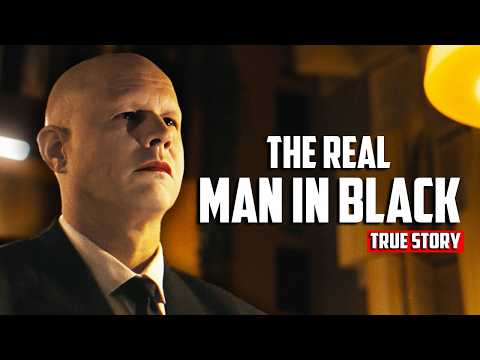
The man’s appearance was sharply tailored, almost unnaturally perfect, and reminded Hopkins of an undertaker. His face and clothing combined human features with several artificial or lifeless details.
- He wore a neatly fitted black suit with black shoes, black socks, a black tie, and a highly polished, round black derby.
- His bald head had no eyebrows or eyelashes, and his smooth, dead-white skin had a plastic-like quality.
- He had a very small nose with a low bridge and slight pugnose, along with small ears set low and far back on his head.
- His lips appeared ruby red, while his darkish eyes could not be identified as brown, dark blue, or green under the fluorescent lighting.
- He had no visible teeth, a receding chin, and a mouth formed as a perfectly straight slit.
- His head never turned or nodded and appeared to blend into his collar, giving the impression that it was entirely immobile.
The Unnaturally Perfect Suit
The visitor’s black suit appeared newly made and never worn. Its physical behavior suggested rigidity rather than ordinary tailoring.
- The fabric was absolutely wrinkle-free and retained sharp creases.
- When he sat down, the crease in his trousers did not disappear.
- His pant legs bent at the knee without the normal drawing or pulling of fabric.
- A razor crease remained standing above the knee, which the narrator described as the “super perfection” of his attire.
- The visitor wore gray suede gloves; bright red lipstick was smeared across the back of one glove.
- Because the slit-like mouth appeared to have no lips, the narrator characterized the lipstick as a poorly executed decoy that gave him the appearance of a “Charlie McCarthy” dummy.
Voice and Interaction Style
Hopkins recognized the visitor’s voice as the same one he had heard on the telephone. The man spoke in an expressionless, monotone manner and did not conduct a normal conversation.
- His English was flawless and textbook-like, without an accent, inflection, intonation, or emotional coloring.
- Hopkins described the delivery as “scanning speech,” comparable to a machine capable of talking.
- The visitor only confirmed what Hopkins said and offered minimal prompts such as “then what happened next.”
- He raised no contradictions, asked no directed questions, and displayed no apparent curiosity beyond prompting Hopkins to continue.
- Despite the physical detail Hopkins provided about the visitor, the man neither corrected nor elaborated on the description.
The Disappearing Penny Demonstration
The visitor demonstrated an unexplained ability before making his demands. The event centered on one of the two coins Hopkins had recently received from the paper boy.
- Without being asked, the man stated that Hopkins had two coins in his left pocket.
- Hopkins knew the statement was correct because he had just paid the paper boy, leaving a dime and a penny.
- The visitor instructed him to take out the bright new copper penny and hold it flat in his palm.
- He then told Hopkins, “Don’t look at me. Watch the coin.”
- The penny changed from copper to silvery and then bluish while Hopkins’s hand remained sharply focused.
- It lost its flat disc shape, blurred into a fuzzy ball, and slowly dematerialized without emitting a glow, sound, or smell.
- Hopkins remained spellbound and did not look toward the man during the transformation.
- He felt only the weight of the penny gradually disappearing and believed the visitor used neither magic words nor any visible “hocus-pocus.”
- The entire change occurred in complete silence.
Demands to Destroy the Stevens Materials
The man’s purpose became explicit when he began discussing Hopkins’s recordings and correspondence. His delivery remained calm and unemotional rather than openly threatening at first.
- He stated without prompting that Hopkins possessed tape recordings of the Stevens case, including the hypnosis sessions and their details.
- He also knew that Hopkins had related correspondence connected with the case.
- The visitor ordered Hopkins to destroy the tapes, the case correspondence, and everything he had written about UFOs, even material unrelated to Stevens.
- His instruction was curt: “Do it. That’s all.”
- He did not display anger or indignation while issuing the order.
- The man said he would know when the tapes and documents had been destroyed.
- He threatened that Hopkins would suffer the same fate as Bonnie Hill if he failed to comply.
- As he finished speaking, his speech slowed markedly and his pitch changed, although his tone and phrasing remained free of intonation.
- His final explanation was, “My energy is running low. Must go now.”
- The entire interview lasted only a few minutes—perhaps 20—after which Hopkins was badly shaken and kept all his outside lights on to see who was around him.
The Visitor’s Departure
Hopkins never learned the visitor’s name, and the man left without revealing how he had arrived or where he went. The departure ended with an unexplained light in the driveway.
- The visitor descended the steps with both feet on each step and held onto the railing.
- He walked around the corner of the building and out of Hopkins’s view.
- At the moment he disappeared, a bright bluish-white light appeared in the driveway without casting a shadow.
- Hopkins saw no vehicle and found nothing at the mouth of the horseshoe-shaped driveway, which served three houses.
- Hopkins never thought to look upward, leaving the source and location of the light unresolved in his account.
The Animals’ Reactions
While the visitor was present, Hopkins’s dog reacted with fear, whereas his cat remained calm. The contrast reinforced the sense that the visitor was perceived as threatening by at least one household animal.
- Hopkins’s half-Collie, half-German Shepherd dog had been a reliable watchdog and had never previously appeared frightened.
- During the encounter, the dog whined, ran into a front-room closet, and urinated.
- Hopkins had to drag the dog out of the closet.
- His cat remained unmoved and showed no comparable sign of fear.
The Barney Hill Death Question
When Hopkins asked about Bonnie and Betty Hill, the visitor confirmed Bonnie’s death and rejected Hopkins’s guess that it resulted from a heart attack. The exchange closely paralleled the disappearing coin.
- The visitor said, “No, because he did not have a heart. Just as you no longer have a coin.”
- The host identified the person being discussed as Barney Hill, who died in 1969 at approximately age 46.
- Barney Hill died after experiencing a sharp pain in the back of his neck while outside near a pool, an episode documented in a book by Kathleen Martin.
- Doctors attributed the death to a brain hemorrhage or stroke.
- No autopsy was performed, so whether Barney Hill truly lacked a heart cannot be established from the available medical evidence.
- A spinal tap was performed while Betty Hill was in a coma, and Barney Hill died in the hospital.
The Men in Black Pattern and Hopkins’s Aftermath
The host connects the visitor to other apparent Men in Black episodes, emphasizing the fear and enforced silence experienced by witnesses. Hopkins’s response showed how seriously he took the implied threat even though he did not describe buying a gun as part of the visitor’s explicit instructions.
- The host cites the Calvine and Rex Heftlin cases as examples of witnesses becoming terrified and falling silent.
- He compares Hopkins’s visitor with the buzz-cut man who appeared at the Stevens house and warned the family not to speak.
- The visitor’s knowledge of Hopkins’s tapes and case correspondence made the demand specifically tied to the Stevens investigation.
- Although Hopkins had never owned or handled a gun, he subsequently bought a .38 Special revolver for self-defense.
- Hopkins also received a concealed carry permit after the chief of police strongly recommended one because of repeated calls from drug users, or “junkies,” at his office and door.
- The episode ends with the Stevens case still unresolved, while Hopkins’s encounter remains centered on the visitor’s precise knowledge, the silent disappearance of the penny, the threat to destroy evidence, and the unexplained bluish-white light.