[@HamRadioCrashCourse] Radio Fire Watch & The Importance Of A Simple Analog Repeater
· 6 min read
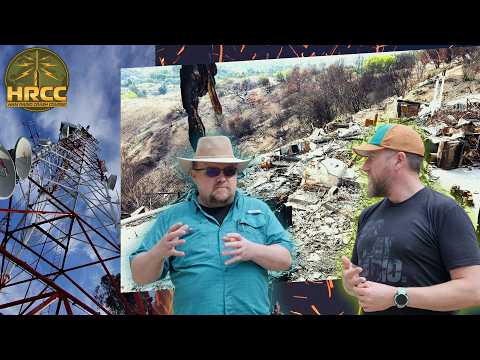
Link: https://youtu.be/C7lWtknVykY
Duration: 15 min
Transcript: Download plain text
Short Summary
Mark Hughes of the Boondock Echo amateur radio program, recording at the old KOCE broadcast tower in La Habra Heights, explains the terrain-driven canyon fire and the La Habra Heights Fire Watch's spotting and evacuation-relay role. He recounts the 7-8 acre fire that burned with no wind, the Fire Watch's radio net, and the repeater swap from a 2001 Kenwood to a 2026 model. He also notes the cause is still under investigation, and that Tammy's home and her nine animals were lost.
Key Quotes
- "we can collect information and we report it out in an emergency every 15 minutes, um which is much better information than they usually get from their PIOs or anybody else." (00:02:42)
- "So, if you're ever in a situation like this, evacuate early." (00:07:23)
- "Let me tell you what we did. So, this was a terrain-driven fire. So, you've got this canyon, and it kind of funnels everything up to the top. It's like a chimney." (00:08:03)
- "even like this, the the material's so dry, and there's so much of it that you can't get firefighters out there fast enough. The really only way you can fight this is from the air." (00:08:23)
Detailed Summary
Interview Setting and Background
- The interview is with Mark Hughes of the Boondock Echo amateur radio program, recorded at the old KOCE broadcast tower — no longer used for KOCE — which sits on an elongated hill with the best radio reception in the area.
- Mark served as net control for the La Habra Heights Fire Watch during the incident, and the program was also visited to check a newly installed repeater site.
The Fire: Terrain, Size and Behavior
- The fire burned approximately 7 to 8 acres, destroyed a few homes, and originated west of the repeater site.
- It was terrain-driven: a canyon funnels all the fuel up to the top like a chimney, so with dry material the only effective suppression was aerial drops from helicopters and planes.
- The fire spread very fast, burning the fuel up the canyon in about 15 minutes, even on a relatively windless day. Wind at the burn scar visit was about 5 to 10 mph.
- Strong winds were the limiting factor for aviation: crews ground their flights when wind picks up because dropped water atomizes and never reaches the ground, so crews could not effectively suppress the fire; under real wind, embers would have scattered over a wide area.
- Firefighters held the fire break line and contained the fire to a small area, even though the flames reached right up against houses.
- Despite the fast spread and heavy evacuation needs, there was no loss of life, though significant loss of livestock/animals was reported alongside property damage.
- The burn scar looked very similar to a pre-fire canyon view — a road cutting into the canyon with unburned vegetation on the sides funneling up to the top.
Cause Still Under Investigation
- Investigators have not released the fire's cause. The two leading theories are gardeners using metal tool blades or a possible homeless cooking fire.
- Firefighting resources could not be moved out of the county into the area as quickly as the situation demanded.
The La Habra Heights Fire Watch's Role
- The Fire Watch looks for fires and retreats, calls 911, coordinates by radio, and shows up at evacuation centers to help (including water and food for firefighters). It does not do its own firefighting.
- Fire Watch used spotters living in the heights with radios to detect smoke and activate the net the moment smoke appeared, before any precise location was known.
- Mark ran two scanner-listening amateur radio operators in La Habra, Dennis and Kelly, monitoring LA fire tactical channels and reporting back; information was then relayed to Fire Watch members in 15-minute intervals.
- The Fire Watch does not issue evacuation orders itself — it relays that sheriffs are evacuating and advises people to leave, because LA County leadership and the EOC take time to issue formal orders while sheriffs act on their own training and information.
- Deputy Sarah was credited with loading people into his truck and racing them to safety down the fire road.
Casualties and the Household Loss
- Tammy's house — the home of a La Habra Heights Fire Watch member — was destroyed, and her nine animals did not survive.
- Tammy learned about the fire about 15 minutes before she was in danger, but she was a couple of cities away and could not save her animals.
Amateur Radio as the Evacuation Channel
- Ham radio was used to relay evacuation information on Casilero (Canyon) immediately, potentially reaching hundreds of people at once, whereas cell phones reach only one person at a time and are too slow.
- This relay happened before the county could activate WEAR and other emergency alerting and evacuation response systems.
- The stated rationale: get evacuation information to people faster so they can leave and clear the way for firefighters to work.
Repeater Hardware and Testing
- The failing repeater was a 2001 model Kenwood, being replaced with a 2026 Kenwood model. The old unit was a 2U with a large power supply doing battery switchover; the new unit is 1U, with roughly half devoted to power supply and battery charging, running on AGMs rated 100 amp-hours each for a total of 300 amp-hours.
- On-air testing of repeater 172 on Las Palomas, height 6 produced loud-and-clear checks on 132 and 157, but 100 was barely copyable under local interference. A squeal was heard, prompting consultation with a radio technician.
- A new repeater was installed at a fire-watch vantage point; the host saw its antenna and confirmed the site can be reached from the ridge.
Advice and Future Goals
- Roads in the area are narrow, with little room for fire trucks and evacuating residents, and hydrant coverage is uneven — low water volume in some parts of the Heights, better on the east side, and unclear on the west side — so the advice is to evacuate early.
- The ultimate goal of the radio program is to raise more money and install repeaters in other locations to cover communication dead zones.