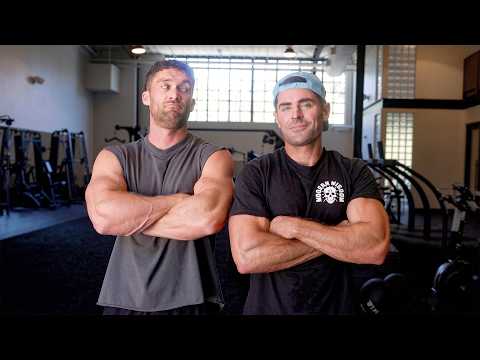
[@ChrisWillx] A very slow training session with Zac Efron.
![[@ChrisWillx] Summarizer](https://summaries.pages.dev/img/logo.webp)
Link: https://youtu.be/5k-BbXf2lMo
Duration: 45 min
Transcript: Download plain text
Short Summary
Zac Efron joins the podcast for an interview covering his intense physical transformations for roles like Iron Claw and Baywatch, his CrossFit era, an injury at Chris Hemsworth's house, and a near-15 ft fall on a Ninja Warrior course. The conversation also covers TRT, BFR training, lymphatic drainage, and on-set stories with Russell Crowe, Christian Bale, and Nicole Kidman.
Key Quotes
- "The advantage is if you're jacked enough, you can be a superhero no matter what the role is." (00:13:38)
- "You forget how to sleep. It's basically shift work. It's basically shift work. You're a shift worker for months on on camera." (00:18:24)
Detailed Summary
Zac Efron Interview — Detailed Episode Summary
Guest Background and Career Preferences
Zac Efron joins the podcast as an actor known for intense physical transformations and a CrossFit-focused training era. His career preferences and reflections on the industry set the tone for a wide-ranging conversation about craft, fame, and the body.
- Zac Efron is an actor who has done extensive physical transformations for movie roles and previously had a CrossFit-focused training era roughly between 2016 and 2020.
- He prefers independent films over superhero roles, citing 2007–2008 (e.g., There Will Be Blood, No Country for Old Men) as the last golden era of strong indie film before "everything went superhero" for "a decade and a half."
- Efron jokes he would do a superhero role for about $20 million.
Iron Claw Movie Prep
Efron describes his preparation for The Iron Claw — playing the massive Kevin Von Erich — as the hardest movie prep of his career. The Texas heat, the caloric load, and the metcon-style training combined into a brutal four-month build.
- Iron Claw prep (playing the massive Kevin Von Erich) was Efron's hardest movie prep, requiring a grueling Austin, Texas training block in very hot outdoor conditions.
- Ben programmed the workouts remotely and sent them via text, with sessions heavy on metcon supersets: about 2 minutes balls-out, switching between exercises like deadlift to Nordic curl on a stability ball.
- A typical block featured 2 minutes all-out cardio followed by pull-ups/pulldowns with chest press variations.
- He consumed about 6,000 calories a day for the first 4 months and went from a 29-inch to a 34-inch waist in about 4 months.
- His estimated basal metabolic rate was around 3,600, with wrestling layered on top of that demand.
- He peaked at 205 lbs and now weighs about 175 lbs, with a dramatically different body composition between the two states.
- Diet was tons of chicken, rice, sweet potato, and "too much salmon," which he says gave him mercury poisoning — a notable and surprising consequence of the bulk.
Baywatch Prep and the Diuretic Story
Baywatch prep was shorter but required constant maintenance because Efron had to be shirtless every day. The combination of cardio supersets and dehydration strategies produced visible results — and visible side effects.
- Baywatch prep took about 3 months, was primarily cardio supersets, and was built on prior bodybuilding mass.
- He took too many diuretics, describing the effect as "peeing Coca-Cola," and had to maintain daily "mini bodybuilding prep" (morning push-ups, elastic bands, pull-ups after sugar) because he had to be shirtless every day.
- His heaviest during Baywatch was around 175 lbs (his current weight), but with a slightly different body composition and visible diaresis/striations at low body fat.
Back Injury at Chris Hemsworth's House
A deadlift-focused workout in Hemsworth's gym led to a serious back injury that took roughly a year to recover from — a useful counterweight to the otherwise successful transformation stories.
- Efron trained with a deadlift-focused workout at Chris Hemsworth's house, where he injured his back.
- The injury involved a two Belgian/disc issue and a Schmorl's node with edema, requiring roughly a year of recovery.
Ninja Warrior Stunt Setbacks
A pair of on-set stunts on what sounds like an American Ninja Warrior-style course produced a clean first take and a dramatic second take — both revealing how production safety decisions can hinge on a single miscommunication.
- Efron completed a full American Ninja Warrior course on his first take on set, but only because he told the crew he wouldn't attempt the whole course and they laid stunt mats only for the first section.
- On the second take, he fell from the standing ladder from about 15 ft into the standard water below.
Training Insights and Programming Philosophy
The conversation turns to how Ben thinks about training, recovery, and the toolkit he uses with clients like Efron. CrossFit, TRT, hyperbaric oxygen, and BFR training all get specific, actionable treatment.
- CrossFit is described as "metabolic conditioning under heavy load with complex lifts," with the snatch identified as the most valuable (and most dangerous at high reps) movement.
- Active recovery like using an assault bike on off-days speeds up clearing DOMS, and light cardio/stretching two-a-days on heavy days reduce next-day soreness.
- TRT has helped with recovery from musculoskeletal/neuromuscular fatigue (not central nervous system), so HRV does not meaningfully drop with daily training; side benefits include mild libido, brain, and motivation effects, with testosterone framed as "a molecule of forward motion."
- Hyperbaric chamber: Ben followed an 18 consecutive day, 2-hour per day protocol ("20 and 5") with Gary Brecka, totaling about 2 hours at depth plus 90 minutes prep, calling it expensive but elite.
- Travel training hack: Rogue rubber bands are recommended as the best inexpensive option.
- BFR (blood flow restriction) training uses Katsu bands to partially occlude blood flow, tricking the body into perceiving higher training stress.
- The classic studied protocol is a 30/20/10 strip-set rep scheme.
- A sample travel BFR workout: 30 squats, 30 TRX pull-ups, 30 lunges, 30 push-ups, then a 20-rep round, with both arms and legs occluded simultaneously (acknowledged as carrying cardiovascular/stroke risk but "worth the gains").
- Pressure should be calibrated so pressing on a fingernail/toenail restores blood flow within 3 seconds; Japanese electronic cuffs dial in mmHg.
- Mike Israetel is cited as a strong evidence-based training influence, with Ben having appeared on his podcast at episodes 75, 180, and ~600.
Biohacking, Recovery, and Health History
Beyond the gym, the conversation covers a wide range of biohacking interventions and Efron's personal injury history — including an iconic-sounding household accident that left lasting dental consequences.
- Efron broke his jaw at age 22 by slipping in socks on granite by a fountain inside his house, resulting in ongoing uneven jaw that aches in the cold and makes chewing difficult.
- The speakers discuss embryonic development claims that the gastric system (mouth to anus) develops alongside the fascia, suggesting manipulation through the mouth or nostril can elicit fascial changes elsewhere in the body.
- On first meeting Ben, the host was given an ozone enema and a coffee enema within the first hour in Idaho.
- The host endorses Eight Sleep as a gamechanging product he would sell to anyone, claiming it helps sleep when detox pathways are active.
- Lymphatic drainage is discussed as a non-surgical cosmetic intervention that reduces facial puffiness by clearing fluid that would otherwise require filler or makeup; an Instagram practitioner with about a million followers demonstrates it by treating one half of the face, and it's analogized to taking NAD or creatine to offset sleep deprivation.
- Ben's main detox-pathway issue is sleep difficulty, sometimes sleeping only 20 minutes a few times a night, attributed partly to movie schedules and creative rumination.
- Recommended creators: Nick Norit (MD, PhD health/science Substack writer) and Thomas DeLauer are flagged as still underrated in the biohacking space.
Acting, Fame, and the "Reality Distortion Field"
Acting for Efron is fundamentally about listening, but the harder part of the job is what happens off-camera. Fame creates a permanent shift in how rooms respond to him.
- Acting is summarized as "listening," and the speaker prefers playing "real people, not super jacked people," finding cross-genre work like comedy challenging and fun.
- The hardest part of acting is fame/notoriety, especially after a certain point when it becomes "very hard to be in groups of humans."
- Meeting the 50th fan in an hour and a half becomes draining, even though individual fan interactions about how a film impacted them can be "the best interaction ever."
- Joe Rogan is used as an example of fame creating a "reality distortion field" where a room's behavior changes when he walks in, compared to 28 Days Later-style performative shifts and to how people behave around a "really, really beautiful woman" or figures like Trump and JD Vance.
Filming Schedule Realities and Crew Dynamics
The logistics of being a lead actor are laid out in concrete shifts and call times, with sleep collapse described as an occupational hazard.
- As a lead, the actor is "first one in, last one out every day," with a 10–12 hour workday and required 10-hour turnaround.
- A typical week: 6:00 a.m. to 6:00 p.m. start, then by Wednesday call times shift to 4:00 a.m.–noon, then midnight to 4:00 a.m. Thursday, 8:00 a.m. Friday; weekends run 16–17 hours after Friday.
- Weekly sleep during filming totals "maybe four hours a night," described as "basically shift work" where "you forget how to sleep."
- The film crew is praised as "the best in their fields" across hair/makeup, special effects, sound, and cinematography, with the lead acting as "the quarterback of this amazing squad."
Set Anecdotes: Crowe, Bale, and Kidman
Three on-set stories illustrate how veteran actors manage intensity, precision, and method discipline — and the costs of crossing them.
- Russell Crowe was "an absolute legend of a human" on the set of The Greatest Beer Run Ever, despite a loose industry reputation for being difficult.
- Crowe insisted a camera operator move sides for a shot, telling the crew "I'm not going to start the take until you move to the other side. I know that you're wrong," and was ultimately confirmed correct — not moving could have wasted 10 takes, killed the edit, required filming the next day, and cost millions of dollars.
- Christian Bale (per Keegan) kicked off at a camera crew member because he had been on set for 6 hours preparing for a difficult emotional scene and someone was behind his eyeline.
- The speakers note that going into overtime (OT) makes the line producer and finance guy "kick off" at everyone on set, and that actors walk a thin line between their real self and the character, often already stretched thin and tired.
- Nicole Kidman worked as a method actor on The Paperboy with Matthew McConaughey, staying in character the entire time with a southern accent; because her characters were in love with Efron's, he initially thought she was flirting with him off-camera.
Notable Surprises and Takeaways
A handful of facts that are either numerically striking or narratively memorable — useful as a quick-reference recap.
- Efron's Basal Metabolic Rate during Iron Claw prep was estimated around 3,600 with wrestling on top, and he was eating ~6,000 calories a day for the first 4 months.
- He contracted mercury poisoning from excessive salmon during Iron Claw prep.
- He described his diuretic use during Baywatch as "peeing Coca-Cola."
- Efron once fell ~15 ft into water on a Ninja Warrior course without stunt mats after completing the full course on his first try.
- Schwartz mentions having had ozone and coffee enemas within his first hour of meeting Ben.