[@JesseMichels] Founder Of Israeli Space Force Says We Have Agreement With Aliens

Link: https://youtu.be/jMJDFndJAwc
Duration: 99 min
Transcript: Download plain text
Short Summary
Trial lawyer and King's Counsel Jonathan Kaplan, author of "UFOs: The World's Best Kept Secret" and a UFO researcher since the late 1960s, works through his book with interviewer Jesse. They examine Prince Philip's private Equiry inquiry, the MJ-12 documents and Truman's 1947 directive, James Forrestal's suspicious death, the Vina Brazil crash retrieval, Haim Eshed's Hebrew-only book, and a possible UFO motive for the JFK assassination. Kaplan argues non-human intelligences are real but should not be presumed benign, and expects no European disclosure for at least 5 to 10 years.
Key Quotes
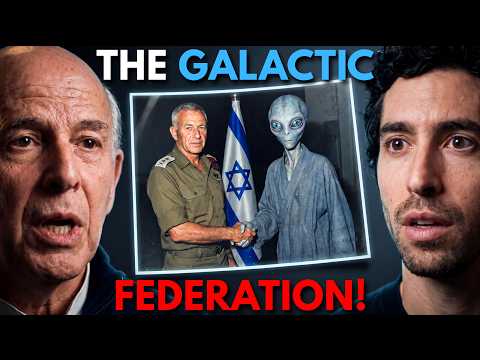
- "And that interview went actually even further than book and talked about agreements between the United States uh one or two other countries and a federation called the what he called the Galactic Federation. So basically you have this very esteemed Israeli scientist talking about crashes, talking about uh the acknowledgement of um non-human intelligences, talking about agreements with terrestrial governments. And it was pretty astounding." (00:20:09)
- "If Roswell happened, if a craft was recovered, as I'm firmly convinced it was at Corona, if it was then the subject of a highly classified reverse engineering program, and that is your biggest secret, one of the biggest uh secrets in the United States, the last thing you are going to do is to give credence to the discovery of that craft and of the reverse engineering programs that have been set in train." (00:26:13)
- "So, I mean, there's a whole track record of this and evidence and I'm quite convinced the CIA killed Kennedy. I think it is a very strong case uh that this was to do with a UFO subject." (00:56:51)
- "So, I I think we shouldn't necessarily and should not um ascribe benign intentions to these non-human intelligences. They've done very little, I think, to earn that uh label." (01:29:11)
- "My whole purpose in writing the book is that I really wanted to uh have an informed debate and based on reliable evidence and to involve academia and um I think that is absolutely fundamental" (00:44:41)
Detailed Summary
Jonathan Kaplan on UFO Evidence, MJ-12, Royal Inquiries, and Disclosure Politics
Kaplan’s Background and Method
Kaplan approaches UFO evidence as a trial lawyer and researcher rather than as a conventional eyewitness, and interviewer Jesse works through his book section by section. The discussion combines personal contacts, documentary analysis, political history, and unresolved questions about verification.
- Jonathan Kaplan is a trial lawyer, barrister, and member of the King’s Counsel who wrote UFOs: The World’s Best Kept Secret, a broad history of the strongest UFO evidence from roughly the last 70 years.
- He says he became involved in the subject in the late 1960s and early 1970s, when he met John Keel, John Mack, and Stanton Friedman, although he stresses that his knowledge comes mainly from other people’s accounts and his own evaluation of evidence.
- Kaplan describes the book as both an introduction for newcomers and a source of additional details for readers already familiar with UFO research.
- He says his purpose in writing it was to force an informed debate based on reliable evidence and to bring academic institutions back into a field he believes was deliberately degraded after the Truman directive of 1947.
- Kaplan declines to characterize the private views of living people, explicitly passing on speculation that King Charles is interested in UFOs.
Prince Philip’s Private Equiry Inquiry
Kaplan’s access to British royal UFO material began through Flying Saucer Review roughly 50 years ago. He says the resulting inquiry operated with Prince Philip’s knowledge and consent and produced reports that were discussed at the palace.
- Kaplan served on the editorial board of Flying Saucer Review, and part of his duties included delivering each issue to Prince Philip’s Equiry, the male staff attendant responsible for such matters.
- The inquiry brought in witnesses to significant UFO events, prepared transcripts and reports, and discussed the findings at the palace, according to Kaplan.
- One investigated case involved BOAC Captain Howard, who reported that a flying saucer followed an aircraft arriving from New York; 10 crew members and some passengers watched the object for 18 minutes.
- Kaplan says pilots who reported UFO sightings during the 1960s and 1970s were generally penalized, giving the Equiry material that differed from the official aviation explanation.
- Another case involved two schoolboys in Darbisha who photographed three flying saucers; the inquiry sought to interview them about how the photographs had come about.
- Prince Philip later described the inquiry in Sounds from Another Room, including a meeting arranged by an army general who introduced the Equiry to a woman named Mrs. Markham in Chelsea.
The “Mr. Janus” Meeting
The Chelsea meeting produced an anomalous account involving a man calling himself Mr. Janus and an apparent demonstration of non-ordinary communication. Kaplan presents the episode through the Equiry’s contemporary notes and a later account by one of Prince Philip’s senior aides.
- According to the Equiry’s notes, Mr. Janus questioned the inquiry about Prince Philip and UFOs, demonstrated an ability to read the Equiry’s mind, and described advanced civilizations interested in developing another race, helping it progress, and saving the planet.
- The Equiry was S. Peter Horsley, although Kaplan notes that the name is also transcribed as “Peter Horley.”
- Horsley quickly concluded that Janus might be extraterrestrial or a non-human intelligence, choosing “extraterrestrial” because that was the pilots’ principal focus at the time; he also recorded that Janus appeared to communicate on levels beyond speech.
- One of Prince Philip’s chief aides later wrote openly about meeting someone who “seems to know a ton about UFOs and ETs” and could read his mind, while personally speculating that the person was nonhuman.
- Kaplan says the published royal account could not have appeared without Prince Philip’s approval, lending institutional context to the story.
- Horsley became nervous and left the meeting. Although his note would have gone to Prince Philip, no introduction followed, and a later attempt to contact Mrs. Markham—also transcribed as Mrs. Malcolm—failed because she had moved.
Royals, Mountbatten, and Wealthy UFO Backers
Kaplan places the Equiry inquiry within a wider pattern of royal and elite interest that predates the modern UAP disclosure movement. The supporting examples are presented as documented contacts, reported sightings, or claims whose provenance remains debated.
- Lord Louis Mountbatten, the current king’s uncle and a Royal Navy officer during the war, was killed when the IRA bombed his boat. Kaplan cites a report that a craft landed on his Broadlands estate, was seen by his gardener, and was reported to Prince Philip.
- American journalist Dorothy Kilgallen, a friend of Marilyn Monroe and the Kennedys who died under mysterious circumstances, wrote from London in 1955 that reliable sources had told her a craft had crashed with small humanoids aboard.
- Kilgallen attributed her information to a very senior cabinet minister; Timothy Good has speculated that the source was Lord Mountbatten.
- Prince Hans-Adam II of Liechtenstein appears in photographs with a man transcribed as “Bob John,” apparently Bob Dean, who ran the Princeton Anomalous Engineering Research Center.
- The same royal material places Dean alongside Hal Puthoff and Ed May, who helped run the CIA’s psychic spy program. Kaplan sees this as part of a broader European royal tradition of interest in UFOs and believes Monaco has a similar history.
- Kaplan argues that royal interest is better understood as an existential question—“Who are we? Where have we come from? What do these sightings signify?”—than as an application of Maslow’s hierarchy of needs.
- He knows of no actual attempts by royal families to contact non-human intelligences, although he says the subject is discussed privately beyond ordinary dinner-table conversation.
- The Rockefellers funded substantial UFO research, including work by John Mack and Steven Greer during the 1990s; Chris Mellon, described as one of the few remaining heirs to the Mellon family fortune, is now prominent in the American conversation.
- In Mark Christopher Lee’s documentary about UFOs and royalty, Nova Scotia diver Dan Castello—claiming knowledge of a top-secret project—says he saw King Charles flying in a saucer.
Haim Eshed and Beyond the Horizon
Kaplan examines Israeli astrophysicist Haim Eshed’s Hebrew-only book as a major, difficult-to-assess source of claims about crashed craft and alleged agreements with non-human intelligences. He also recounts Eshed’s sudden refusal to discuss the material after David Grusch’s 2023 congressional testimony.
- Haim Eshed, described as the “father of the Israeli space industry” because of his role in early Israeli satellite programs, published Beyond the Horizon in December 2020 with journalist Hanan Yagai.
- The book has never been released in English, so Kaplan arranged for it to be translated before examining its final section, which covers crashes less widely discussed in mainstream UFO literature.
- Eshed’s final chapter reportedly covers his interpretation of Mars rover photographs as evidence of intelligent life and agreements between Israel, England, Japan, and one or two other countries with what he calls the “Galactic Federation.”
- In a newspaper interview shortly before publication, Eshed went further than the book by describing agreements involving the United States and one or two additional countries, along with government acknowledgment of non-human intelligences and UFO crashes.
- Eshed claims an elliptical craft dating to 2000 B.C. was discovered at Comanche Point in the Grand Canyon, which he offers as an explanation for restricted areas of the canyon.
- He states that 30 UFO crashes have occurred, discusses bases on Mars occupied by humans and extraterrestrials, and says humanity has already flown to Mars.
- After Grusch’s July 2023 congressional testimony made international headlines, Kaplan traveled to Israel to reach Eshed, but Eshed stopped answering calls and emails, while Yagai refused all interviews.
- Kaplan warns that Eshed’s claims cannot be responsibly evaluated until the mechanism by which he obtained his information is understood.
MJ-12, the Truman Directive, and British Involvement
The MJ-12 material forms the documentary center of the conversation. Kaplan says he accepts that some documents may be false but considers the vast majority genuine and places their alleged origin in a formal Truman-era directive.
- The MJ-12 documents were released in tranches from the 1980s into the 1990s and describe an elite military intelligence and science committee operating under Presidents Truman and Eisenhower.
- A directive allegedly initiating MJ-12 was signed on September 24, 1947, and Kaplan notes that Truman’s and James Forrestal’s diaries record the three men meeting at 11:30 a.m. that day.
- Forrestal’s diary entry for October 1, 1947, records a meeting with Sir Henry Tisdale, then chief scientific adviser to the UK Ministry of Defence, and Vannevar Bush.
- During October 1947, Forrestal attended further meetings with three senior British Air Force officers, with Eisenhower present on some occasions.
- Tisdale returned to London and established a secret flying-saucer working party inside the British Ministry of Defence.
- Its report was produced in only one copy for Tisdale, with a preface stating that, following the American lead, the subject should receive as little publicity as possible.
- The Majestic documents discussed are primarily memos and letters rather than counterintelligence reports. Their personnel included James Lei and Richard Drain, both closely involved with UFO committees.
- Lei received an award from CIA director John McCone for service on a multi-agency project, while Drain was researched through the CIA reading room.
- Allen Dulles’s diary, published only a few years before the interview, reportedly contains an entry consistent with a Majestic 12 document, although one speaker could not immediately confirm that reading.
- Some MJ-12 documents refer directly to the Kennedy assassination through the highly contested claim that Kennedy was interfering too much with “our activities.”
Corroboration for MJ-12
Kaplan supplements the documents with claimed eyewitness statements and links them to military debriefings, the Carter administration, and CIA offices allegedly connected to crash retrieval. The purpose is to show that MJ-12 was not confined to isolated paperwork.
- Eric Walker, approached by researcher William Steinman, said on a contemporaneous tape, “Yes, I know of MJ12. I’ve worked with MJ12.”
- Alonzo McDonald later confirmed to researcher Eric Davis that MJ-12 existed and was also supposed to participate in Jimmy Carter’s UFO briefing.
- Robert Sarbacher, one of Vannevar Bush’s leading atomic-energy researchers, said Walker was privy to UFO debriefs at Wright-Patterson Air Force Base.
- When Steinman and Scott Crane entered Walker’s office asking about UFOs, Walker responded that elite families had long histories with the subject.
- Kaplan identifies the CIA’s counter-proliferation mission and the Office of Global Access—formerly the Office of Global Crash Retrieval—as relevant institutions.
- He argues that the latter was an existing facility that could be lent to crash retrievals, providing an organizational basis for claims that the United States has handled recovered craft.
James Forrestal’s Death
The alleged killing of James Forrestal is presented as one of the most consequential consequences of the secret described in the MJ-12 files. Kaplan and the host emphasize the physical details of his death and the exclusion of ordinary investigative procedures.
- James Forrestal rose from Assistant Secretary of the Navy to Secretary of the Navy and then Secretary of Defense, and the MJ-12 documents claim that he was killed over the UFO issue.
- He became unstable and mentally exhausted, was removed from his position by Truman, and was admitted to Bethesda Naval Hospital.
- Even his priest, Monsignor Sheehy, was denied access, and Forrestal’s brother eventually arranged his release after approximately six or eight months, with family members reporting that he seemed healthy.
- On the day before his scheduled release, Forrestal was found on a flat roof below his hospital window after allegedly falling from the 19th floor.
- A bathrobe cord was tied around his neck and connected to a radiator, while broken glass was found on a rug in his room; he had been in the middle of transcribing a play by Sophocles.
- The death was handled through a closed naval inquiry with no inquest and no family members called to testify.
- The official explanation was that the cord slipped from the radiator, but Forrestal’s brother was convinced that he had been murdered, and the speakers argue that it would have been easy for Navy personnel to throw him from the window.
Disagreement: Was MJ-12 a “Flood the Zone” Operation?
Kaplan and Jesse sharply disagree over the provenance of the MJ-12 releases. Their exchange centers on whether exposing documents would protect a far more important secret or deliberately discredit future evidence.
- Jesse argues that the documents were released as a counterintelligence initiative under James Jesus Angleton, a longtime ally of Allen Dulles, with former admiral Bobby Inman supposedly participating.
- Kaplan rejects the theory outright and calls the claim that Inman was involved a rumor he does not believe.
- His counterargument is that if a craft had been recovered, as he firmly believes happened at Corona, and a classified reverse-engineering program was operating, that would be among America’s most important state secrets.
- Under those circumstances, Kaplan argues, officials would be highly unlikely to lend credibility to public documents revealing the program’s existence.
- Jesse counters that the 1960s and 1970s produced peak distrust of government through the Church Committee, Watergate, and the Pentagon Papers.
- He suggests the CIA and related agencies released the MJ-12 material in the 1980s to “flood the zone” with information that would naturally be doubted, thereby inoculating the public against accepting any later truth.
The Vina, Brazil, Crash Retrieval
Jesse presents Vina as a physical-crash case supported by living witnesses, medical testimony, and a reconstructed flight path. He says newly uncovered evidence makes it almost certain that a craft and a living being were recovered.
- A UAP reportedly crashed at Vina in Brazil, leading to the recovery of the craft and at least one living alien, with an American aircraft landing at Compinas.
- Jesse says efforts have been made to recover airport logs connected with the incident and that newly uncovered evidence makes the event almost certain.
- He says he interviewed a Brazilian defense minister who confirmed his belief that the crash, craft recovery, and alien recovery occurred.
- The case includes 15 to 20 living witnesses, among them a doctor and military officers, and the UFO’s flight path has reportedly been triangulated.
- James Fox documented the case and related evidence in Moment of Contact. Vina’s chief neurosurgeon was reportedly face to face with the recovered being for four minutes.
- Hospital staff reportedly confirm that the institution where the being was treated is the same hospital described in the recovery account.
- Vina is described as a town of roughly 130,000 people with no prior UFO lore or predisposing local beliefs, which Jesse uses as evidence against collective hallucination.
- Emergency rescue worker Marco Sherezi died after handling the being. His autopsy reportedly found an anomalously strong rare bacterial form, and IPD head Janini is on record saying that a nail from the extraterrestrial penetrated Sherezi’s skin and killed him.
- Kaplan says he interviewed autopsy doctor Arando Fortunado, who called the incident legitimate and said the rare infection could not be ruled out as resulting from extraterrestrial contact.
Grusch, Reptilians, and the Modern Disclosure Era
David Grusch’s congressional testimony and subsequent interviews have moved UFO discussion from the margins into ordinary political and media conversation. Kaplan considers Grusch credible while expressing concern that some public claims have moved beyond the available evidence.
- Grusch’s live testimony before Congress, followed by intelligence personnel stating that the United States possesses crashed craft, has made the subject acceptable for normal discussion within roughly the last three years.
- Kaplan describes special-access programs involving recovered craft as an effective open secret, with contractors including Lockheed Martin, Northrop Grumman, and Raytheon.
- Lockheed Martin is said to have wanted to transfer a craft to Bigelow Aerospace, although that claim remains part of the broader special-access narrative rather than an independently established outcome.
- Grusch’s interview discussed firefights between different species, with U.S. personnel reportedly injured or killed by reptilians.
- On Joe Rogan’s program, Grusch described video of bluish Nordic-type aliens dying in a firefight and a separate confrontation between grays and reptilians flying in tic-tac-shaped craft.
- Kaplan calls Grusch a very credible witness, citing his handling of the Presidential Daily Brief and senior role at the National Geospatial-Intelligence Agency, as well as Carl Nell’s high regard for him.
- At the same time, Kaplan says public discussion is “getting wilder” and expresses particular concern about reptilian claims.
- Grusch’s interview also raised the possibility of underwater bases, potentially off Santa Catalina Island, described as city-block-sized installations from which craft repeatedly emerge and return.
- Dr. Beatriz Villarroel’s work documents thousands of small, reflective objects appearing the day before and on the day of significant events at approximately 26,000 miles in space. They appear as short flashes rather than streaks and are described as extremely flat and mirror-like.
The JFK Assassination and a Possible UFO Motive
Kaplan argues that the CIA killed John F. Kennedy and that the motive involved an attempt by Kennedy to reveal the extraterrestrial presence. The supporting chain includes confessions, treaty arguments, a disputed letter, and the so-called burn memo.
- Kaplan says he is “quite convinced the CIA killed Kennedy” and believes there is a strong case that a UFO-related motive was involved. He notes that the Rockefeller Commission suspected CIA involvement but found no evidence capable of proving it.
- CIA contractor John Sturgis confessed to a Sixth Precinct officer who arrested him for threatening Marina Lorent that he had been one of the gunmen in Dallas.
- During the jury hearing for Howard Hunt’s libel action against Liberty Lobby, the jury found against Hunt. Its foreman later said the CIA killed Kennedy and that Hunt was involved.
- Douglas Caddy was the original lawyer for the Watergate burglars and for Howard Hunt. When a judge ordered him to disclose who had instructed him, he invoked privilege, was convicted of contempt, and had to step aside, although Hunt remained grateful to him.
- Just before Hunt began his sentence at Eglin Air Force Base, he took Caddy to dinner and said Kennedy was killed because he was about to reveal the alien presence.
- Hunt also referred to documents held by the Cubans that were believed to concern the assassination. Kaplan dates this conversation to approximately 1975, about a decade after Dallas.
- Kaplan argues that Kennedy was alarmed and perturbed after the Bay of Pigs and wanted to ensure that no UAP could be mistaken for an incoming ballistic missile.
- Jesse connects that concern to the 1971 SALT One treaty, which he says required the United States and Soviet Union to coordinate on unknown objects in airspace so that a false alarm could not trigger a globally destructive response.
- A letter of unknown provenance between Kennedy and CIA director John McCone calls for coordination with NASA and the Soviets concerning unknown objects. It purports to have been written ten days before the assassination, although its date is given as November 12, 1963 in one transcription and November 1 in another.
- The “burn memo” is described as a communication from MJ-1 to other MJ-12 members stating that Kennedy, code-named Lancer, was interfering too much with MJ-12 activities and that something had to be done about him.
- It was allegedly rescued from the fire after Kennedy’s assassination by a counterintelligence officer and may have come from one of James Jesus Angleton’s safes.
- Angleton kept at least 40 private safes outside the CIA’s registry system, all of which had to be blown after his death; McCone documentation reportedly indicates that some concerned the assassination.
- Speckin Laboratory at Woods and Ryan examined the burn memo’s watermarked paper and concluded that the paper and inks appeared period-correct. Although the laboratory lacked a CIA control sample bearing the same watermark, Kaplan says the document has a prima facie claim to authenticity while remaining highly contested.
Nuclear Sites, Military Witnesses, and Stigma
Robert Hastings’s military database is presented as a large body of testimony from personnel whose clearances and reporting obligations make systematic fabrication harder to assume. The discussion also considers how stigma and personal synchronicity complicate objective analysis.
- Jesse cites Robert Hastings’s UFOs and Nukes as a database of roughly 167—and now closer to 170—military personnel with secret, top-secret, and TS/SCI clearances who report seeing tic-tacs, saucers, and orbs around nuclear sites.
- The witnesses include radar operators and security personnel guarding nuclear weapons, placing many of them in direct contact with sensitive military installations.
- These personnel participate in the Personal Reliability Program, under which they must report even taking ibuprofen. Both speakers cite that level of scrutiny as a reason the sightings cannot easily be dismissed.
- Jesse identifies 13 incidents in Hastings’s book in which UFOs flew over nuclear-weapons storage facilities or shut down missiles, with witnesses named in the documentation.
- No damage to weapon systems was recorded in those cases, although Hastings documented alleged tampering with nuclear weapons.
- Hastings’s second book, Confessions, follows synchronicities and unusual autobiographical childhood experiences that led him to investigate the subject.
- Jesse argues that the deeper a person follows such experiences, the more they multiply “like a hydra,” making personal experience difficult to separate from the phenomenon being investigated.
- Kaplan says many people who become UFO researchers are drawn there by personal experiences involving orbs, synchronicities, or alleged encounters.
- He argues that stigma causes people to deny or minimize their experiences, which makes subjective motivation difficult to separate from objective analysis.
- Jesse compares Kaplan’s position to Plato’s cave myth and the Eleusinian mysteries, specifically the concept of noesis: the primordial soul is placed into a body and forgets its former state, retaining only a glimmer of what it was.
The Menzel–Condon Debunking Network
Kaplan treats the Menzel–Condon network as an institutional effort to stigmatize UFO evidence rather than as a neutral scientific inquiry. The discussion emphasizes destroyed astronomical plates, the closure of Blue Book, and Edward Condon’s troubled security clearance.
- An FBI memo to J. Edgar Hoover described three flying saucers recovered in New Mexico. Each was circular with a raised center, approximately 50 feet in diameter, and occupied by three humanoid bodies only about 3 feet tall.
- The memo says the bodies were dressed in finely textured metallic cloth and bandaged like the blackout suits worn by speed flyers and test pilots. It also described directed energy bringing a craft out of the sky.
- The memo was written by FBI agent Guy Hoddle and is described as the most-viewed document on the FBI’s website.
- Donald or Philip Menzel, described as a Majestic 12 member, recommended Edward Condon to chair the government UFO study committee.
- Menzel was caught destroying astronomical plates in the 1950s, and Dorene Hofflight, who worked with him, described the plate destruction in her autobiography.
- An astronomer at Stockholm University found numerous transient UFOs at Palomar Observatory during the same broader period, while Menzel explained sightings through conventional causes such as temperature inversions and space debris.
- Jesse notes that Sputnik had not yet launched when Menzel used “space trash” as an explanation and says Menzel was also derogatory toward witnesses in the Father Gill sighting in Papua New Guinea.
- The Condon Committee reported in 1969, closed Project Blue Book and the USAF’s public UFO investigation, and urged teachers not to let students read UFO books, not to give the subject academic credit, and to direct them toward astronomy.
- Condon wrote what is believed to have been the first English-language textbook on quantum mechanics, studied at Göttingen with J. Robert Oppenheimer in the 1920s, helped select Los Alamos as a Manhattan Project site, and participated in the civilian open-sourcing of nuclear science.
- Condon’s Q-clearance was stripped in a kangaroo-court-type proceeding alongside Oppenheimer’s by Gordon Gray, who is rumored to have been part of Majestic 12.
- Hoddle then compiled a Red Scare dossier on Condon in an attempt to blackmail him. The clearance was later restored, with someone identified as Branscombe at Harvard saying that he had returned it while working for Menzel, although Condon said he never learned why it was given back.
- Menzel wrote at least one book debunking flying saucers, and Hillen Cutter congratulated him in a letter saying the book should end anyone’s association of flying saucers with non-human intelligence. Cutter later joined NICAP, described as the first civilian UFO research organization.
- Kaplan characterizes historical UFO debunks as having a vested interest in stigmatizing the subject, comparing modern testimony such as Jake Barber’s with earlier cases including Frank Scully’s and the alleged Aztec crash.
Non-Human Agendas and the Case for Caution
Kaplan accepts that non-human intelligences may be real but rejects the assumption that their intentions are benevolent. He cites alleged harm, reproductive interest, and hybridization claims, while acknowledging a small number of potentially beneficial phenomena.
- Kaplan says there are clearly factions among non-human intelligences and possibly factions within those factions.
- Abduction accounts reportedly focus on the gathering of reproductive organs, which he considers possible evidence of a hybridization program.
- Former CIA officer John Ramirez attended a CIA conference where genome sequencing allegedly compared DNA from 1940s “biologicals” with human DNA and found purported non-human intelligence DNA within the human sample.
- Ramirez also heard that the CIA maintained an active hybridization program, although this claim remains attributed to him rather than independently verified in the discussion.
- Kaplan argues that non-human intelligences should not be presumed benign because abductions can involve harm and because cattle and other animals have allegedly been mutilated with broken legs and unusual drop injuries.
- He also cites broader paranormal phenomena as part of the caution, while allowing that alleged radiation reduction at nuclear sites and cures following abductions may be exceptions.
- According to Kaplan, some governments accept that as many as 50 or more species have visited Earth over time, with most being humanoid but possessing variations.
- He says he has never met a non-human being, but Timothy Good told him that on more than one occasion an apparently human person approached Good, seemed to pirouette, and communicated that they were among us.
Host Pushback: Abductions and “Benign” Cases
Jesse challenges the assumption that the abduction record is predominantly harmful by citing a statistical database and a well-known French encounter. The Valensole case provides the episode’s clearest counterexample to Kaplan’s emphasis on risk.
- Jesse cites the Edgar Mitchell abduction database as showing that more than 50 percent of recorded abduction interactions are neutral or positive rather than abusive.
- One example is the Valensole case in France, regarded as one of Europe’s best-documented landing cases.
- Farmer Maurice Mass found a sphere in his lavender fields while workers were picking the flower shoots and subsequently had an apparent telepathic conversation with beings.
- Mass said the beings appeared benign and told him what they were doing, but he never discussed the encounter publicly.
- Jacques Vallée met Mass after the event. Mass refused to explain what had happened, although the speaker believes Vallée may know more about the case.
Disclosure Politics in Europe, NATO, and the Superpowers
Kaplan expects disclosure to remain blocked not merely by secrecy but by the institutional, legal, economic, and national-security consequences of acknowledging extraterrestrial visitation. Jesse and Kaplan focus particularly on Europe’s lack of a public UAP policy and on whether China or the United States will move first.
- Kaplan says no European country is likely to disclose UAP information soon because no European country currently has a public UAP program or policy and legislatures are not formally discussing the issue.
- Since publishing his book, he says several members of Parliament have contacted him because they want that policy vacuum changed.
- He frames European and NATO interest as a defense question involving airspace and territorial waters, citing a sighting over London in the previous month when helicopters quickly surrounded the object to observe, identify, or escort it away.
- Kaplan says that if a craft crashed in the United Kingdom, British special forces would respond, but American personnel would probably collect the wreckage.
- He also refers to a Five Eyes caucus that has met at the Pentagon and shared information among intelligence and signals-intelligence departments.
- His broader expectation is that any government disclosure will come through one of the superpowers; from an American perspective, the central geopolitical question may be whether China or the United States reveals the information first.
- Kaplan doubts that President Trump is primarily interested in substantive disclosure, suggesting that Trump may want to do something no other president has done and that batches of anomalous phenomena would provide sufficient publicity.
- The deeper obstacles, in his view, are that governments would have to admit the existence of legacy programs and a catalog of abuses or crimes that could not easily be explained away.
- Defining disclosure as an acknowledgment that non-human intelligences have visited would produce questions about who they are, their agenda, whether they believe in God, whether humanity is safe, how long the secret has existed, and how it was discovered.
- Kaplan also points to national-security implications involving anti-gravity and free energy, as well as economic effects discussed in a paper by Bank of England analyst Helen Macau.
- On that basis, he expects no full disclosure for at least the next 5 to 10 years.
Kaplan’s Personal Memories and the Life–Death Interpretation
Kaplan turns to memories that he believes predate his birth and may connect the phenomenon to reincarnation or the soul’s movement between states. He presents these experiences as personal recollections rather than documentary proof.
- Kaplan recalls an apparently pre-birth memory of seeing a craft return and speaking to people who came down from it.
- Two beings allegedly showed him his parents and told him that he had to be born again; he was not permitted to board the craft.
- He claims a strong memory of the first 48 hours of his life and says he discussed the experience at length with John Mack, although none of it appears in his book.
- A vivid childhood memory shows beings standing behind him and an inescapable presence, accompanied by a message that his parents were expecting him and that he had to go back.
- At about four years old, Kaplan remembers a woman’s voice loudly reciting the Lord’s Prayer in his bedroom. He initially thought it might have been a little girl from down the street but speculates that it could have been a form of protection.
- He suggests that UFOs may relate to the cycle of life and death, echoing an abductee belief that the body is only a receptacle for the soul and that souls are redistributed among different stages and times.
- Kaplan proposes that UFOs could act as a control mechanism in that redistribution, while expressly acknowledging that he has no evidence for this specific connection.
- He has never undergone hypnotic regression but says he thinks it would be interesting and that he should try it.
Historical Figures, Public Legitimacy, and the Culture of Suppression
The episode places modern disclosure debate within the longer history of UFO research and changing standards of legitimacy. Friedman, Mack, Hellyer, and Rubio illustrate how the subject moved from marginal investigation toward government and mainstream-media attention.
- Jesse argues that calling the sightings science fiction is “even crazier” than admitting they are real because UFO interest exceeds that of almost every other speculative subject by multiple standard deviations.
- He contrasts the enormous public interest in UFOs with the much smaller interest in Bigfoot, noting that no executive-branch official discusses Bigfoot in the same way.
- Jesse asks why the topic became substantially more visible after 2017 and the New York Times article that treated UFOs seriously and revealed government programs.
- His answer is that public interest always existed but lacked institutional validation until the government itself supplied evidence that the subject deserved investigation.
- Stanton Friedman was a nuclear engineer at Westinghouse before becoming known as the “godfather” of UFO research. He left his job to pursue the subject and was known for aggressively separating genuine evidence from chaff.
- Roswell became a major part of Friedman’s life, and he wrote that flying saucers represented a “cosmic WaterGate”: a small number of officials in the United States, Canada, and possibly other governments had known since July 1947 that some UFOs were extraterrestrial craft.
- John Mack headed Harvard’s psychiatry department, won a Pulitzer Prize as a journalist, and wrote a biography of T. E. Lawrence titled The Prince of Disorder. He later became involved in abduction cases and concluded that the accounts represented real experiences.
- Mack was killed in a road accident while crossing a road in London, shortly before Kaplan spoke with former Canadian defense minister Paul Hellyer.
- Hellyer believed the Americans would be very angry about the issue but did not accept the Galactic Federation story.
- Marco Rubio said people tend to think of space aliens, but that his real concern is unidentified objects flying over military installations: things that are not American, whose ownership is unknown, and whose nature should be investigated and disclosed.
- Jesse also mentions Carl Young’s Flying Saucers, which treats the subject as a Sanskrit symbol of psychic completeness and frames UFO investigation as a hierophantic revelation that reveals its truth gradually and never completely.
Kaplan’s Overall Assessment
Kaplan’s position combines firm acceptance of several hidden-government claims with caution about extraterrestrial intentions and unresolved skepticism about verification. The exchange ends without resolving who the non-human intelligences are, whether the disputed documents and crash accounts are authentic, or when governments might disclose the full picture.
- Kaplan accepts that non-human intelligences are real and that governments possess major concealed information, but he insists that existence is not the same as benevolence.
- He considers the vast majority of the MJ-12 documents genuine, the Vina crash near certain, and special-access programs involving recovered craft a deeply maintained open secret.
- His principal warning is that disclosure without understanding alien motives, recovered technology, and the full history of government conduct could expose both national-security secrets and a record of serious wrongdoing.
- The episode’s main unresolved disputes concern whether the MJ-12 releases were genuine, whether the Vina medical evidence supports an extraterrestrial cause, whether the purported JFK–McCone letter is authentic, and how much weight to give abduction accounts that range from harmful to apparently benevolent.
- Even with these unresolved questions, Kaplan expects any decisive disclosure to come from the United States or China rather than from a European government, and he estimates a delay of at least 5 to 10 years.