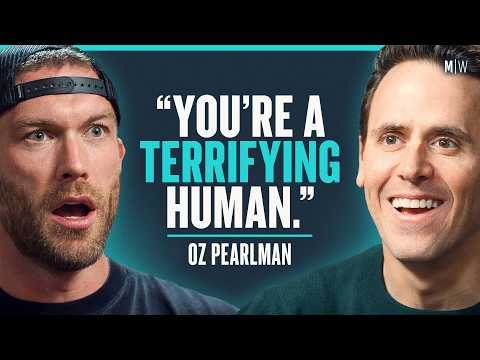
[@ChrisWillx] How to Steal Thoughts Out of Anyone’s Head - Oz Pearlman

· 144 min read

@ChrisWillx - "How to Steal Thoughts Out of Anyone’s Head - Oz Pearlman"

Link: https://youtu.be/6xdW0bdVkVU

Duration: 116 min

Short Summary

Oz The Mentalist, a former Wall Street professional who transitioned to mentalism after 30 years of studying the craft, discusses his journey from restaurant magician at age 14 to performing over 317 shows, including his upcoming White House Correspondents Dinner performance to roast President Trump. He demonstrates muscle reading techniques, shares memory and communication tactics, and reveals how completing the 153-mile Spartathlon ultramarathon taught him that success is mental rather than physical.

Key Quotes

  1. "What I'm doing is learnable, repeatable, and based in science. Those very important things. You can't teach someone to be a psychic." (00:00:40)
  2. "We operate 95% of our lives in that exact fashion." (00:00:16)
  3. "Most people add more details when they lie. They add more details to a story. Oh, you know, I I want to come but my daughter's this and that." (00:00:31)

Detailed Summary

Episode Overview

This episode features Oz The Mentalist (Darren Pearlman), a former Wall Street professional who transitioned to mentalism after 30 years of studying deception. The discussion covers his upcoming White House Correspondents Dinner performance to roast President Trump, mentalism demonstrations, ultrarunning achievements including completing the 153-mile Spartathlon, performance psychology, memory techniques, and the paradox of success and happiness.

  • Oz The Mentalist has performed approximately 317 shows over 10 years
  • He studied mentalism and deception for 30 years before going professional
  • The podcast episode was recorded on February 23, 1988—the same date as the guest's birthdate
  • Modern Wisdom reached 8th in the world on Spotify charts in December
  • The guest has five children and estimates he sleeps significantly less than seven hours per night

Mentalism Fundamentals

Mentalism creates the illusion of mind reading without tricks or gimmicks—it's learnable, repeatable, and based in science rather than supernatural claims. Core principles include building rapport, establishing trust, charisma, and resilience, with resilience potentially more important than charisma for long-term success.

  • Derren Brown is identified as the "godfather" of mentalism in the UK, having been the leading figure for 2–3 decades
  • Kreskin performed on The Tonight Show with Johnny Carson over 80 times
  • Mentalism began approximately 100 years ago when magicians began observing how psychics performed their "tricks"
  • The key distinction between a psychic and a mentalist is that mentalism is learnable, repeatable, and based in science
  • Wonder is nearly universal and hardwired into human DNA, unlike music or comedy
  • The guest claims making performances about the audience provides longevity in his career

The Mentalist's Background and Journey

Oz quit his Wall Street job to pursue mentalism, using doctor/surgeon metaphors to reassure his mother it wasn't a mistake. Starting at age 14 after his parents divorced with no discretionary spending money, he worked as a restaurant magician and created an "agent" mental model as a survival tactic—splitting his psyche so rejection was handled by a separate persona rather than his core self.

  • At age 14, after his parents divorced, he started working as a restaurant magician to generate income for magic tricks
  • He created an "agent" mental model as a survival tactic—splitting his psyche so rejection was handled by the "agent" rather than his core self
  • He used a saltwater and plexiglass metaphor to describe mentally isolating rejection
  • He initially took a narcissistic approach to performance before realizing what he was actually selling
  • He maintains the same personality on stage and in real life, slightly exaggerated, unlike many other performers
  • He hosts the White House Correspondents Dinner and performed for 7,000 people at TikTok Theater in Darling Harbour, Sydney

Mentalism Demonstrations

The guest demonstrated "muscle reading"—observing subtle physical responses to deduce information—correctly identifying a card (King of spades) without touching the deck and identifying a poker hand as two pair of eights without seeing the cards. These demonstrations aren't card tricks—it's pure observation of physical responses.

  • He correctly identified a card (King of spades) without touching the deck using muscle reading
  • He identified a poker hand as two pair of eights without seeing the cards
  • He guessed a subject's birth date (February 23, 1988) using five random cards dealt off the top
  • He claims muscle reading is scientifically real and can be verified by Googling the term
  • He notes statistically most poker hands are "nothing" (no pair or better)
  • He states he could cheat "10 ways from Sunday" if he actually touched the cards due to his magician background

Communication and Memory Techniques

People operate approximately 95% of their lives in autopilot mode, meeting someone and defaulting to predictable questions without genuine engagement. A key technique is asking the fourth question you want to ask as your first question, which jars people out of autopilot. Most people don't actually forget names—they never heard them because their brain was stressed during introduction.

  • Read and write are two different cognitive operations that rarely work simultaneously
  • When someone says something that resonates, people typically start planning their next statement instead of listening
  • He filmed a Netflix special where more cameras point at the audience than at the stage
  • Repeating someone's name twice reduces forgetting within 10 seconds by over 90%
  • Three name-remembering tactics: spell the name, give a compliment with a visual hook, or connect to someone else with the same name—all possible within 10 seconds
  • He gave a TED talk on never forgetting a name after meeting someone within two seconds
  • He produces a weekly newsletter of approximately 1,000 words due each Monday, totaling about 300,000 words over time

Deception Detection and Hypnosis

People tend to add more details when they lie because they feel the need to overprove their story, while honest people are cut and dry. The body cannot lie—you cannot control involuntary responses like heart rate changes, similar to how a polygraph works. Dr. David Spiegel at Stanford's evidence-based hypnotism lab shows remarkable success rates for smoking cessation.

  • People tend to add more details when they lie because they feel the need to overprove their story
  • Honest people tend to be cut and dry with their responses
  • The body cannot lie—you cannot control involuntary responses like heart rate changes
  • Verbal and visual cues from speech patterns, cadence, and facial observation could become more accurate than a polygraph in detecting deception
  • AI could become incredibly good at detecting deception by watching objective measures like pauses between words and speed changes
  • He has been polygraphed as a contestant on a TV game show
  • Single one-time hypnosis intervention for smoking addiction shows 25% lifetime cessation success rate
  • Two to four hypnosis sessions increases success rate to 50–60% for smoking cessation
  • The hypnogogic stage—the moment of jolting just before sleep—is identified as the most suggestible part of the night

Ultrarunning Journey: Spartathlon

The guest, age 43, is a 2:23 marathoner who completed Spartathlon (153 miles from Athens to Sparta with a 36-hour cutoff) after failing the first year when he got swept and gave up at night after vomiting for 8 hours. A key revelation came when a runner who never ran more than a 4-hour marathon finished Spartathlon while he did not, leading to the understanding that success is mental, not physical.

  • He completed 116 miles in Central Park four years ago
  • He is currently training for a marathon in a week and a half with plans for 100-mile races after
  • He failed Spartathlon the first year when he got swept and gave up at night after vomiting for 8 hours
  • A runner who never ran more than a 4-hour marathon finished Spartathlon while he did not
  • Ken Rideout (four kids, wrote a book, keeps executing) reinvigorated his running motivation
  • During ultra running, when blood sugar drops, the speaker immediately wants to quit; taking calories and waiting five minutes typically resolves the feeling
  • Ross Edgley practices "suffering strategically managed," treating his body like an engine by diagnosing and testing component parts
  • Most elite ultra runners have a "darkness" or "edge" to them, though Ross Edgley and Nick Bear are exceptions
  • There is significant overlap between people who have become sober and those now participating in ultra running

Success and Happiness Paradox

The guest estimates success and happiness is three times harder than success alone, while success with happiness and balance is ten times harder than that. He does not believe imposter syndrome can be overcome but sees it as persisting while being useful and driving relentless improvement.

  • He does not believe imposter syndrome can be overcome—overcoming it would mean it no longer exists
  • A show others rate as 10/10 might be only 7.5/10 for the guest, driving continuous improvement
  • Gratitude and performance are often inversely related, as gratitude can reduce the drive to self-assess and improve
  • Contentment is described as radical in the modern world filled with ambition, meritocracy, capitalism, and status-seeking
  • Michael Phelps and Tiger Woods are cited as canonical examples where the price of being the best comes with personal costs
  • He estimates success and happiness is three times harder than success alone
  • Success with happiness and balance is ten times harder than success and happiness without balance
  • The higher one climbs in success, the further there is to fall, and if you reach number one, there is only one direction to go

Performance Philosophy

The guest learned not to foreshadow endings in performances so that if something goes wrong, the audience doesn't know it went wrong. Emotional reactions lose 50-70% intensity after the first time and surprise is almost entirely gone. He views his work like jazz—different paths, bridges, and melodies while adapting to people in real-time.

  • Emotional reactions lose 50-70% intensity after the first time and surprise is almost entirely gone
  • He references Jenny Jerome (Winston Churchill's mother) dining with Gladstone and Disraeli—leaving Gladstone's dinner feeling he was clever, but Disraeli's dinner feeling like the cleverest woman herself
  • Alain de Botton coined the concept of "reverse charisma"—when someone makes you feel interesting rather than being interesting themselves
  • The most engaging conversationalists are not necessarily the most interesting people, but those who make others feel the most interesting about themselves
  • Roger Federer won 54% of his points but 80% of his games, making him arguably one of the greatest of all time
  • Jimmy Carr performs approximately 350 jokes in 40 minutes with significant crowd work
  • The peak-end rule states the most memorable part of any experience is the most emotionally intense moment and the ending
  • Apathy is described as the worst outcome for any performance—not caring or being engaged is worse than any negative reaction
  • He uses a technique called "Fast Forward Your Feelings" where he rates dread about a task on a 1-10 scale, then forces himself to do it immediately

Upcoming Projects and Tour Dates

The guest has been primarily a corporate act for the last 10 years but is now transitioning to more public shows and touring. Upcoming performances include the White House Correspondents Dinner, shows at the Wynn in Las Vegas and the Borgata in Atlantic City, and a Netflix special shooting in July in New York City.

  • May 2nd performance scheduled at the Wynn in Las Vegas
  • June 5th performance scheduled at the Borgata in Atlantic City
  • A Netflix special is scheduled to shoot in July in New York City
  • He hosted the White House Correspondents Dinner where President Trump attended for the first time while in office
  • His intention was not to roast Trump, unlike past comedians at the event
  • He performed for 7,000 people at TikTok Theater in Darling Harbour, Sydney
  • He is transitioning from primarily corporate acts over the last 10 years to more public shows and touring

Full Transcript

Show transcript

You have said that your career is built on a lie. >> Yeah. >> What's a lie? >> The lie is that can read people's minds. >> You can't. >> I can't. I wish I could. >> Okay. Why does what you do work then if you can't read people's minds? >> Well, because I'm giving the illusion of reading people's minds, right? That's the skill. That's really I'm crafting a narrative which in your mind plays out in such a way kind of like the way a magic trick works, but the contract is different with the audience. Because most of us when we watch a magic trick since we've been young and we kind of first experience magic, we know that what's happening isn't real. De facto, the bird that appeared didn't really appear out of nowhere. The person doing this isn't God. They didn't cut a woman in half for real because you can't actually put her back together, right? Science has established what can and can't be done within reason. That's what we believe. So, you can always look and see and say, "Well, there's a gimmick. There's a trick. there's a way that it's being done. And the funny part about what I do, it's called mentalism. It's a form of magic, is that you can't really find how it's being done because there's never that trick. There's never the gimmick. There's never the thing that you do to do it because it's a pure art. It's very similar to standup comedy. I can show up with nothing. I could do a show today for thousands of people with literally nothing. A marker helps. A pad of paper helps, but it's not mandatory. is that you know when you talk about the prestige when people talk the reveal at the end that's kind of the thing that appears to be missing >> the abracadabra the ah yeah well it's not so we still get that moment of the wow the taa the but >> the lead up to it typically doesn't have any form of something that looks like it's doing the trick if that makes sense it appears to be just a test of wills where I've trained my mind to see and observe things about you or influence you in such ways that the method seems to really be mind readading. And that's that's the illusion I'm trying to present. >> Who is the greatest mentalist from history? In your opinion, >> that's a tough question. I mean, there's a guy in the UK named Darren Brown who's really been the godfather the last like two or three decades, I would say, who broke ground. You can't really throw There's a guy named Kreskin, the amazing Kreskin, who in the US was on the Tonight Show with Johnny Carson, I don't even know how many times, over 80, and he was a real character and performed. He created that whole motif. But all of this started, don't quote me on this, but about a hundred years ago, where people used to just pretend to be psychics or depending on what you believe, were psychics. And then magicians kind of observe the way psychics do their tricks or whatever you want to call them. Maybe they're doing it real, maybe they're not. But they found methods. And the key thing to understand that's difference between a psychic and me is what I'm doing is learnable, repeatable, and based in science. Those very important things. You can't teach someone to be a psychic. I've never met a psychic that could teach me to also be a psychic. I could teach you to be No, but it's true. I It's It's really And then it's not always repeatable. So, if you're a psychic, let's do this three times. Talk to my dead grandma three times. I'm going to ask you three questions. Answer all three. It's not like that, right? It's what's in the ether. It's a little bit more ethereal, if you will. And then it's there's it's rooted in science. I can explain to you the method of everything I do. Most other mentalists can explain to you how I do most of what I do. Not all. And that's what can set you apart. But that's the key. There is a method. There's something I'm doing a set of steps. >> What are the component parts? What are the core principles of being a good mentalist? >> I think knowing how to build rapport, how to establish trust, the same things that a hypnotist can do, same thing a good salesperson can do, the same thing that a great con man can do are very important. If you can't get people to trust you and work with you, it won't work. I'm not hypnotizing people to cluck like a chicken. we're having a fun experience together. So, you're winning them over. I would say charisma is important. >> I I would say resilience is really important. It's a lot of poor foundational skills that are useful in all of life. >> So, resilience is really important because it doesn't work at the beginning. >> So, you don't I've never met somebody who was a mentalist who was good at the start. It's very similar to stand-up comedy. You rarely find someone who's been doing standup comedy 6 months who's incredible and is headlining Madison Square Garden. there were 10 or 20 years of work to become an overnight success for most of those people. The same thing applies. It's the same core skill. >> You talk about reading micro expressions, body language. >> That's part of it. >> How how accurate is that in practice? How much can you detect from being able to see what's going on with someone's microp expressions, their face, their body language? >> I don't have an easy answer to that because it depends on the scenario. Does that make sense? A big part of what I do is create an illusion that you can generalize my skills to everything. Does that make sense or no? Because I can explain it what it means. I create a very specific scenario that looks it should look impossible. It should be very entertaining and should be a story you tell to lots of people. You go well if you can do that then remember that then the then connector is what people fill in the blanks. >> And it's not always true. And that's the honest truth is that I create an impression of being able to do everything. Should I give you an example? But I don't know if we're too early in the game. No, no, let's do it. >> But I told your team to get a deck of cards. They bought two decks of cards. Overachievers. Modern wisdom. Correct. Take >> Should we put the glass on? Grab a deck. >> Yeah. I'm not going to put the glasses on. >> It doesn't matter. >> And open it up. I don't want to touch it. >> All right. >> Crack it open. >> Cracking. >> There should be I'm assuming this is where CVS, Walgreens, I don't know where you got it. Are there There should be Joker and um fake cards and whatever. >> Joker. >> I don't know what there is. I have not touched these. So, take everything out that's not a real card. >> Okay? There's something advertising YouTube. There's some rules. There's two joker cards. Okay. >> And please shuffle them up to your heart's content. Like mix there. They're in order right now if they came out of the box. This is a brand new deck. >> Yeah, it looks that way. >> Are you a good shuffler? >> Uh, no. Horrendous. But I uh >> At least you're honest. >> Yeah, dude. I've got I've got certain skills, but shuffling cards. >> Shuffling cards is not one of them, huh? >> No. I imagine that this is something that you do in your sleep. >> So, I was a magician before I was a mentalist. >> Okay. It's kind of akin to doing premed before you go to school and become a doctor, before you become a surgeon or a plastic surgeon. >> I used when I quit my job on Wall Street as many metaphors to becoming a plastic surgeon or doctor to convince my Jewish mother that I wasn't throwing away my life. Um, >> okay. >> All right. I think moderately well shuffled. >> Yeah. But anybody watching this and they're going to assume so magic is slight of hand. As soon as I touch these cards, everything's out the door because I could touch them and do something. Does that make sense? >> Yes. >> And and truly, that's the honest truth. If you hand me these cards, I could cheat 10 10 ways from Sunday. So, here's what I want you to do. I don't want this to be about the cards. The cards are meaningless. I just want to show you how you could generalize a skill. Do you feel like these are mixed? >> I think so. >> Okay. So, if you feel good, if not, by all means, we can shuffle more, but it it's inconsequential because I'm not going to touch them. >> They're pretty mixed. >> Okay. >> Yeah. Yeah. Yeah. Yeah. I did a good job. I did good. >> Mix them again. Do whatever you want. Put them down in front of you. >> Yep. Okay. >> So, you nor I can see them. >> And what I want you to do is take and how do I describe this effectively in a casino? They always tell you to lift off a piece. It's kind of like a cut. Yep. >> So, I want you to lift off. It could be a little. It could be a lot, >> but place a piece over to the side. >> You're going to go for a little. >> Do you feel good about that? >> I feel great. >> Would you like to do it again? It's It's completely your choice. >> I feel great about that. >> Okay. So, see where you cut to. Grab the card. Bring it close to your body. >> This top one. I honestly couldn't care less. If that doesn't feel right, do it. Cut again. Cut somewhere different. And take this card. Here's what I want. Very important. I want you to take and I want you bring it very close to you against and bring it close to your body >> and and make sure I can't see and look at it. Do you see it? >> See it? >> And now look at me. Right now it's one out of 52. Are we in agreement? If not, we start over cuz you want to change. >> So you ask me what has to do with >> actual physical parameters like observing you. >> Google right now. If you want to Google this, Google is muscle reading real. >> Is muscle reading real? >> Yeah. Look it up because right now say to me, well, this can't be real. Literally, if you want to Google it right afterwards, you can Google is muscle reading real. Everybody do that. The idiom response scientifically chat GB will tell you it's real. You can see things in people that will give away the answer. Watch. Try not to react. Cover the card. Put it away. I don't care what you do with it. Think red, black, red, black, red, black. Hearts, diamonds, club, spades. Hearts, diamonds, club, spades. Ace 2, three, four, five, six, 7, 9, 10, jack, queen, king. It's a black card. It's a spade. It's the king of spades. Turn it over. How do we do anyway, >> dude? [ __ ] you. [ __ ] you. >> No. >> Now, what somebody would think in this scenario, one is the card trick, but it's not cuz I didn't touch the cards ever. You could do this again with any cards. It's it it doesn't matter at all. In fact, >> try this glasses. Try these. Try this. Take the cards, put them all together. >> Yeah. >> And mix them one more time, please. >> Okay. You know what's dumb? I actually forgot that that was the name of it. And for the first half of it, while you were looking at me, I thought it was uh clubs. >> Oh. Only after that when you said go through it, I was like, "Ah, that's why I checked again." >> Interesting. >> And then you got it right. No, but you got it right. You got it right when you were going through the But the first time I was like, and then that's why I checked again. I was like, "Oh, [ __ ] no. That's a spade." If you would have thought it differently, the funny part about it, I would have gotten what you thought and not what was wrong. >> Use error, >> right? >> All right. >> Mix them again. Mix them again, please. Now, here's where you could generalize the skill. So, let me ask you a question here. >> Okay. >> Do you know how to play poker >> badly? >> But do you know how the the rules of games like how a pair, three of a kind, two pair, flush, you know, all the rules? >> Uh, yeah. >> Okay. >> Broadly. >> Okay. Mixed. >> If you want to put on the table kind of mixed, do whatever you want. I just want you to feel like >> I've done the mixing, dude. I'm aware that I can do this. Add in an item and you're still going to be able to >> People are going to watch this and go, "Why couldn't he mix better?" That's what I know there. So, take and I want you to I'm teasing you. >> That's my skill. >> Lift off uh like a a chunk. It could be a little, could be a lot. And put one to the right. Perfect. Pick up another and put one to the left. Wonderful. If you saw me right guessing one card, why am I here right now? Think about this. You shuffled the cards. You made them three piles. Why don't we just go to Vegas and why don't I just play poker? >> Let's monetize the skill. It's not necessarily generalized to everything. >> You've shuffled these. You made three piles of your own valition. Is that true? >> Yes. >> Pick up any one of the piles. Please put it in your left hand. Uh like this. Like uh like as if you're going to deal poker and pick up another one of the piles. >> Is that feels right? Put it on top. So you're kind of reassembling. Pick up the last one. Put it on top as You've cut the deck three times. >> Mhm. >> And here's what I want you to do. I want you in front of you over there to deal 1 2 3 4 five cards face down in front of you, please. >> You can put them on top however you want. You're going to take those cards yourself. >> Okay. >> No, bring them close to you. >> Okay. I'm just getting them in. >> Perfect. Grab them all. Put the deck away and bring it close to you. >> Mhm. >> So there's no way I could see and see if you what your poker hand is. Now, don't tell me, but this becomes more monetizable than guessing one card. >> Mhm. >> And close the cards and bring them close to your body. Do you know what poker hand you have? >> Yes. >> Now, again, statistically, you probably have nothing because that's what happens in most poker games. H. But you seemed a little happy. >> How happy did you feel? We don't know. You also said you don't play poker very much, so I'd have to observe you for much longer. But a pair would be the worst hand. The next one would be two pair. Three pair. We would have a a straight or a flush or straight FL. This isn't a card trick. This is just watching you and it's seeing where was their response statistically. Again, I've never touched the cards. This isn't a card trick. This isn't about slight of hand. I think you have two pair. >> And hold on. Hold on. Hold on. Hold on. Before you do this, don't do anything. Hold on. Don't tell me anything about it. I don't think I think the pairs too are I would describe them as both relatively low. That's my feeling. Do me a favor right now. I nothing jumped. I bet you there's no face cards. I want you to take and lay the cards out in front of you one at a time face down in front of you in any order you want. Just lay them in a row of five in front of you, please. >> Okay. Eights. Was there a pair of eights? >> Yes, >> there was. See, I when I said when I said low, you didn't know what to say. You were confused because is that low? It's right in the middle. >> It's right in the middle. That's the difficulty. >> I don't care what the poker hand is. Do you want to know why? >> Why? >> Because from the day you were born until today, a card trick will not be something you remember. >> It won't. So, I'm going to show you something that you will remember. >> I'm scared. >> Are you ready? Because you put these five cards down. From the day you were born until today, what month were you born in? Could you tell me please? >> February. >> February. What day? >> 23rd. >> 23rd of what year? >> 88. >> 88. >> Dude, no. No. No. No. No. No. No. No. [ __ ] I can't tell if it's better or worse given that you're wearing that mask right now. I can't tell. I didn't even realize. I didn't even realize. You're terrifying. You're You're a terrifying human. >> You know, we were talking about cults before we got started. >> I'm starting one now. Are you joining? >> Yes. Yes. Yes. Tell me. We all need to tell me what. This is broken already. Jared, >> we got six. >> It's okay. Good. Uh, dude, that's unbelievable. >> I think you're broken, too. It's very disconcerting. >> Yeah. >> Where do we even go from here? It's the first one. >> I don't know, dude. I'm >> Holy [ __ ] >> Okay. Okay. Okay. Okay. Okay. >> That's it. From the day you're born until today. Put these away. That was just a fun warm-up. I didn't even want to throw these out there that early. >> Okay. Well, >> it's the worst thing I'm going to do. >> Okay. Holy [ __ ] >> Thanks, man. Thanks. Now, now I feel like I'm going to get jump scared by a ghost or something. Uh, so you mentioned that story is a big part of it. That being able to sort of build in more than just being the trick. >> Well, I think that's the key because the story you tell is the the true power of what I do and what provides longevity and has been my secret to success. >> Mhm. >> Which is for years I didn't realize what I was selling, which I think is a core principle that a lot of people don't realize. And when I say selling, people always think that means money. I'm not talking about money. All of us are salespeople in life. We don't realize it. You and me right now, we're selling attention. You're selling people watching and listening to this program because if they stop, your business is done. And it took a long time to grow this, right? Your equity. So, I asked myself, what was I selling? For the longest time, I thought I'm selling. I'm amazing. Look at me. Right? It's a very narcissistic approach. I can do a cool trick. Why does that matter to you? And then I started in inverting the question, saying, why does it matter to anyone else? It shouldn't matter. Who cares? Sure, it's an escape. Sure, it's fun. I could do the same thing as 98% of my competitors and realize it's cool, that's great. I realized what's going to differentiate me is when I make it about other people. So the way the story gets told, the way a thing is remembered is much more emotionally impactful if it has something to do with the person watching you, >> right? That moment that connects with them where that was a card trick, so to speak. But the card trick when you recount it to somebody will be completely different because when I just guessed >> two pair in a poker hand that wasn't that meaningful. But when you sit back and rethink this through and go I shuffled these cards. I cut them a bunch of times and then it was the date of my birth like how could that be right? That story is going to get told in a very different way and hopefully for months and years to come >> and that's a very small parallel but when I perform I always make it about the people watching. If it's for an NFL team, it's going to be what matters to the football viewer. Somebody who's not a fan of me. They I came along for the ride. I'm trying to catch new people and have them buy into me and what I do. And doing that is making it all about them. >> Like when I do my shows, if you come watch my show, the audience is the star of the show. I don't mean that in a cliche new age. I mean, literally, I don't have a show without the audience. I'm panning for gold. And my version of gold is genuine, authentic reactions. people freaking out and other people even if you're not in observing that and feeling that same feeling because wonder is kind of universal. >> Music isn't, comedy isn't. There's almost nothing that is universal. There's a few things, right? But wonder is one of them that's like hardwired into our DNA. We'll get back to talking in just one second, but first tell me if this sounds familiar. You train regularly. You eat reasonably well. Maybe you even supplement. You feel fine, but you're just kind of going off vibes. Most people have absolutely no idea what's going on inside of their body, which is why I partnered with Function. Function gives you access to more than 160 advanced lab tests spanning hormones, heart health, metabolic markers, inflammation, thyroid, nutrients, liver, and kidney function. It even detects early signals linked to more than 50 types of cancer. To put that in perspective, your typical annual physical might test about 20 markers, and function runs over 160. And this isn't just numbers dumped into your inbox. Every result is reviewed by clinicians. Abnormal markers get flagged and you get clear explanations and a personalized protocol with actionable next steps so you can actually do something about what you learned. Best of all, you test twice a year and everything lives in a simple dashboard. You can just track trends over time, make sure that you're moving in the right direction. Normally, this level of testing would cost thousands through private clinics. With Function, it is $365 a year. That's $1 a day to know what's actually happening inside of your body. And right now, you can get $25 off, bringing it down to $340. Get the exact same blood panels that I get and save that additional $25 by going to the link in the description below by heading to functionhealth.com/modernwisdom and using the code modernwisdom at checkout. That's functionhealth.com/modernwisdom and modernwisdom a checkout. There's a cool story about Jenny Jerome. It's Winston Churchill's mother and she got to dine with Prime Minister William Gladstone and his rival Benjamin Draeli on consecutive nights. And when she left the dinner after sitting next to Gladstone, she said, "I left feeling that he was the cleverest man in England." And the following night after sitting next to Draeli, she said, "I left feeling like I was the cleverest woman." >> Nice. That's perfect. >> This wonderful example of what Alander Botton calls reverse charisma or inverse charisma. Some people are interesting. Some people make you feel interesting, >> right? >> Why is it that around certain friends we have lots to say around other people we don't have so much, right? >> You go, well, and no, it's >> how much they encourage us to dig deeper and to think about ourselves. How much of us they can tolerate or they seem like they're willing to hold on to uh how prepared are they to open up about their experience that makes us feel like we have the headroom to be able to do it about ourselves? And I think uh yeah, a lot of people want to develop charisma. They want to me me look at how impressive I am. They want their aura to be electric and the stories to be energizing and everyone in the room to walk in and just But I when I think about the people that I like spending the most time with, it's not always the ones that are the most interesting. It's the ones that make me feel the most interesting. >> I think that's 100% true. And the power of silence that people don't really observe or realize. And it took me so many years. a comedian if they step on their own jokes. If you tell another joke while people are laughing, that's it's it's known as stepping on you're taking away some of their laughter. You're taking away some of the feeling. You cut it short. >> It took me years and years to realize that when people start reacting in a performance, >> I stop because it will continue. It's like an sometimes it's an avalanche that continues. And in fact, we're shooting uh pretty soon a special. I think I can talk about a Netflix special. And one of the big things we talked about is when you normally watch a show you watch on stage, we have more cameras pointing into the audience than on stage. Because when people sit back down after they've experienced it, that's the best moment by far. No, but it's it's not even that. It's because they don't feel like they're on camera anymore. When you're standing, the spotlight's on. Action. When you sit down, you get to unpack what just occurred and it feels as if you're no longer on camera. I liken it to, you know, when you cook a steak, how all the juices come in? If you just take the steak and put it on a plate, you don't pour the juices. That's the most delicious part of it. That's what gives it all the, you know, the the the the juiciness. It's like the the real flavor that happens in my show when people sit and they turn to the person next to them and they're like, "What the?" And he's like, "I don't know, man." And he goes, "How do you I don't know. I like that right there." The real part when I leave the room and you guys, that's the best part. That's where you want to leave the tape recorder on. That's where you want to hear what people really say. And he goes, "Was he in dude? I don't know how he did that. I changed my mind in the middle. How did he That's the best part. That for me is the real joy. >> Sitting with silence is something that takes a lot of skill to realize that there's a third participant if you're ever doing any kind of performance, especially if it's between two people. You and your person that's on stage, there's a third participant or 3,000 participants and that all of the people that are watching, right? >> And allowing that to sit, allowing the sort of wonder to hang a little bit. What when it comes to storytelling, you know, not everybody is going to be prestiging their way through some date of birth revealing card trick, telling stories more generally. What are some of the principles that you think about when it comes to telling a good story? I think this applies. There's a parallel, which is you're not going to probably learn to be a magician or a mentalist, but the core skills that I have are ones that are interchangeable in life. Asking yes or no questions gives you yes or no answers. doors get closed, right? The more you can give a branching tree and ask questions that haven't been asked before. So, a lot of what I do is I design my ideas with the end goal in mind. I literally know what I want the ending to be and then I work a backwards from there. Does that make sense? I know I observe that. For example, I just did something on Fox Business last week. I'm going to be on CNBC next week. I'm watching what do people care about right now. Truly, this is a unique time. There's chaos in the Middle East. Gas prices are going up. Most people are in debt. People care about what's the price of gas going to be. And I went on there and I I I made up the story, but the story, the hook at the beginning is I said there's four Fs that matter most to all of us. Family, friends, faith, finances. You >> going to say fuel? >> Yeah. You know, I Damn it, Chris. I need you on on payroll. Uh but yeah, I I I I didn't want to. It was on Fox News, so faith was important. But I I said that that's a good one, though. is that uh you just needed to you the hook the interesting part at the beginning is you want to liken something that somebody can say oh yeah that makes sense that like it makes sense to me and right away I I brought it back to what are gas prices going to be how does this affect people around the country and it it tied together and again you're not going to do this as a mentalist but most people I think they're in autopilot and when they ask someone else a question or when they meet someone they slip into just like in an airplane autopilot after you take off and until you land. The plane is mostly flown by a computer that just does if this then this, if this, then this. We operate 95% of our lives in that exact fashion. You meet someone, is it like fight or flight? What do I ask them? Oh, what do you do? Okay, where are you from? And yes, you can do that. I'm not saying to be like a weirdo. But if you scratch below the surface and think of the first question, second question, third question you want to ask them and then oh, what's the fourth? Ask them the fourth first. you're much more likely to hit a question that they haven't been asked recently that jars them out of autopilot themselves where they go, "Oh, that's interesting. I never thought of it that way." That's a great question to ask. Something that brings you back to something more introspective and then listen. I know that's the craziest part, but most people just simply wait for their turn to speak next. And as soon as you say something that resonates with them, ding ding ding, their brain starts saying, "I need to say this next. I need to say this." and you're not listening to what they're saying anymore. >> Read and write are two different operations that rarely work at the same time in our brains. So, you have to It's like my my six-year-old has an idea and he wants it right. I'm like, "Put it in a thought bubble. Leave it in the thought bubble. Let's come back to it." Right? That's the hardest thing. It's hard for me, too. But the raising your hand approach and saving the thought is such a challenge in a conversation. >> Everybody criticizes the fact that they don't like small talk. It's it's a almost universal thing that people dislike. the idea of getting into an elevator with somebody that's going to stop at every floor trying to hold together some conversation that means nothing to everybody and uh yeah the idea of ridding yourself of the social foreplay and jumping straight to third base or whatever the equivalent is uh I think is a good idea. >> Well, even asking something that's just different like I you and I probably encounter far more new people on average than almost anyone. I will meet sometimes thousands of people in a week. It's just a part of my job. So how do you connect with them on a real level? I will stop and try to get everyone's names. If I don't know your name, I'll make sure it was Jared. I want to make sure I got it right. Like, that's a very core skill that's so easy to do that most of us just think nothing of. >> How can people become better at that? I've I met a million people on the front door of nightclubs. >> So, it's very tough. So, in that situation, if you're meeting a bunch of people all at once, it can be overwhelming, right? It's like trying to drink from a fire hose. There are ways to slow it down. There's ways to remember names for short-term purposes. Long-term is very different because the way memory imprints. Um, I gave a TED talk last year, most viewed in the world for that year. Humble brag. I'm very proud. I'm very proud of that though cuz I didn't expect it to do that well and I barely made it to the TED talk by the skin of my teeth. That's a different story. But if you ask the TED talk people, the fact that I even made it for the TED talk was within minutes. Flight was diverted. It landed in Seattle instead of Vancouver. We were on the tarmac for two and a half hours. We're trying to figure out how to get me there. Am I going to get in a car and just drive across the border? Finally, it takes off. I Anyway, it was very funny. I sprinted faster than any marathon finish I've ever had out of the Vancouver airport. You know when you're changing in a car, how many times you change in a car? You're just like in a movie, legs out the window, changing, they're seeing my tidy whies. These underwear were embarrassing. They were not designed for public consumption. Anyways, it was crazy. I don't know how that thing came together, but in it, I taught you how to never forget someone's name after meeting them within two seconds because it's very embarrassing. And so I have a a little thing where I've switched up the instructions on a shampoo bottle, which are normally what? Lather, rinse, repeat. Lather, rinse, repeat. Three words every shampoo bottle. Here's what I say. Listen, repeat, reply. So when you meet someone, most people when they hear a name, they actually didn't forget the name. They actually never knew it in the first place. which sounds so silly, but when they say the name, you weren't listening because your brain is going through a stressful period at that moment. Do I already know them? What's going on? You're think of a million things, especially if you're meeting people. There's all different things going on in your brain. So, when they said the name, you didn't actually hear it. You don't know it. If you ask them right then, you don't know the name. >> So, right away, the easiest part, listen. Sounds silly. >> Repeat. I immediately repeat the name twice if I can. What was that? Jared or Jerry? Jared. Got it. Listen. Repeat. If you said it twice, your odds go down by over 90% of forgetting it within the next 10 seconds. And then reply involves some sort of a hook. You want to cement the name in your brain. I've got a few different tactics I use. One of them is how to spell it. So in this case, Jonathan, right, we had Jonathan here. Is that J O N A T H an A's or an O at the end? And then he goes J O N A T H A. Oh, that's the way to spell it. That's the only way those other guys. So right away I've said Jonathan three times. I'm going to remember it much more likely. Like it's much more likely it will not disappear. Second, if spelling, if the name is Chris, I'm not gonna be like, "Is that CH R I S?" Yeah, psycho. Of course, it's Chris. C H R I S. So, you can't spell it. What I might do in that case is pay a compliment, which is Chris. I love that shirt, man. I haven't seen that logo for modernism. Great shirt, Chris. Now, I've said it two more times. I've hooked it with a visual, which is Chris wearing the shirt. In your brain, it tends to click more. The third one is I connect it to somebody else I know. So if I met someone, I go, "Jonathan," I go, "That's so funny. I just read a book by that guy, Jonathan Hate. What a great book, Jonathan. Good name." Boom. I've just connected it. All of those things can happen in under 10 seconds. It's not that much. People like being complimented. It shows that you care about them and you will now remember their name. It's been a cheat code in life for me because I will meet people and they will feel seen and heard where when I leave regardless of if I'm really a jerk they go, "Oh, he's a nice guy." Right? It connects with you on a level because you're being personable and most people don't take the time to do that. >> What how can people become better with memory outside of that? It's not just names. Ebbing house, forgetting curb, space repetitiony stuff. This is a little bit of space repetition with some mind palace location based stuff going in there. >> It's not full pneummonics because if you're trying to remember people's names for longer, you really have to do a little more kind of like hard wiring and cementing and repetition but also having something that hooks the person to either a visual. Um I'm with you like memory palace is smart. One thing connects to the next connects to the next and you can build that out. How many people can remember that for a long time is difficult. >> It's tough. >> My memor is not that great which people will not believe. They'll say, you ask my wife, she'll be like, his memor is terrible. But my memory is great for things that are important for me to remember, >> right? >> Think about that again. For most people, I think that's the case. You can like you can play to your strengths. If you're good at buys and back and those chicken legs, then you're skipping legs day, right? I didn't mean that about you. Legs are great. But I like how Chris is like, "What did you say to me? >> Train today." >> Yeah. But I think that I will do very well at the things that I have to remember and things that I don't care about will kind of atrophy and that's the part that's harder to to really condition. >> Well, this was something that I get asked a lot at the live shows that I've been doing, which is how do I get better at remembering ideas and when I first started trying to not be so much of an adult infant, I'm listening to Sam Harris and Jordan Peterson and and Rogan and these guys just seem to have like idetic memory. Like [ __ ] Ben Shapiro seem to have this like photographic memory. I remember reading things and then trying to explain them to a friend later on that day and I couldn't even remember what book it was I'd been reading and it was so embarrassing and I thought, "God, you know, this suck these people out there that they either have a skill set that I don't have or a capacity that I don't have or that they're that they're using some sort of strategy that I'm not aware of or maybe they're just better people than me." And then I realized that there was no reason for me to remember it. I was remembering ideas to tell my friend in the gym, >> right? And a lot of the time when people are saying, "I wish I remembered more of what I read." I'm like, "Well, why? Why is it that you want to remember this thing that you're reading?" Well, it would be cool to explain to other people. A lot of the time it's that I want to be able to say that I've read it. I want to be able to tell other people and show other people that I know this book that I've been going through or this particular documentary or whatever it might be. And as soon as I started doing the show, I had a reason to remember things. It was high veilance for me like very very highly important for me to hold on to stuff because I wanted to talk about this thing today with this guest about their book right so there was a purpose for me to do that I'm writing you know I do this newsletter every week 300,000 words later well there was a reason for me to learn stuff that week I know that I've got a thousand words to hand in this Monday so there is a purpose for me learning things and remembering things so that I can then recall them but without that it's very difficult to have memory stick. It's very effortful and the only reason that you do it is if there's an outcome on the other side of it. So if you're struggling to remember things that you're learning, I think look at what's the motivation for doing it. And if you don't really have one, I think giving yourself an output reason to remember this stuff is a great place to start. >> I agree. Yeah. I think memory is a difficult one because again most of us will think oh I'm so bad at remembering names or I'm so bad at they'll you'll you'll give yourself you won't give yourself credit for certain things when you probably have very good memory for things that are important for your survival for your dayto-day I need to pick up the kids from school hopefully you are remembering that that's very important but the things that are missing what is it that's that's lacking in that department I find if you can't remember it cheat I write things down >> take copious notes it's been one of my really big hacks in life is I I would say about 10 years ago what started happening is I would have repeat clients who book me for another show and I have a certain set list and with what I do you don't want to repeat tricks over and over because they lose a lot of their pizzazz and appeal so I I start panicking what did I do for them oh my god and then I realized that what I had done for them was asymmetrically special to them and not as special to me so you meet someone and you guess their ATM pin code two years ago right oh you or you you remember I don't remember it cuz I've done 317 shows since you but the feeling that I gave you was so strong and so adamant and I've done things where I guess I guess the name of kids before they're born from parents and I will give them notes and these will be kept in scrapbooks. I met kids who are 10 years old. No way. Yes. That's a a big big reputation maker. I meet someone who's pregnant. I go do you know if it's a boy or a girl? They go yes. I go do you care if it's a surprise? I won't say but I know right now if it's a boy or a girl and do you know your nut top name? and I'll guess the name. I've actually guessed in a few instances not the name that you you didn't think this was going to be the name and it ended up being the name, the one that your husband wanted, you didn't want. And so again, why do I say this? I'm not trying to brag. If you meet someone 5 years later, they remember that moment crystal clear. If you don't, it's hurtful. >> Do you see that? It's like they >> it turns something really beautiful into something that's actually a little bit tarnished now. >> Exactly. And so after that happened on one or two occasions, now I can somewhat to a degree fake it because I can elevate my energy to theirs and they're not really guessing out. But I said, I don't want to have that happen again. So that never happens anymore. Do you know why? Because after that happens, if I'm at an event, I write their name, I write everything. I try to cement it in my mind. Just writing things enhances your memory right away. Just sit down, take the effort at the end of my show, which you might not have a show, but at the end of your day, debrief. What was really important today? I don't journal. I'm not going to lie about that. But I will write down everything that occurs from a business perspective that I want to recall and that I can use in the future. And just by doing that, if I go back to those notes and I can connect these two people, which now through CRM, through very simplistic methods, I can just see this person met me here. They know this person. They might be at this next event. Boom. I have all this information that I can use. Not as a trick. I'm not revealing it in a magical way, but it almost feels that way to people. If I remember something I did for you three years ago, it feels like another experience of wonder and awe. Oh my god, how do you know that still I don't technically I re rewent over my notes, but that the fact that I took the time to take the notes and reviewed them is already a leg up. And you can always find that I do a lot of sales meetings. And at sales meetings, I'm always intrigued by the fact that one person in the room is the number one performer. right here. We're in a room with 3,000 people that flew to the Bahamas because they all want a trip. One person did the best of everyone. What made that person the best that year? That's that to me that's a fascinating thing. That's like when I used to run marathons my faster days and I would win marathons. Being at the start line, there's no bigger rush. There's no better drug. There's no better anything than looking around at everybody else and saying, "I'm going to beat every single one of you today." I can't even imagine being in the Olympics and winning a gold. Like that's the >> the rush. I can't. It's unfathomable because I did that at like a lower level weekend warrior and it was still the best. But in that room, that person must have believed they would be number one. And then that became self-fulfilling and they kept doing everything they could to make that happen. They didn't stumble into it. There's no way the number one person at your company is doing it by chance and never thought it would happen. It's impossible. >> Mhm. A quick aside. Look, you know, sleep matters, but let's be real. Most nights you're probably not getting the sort of sleep that's actually restorative. Eight Pod 5 fixes that. It's a smart cover that you throw over the top of your mattress that actively cools or heats each side of the bed up to 20°. They've even added a temperature regulating duvet and pillowcase so you and your partner can sleep at your preferred temperatures covered head to toe like some temperature controlled mummy. Plus, it's got upgraded sensors that run health checks when you're asleep, tracking things like abnormal heartbeats and breathing issues and sudden HIV changes. There's a built-in speaker for white noise. The autopilot feature learns your sleep patterns, makes real-time adjustments to improve your sleep. It even detects when you're snoring, and lifts your head a few inches to help you breathe better. That is why eight is clinically proven to add up to an hour of quality sleep per night. And best of all, they have a 30-day sleep trial, so you can buy it and sleep on it for 29 nights. And if you don't like it, they will just give you your money back. Plus, they ship internationally. Right now, you can get up to $350 off the Pod 5 by going to the link in the description below or heading to eight.com/modernwisdom and using the code modernwisdom at checkout. That's ei.com/modern wisdom and modern wisdom at checkout. What about deception? How can people better spot liars? So, people I wish I had a a clear-cut way and I don't want to lie to people and tell them here's how you can know who's lying. I feel that anyone who does that is not telling you the truth because people are different, right? We're all different. But all of us have kind of guiding principles that if you observe people, you can tell when something's different. Benchmarks. The same way that you can watch the stock market and you see is it doing better or worse? And that's how you could judge your financial adviser. How did you do against the S&P last year? Right? Oh, we had a great year. How did the S&P do? You got 13%. That was 15%. You're not better. So people to observe them when they're deceptive. Most people add more details when they lie. They add more details to a story. Oh, you know, I I want to come but my daughter's this and that. [ __ ] right? Like as soon as you start adding in more, you're feeling the need to prove beyond. When people tend to be cut and dry and say, "I'm really sorry. I can't make it." Boom. That tends to be true. >> Y >> not always, but more often than not. Now, there are cases where certain people are are are tight on words. They're not very careless. So, somebody who might say, "I can't make it." might be lying to you. Is that different than how they normally talk, check their cadence. I believe that AI in the very near future will become incredibly good at detecting deception because if you can watch somebody when they lie, watch somebody when they tell the truth, watch both of those with several examples. I'm surprised they're not doing it already to be honest, is that you can now view the difference purely by objective measures of how much time between their words when they then speed up. Right? All of those things that are very hard to control, your body does it the same way your heart rate goes up. If you had a bender last night, your body doesn't lie. You can't control the fact that if you go for a workout and you're in zone three the whole time when normally you'd be zone two heart rate, oh man, my body's working harder than normal. So, I think that catching people in lies is much easier than people expect. I do it in a very hyperfocused way for my show, which is at the end of the day one out of 52 cards in this case. Or pick a name. Think of the first letter. You'll be like, "That's impossible." What was 26 letters? Also, nobody's name starts with Q, X, or Z almost ever. So, we can throw out those three, right? I have a skill that looks impossible, but that I've been studying for 30 years. Hence, there's kind of tactics I use. >> Yeah. I uh I think it's an interesting one to think about what AI is able to do to detect that because you've already got it with the baseline metrics of a uh polygraph, >> right? Which is not those are not 100%. At all. >> You think that the verbal and visual cues of someone's speech pattern cadence observing their face would be more accurate than a polygraph if you had a >> very soon. Yes, I think so. I think that in in conjunction with the polygraph, but we're not going to be able to polygraph people very often. >> Yeah. Just on the street. >> It's a hole to do. Have you ever been polygraphed? >> No. Have you? >> Yeah. >> How were you able to beat it? >> So, I can't tell you if I was able to beat it. I was actually on a TV game show. >> Okay. Which side were you one of the contestants or >> contestants? Okay. >> Yeah. And so, I don't know if I could tell you because the only way to know if you beat it is you'd have to have access to the results and we'd have to sit there and do it together, which I that's actually a pretty good idea for a show, but I'm assuming >> to see who the best deceiver is. Sure. >> That would be sick. >> Yeah. >> Politicians. >> What about you mentioned you mentioned sales. You mentioned sales there. What are what are some of the ways that you teach people to become better sales people, more confident as they step into a room where they're nervous, more commanding and likable. >> Being vulnerable is a huge one. So, if if you feel nervous, just saying that, just allowing people into your head and saying, "Hey, I've never done this before. I'm actually quite nervous right now, but you seem like a great person. And I just want to tell you more about what I'm like. Just anything that opens you up that allows you to be human. People hate fakeness. I don't if you have somebody who's a great salesperson, but they feel fake to you. Hey, I got to tell you, you just see that's not you. I can instantly detect deception that that's not really you right now. And you can detect it in a performer. You can detect in a politician. You can detect it in people very clearly. There's a spider sense we have that we can't explain. But right now, if somebody was in the room that I didn't know watching me behind my back, right, that wasn't here. I could feel it. Do Do you know what I mean? I don't know if it's sonar. I don't know where it comes from, but there's some way that you can sense a presence near you. And I'm not talking about ghosts. I'm just mean you can feel someone next to you. Situational awareness. >> I think there's something similar to that where you can detect authenticity. And for me, if you watch my show and you meet me in real life, I'm the same person. I'm just slightly exaggerated. A lot of other people that do what I do aren't the same person when you meet them. Offstage, they're not the same. Comedians especially are not the same people. Actors and actresses day and night >> by design. >> Well, by design, but also it's shocking when you meet some people and you're like, "Oh, you're so different than what I expected." It's kind of a cool thing. You've probably met a lot of famous people, but you're you're just not at all the person I thought you would be. So, right away, I think vulnerability is a huge one. Being able to open up to somebody at a moment's notice and being real with them. Another one is know what resistance is going to occur. I call it channel your inner mentalist. Try to think like they think. Stop thinking like you. Most of us don't think in terms of benefitsoriented language. I I somehow learned this very young which is if I go up to a restaurant cuz my hustle when I was 14 years old, I started doing magic tricks and I need to buy more magic tricks was I went to restaurants and I would get a job being a strolling magician at the restaurant. And I real at 14 I started I was 13 but at 14 I need to make money. My folks had gotten divorced kind of really messy and I we had no money so like I had no disposable income to be like give me an allowance to buy this. So for me to keep doing more tricks which I loved I needed to go work. My mom was like go work and so there was another restaurant magician somewhere else in the city. So I knew that was something you could do and get tips and get parties and print business cards. But I realized if I go in the restaurant and just show them tricks, what makes me special? They don't care about that. They really they they might be cool, but so what? What they care about is we have a line of people waiting to get seats. They're a little annoyed. They're on edge. Go entertain them while they're waiting. Someone just had to send back a steak. It was overcooked. You know what? Go sweeten the deal. Go make them happy because the next 10-15 minutes while everyone else is eating, they're kind of low-level pissed off. Now we have this little, you know, song and dance boy. Head on over. And so I realized that the language I could use for them wasn't they're going to be amazed. They don't care about amazed. Every single person that leaves this restaurant today is going to walk up to you and say what a great time they had and how they're going to come back again with friends. Boom. That's what they want to hear. The manager wants to hear about sales, not about how good my tricks are. So the more you can position yourself as a value ad to the people around you and what's important to them, right? That's what's going to open doors. That's what opened doors for me. >> I had Will Guidara on >> Oh, yeah. I saw his book. So funny. >> It's everywhere. >> Yeah. Yeah. He's crushed it. So, uh, 11 Park A, of course, with the number one restaurant in the world for a while. >> 11 Madison. >> 11. >> Is it 11 Madison? Yeah, I think so. Okay. Um, anyway, he said, uh, he was telling me this some of the crazy stuff that he'd done. Uh, one of them was a couple had supposedly got married that day and the wedding party was such a catastrophe that they weren't able to have the reception. They'd done the marriage thing, but two families bickering, backbiting, power games, all the rest of it. And they had gone for dinner at this place. They' booked the dinner for that evening. So, one of the staff made it her job to work out, they didn't have a first dance. Made it her job to work out what the first dance song would be and they slowed the service for this couple a little bit. So, they were the only by the end of the evening, they were the only people left in the entire restaurant. And I think there's two floors to it. And once they'd finished up, they said, "Oh, you just head upstairs. We've got we we've got to thank you for you for they go into the elevator and they go up and as they walk out they played the first song that they would have had at their wedding and all of the staff had left slowly. All of the different serving staff had left. They thought you know we're kind of left here. We were the last people here. They were going upstairs so they were welcomed for their first dance. Wow. >> With the song and they they've never that what an unbelievable way to reverse like even cooler story maybe than having the reception that you would have had >> and uh yeah that it is very much what's the emotionality how much can you sort of penetrate somebody with that like not just he was able to guess the cards but the cards were also something special to me. It makes it about this person. That's that's the challenge in life, right? Is to connect with other people because I realize other people are going to be the ones who open your door. Your network and who you are is is a huge factor of your success and happiness, right? As you get older, you watch so much more. I heard your Tristan Harris we were talking about earlier where he talks about how much lonier people are now because you don't engage people in real life anymore. It's all screens and text. And it's so true. It's it's prevalent for me. It's probably the same as for you. I don't know how it is for you, but I just I between family, between work, there's just not as much time. And especially if you're ambitious and driven, I have definitely traded career over friendships at various stages where I can't be at this big event. I can't be at this boy's trip. I just it's impossible. I travel too much for work. M >> so when you have that drive and not everyone has that same thing but at a certain point I I I think that connecting with people around you and either forming very strong relationships or bonds that go past like give and take relationships are a huge one for me where I feel that as I get older the people around me that are just taking I don't like that relationship I try to find ones where you're able to keep giving giving giving until the point where you have to take and somebody wants to give at that does that make sense I'm trying I'm saying in a in a poor way but the People that have stuck around the longest for me are ones where it's a back and forth. It's a constant back and forth and it's not always just take take take. >> Yeah. What about confidence? A lot of the time people step into a room, they're nervous, they are about to do some big presentation or some pitch. I understand that likability can come from vulnerability. I think that's a a cool way to connect and also to kind of >> stop the additional level of pressure and shame that you feel about having this hidden thing. you have this secret that you're hiding from someone which is that I do feel nervous or whatever but how about getting over the nervousness feeling more confident feeling more more uh compelling and prepared when you step in >> confidence is a funny one because once you become confident you ask yourself why wasn't I confident 5 10 20 years ago right experience leads to it how do you fast track it >> so I had a kind of a paradigm shift when I was young when I was about 14 which is I would go up to restaurants I would go to the restaurants I would be going up to somebody at a point where they don't want me at all to walk up to them. It's kind of like a telemarketer call. >> I'm 14 years old. I walk up to your table. Exactly. Exactly. You're So, right away, I started to understand that when I walk up to you, >> if if they don't like me or they don't like what my trick or anything about the approach went wrong, it's just negative. Some people wouldn't be that kind. They'd be apathetic. Even worse than telling you, uh, get away is to just sit there and not pay attention and look at you awkwardly, which is just brutal. Just brutal. >> And so, here's what happened. That same thing you talk about confidence. I would leave the table furious. I would feel terrible. I if that happened at two or three tables in a row, it would compound. And by the time I got to the fourth table, even if they were nice to me, I kind of hated them. >> Like a comedian chasing the audience, >> but I had low-level rage. And I realized, but truly, I can't I can't allow you that power over me. I had this real and here's why. It was selfish because I go, if I can't keep doing this, I'm not going to be able to buy more tricks. It was it was very A to B, very linear. And I go, if I can't buy more tricks, how am I going to get better at this thing? So, I said, I have to find a way around this. It was a do or die in my mind of I can't allow the audience or in anybody else's case, the people around me to dictate my self-worth and my confidence. And what I did was almost a weird schizophrenic multiple personality thing. I decided that I was almost two people. And in my brain, I created this like split where I said, "They don't actually know me. The people that were just not nice to me, they don't know me. Oes Pearlman. They met Oes the magician. And I thought the same way that a movie star has an agent, the agent handles the negotiations for contracts, right? You don't go to Brad Pitt and say, "You can't have this trailer. I'm not paying you $18 million. You get 60 million." He has somebody who does that for him, who doesn't who deals with the dirty work. Now, most of us in life don't have agents. So, I decided that I now have an agent in my mind. And when I walk up to you, if you don't like me and you were asking me, I don't care at all. The agent handled that. That wasn't me. I didn't take it personal anymore. And I know that sounds easier to to to say than to do, but I truly somehow disconnected the pain associated with rejection, which is really what it is for most people, the pain and fear of rejection, and decided to put that on someone else who wasn't my core psyche. The best way I can liken it as a visual metaphor is if you have a bowl of water and if I take salt and I pour salt in the water, that water once you stir it is salt water. There's nothing you can do about it. But if you could somehow find a way to insert a piece of plexiglass in the middle, it's invisible. And I poured salt into only one side. This other side stays fine. So, I did this as a survival tactic at a young age because otherwise I don't think I could have made it through continuing to do this job because the rejection is so is so pronounced when somebody just dislikes you. It's the same as romantic rejection. I had trouble with that as a teenager that I wish I had that agent in my mind. I'm like, "No, it wasn't the trick. She didn't like me." >> You weren't able to apply the agent model to the romantic. >> No, because like I didn't have anything. There was no buffer. I'm like, "She just doesn't like me. Damn it. I don't know what to do. I can't get any taller. Yes, I have shoes that are thick, but I don't know what else to do. But if you can find a way to do that, so when you go into that presentation, be prepared. There's no such thing as getting in there being unprepared and saying, "Oh, that's my agent. That's you who screwed up." So, be prepared. Do your homework. Practice. But when you leave, understand that there are two different parts and that you shouldn't assess your self-worth based on if they rejected this little part of you. A quick aside, most people think that they're dehydrated because they don't drink enough water. It turns out water alone isn't just the problem. It's also what's missing from it. Which is why for the last 5 years I've started every single morning with a cold glass of element in water. Element is an electrolyte drink with a sciencebacked ratio of sodium, potassium, and magnesium. No sugar, no coloring, no artificial ingredients. Just the stuff that your body actually needs to function. This plays a critical role in reducing your muscle cramps and your fatigue. It optimizes your brain health. It regulates your appetite and it helps curb cravings. I keep talking about it because I genuinely feel a difference when I use it versus when I don't. And best of all, there's a no questions asked refund policy with an unlimited duration. So, if you're on the fence, you can buy it and try it for as long as you like. And if you don't like it for any reason, they just give you your money back. You don't even need to return the box. That's how confident they are that you'll love it. And they offer free shipping in the US. Right now, you can get a free sample pack of Element's most popular flavors with your first purchase by going to the link in the description below or heading to drinklnt.com/modernwisdom. That's drinklnt.com/modern wisdom. If you know these techniques so well, how good are you at stopping yourself from being manipulated? >> Not great. There's It's funny because >> god damn it, dude. >> I think that that's funny because it's it's almost like the chef who goes home, you know, and it's like, you know, exactly. It's ramen. So figure that one out. Three Michelin stars, best restaurant in the world, hitting up Shake Shack afterwards. But I think that I'm I'm very astute at being manipulated in certain parts of my life versus like my kids can manipulate me like crazy. That love gene will will like mom said you could do that. Like did she though? Did she? Like full manipulation. >> Yeah. Yeah. >> Like my son, this is so funny. He's in like a after school uh math program where I know for a fact he's not allowed to use a calculator, but he was so damn convincing. He's going to love when he hears this. My my my nine-year-old is going to love this. And he's like, "No, we're allowed because we're going into fifth grade." And he goes, "For certain word problems, she told us that we should use a calculator because it enhances our skills." And I go, "There's just no way that's true." He's like, "Email her." And so he was trying to call my bluff. So I >> He knew that he you weren't going to email her. >> I freaking emailed her. Okay. And here's what happened. She writes me back the most dismissive email of like, "All of our questions are designed for no calculator." So no, there's no As if I'm an idiot. Meanwhile, I now get in trouble for my wife for how did you allow him to outwitted by a 9-year-old. emailed and now he looked at me because he couldn't believe that he had gotten me to email the teacher. So to answer >> So he wins either way. Either gets to use the calculator or managed to get dad in trouble and look like >> triple wins because if he hears this podcast, he's going to be in heaven when he hears this. >> So yes, it was full manipulation. I can't lie to you and pretend that I am not manipulated either. But again, I have a hyperspecific focus on what I use manipulation for. >> I am an honest con man, >> if that makes sense. Our contract is not one of I'm going to talk to your dead aunt and tell you things and you're going to pay me money. >> I'm providing entertainment and memorable moments in the guise of deception. I tell you from the outset that this is not real. >> I had uh John Lyall on the podcast and he was looking at uh MK Ultra. He's great great historian researcher here at University of Texas and he is doing original research getting into the archives seeing all of the notes of the people that were getting the electroshock therapy trying to do the um complete reset on people to make them uh pliable manurian candidate type things >> on LSD too. >> Yeah. Well, they were applying a lot of LSD in an attempt to see if that made people more pliable, more suggestible, more able to. And there was a Charles Manson wasn't a part of MK Ultra. He wasn't a part of MK Ultra. However, the fascinating thing is the story is people believe Charles Manson was studied in MK Ultra because there was some additional skill he had that made him good at leading a cult. and maybe he'd learned that from the CIA's investigations or there'd been some sort of sharing of information in that. That wasn't the case. He wasn't a part of it. However, Charles Manson was unbelievably good at manipulating people and getting them to become suggestible. So, he didn't learn anything from the CIA, but John's line was the CIA could have learned a lot from him, >> right, >> if they'd gone to cult leaders. Uh Danny Treyo, do you know Danny Treyo? Hollywood actor. Yeah. Um he was in prison with Charlie. Little Charlie, he called him Charles Manson. And little Charlie was getting beaten up to one of the smaller dudes around the block. He's getting beaten up by some of the other prisoners. He had a rope for a belt and maybe he didn't even have a belt. And he gave him a rope. Danny gave him a rope. Danny and his friends had heard that Charles, little Charlie was able to get you loaded on heroin just through your mind. And they started letting him sleep in their cell cuz they would protect him in return for him giving them mental heroin. And he did it to three of the guys. Only two of them had ever had heroin before. And apparently if you do heroin, you throw up. You're likely to throw up when you take it. The two guys that had done it threw up. The dude that hadn't didn't because he didn't know what his response to heroin should be. >> Right. Uh, but they were basically painting the picture of Charles Manson, this unbelievable reader, manipulator of people that supposedly might have learned these skills from the CIA, which he didn't. But in fact, if the CIA had really wanted to learn how to control and manipulate people, they could have gone to him and said, "Hey, you've got some you've got some really strong skills here." all of the cult leader things that we've seen before. The fact that people are able to bow down, give over their life, their wife, their bank account, their entire sort of spiritual essence to whoever this person is, >> right? >> Because they've managed to sort of play this conducting game. >> They have there's there's a real I'm I'm fascinated by cult leaders and just everything about how they're able to win trust and it's these incremental changes. I liken it to kind of like a cruise ship or a large tanker that when it just turns one degree, it starts changing one degree. Little changes over time can start pushing you in that direction of especially when you earn trust. So w with my craft it's kind of again I kind of guide you in a certain way not for cult leader I'm not trying to take anything from you but I can't do it when you asked me earlier can you do this with somebody who doesn't want to? No it's it can't be done against your will. That's you ask me what's the core skill? Building trust, building rapport, and connecting with somebody. >> Why can't you do it against someone's will ethically or they >> they won't just think about it. If you decide you don't want to take part, then you'll say, "No, I'm not doing that. I'm not doing that. Not it's like it's not an against your will type of thing, >> right? You need to have them, >> I'm not going to touch those cards. I'm not going to. You're just going to stop me dead in my tracks. It's not something you can do against your will." >> Do you know if the same is true with hypnotism? Hypnotism is interesting because um people have a level of suggestability and a good hypnotist will check that as they go. So stage hypnotist does compliance testing out in the audience. They'll do something for everyone. Put your hands together, close them together, close your eyes, imagine they're glued together and they'll see who is the most suggestible >> and based on that they'll bring you up. >> Mhm. Are you you must be familiar with a bunch of tangential skill sets, hypnotism, magicians. Who else are behind who else is sort of if there was a dressing room of people doing stuff similar to yours? Magicians, hypnotists, who else is in there? >> I would say standup comedians because standup comedians in essence are hypnotizing an audience in a certain way and the best ones are guiding you kind of up and down and there's a rhythm to it and my show has a rhythm. So if you were to watch a full show, I have I keep playing devil's advocate as I go. If you were watch my full performance, which I'm starting a tour, so should we should we plug this now? Absolutely. Yeah. So, I'm I don't know when this comes out, but May 2nd, I'm at the Win in Las Vegas. Uh June 5th, I'm at the Borgata in Atlantic City. And coming this summer, I'm shooting a Netflix special, which is going to be I don't know the exact date yet. I don't want to, but it's going to be in July in New York City. Where should people go to find out? >> Everything is on my social. You can just click the link, but I'm O's the Mentalist. So, it's Oz looks like Oz the Mentalist on everything. Twitter, Tik Tok, Instagram. Go there, click the link, get tickets, come see this for yourself. >> Unreal. I had uh Dr. David Spiegel on the show and he is Stamford's head of the uh hypnotism evidence-based sort of uh hypnotism lab and he was saying that you can have a single one-time intervention for lifetime smoking addiction that's got a 25% chance of single intervention full cessation for the rest of your life. And I think when you do two or three or four sessions that goes up to 50 to uh 60%. But again, I would say that that and ask him is that against somebody's will. So if somebody doesn't want to quit smoking, then that won't work is my opinion. But if somebody comes in and they now connect a core memory of something disgusting, something that repulses you. Again, there's different ways that they do it. But I've seen smoking sessation sessions. And now if you connect the two together inextricably in your mind where this thought of doing this is no longer my feeling of I want to have coffee and a cigarette in the morning, that feeling of it now feels disgusting. It feels like if you were to take a a bunch of cockroaches and crunch them in your mouth, if you could create those two together in your mind on a subconscious level, then you won't be able to do it anymore. It will disgust you. Isn't it funny that the human brain has got these sort of weird keyholes? >> Yeah. To trigger >> you're able to slot into that hypnotism is able to slot into that comedy is able to slot into. And I with comedy, you can kind of see why because normal day-to-day human interaction, people say things and you both share in a little bit of surprise and delight. Isn't that cool? When you get toward hypnotism, you go, what is the mechanism that's going on inside of the human brain? Why is it there? Is it purpose-built, >> right? >> Or is this uh spandrel in the same way that a light bulb gives off light, but it also gives off heat? It's not supposed to give off the heat. The heat is just a byproduct of the light. A human brains meant to have this. Is it built in for us to be suggestible? Or is it a byproduct of us having a few other attributes that need to be important? And by playing with it for a few thousand years, humans have found out, ah, actually I can tell something about your cards. I can tell something about your life. I can suggest you to behave in this sort of a way or I can encourage you to stop or start doing something. Well, why do we dream? That's a Have you ever Have you ever lucid dreamed? >> A little. A little. Not much. So when I was in high school and I this is no connection. I wasn't doing mentalism. I was doing magic. But I really was very into like Carl Castanada. I was introduced to those books and just some with lucid dreaming and remote viewing and all this kind of paris paranormal things which I didn't know if I believed or not but lucid dreaming is real. And for about 6 months I I wrote a paper on it my senior year in a psychology class and I was doing it. So lucid dreaming do you know the techniques to do it? These might be rudimentary because they go back about 25 years. >> Okay. You do reality testing. So what I used to do is I would wear a watch and I became almost OCD level. I would check my watch every five minutes. It's kind of like the Leonard DiCaprio Inception where he spins it. I would check my watch every 5 minutes. And you have to start doing this religiously so it becomes a tick. Not a big deal. I check my watch. I'd look at it. I'd look away. I'd look back and make sure it was the same time. I did this at school every day. I did this throughout the day every day. Then as you're going to bed, this I didn't invent any of this. This is all from a book. There's I I hope I'm saying this word correctly, but it's the hypnogogic stage. Hypnot. Do you know how to say that word? Y. >> So, as you're falling asleep, the best way to do it is hold your arm at your side up. And you know that moment when you jolt right before that's when your brain goes into that kind of that's the most suggestible part of your whole night. If you can hold your arm up right before you go to sleep, everyone try it. And right when you feel that, that means you went into it. Now, start self-suggesting. In my mind, I would say, I will remember my dream. I will remember my dream. and you will nod off to bed within the next for most people 30 to 45 seconds. Once you feel that jolt, if you say that as the last thing before you go to bed, what started happening is you will start to remember anywhere from 3, four up to eight dreams a night. This was my my my project. And you'd wake up for a minute in between the dreams. If you want, you can write them down, but you'd start having very vivid dreams. And within about a week of doing this, the checking my watch in my dream, I would now check my watch. It's fully in our DiCaprio. I'd look away. I look back. The watch is always a different time if you're in a dream. It never has consistency. So, I look at it. Now, your brain goes into overdrive trying to explain, well, this is the reason why. The same reason that an alarm in your in your house turns into a car honking in a dream. Do you know what I mean? Before you wake up. So, now your mind is racing against you to try to pull yourself out. >> So, as you get better at it, you realize, I'm dreaming right now. This isn't real. I will not wake up. And now you can take control of your dream. And it's actually the coolest thing in the world if you can put the in the work to do it. I have had moments where I've been lucid since without doing just spontaneous. But I used to have lucid dreams almost every night and it was the coolest >> playing a video game while you're asleep. >> It is truly it's the original virtual reality. >> It's better than virtual reality cuz it's real. >> Yeah. It's incredible. It's worth It's not that hard to do which is most people don't put in the work. I haven't put in the work. I don't sleep that much anymore. I've got five kids. But like it's it was super cool at the time. And I think that I realized at that point there's much more to the mind and there are these things which I don't think are explainable. They're not mystical. But why is that? >> Why is that a skill that I could learn within a week and be able to just take control of my dreams? >> It's like a back door in a computer program. It wasn't designed to necessarily be there, but for some reason it is. And because we've tested and played around with it so much, people have found these ways to do it. How long did it take you to do the to learn to lucid dream? >> I think within less than a week, I was able to start doing it somewhat consistently. And then it was because if you again if you were to just do that little changes, you know, like the atomic habits you have to do like small this was one that wasn't that hard. Every five minutes check my watch. I would always check my watch anyway, but this was just more obsessive. But I would only look at it once. Now was the double tap. Look at it, take a moment, then look back. If you just did that, it started to become something. And then when you in the dream, it was so crazy because the dreams are just as real. When was the last dream you remember? Uh, so >> I don't remember my dreams that frequently anymore. >> Uh, I had one last night that I kind of remember. >> How much do you sleep per night on average? >> Seven hours. >> Oh, wow. That's Yeah. Much better than me. Yeah. >> No kids. >> Yeah. >> Yeah. Yeah. Yeah. Yeah. I'm I'm trying to bank as much sleep as possible in anticipation. >> No, you might with kids, too. Everyone's different, but I I just >> I don't know any parent that has sleep. I don't know any parent of of kids that has that much good sleep. >> I mean, no one's awake, but I just go to bed later. I just don't want to go to sleep because once they go to bed, that's your only time that you get to like, >> [ __ ] I'm liberated. Holy >> [ __ ] This nine-year-old that's gaslighting me into letting him use his calculator is finally gone. This tiny little >> pirate and the judgment from the tutor who writes me back and you could just tell that the the parenthesis was like, "You freaking moron." Like you she couldn't say that, but she wanted to put that in the parenthesis. >> Oh, it's so it's Yeah, that was amazing. Yes. Can I be easily manipulated? I wanted to lie, but the truth is yes, I can and my kids can. A quick aside, there is a stat that genuinely surprised me when I first heard it. 95% of people don't get enough fiber. Not because they're being careless, but because hitting your daily fiber target through food alone is actually quite hard. But that's why Momentus built Fiber Plus. See, fiber isn't just a digestion thing. It's the foundation of your gut health, which drives how well you absorb nutrients, how stable your energy is, and how quickly you recover. If your gut isn't dialed in, everything else that you're doing is working at a fraction of its potential. Fiber Plus is a threein-one formula built to address digestion, gut barrier strength, and blood sugar stability all at once. And this cinnamon flavor is unreal. You might think, fiber, wow, I bet that tastes great. Well, yeah, actually it does, doubters. Uh, I really enjoyed this. Best of all, Momentos offers a 30-day money back guarantee. So, if you're not sure, you can buy Fiber Plus, try it for 29 days. If you don't love it, they'll just give you your money back and they ship internationally. Right now, you can get up to 35% off your first subscription and that 30-day money back guarantee by going to the link in the description below or heading to livemus.com/modernwisdom and using the code modernwisdom at checkout. That's lie mous.com/modwisdom and modern wisdom at checkout. >> When tricks go wrong >> Mhm. >> How first do I do I >> They never go wrong. Perfect. Chris, no. Uh, they they definitely go wrong. >> Do any times come to mind where there was a really big face plant? And I'm also interested in how you recover from that in front of a live audience, whether it's big or small, because I think that, >> you know, someone meant to do something, they messed up this thing that they'd maybe planned or prepared. Perhaps it was their fault or it wasn't their fault. Something occurred just at the right moment or the wrong moment or on a sales call, they quote the wrong number and that kind of they notice themselves starting to lose it. What have you learned about dealing with sort of failure in the moment? Can we talk about sort of the more fluffy side of failure? Seeing yourself as a failure, the self-labeling, the overcoming of the self-rejection and the esteem side. I think in the moment, winning back because you have to do that. If you're on the table and you mess up the first one, you go, I I think I might be able to salvage this. What have you learned about dealing with it emotionally, psychologically, and then also trying to charmingly bring that back around? >> So, I've gotten better like on a a couple fronts. One, I've gotten better at realizing that people remember uh the beginning and the end more than the middle. >> Mhm. >> So, how you leave someone is so much more important than what happens before that. If you can win somebody back over, that will be the last feeling they leave with. >> Pandr. >> Yeah. Huge. And people forget the misses and remember the hits. So, and that's the key to psychics. So, a lot of psychics, if you were to sit in a room and check off, what did you get right? What did you get right? What did you get right? They mostly get things wrong. Right. It's kind of the Roger Federer. He only won 54% of his points. He's arguably one of the greatest of all time. I love that stat. I won 54% of his points but 80% of his games. >> Exactly. >> It's wild. So the win the right point. So with me I realize that how I end is the most important in a show and the the ones that move you for me it's cuz I'm a performer that what matters but there are still major face plants. There are things that go wrong and I actually find I learn way more cliche but from the mistakes because if there it's a mistake that I completely didn't see coming, it really eats me up of like what happened? How did I misjudge that so much? And some of those you learn from, some of those you kind of take the hit and you move on. >> I learned in a big way for me is that >> defining something as a mistake has been a gray area for years. The only way that you know if I made a mistake is if you know what wasn't a mistake. Which is funny because my career is a pick your own adventure. Hear me out. >> It's very clear in a football game if you made a mistake because you lost the game, right? the score at the end of the mine isn't like that. That trick I could have never shown you your date of birth at the end and you would have still been impressed. So it could have gone completely wrong on my end and I would have never gone or maybe there was a second ending at the end of that that you didn't know that was like the kick kicker on the kicker that I didn't do that went wrong that you didn't >> the criteria for success hasn't been defined therefore define what the ending is. I'm going to guess not only your cards, but I'm also going to make sure that the cards are your birthday. >> Exactly. So, what if that never happened? So, what if that last bit never happened? You didn't know went wrong. So, I've learned that I don't in essence foreshadow the ending in many instances of what I'm going to do beforehand. So, that if something will go wrong, >> get out of jail free card. >> I get to get out get out of jail all the time because you don't even know you're in jail when you're performing. >> So, that happens. But there before that there have been mess ups and there's also things where I take a big a big leap of faith like I'm going for stuff. I don't know exactly when this airs but I'm hosting the White House correspondence dinner this year. Uh President Trump has never attended while in office before ever. >> So this is the first time. I believe that that is not a coincidence that he is coming uh somewhat because I am there because in the past been comedians who kind of roast him and my intention is not to roast. >> So >> wouldn't it be funny if you got in there and you decided to do a roast? It's like we're not actually doing any magic this evening. No mentalism. >> Donald Tony Hinchcliffe, come on down. It's just a [ __ ] Avengers assemble. If people come in that Well, I mean, that's the ultimate rugpole. You want to talk about that? It's like you've spent your entire career, three, four decades doing this thing >> just to fake this >> to rug pull the president of the United States into a night roast. >> I I >> I mean, you might lose >> the long game. >> You might be jailed, but uh I I think that's the way that you should That's the swan. >> 50% of you would hate you. 50% of people would love you. There's just >> I actually think that probably mo almost all people would love you. Even Trump Trump's uh biggest supporters would love to watch him go through a roast. He's kind of like hilarious. >> He's been roasted before. >> That's true. But I mean Barack Obama roasting >> skin than most people think. >> I I I Yeah, Barack Obama doing that. Um the difference between us is that one of us is going to be president. That's one of the sort of genesis points supposedly, who knows, of uh >> him deciding that he was going to run for office. That was the last time. 2013 was at it, but he wasn't there as president. >> Yes. >> Yeah. >> Yeah. And Barack sort of points him out in the crowd. The difference is that one of us is president or going to be president. Hilarious. >> I mean, it was it was >> that's sick. So, have you got something special planned for the Donald? >> The most special thing I've ever planned in my life. I think I think I again, you never know what will happen, but my hope is that it's kind of like the Joe Rogan. When I when I guessed Joe Rogan's pin code, there was a feeling of there's no way that Joe was in on this. There's no way Joe didn't even know that was going to happen because you can register surprise very clearly. It's very hard to fake surprise. Y >> it's truly like even an actor actress to say if you know what's happening, you can't. That's why a lot of the scenes they do that are surprises, they actually first take surprise them. >> Yeah. >> Uh like the Dard you know the Die Hard when the drop the when uh Alan is it Alan what's his name? Alan Rickman when he gets dropped. Oh, spoiler alert, Die Hard One. >> Sorry for anyone who hasn't seen it, but it's been 30 years. >> The drop I was told I think I saw the behind the scenes, the director's cut is, do you know at the end when he that they didn't rehearse that in the first take they actually dropped him like do you understand that he was it was Yes. So the first was an honest one because otherwise it's just like shooting a gun if you know you jolt up because you register before you shoot that you're going to feel it. Your body freezes. So, I I think that um I think that like seeing Joe react to the pin code, he's almost as high level as you know he's not in on it. >> Y >> but 100x more is Donald Trump. Donald Trump will not fake it for any >> compliant man on the planet. >> That will exactly there is no world in which I can get him to do what I want for any reason. >> Guess the nuclear codes. That's a way to do it. You'll see what I mean. Something really [ __ ] gnarly. Something really gnarly. like and a war has begun with Russia, but at least the trick was great. >> Um, interesting on the first take thing, McConna in Interstellar. So, when they go down to the planet that's full of waves and they lose an additional seven years because they're down there for one more wave before they can get out and go back up to the the the ship. The ship's been receiving all of these messages. So, there's these backlogged messages. >> Tasty. >> Good. There we go. Um, these backlogged messages for um >> like two decades. And it's his kids. You sort of watch his kids unfolding as they're saying, "Dad, we haven't heard from you. We don't know if he's going to." That's the first take. The one that they used was the first take. And he he told me this story where he was saying he was waiting sort of getting himself in and people try and come and speak to you on set before you're about to go in. And he sort of did a this thing and he watched it and sure enough the first take that they did, I don't think he'd seen what the video was going to be that he was going to be reacting to. And I mean, Danny Treyo told me this as well. This is years ago when I spoke to him on the show. And uh you know, you've got some Mexican gangster dudes, like massive Mexican gangster covered in prison tattoos. They g you now need to learn to act. Like >> Danny's a fascinating human and an interesting actor, but like not classically trained. Right. Right. And uh his whole thing was if you need to walk into a room, sit down and take a drink of water. You don't act like you walk into a room, sit down and take a drink of water. You just do that thing. Right. >> And unfortunately when you're talking about emotional reactions after a while it loses its I mean after the first time 50 60 70% of that emotional intensity is gone and of the surprise almost all of it's gone which is the same reason that you don't want to do the same trick twice. Comedians can't do the same joke twice but musicians can they are expected to. >> Of course play and you don't do yellow. >> If you see the killers and they don't play Mr. Bright Side you feel short changed. If you go back and watch Matt Reefe do a set that he did last time, which I think is one of the reasons that crowd work is becoming so important. It's such a I went to go and see Jimmy Carr in Australia. He actually looked after our clothes as we jumped in the sea at Bondai Beach, which was the oddest scenario that me and me and my video guys and my friends went and jumped in the sea. And Jimmy was like, I'm going to look after the kit. So, we sat on the grass on the edge of Bondi Beach like dad was watching the clothes as we jumped in and we came back and he's like, "Right, I've got a gig to 7,000 people that I need to go and like get dressed for." But Jim's like afternoon was spent watching our stuff as we [ __ ] about in the sea. Anyway, um I went to go and watch him and he does he must do I'm not kidding, dude. >> 350 jokes in an hour and >> Oh, he's a machine 40 minutes. Yeah, he's you talked about sort of up and down for comedians. Jimmy's more like sort of an M140 D. Uh, but even he's throwing a lot of crowd work in. Yeah. And I think that a big part of that is that it doesn't matter. People ask you a question. It's always going to be different. It's always going to be new. You're in a new place. And um yeah, the the differences in terms of art form from musicians and music, which is another keyhole in the back of the human brain. Like why why these rhythms? Why these harmonies? Why these particular sorts of progressions? Why tension and release? And why do we like familiarity in music? But we don't like familiarity even watching a movie. You like watching a movie, but usually the most amazing time is maybe the first or perhaps the second. But after a while, Avengers Endgame just sort of starts to lose some of the and then you need a break, right? >> You take a break from watching Interstellar for 5 years and then >> even though comedy is different, some comedies are better the second, third, fourth, fifth time. >> That's true. >> Wedding Crashers. I can watch Wedding Crashers anytime that movie. So I think it's really interesting when you talk about comedy movies because what you're looking for are your favorite moments moments. >> Yeah. It's almost like a shared microculture around that thing. >> And perhaps the same thing's true with types of standup. But for the most part, if you're going to go and see a show, you want a new joke, too. I know what the I know what the answer to the only time that you don't want that is if someone is with you that hasn't been. You're like, "Dude, you got to listen. We listen to this one. Listen to this one." But that's because you want the special I know. I'm in the know. And there's an awkward moment that's involved exactly with that scenario when you're showing to someone else something that you really care about. There's this moment of what if they don't think it's funny and now they think I'm like and and then you start justifying go no well it's really funny to me like it was he did it better the last time. Yeah. >> It's like being past it's like being past the orcs cable at the front of the car playing a like you got to listen to this and looking back and everyone's like >> yeah that is very awkward. There is no pain like that. Like playing a banger that you think is it was your top played song last year. Everyone's just like I'm not a massive fan of Sleep Token, dude. They kind of suck. Uh so >> that's heavy pressure. >> Recovering from fails, you know, how are you going to feel, do you think, going into this White House, the the the dinner is that going to >> I'm hyper prepared. It's it's really I'm thinking of every scenario that can play out to a degree and just thinking how to how to kind of if in every road A B C D what can I pull off? What can I do? Most of it is centered around I'm going to be trying to do the most amazing thing ever for Trump. >> That's the moment. Know that the people in the room, it's also going to be on live TV. That matters, but what matters is the headline. What matters is the clip. That's really in today's day and age, what people truly remember is typically one or two lines of text. That's what they know. Think about it. Think about people that you know of and you you say, "Well, what do you know them for?" Well, this well, tell me more about that. Well, I don't you know, you don't really know much more than that anymore about a lot of people. >> Yep. >> Well, the simplest message is the one that goes the furthest, which is a problem because for the most part, answers to the big questions that we care about aren't simple. But the ones that are most memeable, most repeatable, most memorable are the ones that go the furthest. So you actually end up with a world in which the answers become less satisfactory and less accurate as the world's demand for answers becomes greater. And the ones that actually are correct are the ones that are overlooked because they're too complex or too nuanced. So it's it's too much work. It's too much work for me to work out what this actually is. I would much sooner just have this simple four-word sentence. That's great. That works for me. So yeah, you're right. you know, clipping culture has kind of moved into print culture and memory culture as well. It's everything. >> How short, condensed, and uh pure, how weapons grade can I make this one thing. >> It's a shame, but it's also what defines people. You know, there's a the peak end rule, which is what you use the most memorable part of any experience tends to be the most emotionally salient bit, the most intense, and the end. And sometimes they're the same. That's why bands tend to finish on their biggest song. That's why comedians tend to finish on one of their best jokes. I imagine that the same thing is true for you when you design your set as well, like, oh, it's going to be the big finish, so to speak. I tried to do the same thing with my live show. >> Um, >> I had this idea, the peak hate rule, which is that uh cultural commentators and individuals in um popular culture are defined by their biggest drama and their most recent one. So if you're Jordan Peterson, um you are someone who pushed back against Bill C16 in Canada and also whatever the [ __ ] he's done recently, right? Something to do with Christianity. Uh if you are Hassan Per, then you said that America deserved 911 and whatever he did recently around Iran. Like everybody online is defined by their biggest blow up and their most recent blowup. And the same thing is true for the answers that we're looking for as well. It's like what is the simplest way to define who this person is? Well, we know who this person is. And I think that, you know, one of the criticisms that gets thrown around or one of one of the explanations for why people hate um criticism is the only criticisms that hurt are the ones that we believe, >> right? >> I don't think that that's true. I think the criticisms that hurt most are the ones that we know aren't true, but that we fear other people might believe. >> That's Yeah, >> that's what optics management is. Because it's not just the pain of being misrepresented, it's the indignation of knowing that it's not true and the fear of thinking that other people might believe it. >> Yeah. >> That altogether I think is kind of the eye of the storm of feeling really really hard done by. It's like I'm being scapegoed for this thing. I don't deserve to be. I know that it's wrong and I'm worried that other people are going to believe it. That is a real trifecta. Uh so yeah, that's why the optics management thing is important. But dude, Trump I mean if you want somebody that has just inbuilt hilarious responses I would roll dice in front of him and I think that whatever he would do would probably be pretty hilarious. >> There's no there's no bad reaction. So if if he's angry, if he's happy, if he's not amazed, if he is amazed, it's a litmus test. It's almost like a mood ring. The mood ring is based on the person observing it, not based on his reaction. Does that make sense? So if I guess something it's fully is because if I guess something if he is uncomfortable by it or he's amazed depending on what your view is of him you will emotionally register that. Does that make sense? Like I might get something even if he says I got it wrong I would say did I? I don't think I think that a lot of people I think that the majority of people would say I think he got it right and Trump's lying. Do you understand? I I I actually think it's an asymmetrical upside bet with whatever I'm going to do >> because and so I've worked out the only thing that could happen that's terrible is apathy. Apathy is the worst. Like absolutely not caring or not being engaged. Um or not being involved, which is that's my real >> and that's when you pull out the roast. >> Yeah. That's when Tony Hinchcliffe jumps out. Shane Gillis gets Shane out here. >> You've got him in your pocket. >> Shane can really nail that. Shane is Do you know Shane? >> Of course. Yeah. Yeah. What I'm interested in what you think your work teaches us about how unreliable our perception of reality is, you know, very >> Yeah. What have you learned about that about people's attenti? And it's been my mission to exactly create these moments of wonder and amazement that can't be explained by seemingly reverse engineering the human mind, knowing how people think and using that knowledge against you in a certain way. and doing this. I've done this for some of the most successful and literally of the top 10 wealthiest people in the world, the majority of them. And knowing that they've run companies, built companies, and I'm not saying that your measure of wealth is a measure of your intelligence. I've also done this for people who won Nobel prizes. None of those things are defacto. IQ doesn't have anything to do with the way in which I fool you and use >> your behavioral like your knowledge of your behavior against you and knowing how people think to trick them in a certain way because misdirection magic a lot of things the core principles >> what do I I'm blown away by how easily people can be fooled >> it's wild because it's like what you just said you said there's a keyhole in the back there's a certain set of tricks it's like a lock that you you have to you you know certain locks the key doesn't really work. I call it the Jiggle Master 3000. But if you hit the door a certain way, click up, click over, it opens. Yeah. Like I had one of those apartments in college where if I gave you the key, you can you'd be like, "Dude, the key is broken." And I'm like, "No, >> it's both a combination lock and a key lock. >> It's everything. I have to lift it up while I do it cuz the lock is not straight." And then I have to kind of like jiggle this way and then turn. And if I did it, I'm like, "Don't you know?" Dude, it's broken. It's a jiggle master 3000. Your brain is the same way. And all I've done is learned how to use the keys in different way where if it doesn't jiggle this way. If I say to you this, do this. And you're like, "No, I can see that you're going to move a little this way, a little this way, and now I've got you." And what people want in general is to feel like they're in control. And I know when people heckle me, people always think the hecklers are the tough ones, the skeptics. I think that's easier because if you can figure out what is the core motivating factor for them, what is it? Is it attention? Is it not looking like they're stupid? Is it not being the center of attention? What's driving their behavior at this moment? If you can figure out what that is, give them what they want within a seeming set of parameters that they've chosen, but you've chosen. So again, within the guys of my show, that person wants to call me out. Great. I'm prepared for it. Call me out. Oh man, you're a smart guy. You know exactly. Come on up here. Let's get you. And now you've gotten that shy. You've gotten that love. You've felt like you're the smarter person. I've shown you behind the curtain in a certain way for certain people. and then I do something you don't understand that's more impressive, now you've bought in. So the same way that a very good comedian >> neutralizes a heckler, not by punching down where the crowd turns against you, >> but more of we laugh together at this person in a perfect world. They laugh with you so we've all won together. It's not a zero- sum game. The same thing applies with me. I'm constantly trying to see how I can get to the end goal, which is a huge amazed reaction. kind of alchemy in that way. >> It's it's jazz I would describe it. I don't have the song set up. I have different ways that I can go. I go from brid this bridge this chorus different melodies and I'm kind of playing people as I go. >> And that's why I've gotten better. I think if you ask me 5 years ago how good were you? I'm like much worse than now much >> because I I I improve with time. I'm curious to see what I'll be doing in five or 10 years. >> Yeah. Well, levitating maybe. I um I I definitely watching Jimmy work the crap. I mean, it was 7,000 people at the Tik Tok arena in uh it's a Tik Tok theater, I guess, but it's a a big boy in uh Darling Harour in Sydney. And you know, shout out to Bondi Beach, Tuji Beach. One of my favorite runs in the whole world. That is such a beautiful run. >> I cross the front. >> Yeah. And then you go long. Yeah. It's like I don't remember how long it was, but I've done that run. I performed in Sydney once and it was awesome. Are you still doing I know you said you ran with Casey Neistat yesterday. Are you still pushing on the endurance stuff at the moment or what? >> So I right now what's happened and I always have excuses. Do you know do you know Ken Ride Out? >> Yes. >> Yes. I just did his podcast recently and Ken's like that guy just man I I like seeing people. He's got four kids. He's so busy. Wrote a book and just keeps executing and he kind of reinvigorated me that day where I have all these excuses. Screw that. My baby's old enough now. She's almost a year old. She's sleeping. There was some difficulty where if I don't sleep the night, it's very challenging for me to get up at 5:00 a.m. I can make all the excuse I want. If I've only slept 2 hours, I could be tough talking. I could call David Gogggins, be like, "Stay hard. I want to go back to bed." So now I've I've dialed in where I'm waking up 5 or 5:30. I'm getting an hour and a half to 2 hour run. No excuses. Get it done before anyone's awake. And I had that a few years ago, too. And now I'm getting I'm finding myself again because for about a year I just wasn't really with it. And now I'm doing I've got a marathon in a week and a half and I'll probably do an ultra >> White House dinner. >> Uh I'm doing the marathon six days before. But that's I would run a marathon that day if I could. I might run a marathon that morning. That's not a big deal, >> dude. Holy [ __ ] >> Anything less than 50 miles does has no material impact on me. Like >> How old are you? >> I'm 43. >> Jesus Christ. >> But a 100 mileer 100 mile give me a little run for the money. But I'd like to do 100 mileer this year. At least one. >> But you did 100 miles inside of Central Park. >> 116. >> Yeah. just four years ago today. >> Congratulations. I mean, you're kind of an insane person. >> We didn't even talk about the running, but the running is a different form of mind control where just I like to find out what I'm really capable of. And I think that so few of us >> know what we're capable of because it's so easy to talk about stuff when you're not in it. But until you push yourself mentally or physically into a certain point of complete discomfort where you hit a breaking point, I think it's kind of like the way military operators are. You don't know if that person, why do they do these SEAL trainings? Why do they hell week? Right? Because you can talk tough, but before you get there, you're freezing cold. You haven't slept. All of these factors are working against you. Your core motivating factors, like, do I really want it that bad? How bad do I want it? I I haven't done it, so I I couldn't tell you. But I want the guy or girl who's next to me in a life or death scenario to have made it through that training and found their motivating factor that they want this so bad that they're willing to do this because that can't be faked. And so you have to push yourself. So the running is one of those things where I like to get to a certain point where I hate it. Don't want to do it. Feel miserable. Body broken. Ideally heat exhaustion. I've had heat stroke which is very dangerous. Don't recommend that. Got through it. Somehow got second place at that race. don't ask. But, uh, everything like breaks down and I 100% want to give up and I talk myself out of it. That that right there changes who you are afterwards. It's like a flips the switch where now when you go back to regular life where things are comfortable, which everyone's different. I know a lot of people are struggling, but call it comfortable is you're not in danger. Now, you can readjust how you handle situations, I feel. So, for me, that was the running. The ultramarathoning really does that for me. >> What have you learned about being able to push through that discomfort? You know, you >> that I can do it. That I can do it. That it's it's your mind plays tricks on you. Your body your your body is directly impacted by the way you think. I had I had a race called the Spartan. Uh it's in my book. I love this race. Such a dumb name. I know. >> It's a great race. It's >> alpha spartathlon 3000 killer. So it's it's called Spartathon for a reason because you run from Athens to Sparta. >> It's 153 miles and it's recreating um the run that Fidipities did for the movie 300. Did you see 300 with Gerard Butler? So I'm not going to tell you the whole story, but like that moment where the 300 Spartans defended against the Persians, if they had not held Thermopoly, the Greeks couldn't have assembled an army. They wouldn't have come. They wouldn't have beat them and we wouldn't have civilization today. The Greeks paint it in a very So the country rallies behind this race and it's this cockami. You have 36 hours to run 153 miles. It is really tough. And I will tell you that all these other races you'll hear about, some of them are very difficult. There's 200, 300. The cut offs, okay, are very easy on those races. No offense, >> the pace. >> The pace. There's just, yes, it's harder to run 200 miles or 300 miles, but not if you have six days versus a day and a half. Just space out. You have to be running the whole time. If you take a nap for an hour, get up, walk for an hour, you're toast. You get hit by the cutoffs. >> I did that race the first year. I did not finish. And when you don't finish the 36-hour race, I got swept, which means I gave up in the middle of the night. The cutoff was behind me, but I gave up. I'm I know I can look in the mirror. I gave up. I was puking for 8 hours. [ __ ] I gave up. I could have kept going. I went to bed in a hotel, woke up, had lunch, and watched people that were older than me, that were less physically fit than me. I was a 225 marathoner at the time, which is quite fast. >> That's [ __ ] >> Yes. My fast was 223. I'm with a guy who's never run more than a four fashioned a 4-h hour marathon. He finished the race when I didn't. That changed me for life because I I was crying. I was like watching him and I felt so great for him. But I realized at that moment it had nothing to do with my body. Nothing. It's like the Matrix when Neo jumps. It's not your body, it's your mind. I gave up. And I realized at that point, you have the ability to flip that switch. And everything is excuses in life. everything. I've seen people who are like paralyzed who go play basketball and do things. It's it's people have a decision where they decide are the factors external to me the one that decide what I do or internally I can make things happen and be relentless in my drive. I came back the next year I was going to die before I didn't finish that race. It was a complete mental shift. It was no question I am going to finish this race and I did. And so it was just a complete different shift in mentality. And again it's stupid. It's ridiculous. It's not necessarily healthy. I'm not telling people to run an ultra, but what I got out of doing that undoubtedly has allowed me to achieve the success I've had in the rest of my life since >> because it recalibrated my mind from like to I know what a real 10 out of 10 is. Before I knew what a six out of 10 was and I could lie to myself about what the other four out of 10 was for effort. Now I know that if I decide without question I'm going to do this, I'm going to do it. And I can look in the mirror and tell myself I know I'm going to do it. So fascinating that you've spent a long time trying to understand how other people's minds work and to manipulate and guess those appropriately. Uh but a good part of the lab that you've learned that in has been internal. >> Yeah. >> In yourself. >> Well, everyone I think you probably I still have imposter syndrome. I still am in rooms where I go, how am I in this room right now? How is am I where you go back to some part of yourself that was probably the most insecure? So, like maybe 15-year-old me is still somewhere in me. And there's like I don't know if it's trauma or what, but you don't really believe you deserve it, but you have to earn it. So, I I still have those >> I could be as confident as you could think of on live national TV, millions of people watching. Some part of me is in there that's still that person. But I think overcoming that person is kind of the mental talk that you give yourself is it's there, but I've now earned the fact that I think I'm here. I've worked hard. I deserve it. and I'm gonna tell myself that I'm gonna kill it. >> What's the biggest lesson that you've learned about overcoming that imposter syndrome? I don't know if you can ever overcome it, if that makes sense. Because overcoming it means it doesn't stay there. I think that it helps me in a certain way where if I have a show that other people will think was a 10 out of 10, it might have been a seven and a half out of 10 for me. And I'm going to be the one who says, "How could I have done that better?" And it's a relentless drive to improve and iterate and improve. And I actually see some people who are in my field who I don't want to say I'm jealous cuz that's the wrong word, but I envy in a certain way where they go, I just killed it. That show was amazing. That was And I'm like, how do you believe that? Because I have the best show ever. I'm still looking on how to polish it, how to make it better, how to improve. You have found such fulfillment and satisfaction in not necessarily mediocrity, but I'm obsessed with being the best ever at what I do. >> It's very difficult though if you don't have that level of intense self-crutiny to become the best ever at what you do. >> And I might never become the best ever, but if I never stop going for that, I think I will continuously improve. If you had the mentality of someone who was happy with where they were at or was more grateful. It's interesting that gratitude and performance a lot of the time a kind of inverse because the gratitude helps you to not push so much to not >> self assess and scrutinize and self-criticize and improve and continue to sort of exist in that lack. And you know this is a a balance I think that a lot of people are looking at at the moment which is well how much do I want to have a string of more miserable successes that reach a higher peak >> right >> and how much do I want to trade some of that in place of being happy right >> contentment unfortunately by design you know it's radical in the modern world that's filled with ambition and a meritocracy and capitalism and people trying to acquire as much status and a claim as they can it's radical to say I'm satisfied like that's one of the most radical things that you can It feels like you're dying. People like, "What do you do next? What's next?" >> Like, as soon as I do this, even if it's the biggest moment of my career, this White House correspondent center, "What's next?" Be the question you get the next day, >> right? >> It's very funny how that exists, >> bro. I I whenever middle of December last year, I didn't know that it was the day that the Spotify charts were going to drop. And Modern Wisdom was eighth in the world on Spotify. It was amazing for a bit. And then >> I saw that. I saw you post that. >> And then >> then you started saying, "How do I get to seven?" >> Yeah. You go, "Well, if I'm anything less than eight next year, if I'm not in the top 10, I might as well kill myself, >> right? >> And if I'm eight, then it's just about acceptable. If I'm seven, it'll be okay again for a while." >> And you go that you can see laid out in front of you what the hamster wheel looks like. >> It's a hamster wheel, >> correct? >> And so that's a very funny thing and it's very hard to relate to. So, I feel like it's an obnoxious thing for me to say and you can relate to it, but it's it's that when I'm things are at their best for me, it's almost it should be the happiest, but it's almost an inverse because now you say I can only go down from here. >> Yeah. If you're number one, there's only one place to go. >> There's only one place to go. >> The higher you climb is the further you fall, dude. And look, this is this is the gold medalist syndrome. Michael Phelps is kind of the canonic. Look at um Tiger Woods, right? >> Tiger Woods. You the goats. And this week, he just flipped his car for the second time. I think he's been in a traffic accident that maybe it's because of alcohol or some drugs or maybe, you know, something that's going on inside of his mind. Like, do you want like that's the price you need to pay to be the best in the world. That's the price that you need to pay in order to do that. And it's a rare time. I was with um some guys in Byron Bay on tour and uh one of them made a really interesting point. He says, "I'm not interested in people that are just successful anymore. It's like I'm interested in people that are successful and happy and balanced because that's so much rarer." So much rarer. The success thing is hard, >> right? >> But success and happiness is easily three times harder and the success and happiness and balance is like 10 times harder than that, >> right? >> So yeah, >> and I think what I'm seeing as I continue in life and something that if you do have children, I don't like judge it in a certain way, but children instantly give you a sense of your mortality. It's there's nothing else that did it for me before and that might be age related, but I don't think it was. I think that as soon as you see the next person, you just realize that you are just >> one day I'll be gone. 100%. That's so true. You don't really see it or feel it as much until you see someone else who's your continuation. >> Who's your continuation? Also, somebody that you instantly want them to outlive you. >> So, that it's hardwire in your DNA where when your children, it's this really crazy thing when they're at a certain age. It's usually between four and five. They realize death and what death is. And sometimes you get these really like just crushing moments where they would say to you, "I don't want to die or I don't want grandma to die." And you're like, you don't know what to say because we're all going to die unless we get uploaded to the cloud. I don't know what's going to happen, but as of now, I don't want you to die either. But you have to explain to that person that they will. And they're not going to understand what that is. And most of us don't because we're in a society that really doesn't. We push death away and we don't really get to experience like I have a good friend who's a a palative nurse who experiences death all the time. And for them, it's so different because they're really with it. They they understand it, they see it. But for us, how often do you see anyone dead? like on a one handful I can tell you in my whole life. I just haven't experienced somebody seen someone die or seen somebody immediately after they're dead that's not at a funeral. like literally twice I saw somebody come out of a of a of a lake that had drowned and it was you know it was like a just a shocking thing because in the movies it's one thing but it's it's not um it's not something you experience and knowing that you will die one day I think is a liberating thought and it's one of those things where it takes the edge off of when you say failures I go what does it matter in 500 years nobody knows who I am you are any of this and that actually feels freeing to me in a certain way >> all of their opinions don't matter in any case >> but that allows me to realize how much stuff that I think right now is a big deal isn't. And I have this little thing I call fast forward your feelings where I get caught up in anxious moments of things I don't want to do that I dread. And I didn't know what to do with it because I would just push them off like the classic procrastination of if I don't want to make this call, I'm not going to do it or I'm not going to do I'm going to keep moving my calendar. And finally, I just decided how bad does this feel right now on a sense of on a scale of 1 to 10? How awful do I feel if I were to do this? And I'm like, uh, like eight or nine. I just really don't want to. Right at that moment, do you know what I do? I set an alarm for 24 hours from today. I force myself just like ripping a band-aid, jumping in a pool, set an alarm 24 hours today, and write, "How do you feel?" It's my alarm. And I would do it right then. I would do the thing I wasn't supposed to, didn't want to do right then. I would force myself. Pick up the phone, hit call. [ __ ] don't do. And I would just do it. And do you know what? When the alarm went off the next day, if I even remembered it, I would say, "How anxious do I feel now?" >> Two. Yeah. >> Not even. And so I decided the same way that I trick people's brains for a living, I'm going to start tricking my own brain. And when I call it fast forward your feelings, it sounds so stupid, but when I say to it right now, I go, I'm going to feel like a two tomorrow. I'm going to do it right now. And I'm going to feel a two right now instead of an eight because I actually am in control of my like mental disposition. It's just a trick. Your mind is just a series of chemicals that's tricking you to do that. That's what the ultra running taught me. When your blood sugar goes low when I'm running, I go through a checklist of what's wrong right now. What's wrong? And the number one culprit almost always is my blood sugar's low. When that happens, I start saying, I want to quit. I feel terrible. I don't want to do this. Boom. Right away, take a ton of calories. See how you feel in five minutes. Don't talk to me before that. Five minutes. Talk to me. And when I say me, I mean me to myself. But I just realized through these different parts of my life what's really going on. I >> mean, that's Ross Edgley's thing, right? Suffering strategically managed. He looks at the component parts of what it is that's making him not feel so good in the moment. >> Smart. He diagnoses diagnostics test like on an engine. And man, I want to meet him. You got to introduce us cuz I'm a huge fan of that guy. He's a [ __ ] man, dude. >> Just a shout out to Ross. I DM'd him once. I'm like, Ross, you're unbelievable. He's like, "Thanks, bro. Like, you're you're a beast." Well, the most of those guys, at least dudes that are really really pushing themselves, there's something deep down that's a there's a kind of a darkness. There's an edge to them. There's only two guys that I've ever met that haven't had that and are in that world. And one's Nick Bear from Bear Performance Nutrition. Okay. >> Uh and the other one's Ross Edgely. And I really really tried to push him when we sat down together and then we got to hang out afterward. And I'm like trying, you know, trying to negotiate. >> What are you running away from? What are you running away from? >> Yeah. What where's the shadow? And he is just he's just got this big happy hippo energy that I I I couldn't I couldn't find anything. I couldn't see anything there. He just really wants to maximize his time on this planet. He's really excitable and excited about doing things. And uh that's kind of even more terrifying. >> Yeah, >> that's kind of even more terrifying that it's simply just a pos a positive disposition putting yourself through suffering. So I think we understand the alchemizing of pain into purpose. But just just choosing pain without the alchemy thing in that I think is is yeah he's he's he's an animal dude. He's >> there's so many people that have become sober. There's there's like a weird overlap of people that are sober that are now in ultrarunning because you convert one addiction for another. >> And I'm not saying that's good or bad. I think it is probably better than substance abuse typically to go do running even though it's left to be seen what damage you're doing. But I think it's better >> Yeah. to a degree, but uh it is fascinating how people will want to push things to extremes and that you watch them and at its at its greatest like Alex Hanold who I just admire so much >> is watching people risk is one thing like I don't want to do that but the fact that somebody else does that brings me tremendous I don't know if I want to call it joy because I'm not joyful when I watch them do it but just wonder like I I I rewatched Free Solo recently with my kids because we watched the skyscraper thing and every time I watch it, forget about the the the the like fact that my hands get sweaty and that I feel a physical like tremendous feeling when I'm watching it. The fact that every mistake is death and that you're watching it and I know he's not going to die, so why am I so nervous? >> But just the fact that you're willing to commit to something like that and that there's people in the world inspires me. It's like that wow people will take something and just go for it. It it's I think that's what we want is to be inspired. >> Unreal. So coming up next, White House, then Netflix special. Two big things. >> The two big things and a few shows. I'm starting to tour. So for the last like 10 years, I've been mostly a corporate act. If you saw me was at corporate events, but now I'm doing more and more public shows. And I want to try one more thing with you. >> Okay. >> I leave you on a high note. >> All right. >> I walked in here, right? Beautiful studio. >> Thanks. >> We shook hands. You hit me up with some delicious drinks, by the way. >> It's good. >> And I said to you that the same way I asked you, how many podcasts I want to go through this? How many episodes have you had as this podcast? >> 1,100. >> So 1,100 moments that hopefully have given people modern wisdom. That was the name of it, right? Successful, interesting people. Find out what makes them tick. All of that sum total has gotten you to be here from February 23rd, 1988 to today. So I want you to close your eyes, okay? And I want you to imagine that you could hop into a time machine. But the time machine is to go through your own life as if you could rewind the same way people say in their last moments they get to see their life. And if I were to say to you to zip back in time and look into the face of someone who for whatever reason, and this is only in the eye of the beholder, impacted you in some way. This could be great, this could be small, this could be recent, this could be years ago. I prefer I I would say not this year because it's too poignant. There's a recency bias. If you just pick a recent guest and you say, "Oh, I spoke to Sam Harris or Tristan Harris." No good. I don't like that. >> I want you, this is more of a right brain exercise at first to see if you can visualize that person's face. Can you see? >> You want someone from the show? >> No. No. I'm so sorry. I had nothing to do with the show. I That's not That's not the way. No, I want to make sure. It's someone that had an impact on you. I don't know why, what, or how. >> Yep. >> Open your eyes. Now, when I did this, right, and I had you think of someone's name, and now I had you think of their face. >> Mhm. >> Someone popped in your head initially. I know. >> Mhm. >> And you go, I don't know whether you said to yourself, that's too obvious of a choice or I don't know what, but always you think of someone and there's a hesitation and you go, should I do that person? It's just that should I? And then you switched. >> I believe this is very funny because I can't explain why, but it's the difference in body language. I think you switched genders. I think you started with a female and went to a guy. Am I correct? >> Yes. >> I could tell. I could tell because if it was two women or two guys, the reactions are similar. You say you asked me about like lie detection. I can tell when things are different. Yep. >> Rather than knowing if they're true or false, but true and false are different. All right, let's try this. The female. >> Mhm. >> The female. I'm gonna get something. You know what? >> Think back in time >> and I'm gonna put you on the spot here. Mhm. >> Rewind. Rewind to I don't know when this was. So if you were to put a time stamp, if we had a pin >> now, if it was if I asked you an anniversary, you'd know the day, month, and year. >> If if it's more wishy-washy, like I played cricket and uh it was like a few years. Is this >> a month, day, and year? A year, a month, and year? Like give me some sort of categorization. >> Uh with the female, >> whatever it was. Yeah. I don't >> Yeah. With the with the first person, uh it would be a year. >> A year. >> Yeah. So one's a year. Now you you the fact that you even said that means with the female means that it's different with the male. With the male, what would it have been? >> Month and year. >> Month and year. That's more details. Let's go with that. Yep. >> That sounds fun. >> Think back in time. So it's 2026. I know you're born in ' 88. So we'll go back from the time machine forward. You probably don't remember the first 10 years of your life as vividly. Maybe you do. So 90s, >> the as or the zeros, we don't call them the teens. You laughed. It's in the as come on. That was too easy. Think odd or even. Odd or even. Odd or even. Odd or even. Now you get confused if it was 2000 or 2010 because you don't know if zero is even or odd. So I'm like torn. I think it was an odd number. Was it an odd number? >> Yeah. >> Yeah. 2007, wasn't it? >> Am I right? >> Yeah. >> I want to make sure that the person watching this now who's skeptical, who says, "Oh, he must have researched this." Now, here's what I would say to that. If I had asked you to think of your third grade teacher, then maybe I could have found out your third grade teacher in advance, right? Let's be skeptical. But I want to make sure you understand there's no way to research real time thoughts because you could have thought of anything. I didn't tell you. You completely decided where we would go. Are we in agreement? Yeah. >> And you even changed your mind. Yeah. I didn't tell you. You changed your mind. Think beginning, middle, end. I'm going to go. You can't see the camera behind me, right? Mhm. Let me ask you a question. Why do you know the month? Why do you know the month? >> Because when I met this person, I remember where I'd moved into. >> Yes. That's why I thought that's why I went with this because I thought it was something to do. Okay. What month was it? >> September. >> September is what I thought. That's exactly right. It was in the fall. >> Mhm. >> [ __ ] >> The the the woman strikes me as somebody where could you could you have done your mother? Of course, but that's too impactful. Versus I think it was a teacher. It's a teacher. Am I right? And now when I said third grade teacher, you got kind of tense about it. I don't know which year it's for, >> but um >> was this a a favorite teacher or not so favorite? >> Favorite. >> Favorite. Y >> the guy that you're thinking of, think of his first name. >> Mhm. >> Think of any letter in his first name. >> Mhm. >> Right. All of the alphabet. Think of that one letter right now. You didn't do the first letter, did you? >> No. >> You were like, I don't want to do that. That's going to be a giveaway. >> And then most people will avoid vowels in names. They because they just think every name has a vowel. So, I'm kind of limiting myself. But I don't know if you did that. I think you probably did. Did you think of a vowel? Yeah. >> Yeah. So, you you you you kind of knew that and you went against me. >> Are you thinking of letter A? >> Yes. >> [ __ ] >> I feel like >> think of his last name. Are you thinking of it? >> Mhm. >> There's some sort of There's some sort of judgment here. >> The last name is Is it hyphenated? That's why you thought of two different people. Oh my goodness. >> It's hyphenated. >> It's hyphenated. Yeah. You're like, "Yeah, he didn't take the mom's, the dad's name." You know, I'm going to go with this. I I can't tell you anything. I might not have spelled this right there. Ask yourself this question. Tell your audience right now. Before I walked in this room, had we ever spoken? Had we ever set up? Is this is this did have you written this down on a piece of paper somewhere? Is this in your phone? Did you Is there any way in the world I could have gone on Instagram, Facebook, Twitter, and found this out? 1% or 0%. >> 0%. >> Who' you think of? What's this guy's name? >> Dave Gardner Chan. >> Dave Gardner Chan. >> [ __ ] you, dude. No. You need to be locked up. Oh my god. And then the best part, the best part is the alleyoop. It's right at the end, which is come on over. I always like to do this. You changed your mind. That is the gold standard for this. The gold standard is you think of something and at the last moment you go, I'm going to change my mind. Right? Because that shows it's real. That's the moment. If you change your mind, shake my hand. Go back in time. How old were you? This teacher, give me a guess. How old were you roughly? Give me a guess. Mrs. Wilkinson, right? >> [ __ ] you. >> Jesus Christ. I feel like I feel like prey in water. >> I feel like prey in water and you're a shark. This is >> I don't know if you knew this. I couldn't do any of this before I arrived here. It's just because I've been drinking Newtonic. That's the only way. >> Bingo. I knew there was an ad read. That's the triple hitter. Forget guessing the names, dude. It's the [ __ ] ad read at the end. Bro, you're amazing. This is >> Appreciate you. Long time coming, my friend. I'm super good luck. I can't wait to see what the Donald does in response to this. >> Me, too. If he punches you in the face, that'll make headlines. >> Love that. >> It's great. It's great press. >> That would be heaven, >> dude. You roll. >> Appreciate you, man. Thanks for having >> All right. Goodbye, everybody. >> Bro, you're the man. >> Thank you. >> Thank you very much for tuning in. If you enjoyed that episode, YouTube knows who you are deeply. It thinks you're going to like this one even more. Come on, press