[@DwarkeshPatel] Xi Jinping’s paranoid approach to AGI, debt crisis, & Politburo politics — Victor Shih
![[@DwarkeshPatel] Summarizer](https://summaries.pages.dev/img/logo.webp)
Link: https://youtu.be/b1TeeIG6Uaw
Short Summary
Number One Action Item/Takeaway:
Monitor institutional developments related to AI in China, specifically focusing on the cybersecurity leading group and the role of Ding Xuexiang, to understand the Party's approach to AI safety and control.
Executive Summary:
Victor Shih discusses China's complex political and economic landscape, highlighting the increasing centralization of power under Xi Jinping and the potential risks of this consolidation. China's focus on AI development is coupled with a strong emphasis on control and security, indicating a cautious approach compared to the West. Despite economic challenges like local government debt, AI remains a high priority, driven by the Party's desire to compete with the US.
Key Quotes
Here are five direct quotes extracted from the YouTube video transcript, representing valuable insights into the Chinese political and economic system:
-
"They’re mindset is, 'Even if we would survive politically, if doing that would result in a loss of power—like having less control over the banks, or scientists becoming more independent—then let’s not do that. Because what's the cost? Some people die, whatever. We have slower growth for a couple of years. But if we get to preserve power, we will go ahead and preserve power.'" - This quote encapsulates a core principle driving Chinese Communist Party policy, prioritizing the preservation of power even at the expense of economic growth or human lives.
-
"If Xi Jinping expresses a preference over a policy direction, that is the direction you have to go toward, no matter what. Because if he observes that you're dragging your feet, or that you're pursuing a slightly different agenda, you’ll be purged. And we’ve seen cases of that." - This describes the highly centralized decision-making under Xi Jinping, emphasizing the lack of autonomy for other high-ranking officials and the consequences of deviating from his preferred policies.
-
"What he said was, 'We need to invest in AI, but we can’t go all out in investing in it without knowing what the brakes are. We have to develop the brakes at the same time.' I think that’s extremely revealing. It’s very different from the American approach. In America, it’s all driven by the private sector. Except for one or two companies, everyone just invests and invests and tries to reach AGI as soon as possible." - This quote highlights the Chinese government's cautious approach to AI development, prioritizing control and security concerns alongside technological advancement, in contrast to the more laissez-faire approach in the United States.
-
"For socialism, they only care about output... As long as the Chinese government tells us this is a strategic sector, and as long as you can prove to us that you can actually produce the thing we want you to produce, if you never, ever make money doing it, that’s perfectly fine." This illustrates how the government approach to output can make long-term success difficult, since they don't account for profitability.
-
"Apparently, that’s the lesson he learned. He basically honed his skills and built his coalitions—for the time that he would take over high-level positions in the Party—for decades, as it turns out." - This describes that Xi Jinping took the Cultural Revolution as a lesson in the importance of maintaining control.
Detailed Summary
Here is a detailed summary of the YouTube video transcript, presented in bullet points, excluding advertisements and sponsor announcements:
Key Topics:
- Decentralization vs. Centralization in China: Examining the balance of power and fiscal autonomy between the central government and local/provincial governments.
- Chinese Elite Politics and Technocracy: Analyzing the backgrounds, qualifications, and competence of Politburo members, questioning if their STEM PhDs translate to effective governance.
- Party Control and Policy Implementation: Investigating how the Chinese Communist Party (CCP) prioritizes power preservation over optimal policy outcomes, even when experts provide sound advice.
- Xi Jinping's Leadership Style: Characterizing Xi Jinping as a detail-oriented, micromanaging leader who heavily centralizes decision-making and demands absolute obedience.
- AI Development and Party Control: Discussing China's approach to AI, focusing on the government's desire to control and regulate AI development to prevent potential threats to Party authority.
- Local Government Debt: Addressing the growing debt burden on local governments in China, its causes, and its potential impact on the economy.
- Economic Model: Socialism vs. Capitalism: Exploring the fundamental differences between the Chinese economic model, emphasizing output maximization, and a capitalist model, focusing on profit maximization.
- Taiwan Invasion Probability: Assessing the likelihood of China invading Taiwan, considering various factors influencing Xi Jinping's decision-making.
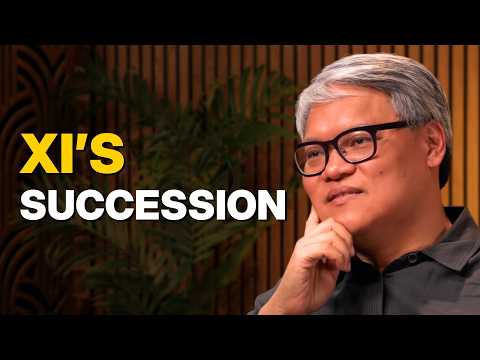
- Succession After Xi Jinping: Speculating about potential scenarios and challenges surrounding the succession of power after Xi Jinping, emphasizing the risk of instability and capital flight.
- Factions Within the CCP: Identifying different factions within the CCP, such as pro-market and statist elements, and their potential impact on policy decisions.
- Economic Forecast for China: Providing a relatively bearish economic outlook for China, suggesting its economy may only be slightly larger than the US by 2040.
Arguments and Information:
- Fiscal Decentralization: China was quite decentralized until 1994. After that, the central government centralized tax collection. Now localities are dependent on the central government.
- Technocratic Credentials: Many Politburo members have STEM degrees, but their practical governance skills are questionable. Political acumen is also crucial for advancement.
- Party's Priority: The CCP prioritizes preserving power over achieving optimal policy outcomes, sometimes leading to suboptimal decisions.
- Xi Jinping's Micromanagement: Xi Jinping is heavily involved in the details of policy across various areas.
- Leading Small Groups (LSGs): Decision-making pushed into LSGs gives Xi Jinping considerable power.
- Political Nose: Xi Jinping has a good "political nose" for internal Party matters, control, and the military.
- AI Approach: China wants to develop "brakes" for AI development to control its use and prevent threats to Party authority.
- Ding Xuexiang: Ding Xuexiang, trusted by Xi, is in charge of cybersecurity and plays a vital role in AI-related matters.
- Enthusiasm for AI: The Chinese government is initially enthusiastic about AI and encourages its adoption but will want to designate people who can pull the plug.
- GPUs: The government could direct Huawei's GPU production towards DeepSeek if needed.
- Local Debt: Local government debt in China is estimated at 120-140% of GDP, used for infrastructure and industrial policies.
- Financial Repression: Financial repression in China acts as a tax on savers. They put their money in banks, and the state banking system has the deposits to finance local governments.
- Capital Controls: Without capital controls, Chinese investors might prefer investing in Silicon Valley.
- Difference Between Economic Models: Socialist model prioritizes output maximization. Capitalist model prioritizes profit maximization.
- Bureaucracy Involvement: Bureaucrats and experts are involved in evaluating projects for state funding.
- Waste: The Chinese financial system has a large amount of money going down a hole.
- Reasons why Investment not Productive: After initial infrastructure boom, diminishing returns, and shrinking population.
- Rent Seeking: Corrupt politicians get envelopes under the table and pay their superiors.
- Potential Solution: Government could decrease national defense/industrial policies and bolster domestic demand with welfare policies and decrease local government debt.
- High Savings: High savings concentration amongst high earners.
- Taiwan Threat: Likelihood of invading Taiwan depends on various factors and Xi's risk tolerance.
- Effect of Ukraine: Ukraine increased the threshold for Taiwan invasion.
- Information Flow: China's top leadership listens to experts but might prioritize political considerations or receive conflicting advice.
- After Xi Drops Dead: If Xi were to die tomorrow, we could see capital outflows.
- Successor: No succession plan is in place.
- China Growth: By 2040, the speaker anticipates that China will be 1x-1.2x the US economy.
- Pro Market vs Statist: Broadly, pro-market figures with experience along the coastal provinces and statist figures with careers in SOEs and the military industrial sector.
This summary captures the core elements of the discussion and the speaker's perspective on the topics covered.