[@hubermanlab] Access the Power of Now to Experience Life More Fully | Eckhart Tolle

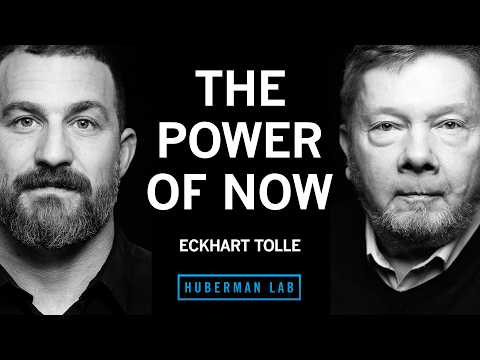
Link: https://youtu.be/brzkTni-nTQ
Duration: 126 min
Transcript: Download plain text
Short Summary
Andrew Huberman hosts Stanford neuroscientist Echart Tole (transcribed as "Echart Tole"), a teacher of consciousness and author of The Power of Now and New Earth, in a conversation about present-moment awareness, non-conceptual knowing, and the "power" that flows through practitioners. Tole argues that identity built from names, toys, body and possessions is a conceptual fiction that keeps the ego in a state of insufficiency, and that beyond it lies a deeper identity present in the now. Huberman adds neuroscience and personal-practice perspective, noting that he previously paid thousands of dollars per year for health data now available for $365 a year through Function Health, and that an inward place unaffected by circumstance can be reached in meditation.
Key Quotes
- "Honor this moment because that's all there ever is. There is nothing else ever in your entire life." (00:07:04)
- "One thing the ego cannot tolerate is peace for very long." (00:22:51)
- "the only immunity you have against being possessed by thought ultimately is awareness" (01:37:50)
- "you can't do a meditation because meditation the very purpose of meditation is the realization of being." (01:45:35)
- "The world is not here to make you happy." (01:46:24)
Detailed Summary
Echart Tole on Consciousness, Conceptual Identity, and the Power of Presence
Episode framing and central thesis
The episode opens with Albert Camus’s line, “In the midst of winter, I found in myself an invincible summer,” introducing the idea of an inner source of power that does not depend on favorable external circumstances. Huberman then speaks with spiritual teacher and author Echart Tole about present-moment awareness, the construction of the ego, and the deeper identity that becomes accessible when conceptual thought subsides.
- Huberman introduces Tole as a teacher of consciousness and the author of The Power of Now and New Earth. Tole is presented not simply as a meditation teacher, but as someone who describes practical methods for recognizing consciousness and applying that understanding to everyday life.
- Huberman identifies himself as a professor of neurobiology and ophthalmology at Stanford School of Medicine and describes the podcast as a means of making actionable scientific information available to the general public.
- Because words are “blunt or insufficient tools” for communicating feeling states, Huberman asks Tole to begin with an experience rather than a conventional question-and-answer session.
- Tole’s central distinction is between the identity formed by names, possessions, knowledge, personality, and other concepts and a deeper identity that is already present in awareness. He argues that the first identity is a useful but fragile fiction, while the second is the source of lasting inner power.
Guided exercise: entering the present moment
Tole begins with a direct exercise designed to shift attention away from conceptual thought and toward immediate sensory experience. The exercise alternates between perceiving the external environment and noticing the deeper awareness that perceives it.
- Tole observes that people usually direct most of their attention toward the future or the past: toward what has not yet happened or toward a remembered past that becomes increasingly idealized as the person grows older.
- The first step is to look around the room and consciously take in visual information and sound, including the sound of Tole’s own voice. This deliberately slows attention enough for thought activity to diminish.
- As sensory input is noticed without immediately labeling, interpreting, or classifying it, Tole says a sense of inner stillness becomes available in place of the usual stream of thought.
- Tole rejects Descartes’ “I think, therefore I am” as a mistaken equation of being with thinking. He argues for a dimension of consciousness that remains present when thought is absent.
- He states that nothing has happened in the past or will happen in the future: the past is remembered now and the future is projected now, leaving “only now” as the actual location of experience.
- Tole distinguishes two levels of present-moment awareness. The first attends to external things and honors the current moment; the second recognizes “the one who is aware” rather than the historical personality, body, or ordinary identity.
- He summarizes this structure by saying that stillness is awareness and that awareness can then become aware of the surrounding stillness, a formulation he treats as common to many spiritual traditions.
Why words cannot directly contain experience
The conversation then examines why philosophical and scientific language can describe concepts about consciousness without transmitting the experience of consciousness itself. Both speakers use this limitation to explain why labels can obscure direct experience.
- Tole contrasts numbers with emotional states. Three dots on a page can reliably represent the number three, but the word “sad,” which has roughly 10,000 variations across languages, does not communicate the exact feeling it names.
- Huberman adds that even a neuroscientist trying to describe his own thinking usually falls back into words. Although words are indispensable for communication, the inability to capture a feeling state directly contributes, in his view, to people remaining stuck in conceptual descriptions.
- Tole notes that major philosophers have treated the “problem of being” through works such as Sartre’s Being and Nothingness and Heidegger’s Being and Time. Their concepts illuminate the question, but concepts subtract from direct being.
- The practical implication is that a person can describe awareness, beauty, sacredness, or grief without another person experiencing those states. Experiences have to be shared through presence, example, or direct contact rather than through a perfectly sufficient verbal label.
How conceptual identity develops
Tole traces the ordinary self from early childhood, showing how a child gradually accumulates names, objects, abilities, and comparisons until the resulting mental model is mistaken for an enduring self. This developmental sequence is presented as necessary but ultimately limited.
- Tole frames the demand for words, names, and concepts as a normal stage of human development. A child initially encounters the world directly but soon begins organizing it through categories and ownership.
- A child’s first major concept is often its name. Tole describes children who, after being told “you are John,” refer to themselves in the third person as “This John is hungry” before eventually equating their being with the word “John.”
- He argues that “my name is John” is less misleading than “I am John,” because a name is only a sound rather than a self-existing entity.
- Conceptual identity then accumulates in stages: first the name, then a toy marked as “mine,” then possessions such as a car, the body as “my body,” and finally abilities and knowledge expressed through claims such as “I know more than you.”
- Once enough concepts have accumulated, an egoic entity emerges that the person wholly identifies with. Tole describes this identity as a shallow mental fiction that presents itself as “me.”
- He argues that this identity is rarely at ease for long. It continually generates feelings such as “I’m not quite enough” and “I haven’t arrived yet,” because whatever is achieved can immediately become the foundation for another comparison or desire.
The body, comparison, and the dog example
Tole uses body image to show how conceptualization can generate suffering that is not present in more direct forms of consciousness. His dog comparison is intended to separate consciousness from the later human tendency to conceptualize and compare the body.
- Many humans develop body-image problems because they first form a conceptual image of the body and then compare that image with other bodies.
- Tole says dogs do not form a conceptual image of themselves and therefore do not experience comparable body-image problems.
- He does not use the dog as an argument against consciousness; rather, he describes dog consciousness as an earlier developmental stage in which conceptual self-image has not yet become dominant.
- In humans, the body becomes one more conceptual possession and therefore one more object that can be judged as attractive, inadequate, old, or inferior.
Ego, conflict, and the horizontal level
Tole argues that much conflict follows from mistaking a conceptual identity for the whole person. He then separates the “horizontal” dimension of achievement and social life from the deeper “being level” on which he locates identity.
- Because people identify with their conceptual selves, a disagreement can be experienced as an attack on the self rather than merely as a differing opinion. Tole links this confusion to interpersonal anger and, in extreme cases, violence.
- The ego requires otherness in order to maintain its fragile sense of self. It emphasizes enemies, struggles to tolerate peace for long, and can generate conflict even while professing to seek peace.
- Tole extends the same mechanism to countries, religions, religious groups, and political groups. Collective identities are reinforced by opponents, producing large-scale versions of the same unnecessary unhappiness found in individuals.
- He distinguishes the conditioned “human you”—the personality, biography, fears, and desires shaped by the past—from the “being level.” Most people remain on the horizontal human level, where a satisfactory self can never be securely established.
- Tole nevertheless endorses pursuing goals, acquiring knowledge, developing skills, traveling, and gaining experience. These activities enlarge a person, but they do not resolve the underlying sense of insufficiency.
- He notes that the human condition has persisted for thousands of years and appears to be intensifying as minds become more complex and more continuously filled with conceptualization.
- Thinking remains a powerful tool for creation, but it is an unstable basis for identity. An identity derived from thought is therefore a “pseudo identity” accompanied by fear, anxiety, or unease in either the foreground or background.
The inner voice and the beginning of awakening
Tole describes spiritual awakening as beginning with the recognition that a continuous internal voice is operating, even before that voice has been identified as separate from the self. His 3:00 a.m. example illustrates how thought is mistaken for immediate reality.
- Until the inner voice is noticed, a person is fully identified with it and treats every thought and the emotion attached to it as present reality.
- Tole describes waking at 3:00 a.m. in a warm, soft bed while anxiously projecting future scenarios. Because the emotional system cannot distinguish a projected thought from an actual event, the imagined danger produces panic.
- The internal voice commonly speaks in the first or second person: “You should have done this,” “Why didn’t you do that,” or “Look at what that person did.” Such commentary can occupy awareness so completely that people remain unaware of their immediate surroundings.
- Tole says many people carry an inner judgment rooted in an earlier experience or an idea about another person or group. This judgment can exert a powerful negative influence on happiness.
- Huberman describes this low-level influence as “almost like being possessed,” while also noting that not every “should” is harmful: some social rules are genuinely useful.
Self versus other in the immune system
Huberman uses biology to illustrate the foundational distinction between self and other. He then connects this distinction to Tole’s claim that conceptual labels can interfere with direct perception.
- Recognizing self from other is a core principle of immune-system function, trained during development. When a pathogen or splinter enters the body, the immune system can identify it as foreign and generate white blood cells that attack it.
- Huberman uses this biological mechanism to frame the psychological need to distinguish oneself from others. The same basic discrimination that protects the body can become psychologically destabilizing when the mind rigidly treats any difference as a threat.
- The point is not that self-recognition is inherently defective; rather, an identity based on opposition remains unstable and tends to require continual boundary maintenance.
Verbs over nouns
Huberman’s second biological analogy concerns the limitations of naming. Nouns are necessary for shared scientific language, but understanding requires attention to processes and actions rather than to labels alone.
- Huberman notes that terms such as “neuron,” “glial cell,” “blood vessel,” and taxonomic categories are indispensable for teaching biology, even though the names themselves reveal nothing about how the nervous system functions.
- His practical recommendation is to discard as many nouns as possible, use only the minimum necessary, and emphasize verbs—the actions and processes through which a system actually operates.
- Tole links this principle to the opening exercise: noticing what is seen and heard allows the listener to attend to processes before interpreting them through categories.
- In Tole’s tree example, a parent names a tree and the child stops looking at it. The name creates the illusion that the child knows what the tree is, although the name does not communicate the tree’s appearance or direct presence.
- Huberman’s baseball analogy similarly distinguishes a scoreboard from the game it tracks. “A’s beat the Padres” omits hits, catches, errors, and the presence of the opposing crowd, so the statistical representation is not the total event.
- Labels can also be practically necessary. Calling someone aggressive may help another person recognize a danger and avoid repeating the interaction, even though the label also alters the person’s appearance and behavior.
- Huberman argues that the most effective way to communicate an experience is to place another person in front of it—for example, showing them a nerve cell under a microscope—because no description fully substitutes for direct exposure.
Non-conceptual knowing and the Alaska forest
Tole contrasts conventional, conceptual knowledge with a second mode of knowing that he calls non-conceptual knowing. His account of a forest walk shows how verbal knowledge initially organizes perception and how moving beyond it opens a different quality of experience.
- Tole identifies two ways of knowing: conventional knowing through concepts and non-conceptual knowing, in which an intelligence is present that is inseparable from awareness or presence.
- During a trip to an Alaskan coastal forest reserve, Tole was with a group of five or six people while a knowledgeable woman explained the ferns and other plants, including how each grew and related to surrounding species.
- Tole remained behind and walked slowly until he could no longer hear the guide. As conceptual commentary faded, he became still and directly sensed the forest’s vastness, majesty, beauty, and sacredness.
- He says the experience illustrated the danger of losing awareness inside conceptualization. Once attention is dominated by labels and relationships, people can no longer experience either the external world or another human being directly.
- Tole argues that children are not systematically taught non-conceptual knowing. Conventional school performance rewards conceptual skill, which can cover the deeper capacity to encounter the world directly.
- He describes this as a major price paid for civilization, technology, and science: the loss of the depth dimension of being and the spiritual dimension of experience.
Words as signposts toward the ineffable
Tole explains why spiritual traditions still use words even when the states they discuss cannot be reduced to language. The words are valuable only when they direct attention beyond themselves rather than becoming objects of belief.
- Tole compares spiritual terminology to signposts pointing toward vastness, sacredness, beauty, or awe. The signpost is useful because it indicates a destination that remains beyond conceptual description.
- When people begin believing in the words rather than recognizing that they point beyond words, spiritual teaching turns into ideology. Tole says many religions have undergone precisely this transition.
- He invokes the Buddhist image of “the finger pointing to the moon”: the teaching functions as the finger, while the mistake is continuing to stare at the finger instead of looking toward the moon.
- Huberman notes that even a film, a theatrical performance, or the act of touching hands cannot transmit the full reality of a feeling or being state. Human beings therefore remain dependent on imperfect verbal and cultural tools.
- Tole distinguishes words generated from accumulated knowledge from words delivered from lived experience. The latter carry a different energetic quality and may briefly evoke in the listener something of the forest’s sacredness, beauty, and stillness.
- He suggests that a listener can later enter a forest, recall those words, and use them as a reminder to encounter the environment directly rather than reducing it to concepts.
The power that flows through practitioners
Tole describes a form of “power” that becomes available when the ordinary personality and thought-based identity temporarily recede. The power is associated with unusual aliveness, creative mastery, and the sense of receiving rather than merely producing.
- Tole says practitioners may become intensely alive when free of their normal self and become addicted to that state. On returning to ordinary life, however, the influx of thought and the usual identity usually return as well.
- Tole invokes Malcolm Gladwell’s figure of roughly 10,000 hours of practice as a marker of mastery, but rejects the assumption that every person who practices for that length gains access to the power.
- He uses the Beatles as an example: the group spent a long time playing clubs in Hamburg and Liverpool before its music became truly empowered. At a certain point, Tole says, “the vehicle was ready” to serve as a conduit.
- The speakers disagree about the length of the Beatles’ most powerful period. Tole relays an estimate of around seven years attributed to Rick, while Huberman places the entire peak at about five years, of which three were the years when the energy came through most strongly.
- Tole describes the larger pattern in the great popular and classical works of the 1970s and 1980s and in artists such as Enya and ABBA. Their work may not be explicitly spiritual, yet it can retain originality and quality while the creative energy is flowing.
- He compares the phenomenon to being handed a torch with a limited amount of fuel. The power arrives during particular phases of a career or craft, diminishes, and sometimes returns later.
- Joe Strummer of The Clash is offered as an example: after The Clash disappeared for many years, Strummer returned with remarkable late-career work. Johnny Cash was likewise remarkable at the beginning and end of the final 10 years of his career but experienced enormous troughs in between.
Virtuosity, channeling, and great work
The discussion moves from the creative peak to the mechanism Tole believes makes such work possible. He frames mastery as a condition in which the individual becomes a channel rather than the sole source of the work.
- When practice develops into virtuosity, Tole says the energy appears to come from somewhere beyond the individual. The practitioner becomes a “portal” through which something can reach other people.
- Tole distinguishes this process from a literal entity dictating words or actions. In channeling, a deeper intelligence uses the mind as an instrument, but the instrument must first be made ready through practice and stillness.
- Tole reports experiencing strong energy streams while writing The Power of Now and New Earth. The power still comes through during two-hour talks and retreats, although it no longer flows into his writing.
- He recalls that his childhood bookstore divided fiction into “fiction” and “literature,” treating literature as a distinct quality. Such works become classics that continue to be read and emotionally answered 100, 200, or 300 years after their creation.
- Writers generally have to perfect their craft before the power can flow through. A first manuscript may be “nonsense,” requiring repeated reading, writing, and revision before the work becomes aligned with what is trying to come through.
- Tole says no one can provide a complete definition of a great work. A reader or listener can only recognize it through a direct response from within rather than through a formula.
- He does not claim that everyone is destined to produce a great work. He does maintain that everyone can access the underlying power by developing stillness—the realm of pure presence beneath mental noise.
- Tole distinguishes silence as the absence of external noise from stillness as the absence of the inner noise of thinking. The latter is the condition through which spiritual practices ultimately aim.
Silence, stillness, and interoception
Tole recommends a simple practice involving silence and then describes how it can reveal both interoceptive sensitivity and a non-conceptual knowledge of oneself. His experience in an anechoic chamber illustrates both the possibilities and the limits of extreme sensory reduction.
- In a quiet room—perhaps late at night or in quiet nature—the instruction is to acknowledge the silence as if listening to it. Doing so encourages stillness, because thinking prevents the silence from being directly noticed.
- When thought is replaced by awareness, Tole says the power of the practice is born from the awareness that thinking has subsided and awareness remains.
- Stillness contains a subtle “silent power,” understood as the power of being itself. It can deepen when a person remains with it rather than immediately filling the space with thought.
- In stillness, knowledge of oneself becomes non-conceptual and turns toward the source of experience rather than toward the external world.
- Tole interprets the ancient Greek command “know thyself” as an invitation to discover the deepest level of oneself. Some ancient spiritual traditions call this underlying beingness “I am,” and he says asking “Who am I?” without invoking history or a future yields an experiential answer: presence or beingness.
- He explains that silence can be frightening because removing external noise exposes internal noise that the person may never have heard before. With practice, however, that exposure can become curiosity.
- As a graduate student, Tole was placed in an anechoic chamber by the director of a neighboring auditory laboratory. The director warned that he would not want to remain there long.
- Inside, Tole heard only his heartbeat and the continuous noise produced by his ears, which the brain normally cancels out. The experience was initially off-putting but later felt “cool.”
- By exhaling or breathing more deeply, Tole became able to register changes in his heart rate almost immediately. He describes people as falling roughly into two groups: those with strong interoception who can estimate their heartbeat without taking a pulse and those with little body awareness.
- Tole does not recommend seeking out an anechoic chamber. It is uncomfortable, must be engineered, and is rarely encountered accidentally; ordinary surroundings with a little ambient noise may be more suitable for practice.
Huberman’s inward place
Huberman describes an unplanned meditation experience that changed his understanding of the relationship between consciousness, bodily change, and emotional vulnerability. He connects this inward place with impermanence and with teachings about an inner kingdom or universal consciousness.
- A couple of years before the conversation, Huberman experienced awareness moving inward layer by layer, like a set of Russian dolls. It passed beyond the heartbeat until awareness was reduced to a “tube” with “not a whole lot there,” and he describes the state as very peaceful.
- The experience was neither sought nor prompted. Its practical result was the recognition that an inward place remains unaffected by external events or changes in the physical body.
- Huberman says this realization reduced his vulnerability to events around him and within him. He still feels bad things when they happen, but they do not devastate him in the same way.
- Camus’s “invincible summer” returns here as a metaphor for a power that does not rise or fall with favorable circumstances.
- Huberman invokes the Buddha’s teaching of impermanence. Deriving happiness from impermanent people, objects, or achievements guarantees another period of unhappiness when those conditions disappear.
- He paraphrases Jesus’s answer about when the kingdom of heaven comes: it does not arrive with observable signs but is “within you,” rather than located in external conditions.
- Huberman equates this inward place with consciousness itself—pure consciousness before it takes the forms of thought and physical embodiment—and characterizes ordinary egoic power as a “pseudo power.”
Universal traditions and the problem with the word “God”
Huberman maps the inward source of power onto several traditional vocabularies and then explains why he resists using the word “God.” His concern is that a noun can turn a universal reality into a person-shaped concept.
- Huberman connects the universal power to the Dao in ancient Chinese thought and the logos in ancient Greek thought, described as divine reason pervading the universe.
- In Indian traditions, he distinguishes external divinity as Brahman from internal divinity as Atman.
- He notes that many people responded to his reference to “the Force” in Star Wars, particularly The Empire Strikes Back and Return of the Jedi, but he avoids “God” because a noun encourages people to imagine a separate entity, conventionally assigned the pronoun “he.”
- Huberman calls that personification a “complete misperception” and notes how medieval Christian art often directs the viewer’s attention upward and outward.
- He points to the first Russian astronaut, who traveled into space while the Soviet Union was officially atheist and returned saying he had not seen God there. The episode uses the anecdote to separate lived experience from inherited religious imagery.
The triangle of awareness, ideology, and ego
Tole introduces a geometric framework for understanding the forces that pull people away from awareness. Awareness occupies the apex, while ideological identity and the ego’s pursuit of power occupy opposing points at the base.
- The apex of Tole’s triangle represents awareness. Remaining aware reduces the danger of being captured by ideology or any other collective thought form.
- At one end of the base, identifying with one side of the political spectrum makes a person vulnerable to absorption into that group’s collective thinking. At the other extreme, the ego pursues power and advantage.
- Most people, in Tole’s description, are “at the mercy of thought forms” and are easily taken over by them.
- Awareness provides the only form of immunity Tole identifies against being possessed by thought. It allows a person to move between extremes and remain closer to the middle rather than disappearing into an abstraction.
- Huberman argues that people often mistake stillness and awareness for things that will undermine their ability to function. He instead frames the “art of living” as repeatedly returning to the apex while remaining active in ordinary life.
- Huberman asks whether the path to awareness can include fun, because “getting aware” often carries heaviness and creates the expectation that one must become “real serious.”
Ideology, recognition, and the corruption of creative work
The triangle is applied to the problem of success and public recognition. Tole argues that external acclaim can strengthen the ego at precisely the moment when deeper creative access requires the ego to recede.
- Tole describes ideologies and worldviews as a screen through which people interpret reality. Once the screen is accepted, it can distort perception completely—for example, into the belief that one group is responsible for all the world’s evils.
- The more an ego claims credit for an achievement, the less access it has to the power that originally flowed through the work. Recognition feeds statements such as “I am that” and “I did that,” while also bombarding the person with projections of specialness.
- Tole says deep curiosity often produces valuable work, including efforts to cure diseases, build technologies, create visual art and music, and develop new ideas.
- The culture that rewards this work can also destroy the purity that enabled it. Once success changes the person’s identity, subsequent work is frequently mediocre, disappointing, or damaging to the work that established the reputation.
- Tole cites Rick Rubin’s observation that successful people have a difficult time doing great work again because they begin thinking about concert tickets, going platinum, the next book, and satisfying an audience, drawing them away from the apex.
- Tole refuses to maintain a mental identity as “spiritual teacher.” He speaks as a teacher only while addressing a group, treats the role as a temporary function, and walks offstage as “just a space of consciousness” so the ego cannot reassert itself.
Meditation without goal-directedness
Tole identifies the expectation of a future result as one of the largest practical obstacles to meditation. He argues that trying to reach an imagined state of enlightenment turns the practice into another egoic project.
- The unspoken belief that meditation is a task to be completed in order to “get somewhere” creates seriousness before the practice begins. Even phrases such as “I’m now going to practice spirituality” can shift attention toward a future goal.
- Tole says a meditation cannot be “done” in the ordinary instrumental sense because its purpose is the realization of being. Introducing a destination turns being present into striving for an imagined state such as awakening.
- The opposite extreme is meaninglessness, and Tole says people are nearly as uncomfortable with that as they are with perpetual goal-directedness.
- The meaning of spirituality is therefore to be present, giving attention to the current moment both externally and internally.
- At the level of being, Tole says a person is already complete as a human and has nothing to add to that identity. Learning, new skills, relationships, and experiences remain available, but they are additions to life rather than prerequisites for completion.
Being and doing in the North American illusion
Tole describes a culturally reinforced belief that possessions, career, and comfort expand a person’s sense of being. He argues for pursuing the horizontal dimension of life while rejecting the expectation that it can guarantee happiness.
- Particularly in North America, Tole says people are taught that a good life consists of family, work, resources, and comforts such as watches, cars, and down comforters, and that failure to keep accumulating means “slipping backward.”
- He does not reject those achievements outright. People should strive to bring as much success as possible to the horizontal dimension through a good job, sound finances, and healthy professional, relationship, health, and living conditions.
- Life will always challenge at least one area—relationship, work, health, or finances—and there is rarely a period in which nothing is being challenged. Tole presents this as the inevitable curriculum rather than evidence that life has gone wrong.
- The illusion is that a state in which every part of life functions perfectly can be arranged and used as the basis for happiness. In practice, such a state is brief, because something eventually fails or changes.
- Tole’s formulation is that “the world is not here to make you happy.” It is here to make humans more conscious by presenting challenges from birth onward.
- The recommended response to a challenge is not merely to endure it but to meet it more consciously, or to transcend it by arising in consciousness rather than acting from old conditioned reactions.
Social media: curated happiness, performance, and inspiration
Tole criticizes the idealized image of social media, while Huberman argues for a more balanced assessment of the platform. Their disagreement centers on the inspirational as well as performative content found there.
- Tole calls the curated “look at me” images of happy people lies or projections that conceal the fact that life is difficult for everyone. This can lead young people to believe they are uniquely troubled.
- He also identifies a performative element in which people exaggerate their emotional reactions and turn on the camera before beginning to weep.
- Huberman pushes back by pointing to people who share their challenges in ways that inspire others. His example is a man with brain cancer who conducts fundraising runs, despite some people questioning whether his illness is real.
- Huberman asks that people who inspire others through transparent accounts of hardship receive the same fairness as any other person sharing meaningful experience.
- Both speakers agree that social media contains a performative tendency in which emotional displays are staged for the camera.
- Tole notes that an entire generation grew up believing an experience, good or bad, did not really occur unless it was shared. He says he is grateful to have grown up before that expectation existed.
- He argues that accepting the world’s purpose to make one more conscious can be a relief because it removes unreasonable expectations of other people, circumstances, achievements, and possessions. The expectation, rather than the external event itself, causes much of the suffering.
Gurus, projections, and falling from grace
Tole uses examples of public spiritual figures and unnamed scientists to show how followers project specialness onto people. The projection can help a teacher communicate but can also make the person an egoic target.
- At a dinner-table conversation, someone said, “We created that guy. We held him up. He didn’t do that. He participated in it, but we created that guy,” and the table fell silent. Tole summarizes the principle as “followers create the guru, not the guru himself.”
- Tole describes an unnamed scientist whose difficult experiments and data stood the test of time and who was also a triathlete and forceful speaker who gave talks in shorts and a tank top. Years later, it emerged that his ego had undermined competitors, and the same data now carry less personal appreciation.
- The reverse pattern can occur when a group projects an image onto someone and that person falls from grace. The individual can suddenly become everyone’s enemy, which Tole characterizes as a delusion of the ego.
- Tole says humans are imperfect by design, while people in spiritual practice often expect awakening to turn them into a perfect human being.
- He distinguishes relative sanity from perfection: becoming less insane and reducing the behavior that creates suffering does not make a person flawless.
- Tole says most spiritual teachers eventually fall from grace because followers project perfection onto them. He attributes his own relative immunity to rejecting every projection of specialness: “I’m an ordinary human being. I do my own grocery shopping. I don’t live in an ashram.”
- He nevertheless acknowledges that living in an ashram surrounded by admirers would make it much harder to resist the belief that one is the greatest being ever to have lived.
The table: pure experience and human constructs
Huberman proposes a two-column framework for relating experiential states to the practical structures of human life. The framework prevents a false choice between spiritual awareness and ordinary social participation.
- One side of Huberman’s table contains experiential pure states such as awareness, stillness, and spirituality. The other contains human constructs such as making a living, language, goals, culture, art, science, and the laws of nature.
- For many constructs, Huberman distinguishes an authentic or energy-channeling form from the institutional human version—for example, the pure state of art versus the art industry, or scientific inquiry into physical laws versus made-up claims presented as science.
- Rick Rubin is quoted as saying that almost everything is made up except God, the laws of science, physics, nature, and chemistry, along with professional wrestling, which everyone agrees is made up. Huberman clarifies that this is Rubin’s formulation rather than his own.
- Cultural constructs, including culture, militaries, and economics, are part of reality and cannot simply be discarded. People may fear appearing strange, but they also want connectedness and contact with the world as it is.
- Huberman places the beginning of Tole’s exploration at age 29 and says Tole’s subsequent life has largely involved accessing the experiential side of the table and reporting on it so that others can locate themselves there.
Conscious living and everyday habits
Tole’s practical goal is not withdrawal from ordinary activity but the introduction of awareness into it. Huberman and Tole illustrate the approach with ordinary actions, scientific attention, and the body’s response to presence.
- Tole defines the art of living as bringing a state of consciousness into the world rather than regarding oneself as a separate, more evolved human. Daily life itself can become spiritual practice without withdrawing from the affairs of the world or joining its “madness.”
- In this framework, unconsciousness means complete identification with the conditioned mind, leaving no access to a deeper dimension of oneself. Awakening introduces awareness, which Tole describes as a higher frequency of consciousness than ordinary thinking and as a higher intelligence coming from “the source.”
- Conscious living should not involve reacting to or feeding other people’s egos. It means embodying the relative sanity potentially available in every human.
- Tole’s example is washing one’s hands while consciously noticing the water’s temperature, the scent of the soap, and the sensation against the skin rather than treating the action solely as a means to reach the next task.
- Huberman points out that attending to the water instead of thinking about what comes next loses nothing and may restore energy for the following moment, even though people may regard such attention as strange or detached.
- Tole says reflexive attention to the next task carries a genuine energy cost. He bases this on studying the careers of major scientists and cites Einstein, who took long pauses during walks—sometimes seeming to others like an absent seizure—because those pauses provided access that ordinary continuous thought did not.
Relationships, altered states, and the fear of disconnection
The speakers address a major practical objection to conscious living: people fear that awareness will isolate them from others or lead to an extreme altered state. They instead trace disconnection to conceptual superiority rather than awareness itself.
- Tole says every person encountered in business and relationships is a challenge because many people have large egos and behavior shaped by conditioning. Huberman jokingly invokes Sartre’s “hell is other people.”
- Many people fear that living consciously will sever their ability to connect with others and send them through a portal from which they never return. Huberman says no one wishes to become such a person.
- Huberman points to people in his Los Angeles neighborhood living with schizophrenia or heavy drug addiction who are in severely altered states of consciousness. He says they deserve compassion, but nobody would wish to share their states because extreme dissociation removes the ability to care for the body and for other people.
- He concludes that disconnection happens when a person develops a new conceptual identity as “someone more conscious.” Refusing to turn awareness into another identity preserves the connection.
- Tole locates the division between people in the egoic state’s continual labeling, judgment, comparison, and sense of superiority or inferiority. Such separateness can exist even between close friends.
Closing assessment and practical takeaways
Huberman closes by praising Tole’s ability to teach without building an identity around specialness. The final emphasis is on repeatedly returning to awareness with attention, intent, and a degree of playfulness.
- Huberman says what has drawn people to Tole is that he discards the notion of specialness while still stepping onto a stage or taking a microphone so the energy can come through. He then understands how to separate from that role when leaving.
- He describes this as an “exquisitely rare quality” within Tole’s long career of teaching people how to be human, while noting that people who merely imitate this quality are eventually exposed.
- Huberman thanks Tole for providing practices from the opening exercise through the final discussion. These tools are intended to help listeners spend more time at the apex of the triangle rather than being continuously pulled toward ideology or egoic power.
- The closing takeaway is that people inevitably slide toward one side or another. Attention, intent, and even some fun or playfulness can help them work their way back toward awareness.