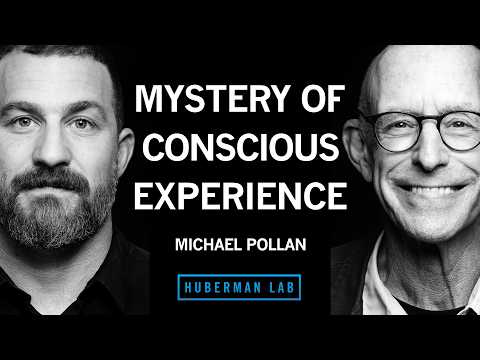
[@hubermanlab] What Humans, Animals and Plants Tell Us About Consciousness | Michael Pollan
![[@hubermanlab] Summarizer](https://summaries.pages.dev/img/logo.webp)
Link: https://youtu.be/nk15CT41MFc
Duration: 122 min
Transcript: Download plain text
Short Summary
Michael Pollan, journalist and author of The Omnivore's Dilemma and How to Change Your Mind, joins Andrew Huberman for a wide-ranging Huberman Lab conversation about consciousness, plants, psychedelics, food policy, and caffeine. The discussion explores filter theory, plant intelligence, vagus nerve signaling, AI consciousness, and a deep dive into Pollan's caffeine fast and experience, alongside current psychedelic policy developments.
Key Quotes
- "there is nothing we know with more certainty than the fact that we're conscious. It's the only thing we can be sure of. Everything else we know through consciousness, right? Everything else is an inference, but we have this thing that we know we have." (00:07:26)
- "if you conceive of consciousness as like electromagnetic waves, um, brains are like radio receivers or TV receivers. You wouldn't you wouldn't look in the TV set for the woman who gave you the weather report. You know, she's not there. She's somewhere else." (00:00:07)
- "actually consciousness doesn't begin with thought in the cortex but with feeling in the brain stem or feelings registered in the brain stem and the reason we have consciousness according to this theory is um because there are these homeostatic set points" (00:43:57)
- "We are in relationship with plants domesticated plants in particular. I think they manipulate us in various ways. But it's it's not at the level of the individual plant. and it's at the level of the this the evolution of the species." (00:23:12)
- "I think I think Trump's doing the right thing for the wrong reasons, but there we are. So I think it will happen soon. It's going to be uh an earthquake when it happens because they'll be approved as medicines and to be administered in a certain way with some regulations. But the message that the public will take that the society will take is that these things that we thought were dangerous drugs are medicines." (02:28:12)
Detailed Summary
Episode Overview
Andrew Huberman (Stanford neurobiology/ophthalmology professor, host of the Huberman Lab podcast) interviews journalist and author Michael Pollan about his latest book, A World Appears: A Journey into Consciousness. The wide-ranging conversation spans consciousness, plant intelligence, brain-body signaling via the vagus nerve, AI, psychedelics, food policy, and a deep dive into Pollan's caffeine fast and experience.
- The discussion draws on Pollan's books including The Omnivore's Dilemma, How to Change Your Mind, The Botany of Desire, This is Your Mind on Plants, and A World Appears: A Journey into Consciousness.
- Pollan has upcoming work on the microbiome, planned as a short audiobook next year.
Defining Consciousness and Sensience
Pollan argues consciousness is the only thing humans can know with certainty, since everything else is inferred through it; studying consciousness used to be the "kiss of death" for neuroscientists, reserved for the already-accomplished.
- He defines consciousness operationally as subjective experience, distinguishing it from reflexive response; humans add metacognition (awareness that one is aware) plus emotion.
- He distinguishes sensience (a basic, ground-floor awareness of environment, possibly universal to life) from full consciousness — plants and single-celled organisms may have sensience without consciousness.
- Thomas Nagel's 1970s essay "What Is It Like to Be a Bat?" anchors the working definition: if it is like something to be an entity, it is conscious.
Plant Intelligence Without Consciousness
Pollan stops short of calling plants conscious but documents clear plant intelligence and argues plants actively manipulate human behavior at the species level.
- Corn plants navigate mazes to find ammonium nitrate fertilizer; plants send defensive toxins in response to the sound of caterpillars chewing; roots grow toward the sound of running water in pipes.
- Plants have roughly 20 senses (humans have 5–6), including gravity, pH, and nutrient gradients, and respond to the same anesthetics used on humans — a Venus flytrap under xenon gas will not clamp down on insects.
- Plants shaped human evolution at the species level: corn and cannabis (originally in western China) spread worldwide because they produced compounds humans wanted.
- Caffeine, nicotine, and other psychoactive plant chemicals typically don't kill the consumer; instead they alter the consumer's mind, sometimes diminishing appetite.
- Pollan illustrates this with his cat Frank getting so intoxicated on catnip nightly that he forgets where the plant is.
- In The Botany of Desire, Pollan frames plants as having "mastered" human desires: beauty (flowers), consciousness change, and food.
Bodies, Brains, and the Vagus Nerve
Huberman and Pollan cite Antonio Damasio's 1990s work and Mark Solms (a South African psychiatrist/neuroscientist and Damasio protégé) for the idea that consciousness begins with feeling in the brain stem, driven by homeostatic signals like hunger, warmth, cold, and itch — with the cortex only later labeling those feelings.
- Pain is presented as a conscious phenomenon that doesn't require a cortex: children born without a cortex and decorticated animals still experience it.
- William James described the sequence — body spike first, brain labels it "fear" second.
- Roughly 80% of vagus nerve traffic runs from body to brain, with only 15–20% descending; current feelings may integrate events from the last ~10 hours across organs like the spleen, liver, heart, and pancreas.
- In a moral-disgust study, people given powdered ginger were less judgmental of scenarios like incest or eating one's dog because the ginger calmed their stomachs, supporting that "moral disgust" literally passes through the gut.
Microbes and Minds
Pollan and Huberman cite Stanford's Justin Sonnenburg on microbiota influencing mood, energy, and sociability; humans carry more bacterial genes than human genes and outsource production of key metabolites (glutamate, GABA, serotonin, short-chain fatty acids) to gut bacteria.
- Huberman speculatively wonders whether human pursuits like Mars travel or politics might ultimately serve microbes trying to spread, noting space food's ultraprocessed sterility could harm those microbial communities.
- Stefano Mancuso's Brilliant Green is cited for the perspective that humans may be "dupes of bacteria" benefiting from our sociability.
Brains vs. AI
Both speakers argue AI lacks subjective experience. Pollan believes a vulnerable, mortal body may be required for feelings, distinguishing a simulation of a thought (where chess or Go can match human play) from a simulation of a feeling (which cannot).
- The brain-as-computer metaphor is rejected: neurons aren't simple on/off transistors; memories are stored in one or two structures but distributed widely; a computer whose hardware changed with every experience would be useless.
- Work by Susumu Tonegawa at MIT and Mark Mayford at Scripps showed that neurons activated during learning can be replayed (even backwards or all at once) to reproduce the same behavior.
- Companies are actively trying to build conscious AI, not just intelligent AI.
- Alison Gopnik has suggested the "hard problem" may persist partly because consciousness is treated as one thing rather than broken into ego self, emotion, and self-reflection.
Filter Theory, Panpsychism, and Psychedelics
Pollan compares brains to radio/TV receivers that channel consciousness rather than generate it, and does not dismiss panpsychism (the view that particles carry a bit of consciousness that combines in larger beings).
- Christof Koch, a committed physicalist and former head of the Allen Brain Institute, reportedly became convinced after an ayahuasca experience that consciousness exists outside the brain; Huberman does not share that conviction but says he respects it more than he used to.
- Henri Bergson and Aldous Huxley (in The Doors of Perception) are cited for the filter/reducing-valve view, with Huxley's "measly trickle" framing.
- They speculate about quantum effects (operating at all scales and explored via entanglement) and within 50 years, whether quantum reality contributes to consciousness.
- Pollan describes a high-dose psilocybin experience in which he felt himself explode into blue post-it notes that coalesced into blue paint and merged with a Bach unaccompanied cello suite played by his guide, with no subject-object distinction ("I was it. I wasn't listening to it").
- He distinguishes ego dissolution from ego inflation in psychedelic experience and notes ego transcendence can also come from meditation and awe.
- UC Berkeley's Dacher Keltner awe study had participants draw stick-figure self-portraits before/after an awe experience; post-experience self-figures shrank to about one-third of original size.
- Huberman pushes back on the 1960s "one love" framing of collective consciousness, arguing humans are fundamentally self-interested until they feel secure, and that universal LSD use would not solve collective problems and might make things worse; Pollan agrees the psychedelic dream has long been pro-social but warns neither ego dissolution nor ego inflation reliably produces pro-social outcomes.
Pollan's Backstory and Books
Pollan grew up the oldest of four kids with an alcoholic father, which made him value practical things and start with materialism before moving to "weirder ideas"; he grew up on suburban Long Island.
- At age 4–5 he planted a watermelon seed and smashed the football-sized fruit on the patio running to show his mother; at around age 8 he sold his mother strawberries from a backyard "farm."
- He began drinking coffee with his father around age 8 or 10 as a way to connect with his absent dad at early-morning breakfasts.
- He credits Wendell Berry (a poet, farmer, and essayist who had died approximately two weeks before the recording) with framing the human relationship to nature as "a legitimate quarrel," more like a marriage than the Thoreau/Emerson wilderness-spectator tradition.
- His first book, Second Nature, used his garden as a microcosm for how to behave in nature.
- The Omnivore's Dilemma (around 2006) became a cultural touchstone with the mantra "food, not too much, mostly plants," distinguishing his work from Eric Schlosser's Fast Food Nation and Marion Nestle's Food Politics, which Pollan calls "great books about bad relationships."
Food Writing and The Omnivore's Dilemma
Pollan's core mantra is "food, not too much, mostly plants"; he wrote an ~8,000-word New York Times feature (later a chapter in Omnivore's Dilemma) tracing one cow from insemination to slaughter and contrasting an oil-based beef chain with a sunlight/grass-fed chain.
- Editors wanted to cut his four paragraphs on grass-fed beef; he kept them to show "the hope that we can grow our food using sunlight, not oil."
- A butcher on College Avenue in Oakland told Pollan he was the sixth person that week to ask for grass-fed beef, signaling rapid consumer uptake.
- The dominant U.S. beef chain depends on fossil fuels to grow the corn that feeds cattle, plus pharmaceuticals because corn makes the animals sick.
- A recent re-introduction still finds the food system dominated by corn and soy, the building blocks of ultraprocessed food that is making people sick.
American Diet and Policy (MAHA)
Pollan argues America never had a real food tradition — fast food effectively is America's tradition — so Americans were more vulnerable to food marketing than the French or Italians.
- Classic American foods (fried chicken, hot dogs, hamburgers, mac and cheese, French fries, cotton candy) are very unhealthy, and most chronic diseases killing Americans are diet-related.
- U.S. corn subsidies produce high-fructose corn syrup contributing to diabetes, meaning the government simultaneously subsidizes sugar and its treatment.
- He recommends policy that makes healthy food cheaper relative to unhealthy food.
- After 2+ years, the administration's only food change was getting companies to voluntarily remove some dyes from cereal — not a crucial health problem.
- The "big beautiful bill" eliminated farm-to-school and farm-to-institution support for small/regenerative agriculture, while the administration deregulates pesticides.
- The food movement was once coded left-liberal and called elitist, but MAHA has brought right-wing alignment on pesticides and removing ultraprocessed food from schools.
- While writing Omnivore's Dilemma, Pollan met "Maha Moms before they were called that" at Joel Salatin's Virginia farm (45 minutes from the interstate), Weston Price Society members (since the 1930s) who drove 100 miles for clean food.
- Salatin pioneered grass-based agriculture by rotating species over the same grasslands; Rep. Chellie Pingree (Maine organic farmer) collaborated with Maha activists to strip pesticide-maker liability exemptions from an appropriations bill twice.
Psychedelic Policy
Pollan argues psychedelic policy is advancing faster than food reform because it lacked an entrenched lobby like the industrial food industry.
- Rick Perry publicly calls himself "a knuckle-dragging Republican who's into heart medicine" and works bipartisanly to make psychedelic medicines available to veterans with PTSD and substance abuse issues.
- Anything getting done politically now requires support from both right and left, a strategy Rick Doblin pursued early on (including accepting a contribution from Rebecca Mercer).
- At a veterans event, Doblin opened by noting he was a conscientious objector during Vietnam to a room of SEALs and special ops veterans, who responded with smiles.
- Resilient (formerly Lykos/MAPS) resubmitted MDMA for trauma treatment with additional data and appears fast-tracked.
- Compass Pathways' psilocybin treatment is reportedly close to FDA approval, possibly before year-end.
- An executive order originally for ibogaine was expanded to other psychedelics after a White House staffer noted it would be crazy to apply only to ibogaine.
- Pollan attributes some momentum to Joe Rogan texting the president after an ibogaine show, with Trump motivated by the "manosphere" vote after polling showed him losing it — doing "the right thing for the wrong reasons," which Pollan calls an "earthquake."
- Approved MDMA and psilocybin will be administered as medicines with regulations, but Pollan warns public education is needed because people will assume previously "dangerous drugs" are safe.
- He cites risks for people with predispositions to psychosis or heart issues and points to cannabis legalization as evidence that widespread use surfaces addiction and psychosis issues not previously seen.
- He has interviewed people whose psychedelic experiences cured addictions, depression, and OCD; mental health needs new tools because existing ones don't work well.
- Rogan thanked Tim Ferriss and Pollan for sticking their necks out early when it was risky; Pollan was nervous publishing How to Change Your Mind about his own psychedelic experiences.
Caffeine Deep Dive
Pollan's caffeine chapter became one of three chapters in This is Your Mind on Plants; about 90% of the world's adults consume caffeine daily.
- Roland Griffiths, the Johns Hopkins psychopharmacologist who later launched the psilocybin renaissance, previously worked on caffeine and proposed the caffeine fast to Pollan.
- Quitting cold turkey produced flu-like symptoms, ADHD-like focus problems, and writing-block for Pollan; he did the fast for about three months.
- After resuming, his first cup was the best drug experience he ever had, better than any psychedelic — he cleaned his closet and tidied the garden, which he normally doesn't do.
- He tried restricting caffeine to one day per week (Saturdays); the Saturday coffee was wonderful for a few weeks, until a Thursday deadline broke the rule, kicking off a slippery slope back to daily use.
- Coffee and tea contain polyphenols valuable to the microbiome independent of caffeine.
- Pollan says caffeine has positive health effects up to seven or eight cups a day, with benefits including reduced blood pressure and Parkinson's help; he called caffeine "cocaine without all the problems."
- He cited studies in which caffeine-consuming students outperformed placebo controls before exams.
- He also drinks green tea and argues thinking about drugs has been contaminated by the drug war — drugs are neither good nor bad; context determines outcomes, with caffeine as a case study.
- Huberman said he will seriously consider trying the off-and-back-on caffeine experiment himself.
Notable Numbers and References
- 1970s: Nagel's bat essay; 1970: mirror self-recognition in a chimpanzee; 1990s: Damasio's work; 2020: EWG study estimating 200 million Americans exposed to PFAS and 122 million drinking water with high carcinogen levels.
- 50,000 wolves remaining in the U.S. as a contrast to abundant dogs.
- ~80% of vagus traffic ascending; 15–20% descending; current feelings integrating ~10 hours of body signals.
- Quantum computers chilled to nearly absolute zero; 50-year horizon for testing quantum contributions to consciousness.
- Stick-figure self-portraits shrunk to ~one-third after awe; ~8% of U.S. landscape "locked up" as preserved land.
- Omnivore's Dilemma cow chapter ~8,000 words.
Wrap-up
Huberman directs listeners to show notes and captions for links to Pollan's books and to subscribe to the Huberman Lab YouTube channel, follow the podcast on Spotify and Apple, and subscribe to the free monthly Neural Network Newsletter at hubermanlab.com.