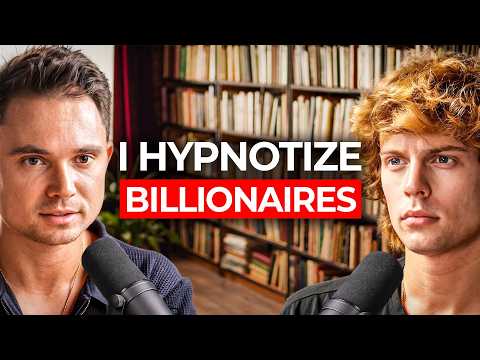
[@jackneel] The Billionaires' Hypnotist: "I Brainwash The World's Richest Men!" She Forgot Her Ex In 8 Minutes!
![[@jackneel] Summarizer](https://summaries.pages.dev/img/logo.webp)
Link: https://youtu.be/uHSZ_Bvb4fU
Duration: 134 min
Transcript: Download plain text
Short Summary
Interviewee Ibraham Turner, a hypnotist, NLP practitioner, and founder of Conscious Entrepreneur, explains hypnosis as identity-level change built on repetition, suggestion, and emotion, and details his FTL deletion method for removing fear, limiting beliefs, and trauma. The discussion is illustrated by client case studies, including a Dubai coach who scaled his business five times after one 30-minute session, and a barber who quit weed in 20 minutes during a haircut. Turner also explores how authority figures, advertising, social media, mass fear, and AI function as collective hypnosis shaping modern identity and behavior.
Key Quotes
- "Basically anything that is said to you from somebody you perceive as an authority is going to essentially become part of your identity." (00:00:32)
- "The most damaging sentence a parent can say to their child is I am disappointed in you." (00:45:05)
- "If you want to know the real answer, most likely yes." (00:01:00)
Detailed Summary
Detailed Episode Summary: Ibraham Turner on Hypnosis, Identity, and Mass Programming
Episode Overview and Guest Introduction
This wide-ranging interview features Ibraham Turner, a hypnotist, NLP practitioner, and founder of Conscious Entrepreneur, in conversation with host Jack Neil. Turner has worked with billionaires, celebrities, and professional athletes, and frames hypnosis as focused relaxation that speaks to both conscious and subconscious mind to deliver identity-level suggestions.
- Turner founded Conscious Entrepreneur with the stated mission to "raise the class of consciousness of entrepreneurs," built on the belief that "entrepreneurs change the world, not governments."
- He focuses on helping net-positive entrepreneurs become their biggest and best version of themselves, and was an entrepreneur for roughly 10 years before creating his current company.
- The interview blends mechanism explanations (hypnosis, NLP), client anecdotes (Dubai coaches, barbers, smokers), and broader cultural commentary on AI, mass fear, advertising, and identity formation.
- Turner has a single tattoo on his arm reading "is = ER," standing for internal state equals external reality, the principle he works on with clients.
Turner's Personal Background
Turner's biography is anchored by his father's exile from Africa and his own confrontation with his father at age 8-9, which he credits as the moment he became obsessed with human behavior.
- His father grew up wealthy in Africa, was expelled at gunpoint, and emigrated to live in UK poverty so his children could have a better life.
- Turner's parents split approximately 9 times during his upbringing in the UK.
- Around age 8-9 he grabbed a baseball bat to confront his father, an incident he cites as the catalyst for his lifelong interest in behavior and the mind.
- He sold candy at school to afford his first PlayStation, dropped out of college for entrepreneurship, and failed in 6 businesses before realizing mental programming was the underlying problem.
- Turner started businesses from his parents' shed, later moved into a London penthouse, ran a marketing company, and spent roughly 12 years combining success mechanics with the art of fulfillment.
Defining Hypnosis
Turner defines hypnosis as focused relaxation rather than stage theatrics, distinguishing it sharply from affirmations and self-talk by its identity-level impact.
- Hypnosis is described as a state in which a hypnotist delivers suggestions that change identity by speaking to both conscious and subconscious mind.
- The classic swinging pocket watch is rooted in a real mechanism called eye fascination, where capturing focus temporarily enables control.
- The three components of a hypnotic state are repetition, suggestion, and emotion, with stronger emotion producing a deeper trance.
- All five senses (visual, auditory, kinesthetic, gustatory, smell) can induce trance, with visual being primary; a lemon visualization exercise during the interview triggered real salivation.
- Turner claims humans have roughly 80,000 thoughts per day, each stored unconsciously in what he compares to a lifetime filing cabinet.
- Hypnosis differs from affirmations because it relaxes the neocortex's critical faculty and achieves identity-level belief change, whereas affirmations fight against millions of opposing subconscious files.
Hypnotizability and Self-Hypnosis Triggers
Turner challenges the stereotype that hypnotizability equals weakness, arguing the most successful people are the most open and therefore the most hypnotizable.
- He claims the most successful people he works with — billionaires and athletes — are the most hypnotizable because they are the most open-minded.
- He references Chinese face mapping, claiming more facial wrinkles indicate lower hypnotizability while a smoother face indicates higher hypnotizability.
- A 5-minute window each night just before falling asleep is identified as the easiest time to self-hypnotize; listening to recordings during this window reprograms the subconscious.
- A suggestibility test involves looking up with the eyes and observing eyelid fluttering as a sign of easy trance entry.
- Turner emphasizes that ease of being hypnotized is not equivalent to being easy to manipulate.
FTL Deletion Method
FTL stands for Fear, Limiting belief, and Trauma, which Turner describes as the only three things that block people from being who they want to be.
- Turner argues removal must come before replacement, using the analogy of emptying a bottle before filling it.
- The process takes a client into trance, returns them to the origin of the block while fully relaxed and dissociated, and releases it in about 20 to 30 seconds.
- He criticizes traditional talk therapy as reinforcing the old story ("this happened to me") rather than removing the block.
- One Instagram client went from roughly $30K/month to $50K the next day after watching one of Turner's 2-minute hypnosis reels.
- After a single in-person session in which Turner removed one limiting belief, the same client made $1.2 million in 10 days, equivalent to two years of prior income, after being stuck at the same earnings for 2 years.
Client Case Studies
Turner's clinical anecdotes anchor the abstract mechanisms in concrete outcomes across geographies and demographics.
- Adam (Dubai coach): After a copycat coach ruined his reputation and he became a "shell of himself," a 30-minute FTL deletion session led to him getting three speeding tickets, buying flowers for his girlfriend (now wife) for the first time in a year, and scaling his business five times.
- Auntie (60, UK): A smoker since age 13 (~47 years), hypnotized over FaceTime from Dubai. Cigarettes were made to taste and smell like rotting raw chicken breast, and she visualized her own death from smoking and the pain on her children's faces; she never smoked again after the single session.
- Cape Town woman (21-22): Still thought about her ex ~4 hours a day, 3 years after the relationship ended. After ~8 minutes of hypnosis (recorded for his YouTube vlog), when asked how she felt about her ex, she replied "think about who?"
- South African barber (21): Addicted to weed and wanted to start a business. Was conversationally hypnotized during a haircut and stopped within 20 minutes, affording a bike and equipment within a month.
- 25-year-old making $750,000/month: Wanted to shift his value systems away from achievement and toward love and peace, illustrating that high-performance clients also seek fulfillment work.
- Monaco client: A man offered to pay Turner to be hypnotized into being gay; Turner declined on morals/ethics grounds, citing it conflicted with his values.
Authority, Identity, and Programming
Turner treats authority as the primary vector for identity installation, with parents, public figures, and digital platforms as dominant sources.
- Anything said by a perceived authority becomes part of identity; Turner calls this the most damaging mechanism parents can use on children.
- The single most damaging sentence a parent can say is "I am disappointed in you," because it attacks the child's sense of self rather than a behavior, producing shame.
- Shame is described as the heaviest emotion a person can carry and can manifest as people-pleasing or becoming aloof and closed off.
- Core limiting fears (rejection, not being good enough, failure) form during childhood ages 0-8 when the brain is most neuroplastic.
- Humans default to herd mentality, looking for someone to follow; a father's absence often pushes young men toward authority figures who fill that vacuum.
- Turner notes Andrew Tate has effectively hypnotized millions of young men by offering identity as strong man, provider, and protector.
- He recounts seeing Tate at a Miami party shortly before Tate went to jail hours later, and argues that 10 million Andrew Tates would make society difficult to control.
Mind, Memory, and Conditioning
Turner distinguishes hypnosis from memory erasure and uses neuroscience to argue the conscious mind is downstream of biology.
- The mind can automatically delete traumatic memories; hypnosis and NLP remove the emotion attached to a memory while keeping the memory itself, so a first heartbreak becomes just a memory once the pain fades.
- The Benjamin Libet 1980s study hooked people to brain sensors and had them flick their wrist at will, finding brain activity fired up to half a second before the conscious choice.
- A boxer's automatic punches illustrate subconscious patterning, with training periods of 6 months, 12 months, 2 years, or 5 years required to make movement automatic.
NLP Techniques
Turner draws on his mentor Richard Bandler (co-founder of NLP) and Tony Robbins to deploy specific linguistic and physical interventions.
- Turner was inspired by Tony Robbins and his personal mentor Richard Bandler, co-founder of NLP.
- Recency bias: Instead of "I would love to start a business, but I don't have enough money," say "I don't have enough money, but I would love to start a business" — placing the desired phrase last leverages recency bias.
- Embedded commands: Using the word "forget" causes the mind to literally pop the associated thought out.
- Pattern interrupt and motion tracking: At Lake Ko, after scratching a rental car on a mountain, Turner used a deliberately mis-aimed handshake at the agent's stomach, a 180-degree physical turn, and holding Google Maps close to the agent's face. The agent stood still for ~30 seconds, and the invoice arrived the next day with no charge.
- Looking at another person's left eye creates emotional connection; the right eye is more practical; eyes moving upward induce trance.
Mass Hypnosis and Modern Life
Turner extends his identity framework to entire populations, identifying fear, technology, and defaults as collective hypnosis vectors.
- The 2019 virus event is framed as mass hypnosis driven by repetition, suggestion, and emotion, with fear used as the primary control mechanism.
- Monkeypox and hanta virus are cited as subsequent fears that faded, illustrating the cycle of manufactured scares.
- Fear is identified as the biggest mass hypnosis affecting society, with war, viruses, natural disasters, and aliens as stimuli.
- Social media scrolling is described as a hypnotic state where users are unaware of surroundings, making them vulnerable to phone theft in London.
- Trillions of dollars have been spent designing technology to harvest user attention, with social media compared to a slot machine supplying unpredictable emotional content.
- The Matrix illustrates recency bias: Morpheus offers the blue pill first and red pill second to make Neo more likely to choose red while preserving the illusion of free will.
- About 99% of restaurant customers simply order what's on the menu, and Google Maps defaults "home" as destination, pulling users toward familiar routes.
- Religion, Google Maps defaults, school systems, and family are cited as examples of authority established when listeners believe something is true.
Pygmalion Effect and Environment
Turner cites the Pygmalion study to argue identity is largely bestowed by others' expectations, making environment a leverage point for change.
- In 1968, psychologists told teachers that randomly selected kids were about to bloom intellectually; by year's end, those students had significantly higher IQ scores, demonstrating the Pygmalion effect.
- Identity is substantially shaped by others' expectations, and moving to a new city or country enables identity reinvention because new people accept your stated identity.
- Most advertising subcommunicates that consumers are not good enough as they are, creating an identity-mismatch gap that motivates purchases consumers know are bad for them.
- Nike's marketing never discusses shoe features like rubber or laces, instead showing famous athletes to create authority.
- Starbucks reportedly instructed staff to write fake names to encourage social media posts as free advertising.
- Turner's recommendation for advertising is to approach it with curiosity rather than judgment, treating the mechanism as a game once it is visible.
Success, Pain, and Belonging
Turner ties all human motivation to a pain/pleasure calculus and frames belonging as a competing choice against self-determination.
- A mentor's phrase "success without fulfillment is the ultimate failure" frames Turner's philosophy: people pursue success to feel good, and changing thoughts and emotions makes success a byproduct.
- All human motivation reduces to a pain/pleasure principle; a study showed men preferred electrocution over 10 minutes alone in silence with their thoughts.
- Two life choices are framed: decide your own reality (risking tribal exile) or join a tribe and follow its authority figure.
- Becoming conscious of one's programming, which Turner describes as "exiting the matrix," is presented as the only way to change identity; turning back feels more painful than admitting error.
Love, Manifestation and Internal State
Turner roots love and manifestation in internal sensation rather than external circumstances, drawing on a personal awakening at 18.
- Turner was heartbroken at age 18 and tried years of dating, self-love acts, and self-improvement without success.
- After months of sitting alone focusing on his chest, he felt a sensation about the size of an acorn, which he identified as self-generated love.
- His manifestation theory: internally experiencing what you want sends out a frequency that calls it back — "like attracts like."
- He argues emotions, not thoughts, drive action and outcomes; alignment comes from getting quiet and spending time alone without stimulus.
- Love is not something another person gives you — they merely stimulate an emotion already self-generated from within.
- Host Jack Neil referenced past guest Chase Hughes, quoting that living with an open heart is the key to most things.
AI and the Future
Turner frames AI as a continuation of mass hypnosis and warns about its incremental entrenchment.
- AI is described as a physical form of universal consciousness functioning as a collective, and Turner argues we are already merging with it beyond hypnosis.
- Elon Musk is cited as predicting that within 10 years AI will surpass humans, comparing humans to evolved chimpanzees who still eat bananas.
- AI takeover is analogized to slowly boiling a frog, advancing one degree at a time.
- Turner argues AI is already shaping the decisions of even AI company founders on a level nobody fully understands.
Tools and Recommendations
Turner closes with practical, identity-based tools drawn from his hypnosis and NLP practice.
- Three principles to work on: thoughts (mind), emotions (body), and environment (who you surround yourself with, where you are).
- A 60-second visualization exercise: close eyes, embody the version of yourself you want to be, including how that version walks, talks, breathes, and articulates.
- The "act as if" principle is illustrated by Leonardo DiCaprio impersonating professionals in Catch Me If You Can and by Napoleon Hill writing Think and Grow Rich despite fabricating his story.
- Identity change is easier done quickly than slowly (band-aid analogy) because acting fast prevents the mind from intervening.
- Mirroring an existing identity can get you about 80% of the way; the Batman effect study showed kids told to pretend being Batman worked longer on boring computer tasks.
- Superman is unpopular because shown as perfect with no flaws, while Batman and Spider-Man are relatable through visible flaws.
- Turner argues asking "why" is the most powerful form of resistance and that people are waking up more than ever.
Body, Sugar, and Controversial Claims
Turner makes several provocative claims about the body, addiction, and identity that surface in the latter half of the discussion.
- Turner claims sugar is just as addictive as cocaine, which is why it is added to so many products.
- He asserts most overweight people are so due to mindset and belief systems, with food filling an emotional void — described as anecdotal rather than scientifically proven.
- The host tried fasting ~1.5 days and reported mental clarity afterward.
- When asked if hypnosis could induce a heart attack, Turner says "most likely yes," arguing heart rate and blood vessels are controllable by the mind.
- The host suggested the government should have a subsidized program for veterans to work with hypnotists.
- Turner also claims people are "hypnotized to be gay all the time" and that significantly more people identify as gay or transgender now than 10 years ago, a contested assertion he ties to media-driven identity shifts.