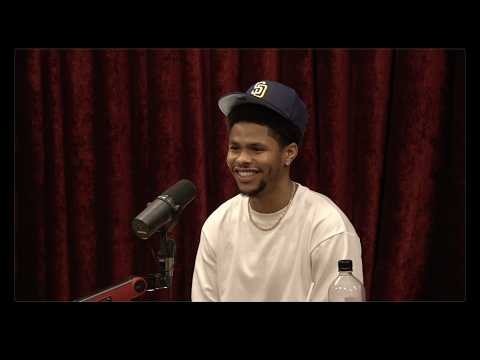
[@joerogan] JRE MMA Show #175 with Shakur Stevenson
· 7 min read
![[@joerogan] Summarizer](https://summaries.pages.dev/img/logo.webp)
Link: https://youtu.be/6VFZlIwwRKc
Duration: 132 min
Short Summary
Errol Spence Jr. attributes his standout performance against Teofimo Lopez to his early start at age five, which allowed his instincts to fully engage during the 12-round contest. Joe Rogan highlights that Spence's focus on defense and cognitive health positions him as a complete fighter capable of both outboxing and standing to trade blows effectively.
Key Quotes
Key Quotes
- "Honestly, it's just hard work, dedication, and um God-given ability. God-given ability. I think you have all that plus intelligence plus you start a real young and there's something about those dudes who start real young. You grow up with that. It's like in your central nervous system as you're a young child." (00:01:04)
- "Like when we fought, I felt like my brain just knew how to win. Like it just everything was just like my instincts kicked in and everything just took over. Like I didn't even it it felt like an out-of- body experience." (00:01:45)
- "I for me personally, I feel like I'm like the best fighter in boxing. And I don't like mean this in no disrespectful way cuz I got a lot of fighters in boxing that I still watch to this day that I like and I'm like, "Okay, they I I'mma steal this. Um, Usyk. I love Usyk. I love Usyk. I love Bavar. I love them um Eastern European styles. But um for me, like I just feel like I'm a fighter that could do it all. Like I can do it all. Like whatever needs to be done to get the job done, I can do that. So some nights you might see I might outbox people. Then some might some nights I might stand there and beat a guy up and beat them at their own game. So, um I think for me I'm the most complete fighter in boxing." (00:05:39)
- "That's that's an unusual mindset. Yeah, it is. You know, it's just, you know, it is what it is. It's um it's We're fortunate to be able to have her though, like cuz like if there's anybody that's going to elevate the sport and bring in new fighters, it's going to be someone who is the really the only person in the sport that gets a tremendous amount of attention as a woman." (00:12:58)
- "Well, there is no question the skill level and the talent when it comes to punching is way better in boxing. You see some sloppy [ __ ] that people do in MMA with boxing, but you also have to think they're thinking about takedowns. They're thinking about getting kicked. They're thinking about their calves getting kicked out from under them, their legs getting kicked, their body getting kicked, messing up their punching, huh? Everything. Knees, elbows, and then there's stuff that you do in boxing that you can't do in MMA because like your legs exposed. Yeah." (00:37:29)
Detailed Summary
Key Fighter Profiles and Performance
- Errol Spence Jr. attributes his strong performance against Teofimo Lopez to a young start at age five, fostering god-given instincts that guided him through a 12-round contest. Joe Rogan emphasizes that Spence's style of setting traps and minimizing damage establishes him as one of the best ever at these aspects.
- The performance against Lopez served as a wakeup call for the division, demonstrating that fighters like Lopez and Arnold Barbosa can excel against higher competition in New York. Spence's ability to stand and trade punches against William Zapeda helped establish early respect and prevented judges from favoring the more active opponent.
Career Milestones and Strategic Goals
- Spence expresses a commitment to protecting long-term cognitive health by avoiding excessive punishment, contrasting his approach with old-school boxers who may struggle with speaking in later years. He credits his discipline in making life sacrifices as critical for maintaining peak condition and countering criticisms regarding his social media activity.
- Terence Crawford's recent performance reached approximately 70% of his full gym capability, representing an 'okay day' that required high-level discipline to sustain over 12 rounds. Early career trials prepared the 28-year-old fighter to be 100% on top of his game in his prime, with Terence Crawford serving as a lifelong mentor since he was 19.
- The fighter's partnership with Terence Crawford involves gym sparring to simulate high-level conditions, where Crawford's victory over Canelo silenced critics regarding his ability to handle elite competition. This partnership highlights the importance of switching stances and executing unique techniques, such as a straight-left punch followed by a hook.
Technical Innovations and Future Directions
- A discussion on financial security aims to leave boxing while financially secure and physically unscathed, with Andre Ward serving as a role model who left undefeated after an Olympic gold medal. Andre Ward's fight against Valery Kovalev was marked by a drop followed by a recovery to secure the win against an 'insanely' strong opponent.
- Sparring sessions with Vasyl Lomachenko, where the fighter performed 12 straight rounds, provided insights that influenced the timing of future championship bouts. Tio Cruz's three-round sparring session demonstrated his strength and confidence, effectively countering claims of his toughness and highlighting his explosive speed and piston jab.
- The historic upset of Buster Douglas defeating Mike Tyson as a 42-to-1 underdog was triggered by his mother's death and preparation, a moment witnessed at a gas station by the speaker. The speaker's little brothers played a crucial role in shaping a champion mindset, holding him accountable for victories against specific opponents like Joseph Adorno.
Coaching and Organizational Excellence
- Oscar De La Hoya proposed that Ryan Garcia must develop his right hand alongside his world-class left hook to become a complete fighter, with the fighter expressing willingness to compete at 140 pounds. A 10-pound rehydration clause was implemented for the Javante fight, a smart move given Ryan Garcia's size and the lack of such clauses in previous major bouts.
- Coach Robert Garcia and others are recognized for their ability to guide fighters effectively, with coaching teams requiring a clear distinction between father and coach roles to avoid hindering the fighter. The development of fighters is significantly influenced by the gym environment, with training with elite partners exposing bad habits that require attention.
- The UFC's maintenance of eight championship belts over the last decade preserves the purity of the sport, while boxing demonstrates superior skill levels and punching techniques. Wrestling is identified as the premier skill in MMA, with Jon Jones regarded as the best ever due to his intelligence and ability to set traps during fights.
Legacy and International Collaboration
- Historical figures like Muhammad Ali and George Foreman provided examples of fighters who excelled on fight night despite appearing poor in training, driven by strategy and preparation. A past discussion with Vasyl Lomachenko was missed, yet the sparring demonstrated the ability to outbox conditioning, while the speaker identified a strong connection with viewers as regular people who bleed the same.
- The 2016 Brazil Olympics highlighted a Russian anti-doping scandal where micro-abrasions in urine jars allowed for the swapping of clean samples, ensuring the entire team remained doped. A transparent protocol focused on performance improvement rather than just cheating detection was demonstrated in a documentary, emphasizing the necessity of collaboration with organizations like WADA and USADA.